In short
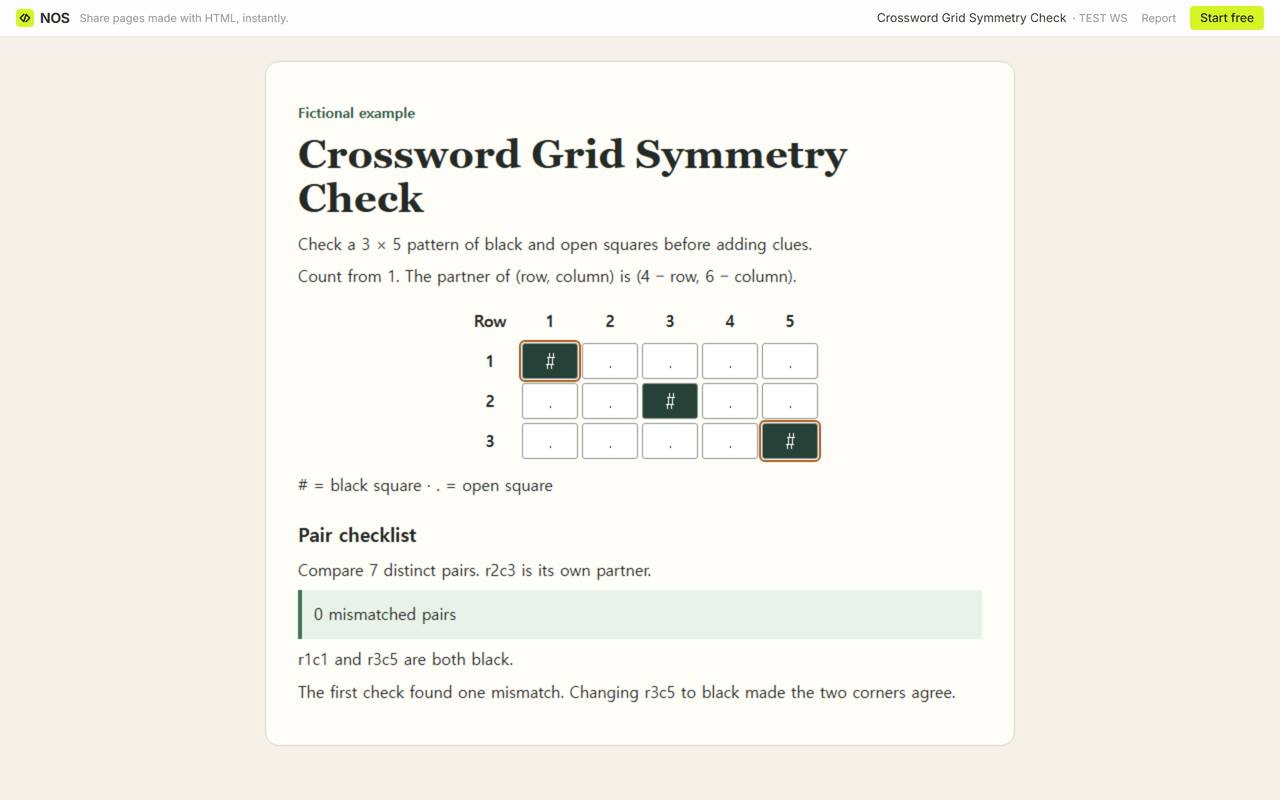
For a 3 × 5 grid numbered from 1, pair each square (row, column) with (4 − row, 6 − column). Compare each pair once. The center r2c3 pairs with itself.
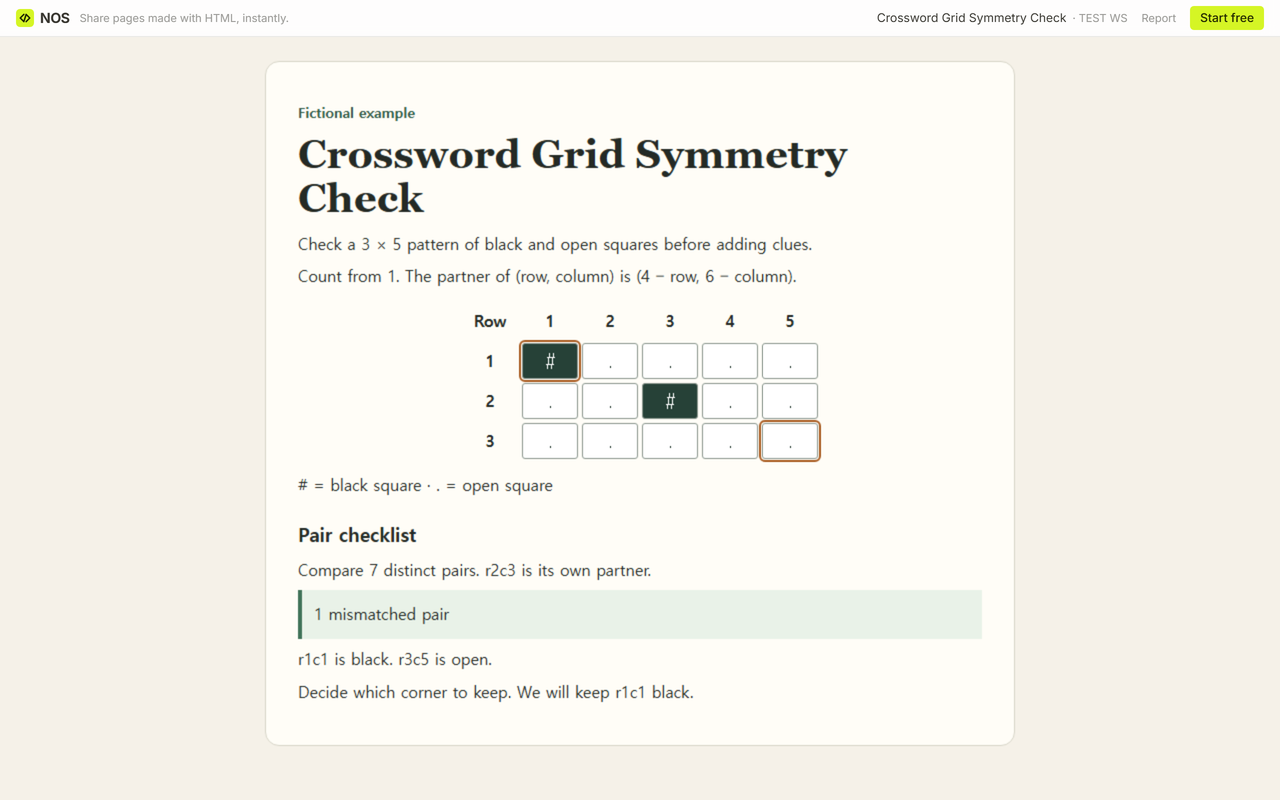
A black square in the upper-left corner has a partner in the lower-right. We tried a fictional 3 × 5 grid with those corners marked differently. Keeping the upper-left square black gave us one small correction to make before adding clues.
Which squares meet after a half turn?
A half turn reverses the row and the column together. For a grid with R rows and C columns, the partner is (R + 1 − row, C + 1 − column). Count both coordinates from 1. On our example, r1c1 goes to (4 − 1, 6 − 1) = (3, 5), or r3c5. The other corner pair is r1c5 ↔ r3c1.
Work from the top left in row order. Compare the first row with the last row in reverse. In the middle row, compare r2c1 with r2c5 and r2c2 with r2c4. Skip r2c3 when you count pairs. Starting over from the bottom right would list the same mismatches again.
What changes when you fix the corner?
Type the three original rows into the blank checklist. Use # for a black square and . for an open square.
#....
..#..
.....
The check compares 7 distinct pairs and reports 1 mismatched pair, r1c1 ↔ r3c5. Replace the final dot of the third row with # and check again.
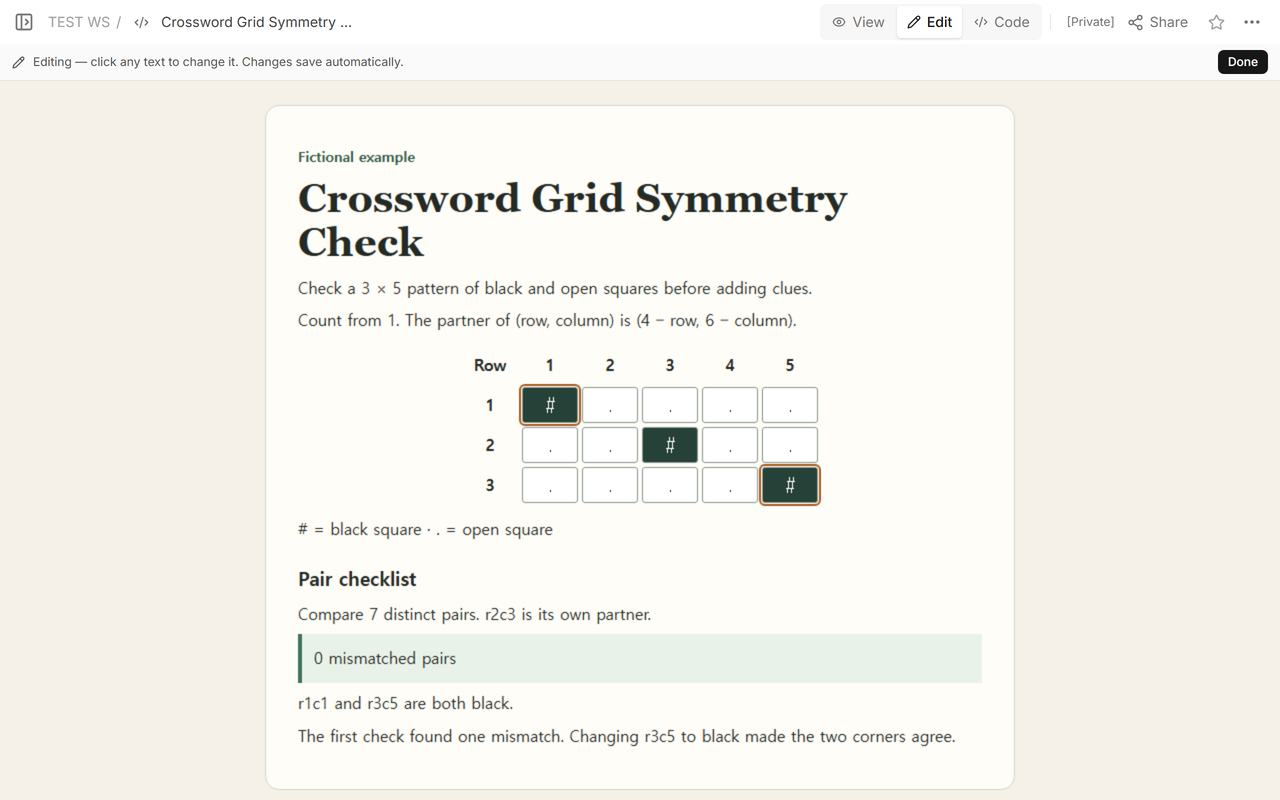
The rows now read as follows.
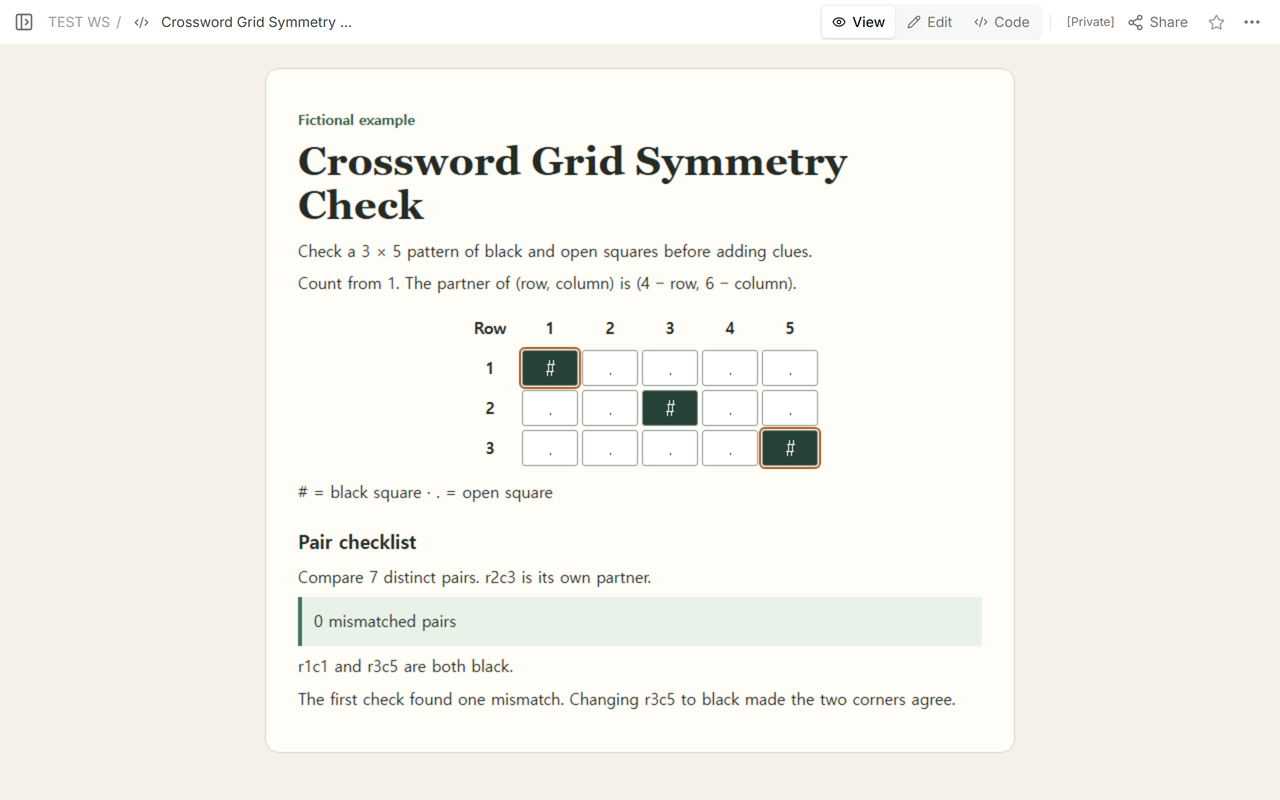
#....
..#..
....#
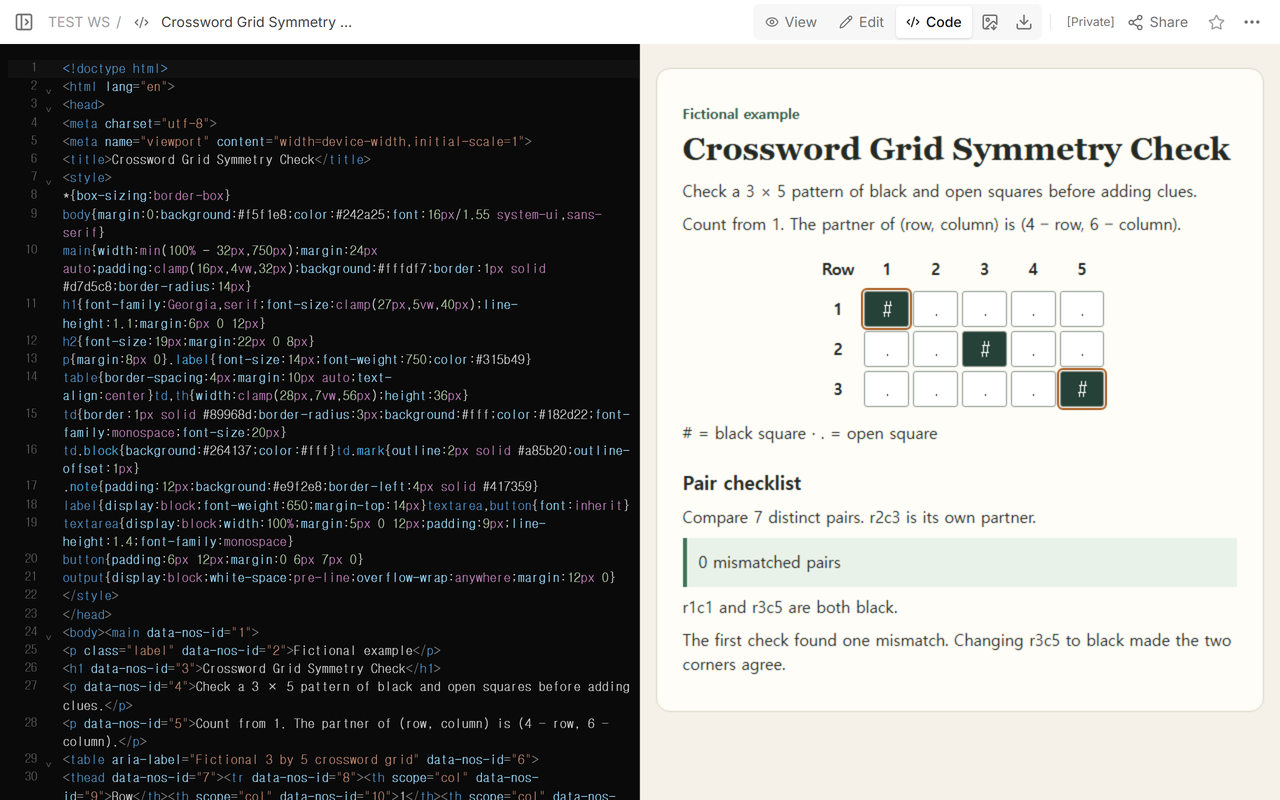
The result is 0 mismatched pairs out of 7. The grid has 15 squares, 14 in pairs and one at the center, so (15 − 1) ÷ 2 = 7. At r2c3 the formula returns (4 − 2, 6 − 3) = (2, 3). That square can be black or open without creating a mismatch.
What if the grid is blank or has no center square?
Keep a clean copy of the blank HTML file and open it in your browser. Enter one row on each line, then choose Check symmetry. A blank worksheet shows “Enter a grid to check.” A grid made of dots is an explicit set of open squares. Every row needs the same length and can contain only # or .
In a 2 × 2 grid, r1c1 pairs with r2c2 and r1c2 pairs with r2c1. There are 2 pairs and no self-paired cell. A 1 × 1 grid has 0 distinct pairs and one self-paired cell. These are exact counts.
When not to do this
Use this check when your design calls for a half turn. If your brief calls for mirror symmetry, compare the cells across the specified mirror line instead. Review the answers, open-square connectivity, and submission requirements separately.
How can someone else check the corrected grid?
We used NOS Workspace to display the example and opened the same Share address with a signed-out browser before and after correcting r3c5. The shared example now shows two black corners and zero mismatched pairs.
Related guides
When you start adding letters, see how two crossword clues can share a single cell. For a different use of grid coordinates, see how a word search checks the path between two cells.