In short
A useful board member orientation manual tells a new director what to read, where the official records live, who answers each question, and what to do before the first meeting.
Keep bylaws, policies, minutes, and financial records in their governed systems. Use the manual as the route into those records, not as a substitute for them.
We built and shared a fictional nonprofit example, corrected one deadline on the existing page, and confirmed the same public link showed the corrected version.
The NOS Team created a fictional orientation manual for Harbor Light, a made-up neighborhood arts nonprofit. The page gives a new director a role boundary, a meeting sequence, four questions for reading financial reports, a conflict contact, and a first-30-days list. No real board, director, donor, employee, email address, or financial record appears in the example.
This is a worked communication example, not legal advice or a universal governance policy. Your organization has to supply its own bylaws, duties, meeting rules, records, contacts, and jurisdiction-specific requirements.
What should a board member orientation manual include?
Start with the decisions a new director must make before the first meeting: which materials to read, how to submit questions, how to recognize a possible conflict, and which record controls when a summary and an official document differ.
The National Council of Nonprofits board-orientation outline includes mission and history, board and staff information, a conflict policy, recent financial reports, bylaws, committee information, and the meeting calendar. That outline is a reference, not a claim that every organization needs the same packet.
Our fictional manual turns that broad list into six reader questions:
- What is my role? State the governance work and the boundary between board oversight and staff management for this organization.
- How do meetings work? Name where the packet appears, when questions are due, who chairs the process, and where actions and draft minutes go afterward.
- What should I review about finances? Point to the approved budget, current report, explanatory notes, reporting period, and requested board decision.
- What if I may have a conflict? Give the contact and point to the current policy. Do not improvise a legal conclusion inside the summary.
- What should I finish in the first 30 days? Convert the reading list and introductions into visible tasks.
- Where is the official record? Name the board portal, calendar, policy file, or other maintained system for every important item.
How did we build the fictional manual?
We wrote one complete mobile-friendly page. Its first screen identifies the example as fictional and gives the new director one immediate deadline. The rest of the page is organized around role, meetings, finance, conflicts, and the first 30 days.
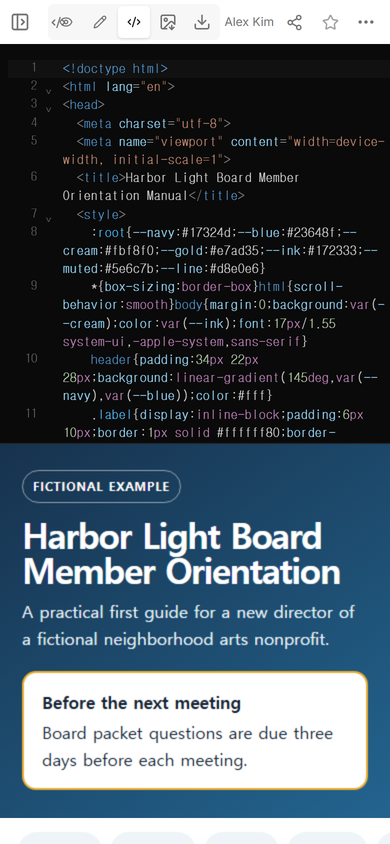
The initial example said packet questions were due three days before a meeting. That was a fictional test value, not governance guidance. View made the deadline and the role boundary readable at phone width.
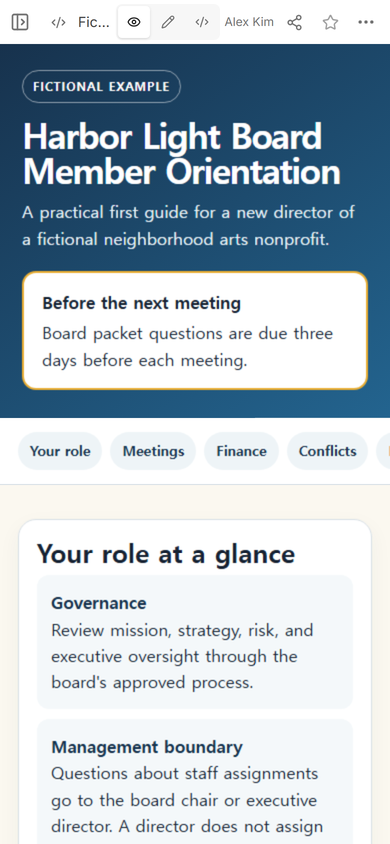
We then opened Share and used the viewer link created for this page. The captured panel said that anyone with the link could read the page without signing in and could not edit it. Search indexing was off in this captured state.
Download the complete fictional manual
How do you update a board orientation guide after sharing it?
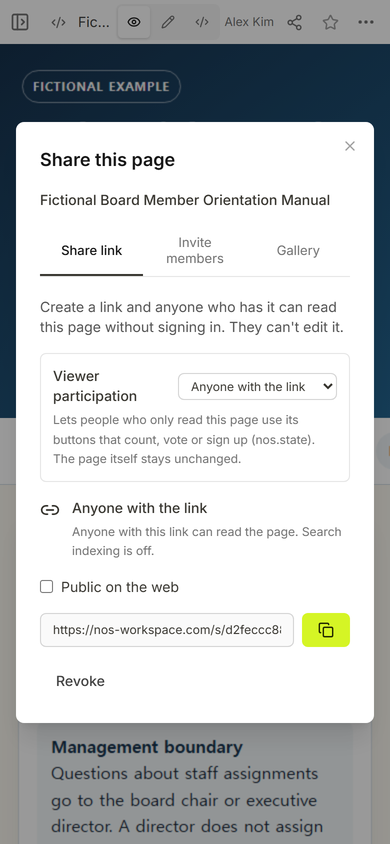
Change the maintained page rather than creating another orientation address. We opened Edit and selected the deadline line on the original page.
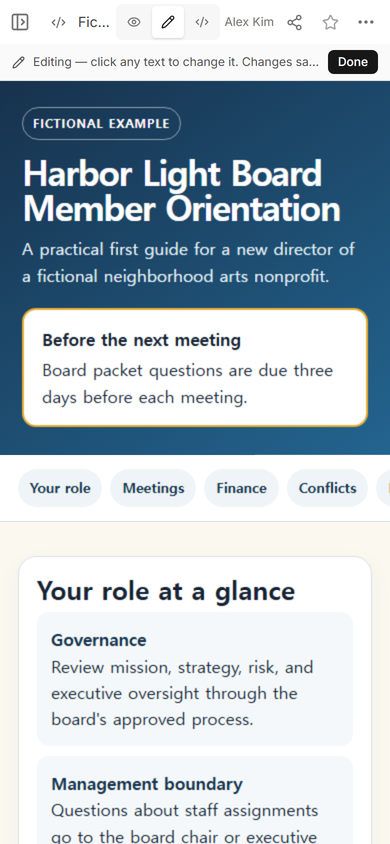
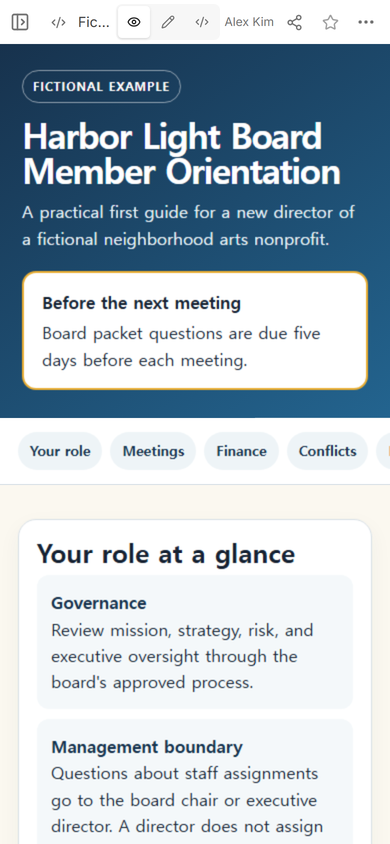
The first direct text change did not replace the whole line. It inserted new words into the old sentence, and the next edit could no longer match that rendered line to the source. That is the practical warning from this example: after a visual edit, read the entire sentence in View. Do not assume a changed fragment means the source is clean.
We recovered by opening Code and replacing the page with the complete checked source. The corrected deadline was five days. This was still only a fictional deadline; the point was to verify the update path on the same page.
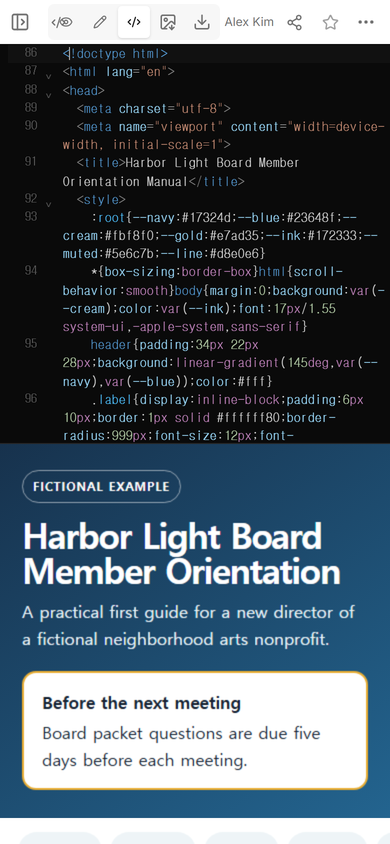
We returned to View and read the sentence again. The old three-day wording was gone from the visible page.
Finally, we opened the original public address at phone width. It showed the same corrected sentence and the same role section.
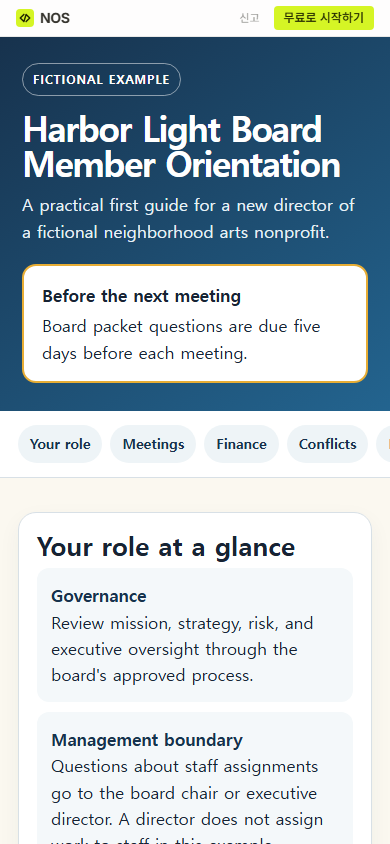
Result: one fictional board orientation page now routes a new director to the role boundary, meeting routine, financial reading questions, conflict contact, official records, and first-month tasks. The original share link displays the checked five-day example deadline.
How should a new board member prepare for the first meeting?
Give the new director a short route through the actual packet instead of a folder dump. In the example, the route starts with bylaws, the conflict policy, latest approved minutes, strategic plan, current budget, meeting calendar, and current packet. The manual names the portal as the official location and tells the reader to report a mismatch.
A practical sequence is:
- Confirm access to the official board records.
- Read the role description and the boundary for staff communication.
- Review the agenda and identify which items ask for a decision.
- Read the current financial report beside the approved budget and reporting period.
- Disclose a possible conflict through the named process before deciding for yourself how to participate.
- Send unresolved questions to the specified contact by the organization's actual deadline.
If you are coordinating several people and dependencies around the start, the onboarding checklist guide shows how to add an owner and a definition of done. A board-specific manual still needs the governance material above; a general starter checklist does not supply it.
What financial information belongs in board orientation?
Point to the organization's actual financial records and teach the reader what questions to bring. The example asks for the reporting period, the comparison with the approved budget, assumptions or restrictions that need explanation, and the decision or follow-up requested from the board.
Do not copy donor details, payroll, bank information, or confidential board material into a public orientation example. A public-facing summary can name the official record without reproducing it. The board portal or other approved system remains the place for the real documents.
When the board must choose between options, a concise decision memo can keep the requested choice, evidence, alternatives, recommendation, and unresolved conditions together. The memo supports a decision; it does not record an approval that has not happened.
What should happen when a director sees a possible conflict?
The manual should identify the organization's policy and the person who receives the disclosure. The IRS explanation of conflict-of-interest policies says the policy is intended to provide a process for an affected individual to advise the governing body of relevant facts and for handling participation in the matter.
Our example therefore says “disclose first” and directs the reader to the fictional board chair and governance contact. It does not decide whether a conflict exists, invent a recusal rule, or replace the organization's adopted policy.
What belongs in the first 30 days?
The fictional list has four outcomes: the director has read the core records, met the chair and executive director, opened the current portal materials, and reviewed the next agenda with unresolved questions routed to the named contact. Replace those items with your own confirmed expectations and owners.
For annual priorities, the annual planning meeting agenda is the next useful guide when the board must compare initiatives with capacity and record what starts, waits, or still needs evidence.
When not to do this
- Do not treat a public summary as the bylaws, conflict policy, approved minutes, financial report, legal advice, or evidence that a director completed orientation.
- Do not publish confidential board packets, personal data, donor records, payroll, banking details, legal advice, or restricted meeting material.
- Do not invent quorum, voting, notice, fundraising, attendance, or legal duties because a template has an empty space.
- Do not use one page as the only control when your organization needs acknowledgements, permissions, version history, or access restricted to authorized directors.
Using NOS for the orientation summary
NOS was used here to hold the complete HTML page, compare Code and View, create a viewer link, and update the existing page. The captured Share panel said that anyone with the link could read this example without signing in and could not edit it. That access is suitable only for material your organization has decided can be shared that way; keep governed and confidential records in the approved system.