“The bus arrived late. The class entered the museum.” Those events happened in order, but the second sentence does not explain what the delay changed.
A cause-and-effect organizer needs room for that explanation. Put the event in one space, its result in another, and the supporting detail beside the arrow. Students can then check whether they have found a causal connection or merely copied two neighboring sentences.
Blank template and worked example

Open the complete example · Blank PDF · Worked PDF
Download the HTML version to adapt the browser page. The worked material is fictional. Use the blank PDF for a printed activity or record; the browser preview switches between versions.
For a task that only asks what happened first, next, and last, use a sequence organizer. A T-chart fits a comparison between two options; it does not by itself establish a causal link.
Choose the pattern the text actually contains
A set of reading organizers includes cause-and-effect layouts as well as sequencing and problem-and-solution layouts. Those structures ask readers to do different work.
Use one of these three formats for this activity:
- A pair: What happened? What happened because of it? Which detail connects the two?
- A branch: One event points to several separate results, each with its own evidence line.
- A chain: Event A leads to B, and B leads to C. Each arrow needs an explanation.
For a blank pair, copy:
Text/title: [ ] Location in text: [ ]
Cause: [ ] → Effect: [ ]
The detail that connects them: [ ]
My explanation: Because [ ], [ ].
What the text leaves uncertain: [ ]
Keep the cause and effect as events rather than broad labels. “Weather” is a topic. “Heavy rain closed the outdoor path” is an event the reader can examine.
A short passage with a worked answer
Use this original fictional passage as a practice text:
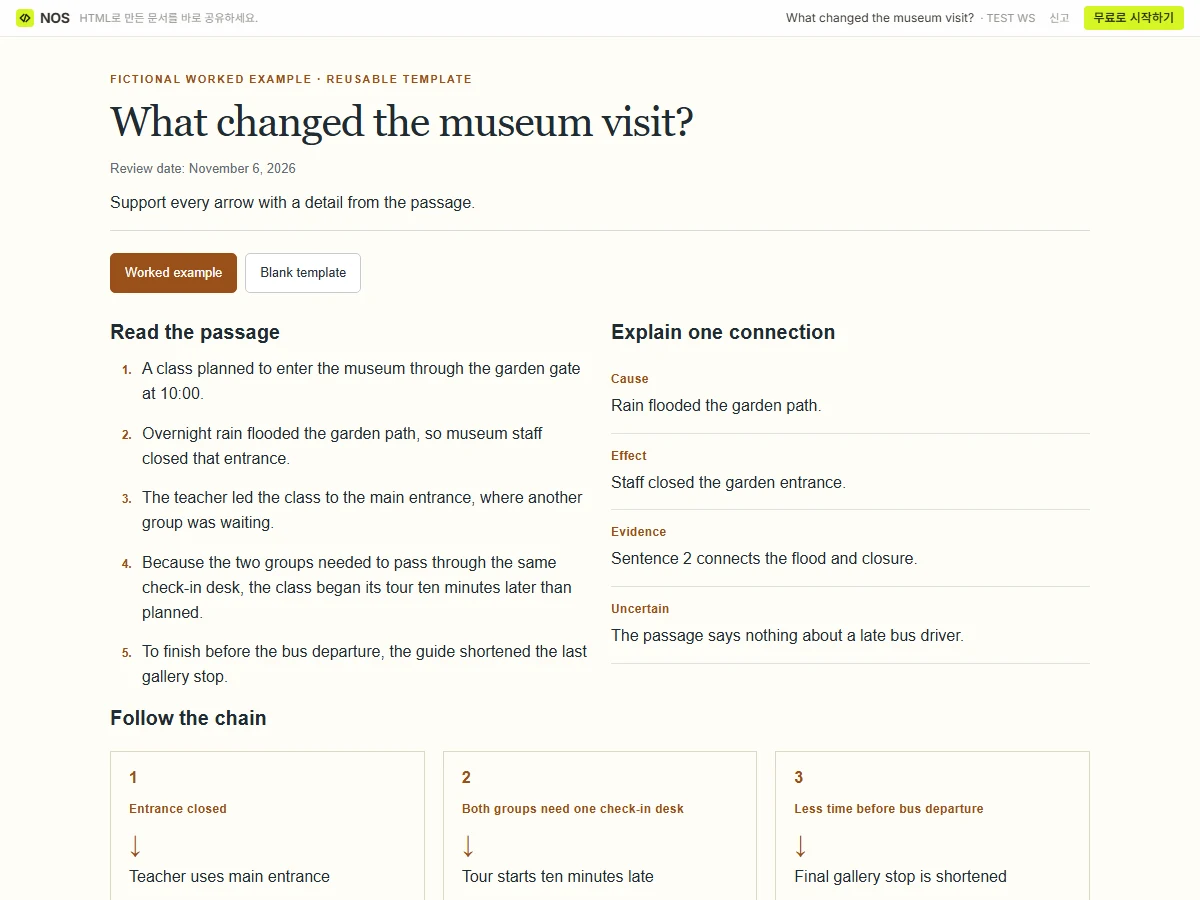
1. A class planned to enter the museum through the garden gate at 10:00.
2. Overnight rain flooded the garden path, so museum staff closed that entrance.
3. The teacher led the class to the main entrance, where another group was waiting.
4. Because the two groups needed to pass through the same check-in desk, the class began its tour ten minutes later than planned.
5. To finish before the bus departure, the guide shortened the last gallery stop.
Start with a pair students can support directly:
Cause: Overnight rain flooded the garden path.
Effect: Staff closed the garden entrance.
Evidence: Sentence 2 explicitly connects the flooded path and the closure.
Explanation: Staff closed the entrance because the path leading to it was flooded.
Then build a chain:
- The garden entrance closed, so the teacher used the main entrance.
- Both groups needed the same check-in desk, delaying the tour.
- The later start left less time before the bus departure, so the guide shortened the final stop.
For the first link, students must connect sentences 2 and 3. For the second and third, the passage gives the reason explicitly.
Do not add “the driver was late.” The passage says nothing about the driver’s arrival. It also does not say the class missed its bus.
Show why a tempting answer does not work
Consider this response:
Cause: Another group was waiting.
Effect: It rained overnight.
The two details are in the passage, but their direction is wrong. Nothing in the text makes the waiting group a cause of the rain.
Another answer is closer:
Cause: It rained.
Effect: The last stop was shorter.
That connection is too compressed for this exercise. Ask the learner to fill the missing links: flooded path, entrance change, shared check-in, delayed start. The explanation then shows how the beginning relates to the result.
A signal word can help students locate a connection, but the evidence line still matters. “After” can mark sequence without explaining cause. Have students complete “because” in their own explanation and then point to what supports it.
Use a branch without turning possibilities into facts
Give a new original passage: “The school moved the concert indoors. Staff carried the chairs into the hall, and the student announcer replaced the outdoor directions on the welcome sign.”
The central event is moving the concert indoors. Its two stated effects are moving the chairs and changing the sign.
“Everyone stayed dry” may be a reasonable prediction, but it is not a stated result. Put it in a separate Possible effect to discuss area if prediction is part of the lesson. Do not mix it with the reading answer key.
The same distinction matters in nonfiction. An organizer can show the relationship a source claims; it does not independently establish that a proposed cause is correct.
Generate a lesson-specific version
Create a cause-and-effect reading activity for [grade/group] using only this passage: [paste passage]. Learning focus: [one pair / one cause with several effects / a chain]. Produce the passage with sentence numbers, a blank organizer, and a separate teacher key. For every answer, identify the supporting sentence numbers and explain the causal connection. Mark inferred links as inferences. Do not turn sequence into causation or add facts, quotations, or page references. Include one plausible wrong answer and a correction tied to the passage. If the passage does not support the requested pattern, tell me which relationship is missing instead of inventing it. Return editable worksheet text and a print-friendly HTML version.
Check every arrow in the key. If you cannot explain one with the passage, remove it or make the uncertainty part of the discussion.
Share the teacher model after checking the evidence
Open this example’s NOS share link.
Keep the student handout in your class’s usual document or print format. If colleagues need to review the worked model, save its HTML version in NOS and send the page link.
You can correct a sentence reference in the saved page and reopen the same link to check it. That keeps the review link useful while you refine the model. Keep the student version separate from the answer key, and replace any printed key that contains the earlier error.