In short
Measure the pole width and finished drop, choose fullness, and enter the usable fabric width after selvedges.
Add the vertical pattern repeat, top allowance, bottom hem, side turn, panel count, and number of windows.
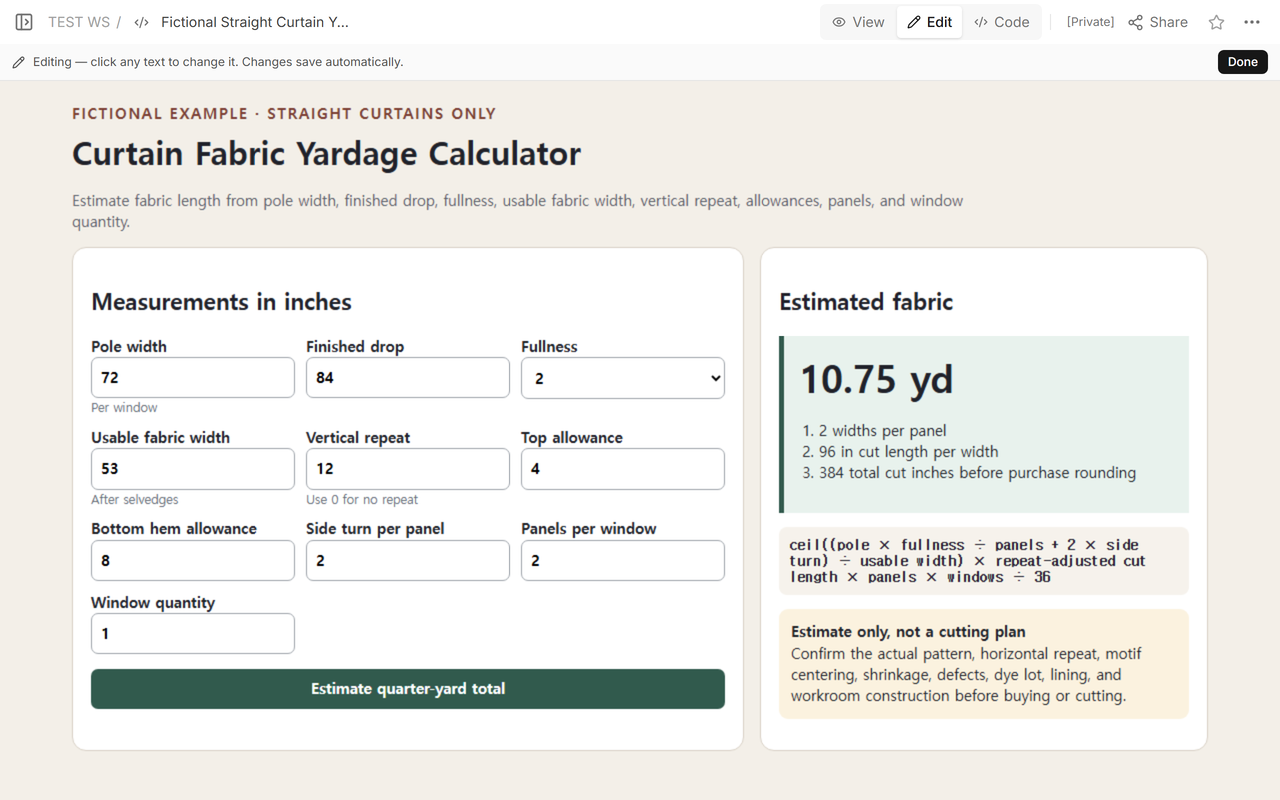
The worked straight-curtain example needs two fabric widths per panel, a 96-inch cut length, and 384 total cut inches before purchase rounding.
That becomes 10.75 yards after rounding up to the next quarter yard, but it is an estimate rather than a cutting plan.
Start with the usable result: download the complete straight-curtain yardage calculator. The file contains the inputs, formula, repeat adjustment, quarter-yard rounding, error states, and limitations.
What does the completed yardage estimate include?
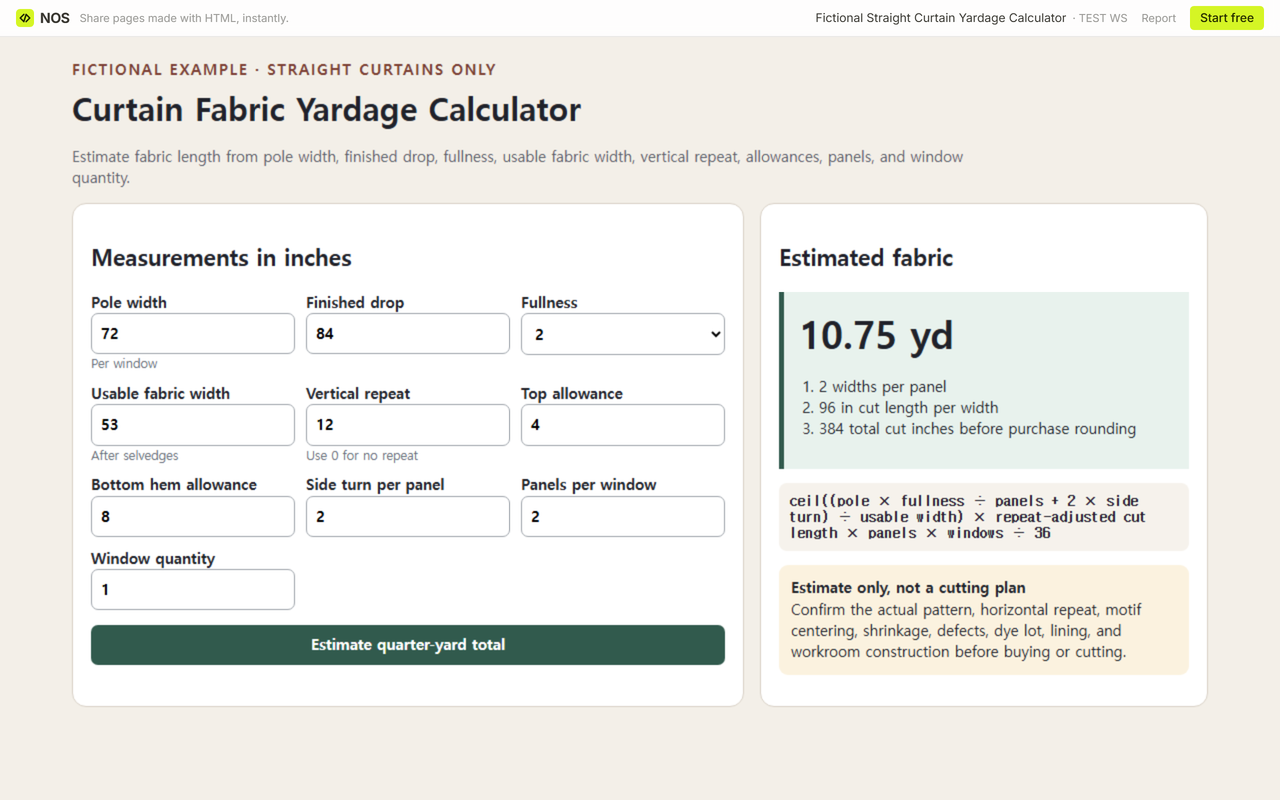
NOS Team used a fictional pair of straight curtain panels for one 72-inch pole. The finished drop is 84 inches, fullness is 2, usable fabric width is 53 inches, and the vertical repeat is 12 inches. The design adds 4 inches at the top, 8 inches at the bottom, and a 2-inch side turn on each side of each panel.
How does pole width become fabric widths?
First multiply the 72-inch pole by fullness 2 to get 144 inches of finished coverage. Divide that across two panels to get 72 finished inches per panel. Add twice the 2-inch side turn, producing a 76-inch cut width per panel. Divide 76 by the 53-inch usable fabric width and round up: each panel requires two fabric widths.
Usable width is already the width available after selvedges. The source methodology starts from nominal bolt width and subtracts one inch for selvedges; this calculator asks for usable width directly, so it does not subtract that inch again.
How are drop, allowances, and vertical repeat combined?
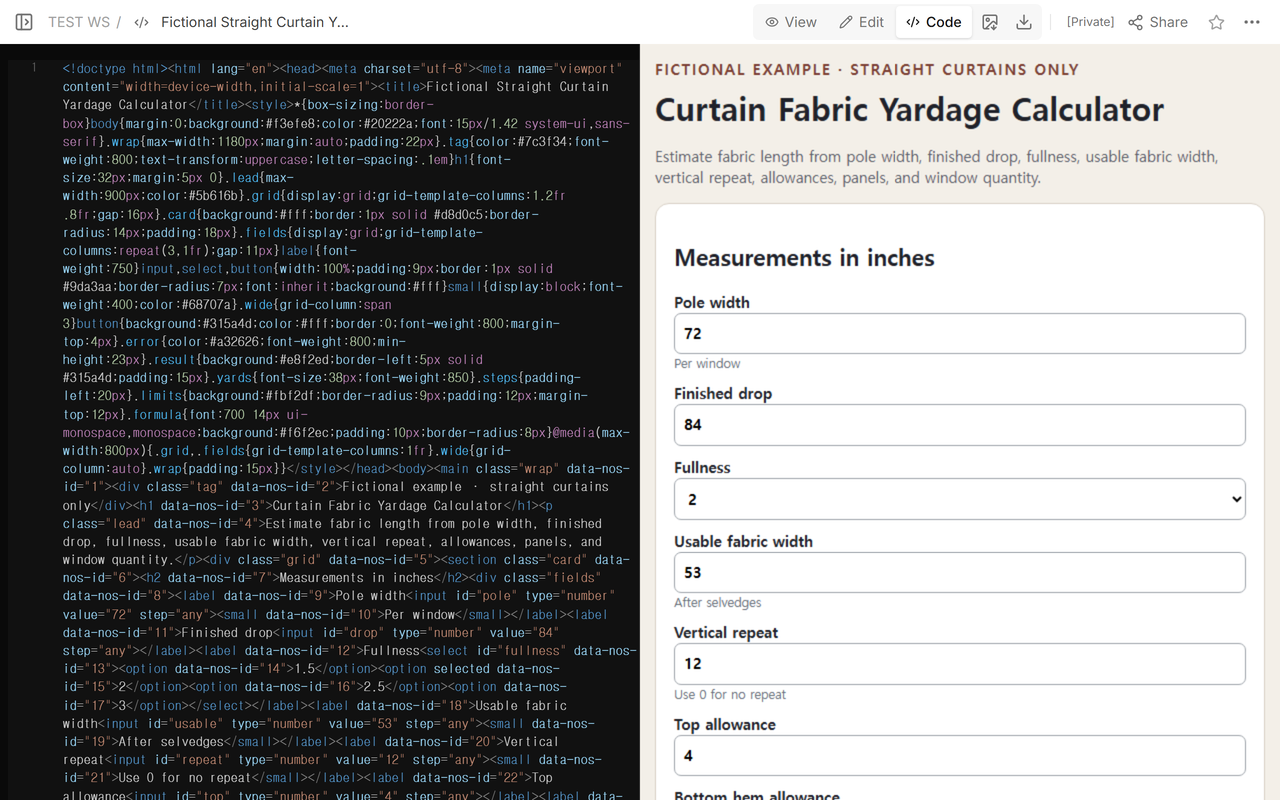
Add the 84-inch finished drop, 4-inch top allowance, and 8-inch bottom hem to get a 96-inch raw cut length. When vertical repeat is greater than zero, round that length up to a whole repeat. Ninety-six is already eight repeats of 12 inches, so the adjusted cut length remains 96 inches. A zero repeat means no repeat adjustment; it does not remove the top or bottom allowances.
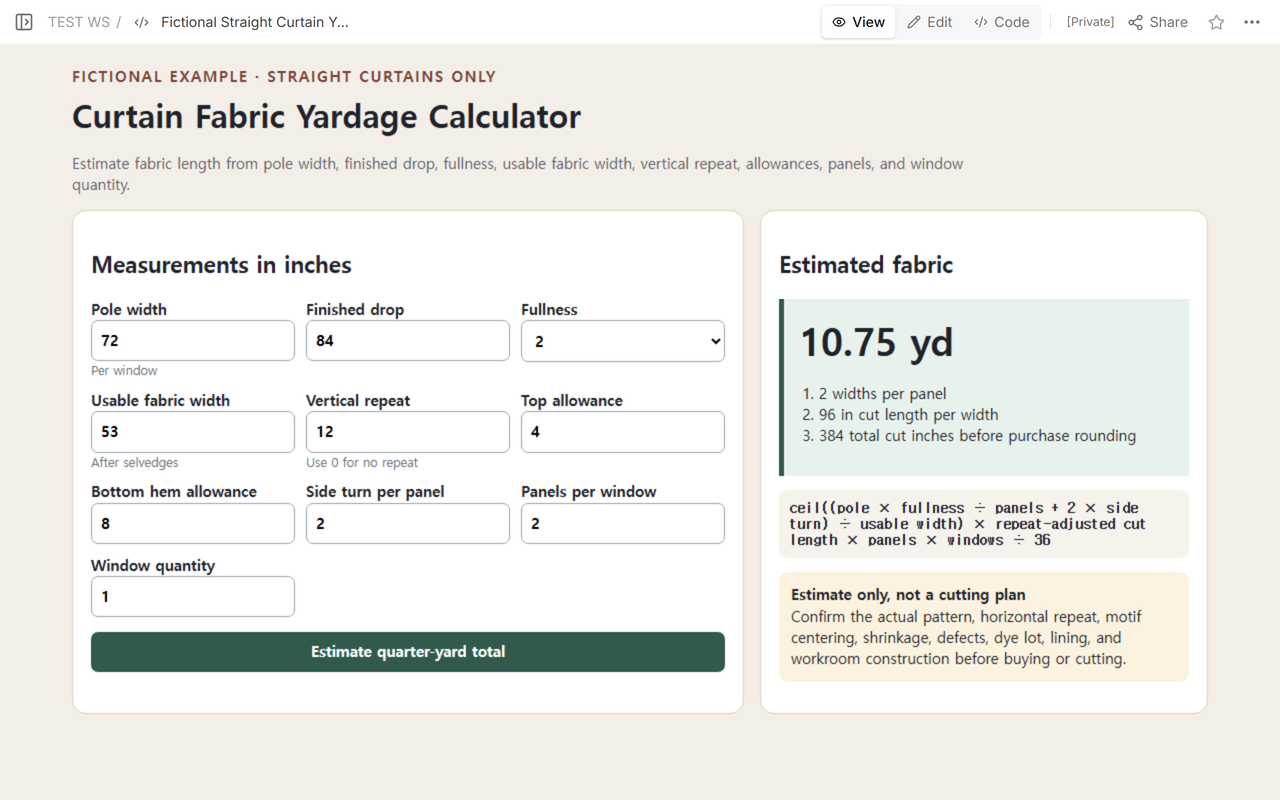
View puts the entered measurements beside the result, which makes a missed allowance easier to spot before the estimate is carried elsewhere.
How does the estimate reach 10.75 yards?
Multiply the 96-inch cut length by two widths per panel, two panels, and one window. The result is 384 inches. Dividing by 36 gives 10.6667 yards. The calculator rounds upward to the next quarter yard, producing 10.75 yards. It never rounds a purchase estimate downward.
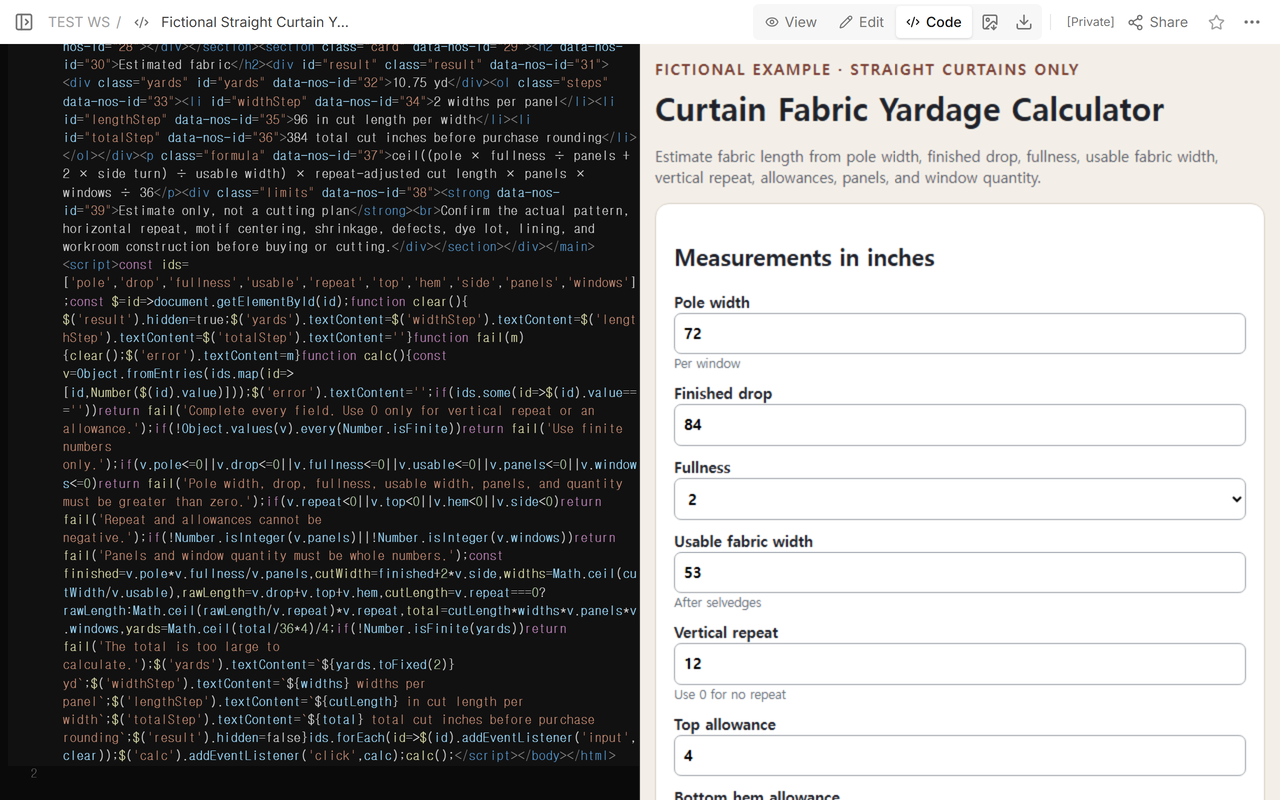
The lower Code screen shows this sequence and the error branches. If a required value is blank, zero, negative, non-finite, or a fractional panel count, the old result is cleared before the error appears.
Which official assumptions are preserved?
The source method separates finished coverage, panel width, usable fabric width, cut length, pattern-repeat adjustment, panel quantity, and window quantity. Its fullness choices are 1.5, 2, 2.5, and 3. This example preserves those choices and the quarter-yard purchase rounding while narrowing the task to unlined straight panels.
The calculator uses the supplied pole width as the coverage width. It does not add an outside-mount overlap automatically. If the real design requires overlap beyond the pole, include that decision in the measured width or follow the actual pattern instructions.
What does this calculator deliberately not replace?
It does not create a workroom cutting plan. It also does not resolve a horizontal repeat, center a motif, match a pattern across seams, calculate a differently sized lining, add shrinkage, allow for defects, choose a dye lot, place pleats, or interpret a commercial pattern. Those are separate material and construction decisions.
The example tests seven invalid cases and leaves zero stale results. That protects the displayed estimate from obvious entry failures, but it cannot tell whether a measurement, fabric specification, or sewing decision is correct.
How can someone inspect or share the estimate?
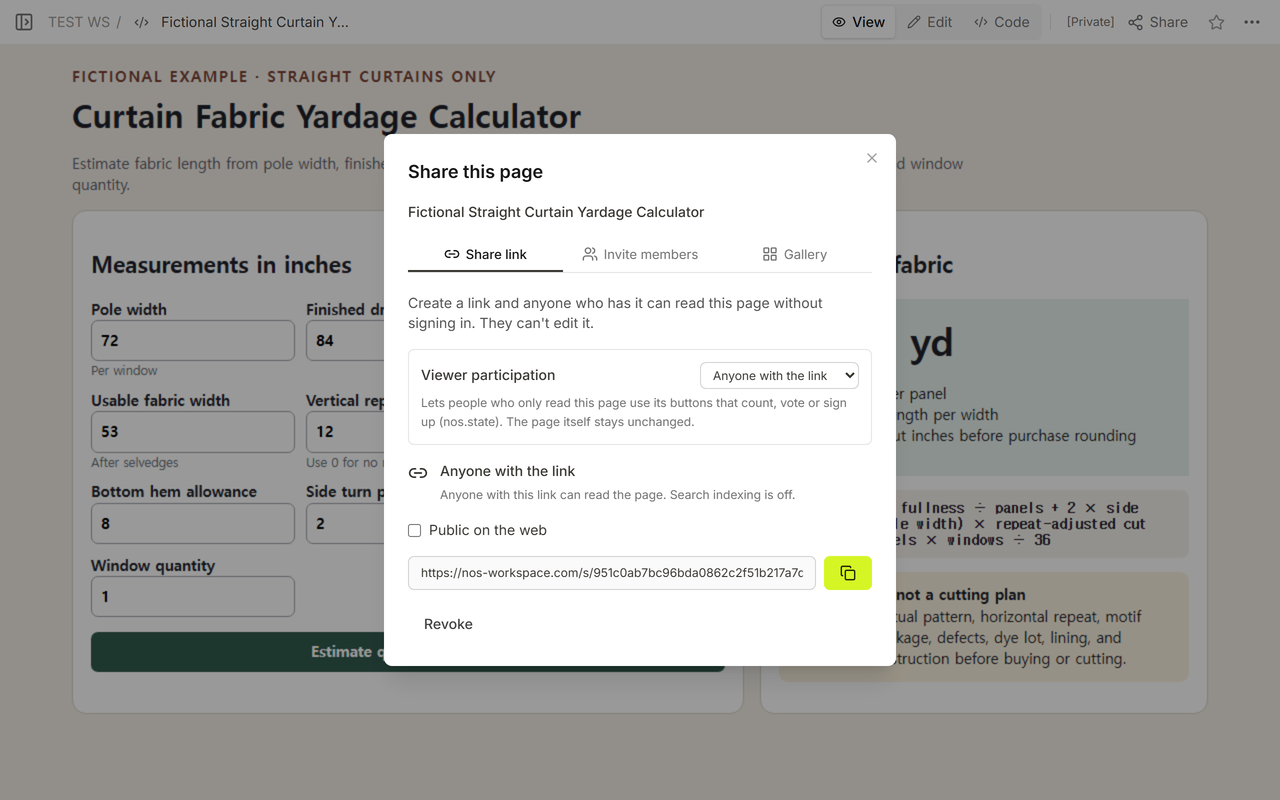
The captured Share panel supplies the reader address for this fictional page. Edit opened the same owned NOS page. Code, View, Edit, Share, and the public reader therefore refer to one example rather than separate reproductions.
When not to do this
- Do not buy or cut from this estimate without checking the actual pattern and workroom plan.
- Do not ignore horizontal repeat or motif centering for patterned fabric.
- Do not assume lining uses the same width or cut layout as face fabric.
- Do not combine measurements from different unit systems or fabric specifications.
Using NOS for the yardage page
NOS displayed the self-contained calculator in Code, View, Edit, Share, and the public reader checked here. The arithmetic runs inside the opened page; NOS does not inspect the fabric, pattern, shrinkage, defects, or dye lot. Check the official NOS pricing page for current plan information.
Which measurement tools help next?
Use the inches to pixels converter only when preparing a screen-scale reference; it does not replace physical fabric measurements. Read calculator to link when the goal is to package an inspectable calculation for another reader.