In short
A kiln firing log preserves what was loaded, what the controller displayed, when each checkpoint was recorded, and what was observed after cooling and unloading. Identify the kiln, responsible role, firing type, program reference, evidence cones, and load before the timeline. Keep observed values separate from recommendations and judgments. The log does not replace the kiln manufacturer's instructions or the studio's approved operating and safety rules.
Download the completed fictional kiln firing log
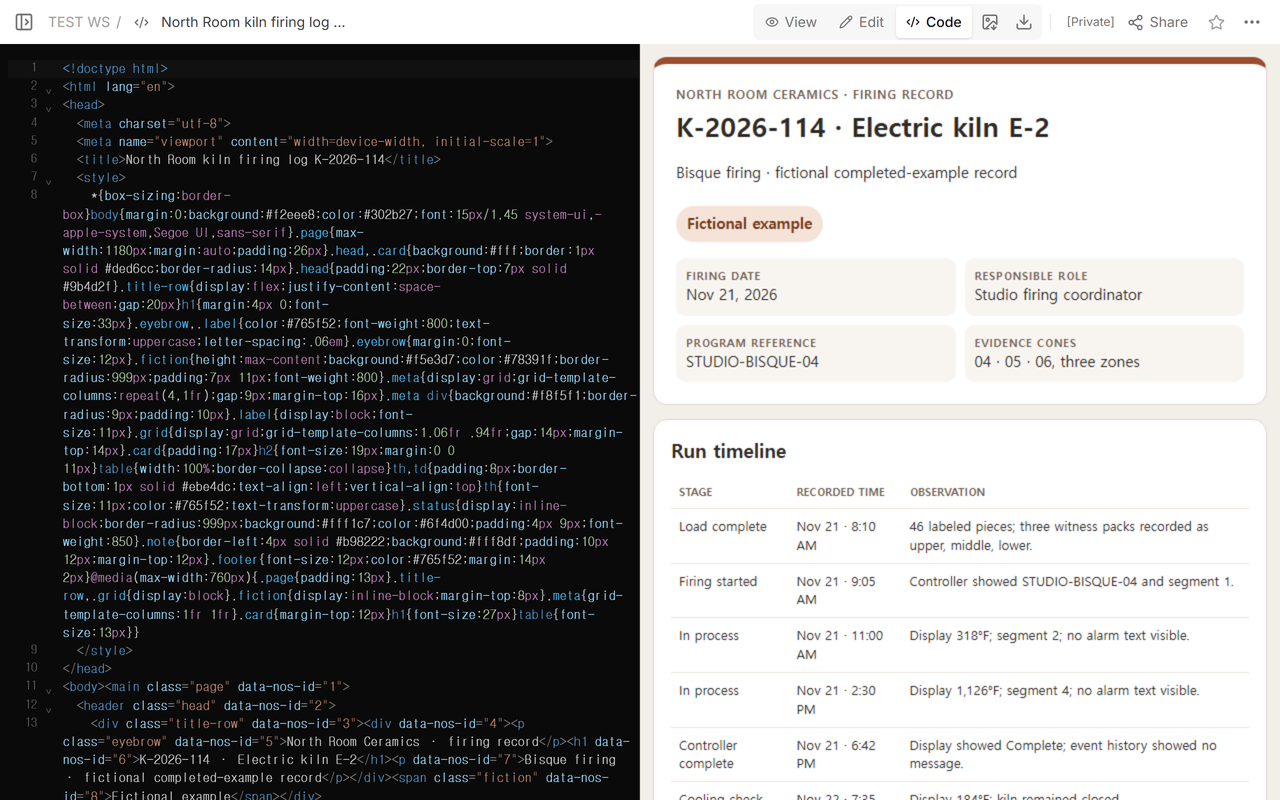
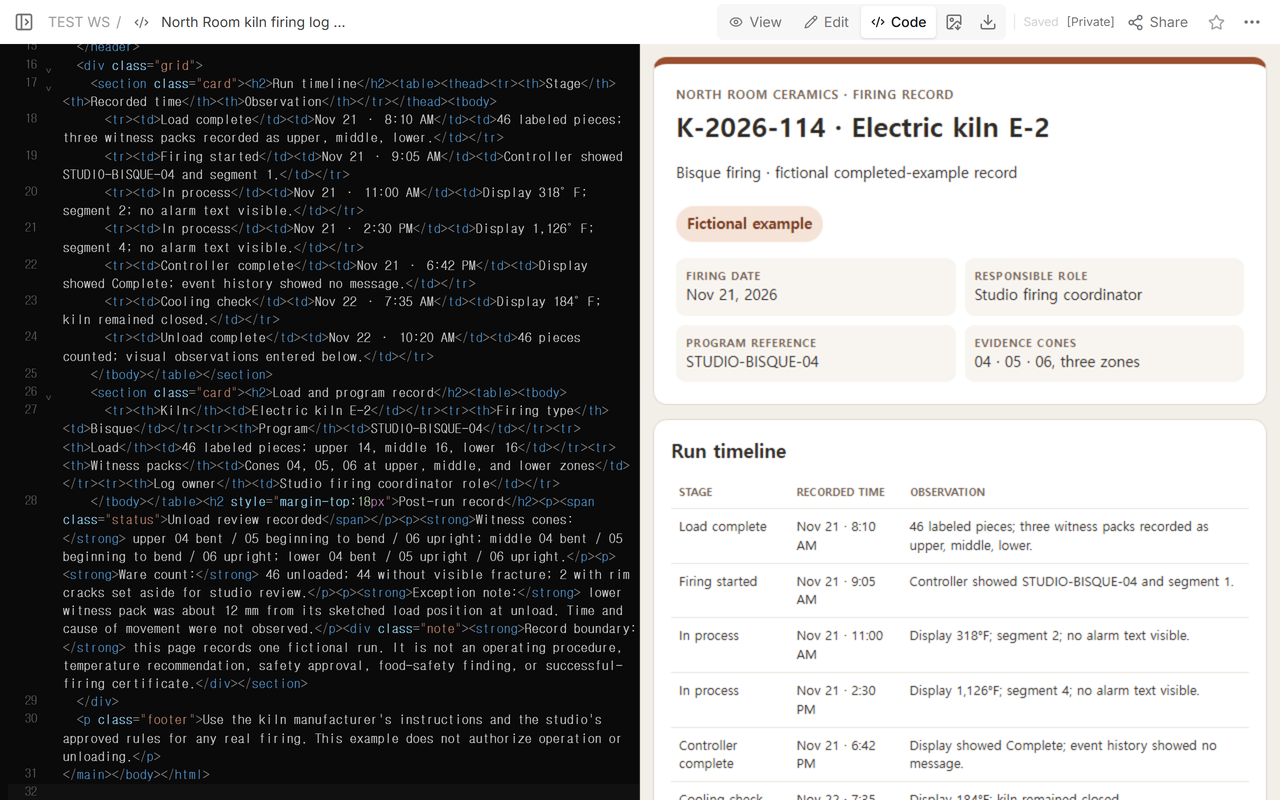
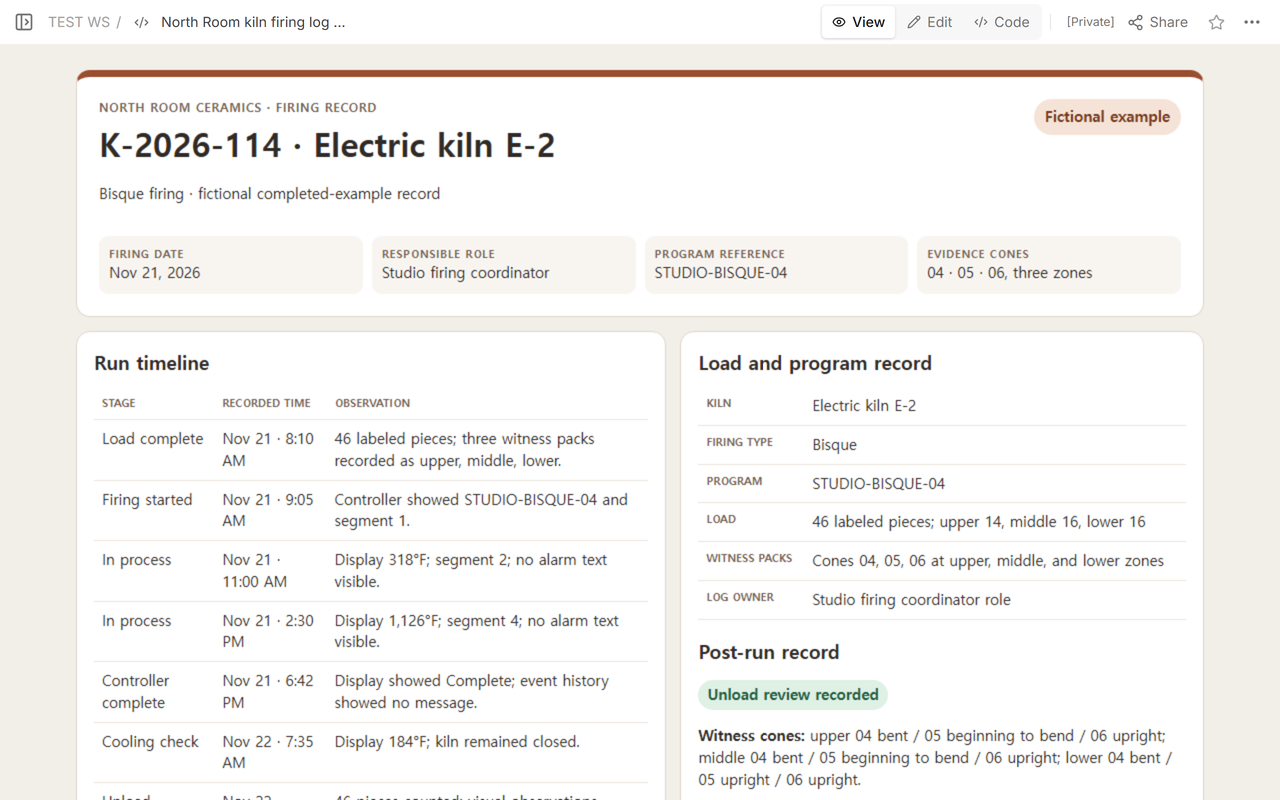
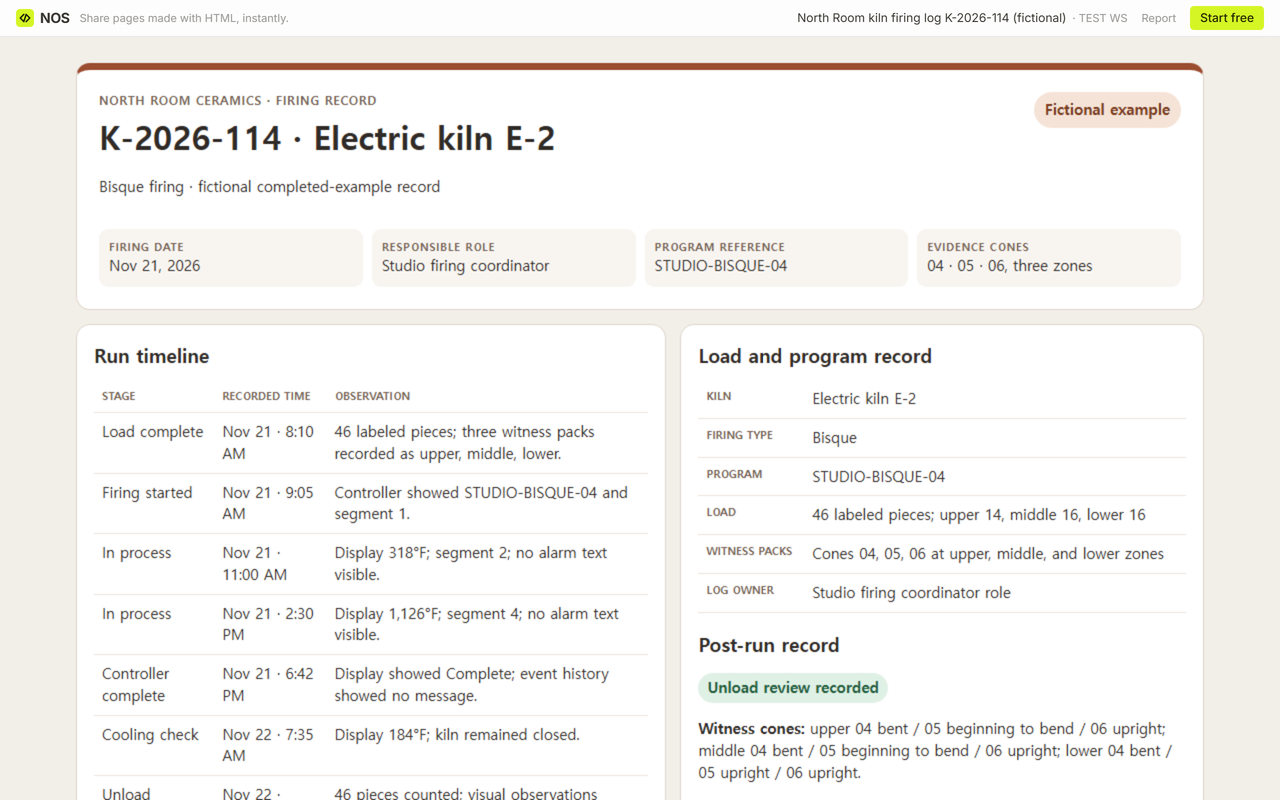
The download contains K-2026-114, a fictional electric-kiln bisque record dated November 21-22, 2026. It records 46 labeled pieces, program reference STUDIO-BISQUE-04, three witness packs, seven time points, the unload count, two observed rim cracks, and a displaced lower witness pack. These entries demonstrate record structure; they are not settings or limits for a real kiln.
What does a complete kiln firing log include?
Begin with a run identifier that will not be reused. Add the date, kiln identifier, responsible role, firing type, and the exact name of the studio-approved program reference used for that run. Record the evidence-cone numbers and their locations as part of the load record. This lets a later reader connect each observation to one defined firing instead of guessing which kiln or program a loose note describes.
The public IUS Ceramics kiln log sheet provides fields for the kiln, person firing, firing type, cones, load/fire/cool/unload dates, and time-based notes. Its interval table also carries temperature and equipment observations. This example uses that recordkeeping pattern, but it does not copy an operating sequence or supply instructions.
How should you record the firing timeline?
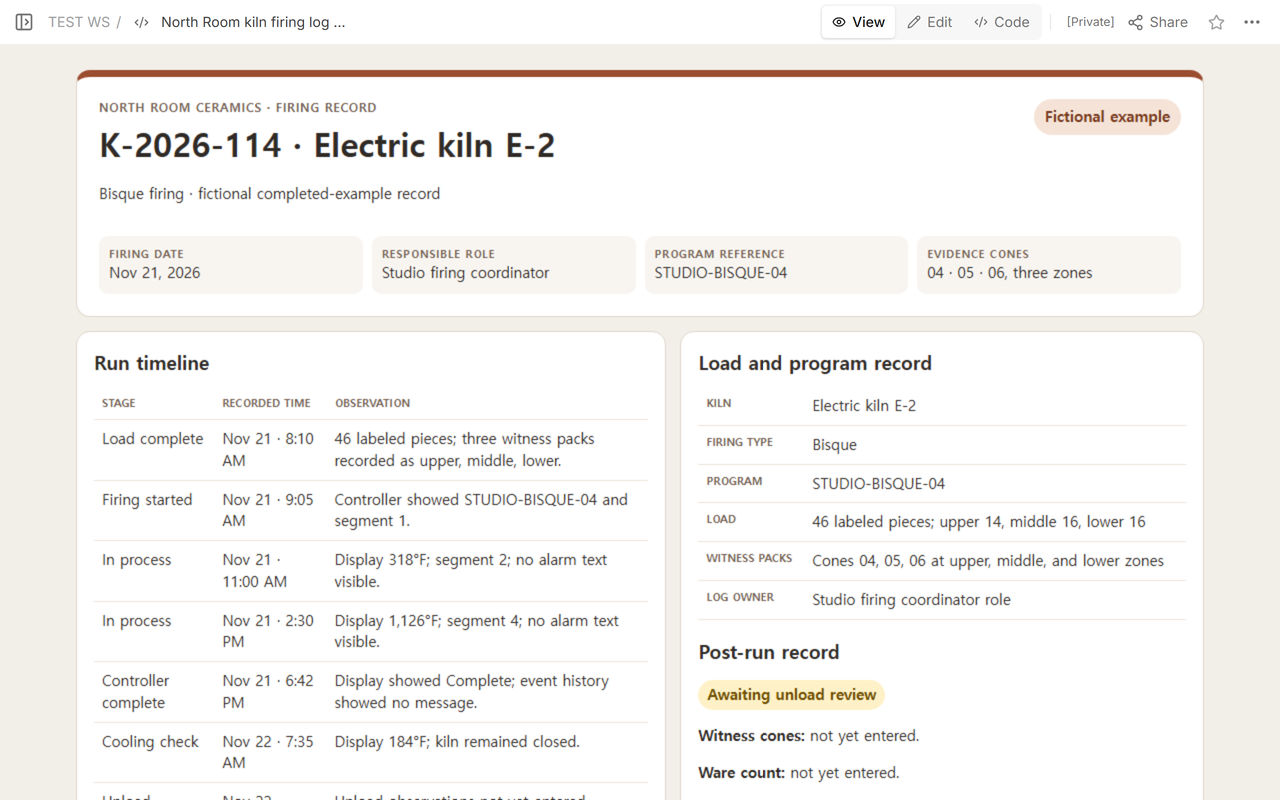
Use one row per actual checkpoint. Write the stage, date and time, then the value or state that was visible at that moment. K-2026-114 records load complete, firing started, two in-process checks, the controller's Complete display, a cooling check, and unload complete. The in-process readings are historical observations from the fictional record, not targets for another run.
Do not rewrite an unobserved gap as a smooth sequence. “No alarm text visible” describes one checkpoint. It does not prove that no message appeared at another time. “Event history showed no message” describes what the fictional reviewer saw at the recorded checkpoint. It is not a safety clearance.
Why keep the load, program, and evidence cones together?
A firing result is easier to revisit when the log retains the load count and zone split beside the program reference and witness-pack locations. The example has 14 pieces in the upper zone, 16 in the middle, and 16 in the lower zone. It records cones 04, 05, and 06 in each zone. Those numbers identify what the fictional record contains; they do not recommend a cone or program for another clay body, kiln, or studio.
The Smithsonian's public Frans Wildenhain kiln log record describes a 90-page handwritten log from 1971-1979 that recorded firing time and gas use. The object record is useful evidence that firing logs can preserve repeated run history over years. It does not supply a modern electric-kiln procedure.
How do you close the record after unloading?
Record what was actually counted and seen. In the completed example, 46 pieces were unloaded. Forty-four had no visible fracture at that review, while two had visible rim cracks and were set aside for the studio's review. The wording stays narrow: it does not certify strength, fitness for use, food safety, or firing success.
Write witness-cone observations by zone without turning them into a universal pass/fail label. K-2026-114 records the observed positions for cones 04, 05, and 06 in the upper, middle, and lower packs. Interpretation belongs to the studio's qualified reviewer under its actual materials, equipment, and rules.
What belongs in the exception note?
Describe the exception and the limit of what is known. The lower witness pack was about 12 mm from its sketched load position when the fictional kiln was unloaded. The log does not claim when or why it moved, because neither fact was observed. That distinction keeps a later hypothesis from becoming part of the run history.
Keep “unknown” visible. If the time, cause, reviewer, or follow-up decision is missing, leave that field unresolved. A plausible explanation is not a recorded observation.
Can the same shared kiln log be updated?
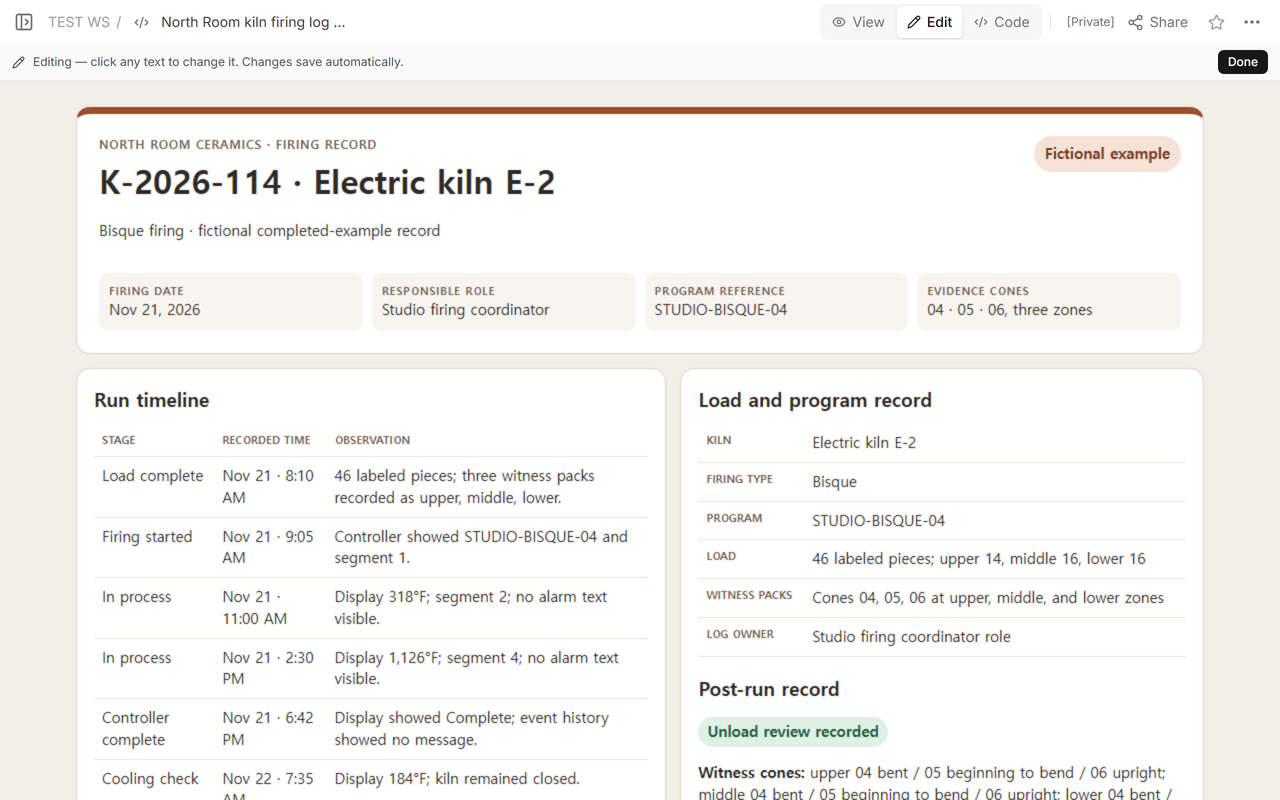
In this NOS example, the initial page showed “Awaiting unload review.” The existing page was then updated to “Unload review recorded,” and the added observations appeared at the same reader address. The earlier upload copy remains in the production evidence, while the maintained page shows the current record.
An update should not erase the firing identity or earlier time points. If your studio requires an amendment history, reviewer signature, locked record, or separate incident workflow, follow that requirement. A shared HTML page does not create those controls by itself.
How is this different from a maintenance schedule?
A firing log records one completed run in time order. The home maintenance schedule plans sourced due dates and leaves unknown dates blank. The maintenance SOP template connects an authorized task, completion evidence, exceptions, and a closure decision. Use those records for their own jobs; do not turn this firing log into an equipment-service procedure or future maintenance calendar.
How do you reuse the template?
- Replace the fictional run ID, date, kiln, responsible role, firing type, and program reference.
- Record the actual load count, zone description, and evidence-cone locations used by your studio.
- Add only checkpoints that someone actually observed, with their dates and times.
- After the studio's approved cooling and unloading process, enter the actual count, cone observations, visible results, and unresolved exceptions.
- Keep interpretations, approvals, and follow-up decisions attributed to the responsible studio role.
- Retain the manufacturer's instructions and studio rules as the operational authority.
When not to do this
Do not use this template to choose a firing program, cone, ramp, hold, temperature, cooling point, or unloading time. Do not treat it as training, an operating procedure, a safety certification, a food-safety determination, or proof that ware is suitable for use. If the manufacturer, studio, insurer, regulator, or institutional policy requires a prescribed log or controlled system, use that record. For an emergency, equipment fault, injury, or suspected unsafe condition, follow the studio's approved response process rather than relying on this example.
Where NOS fits
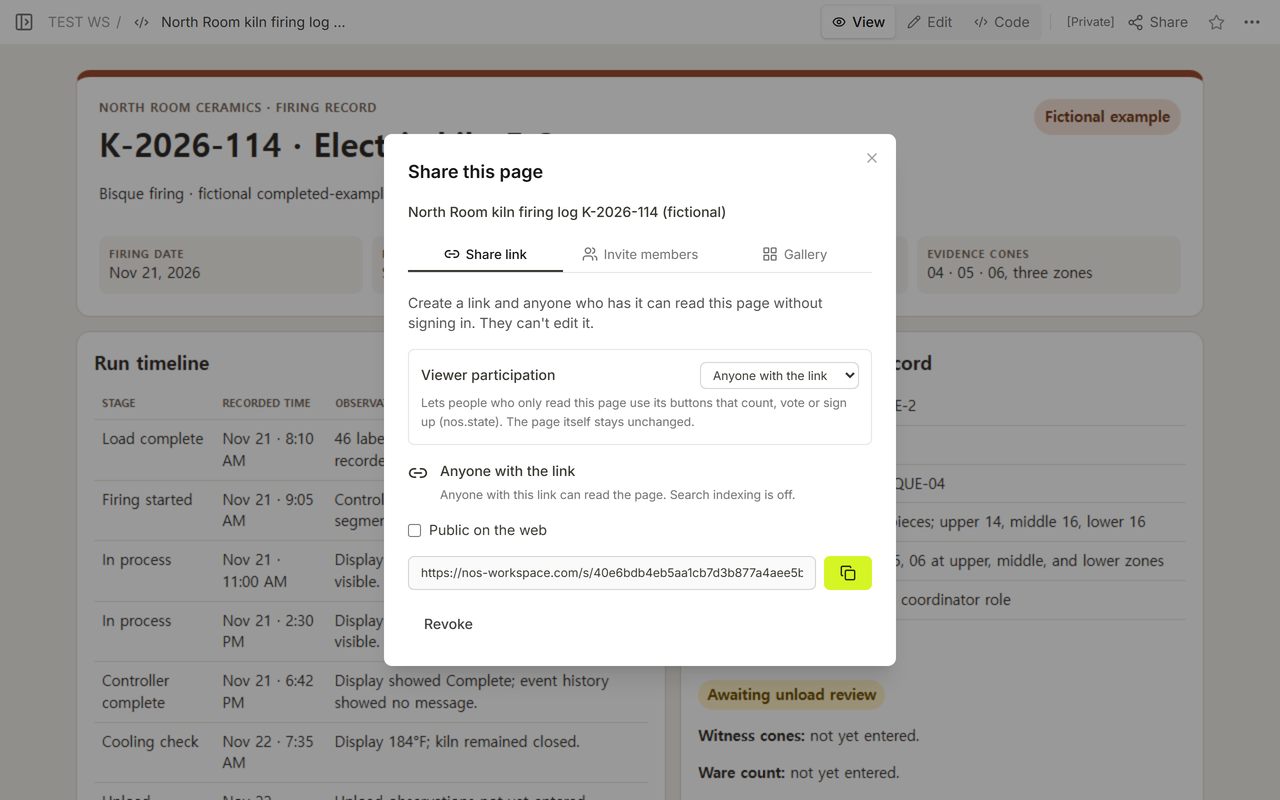
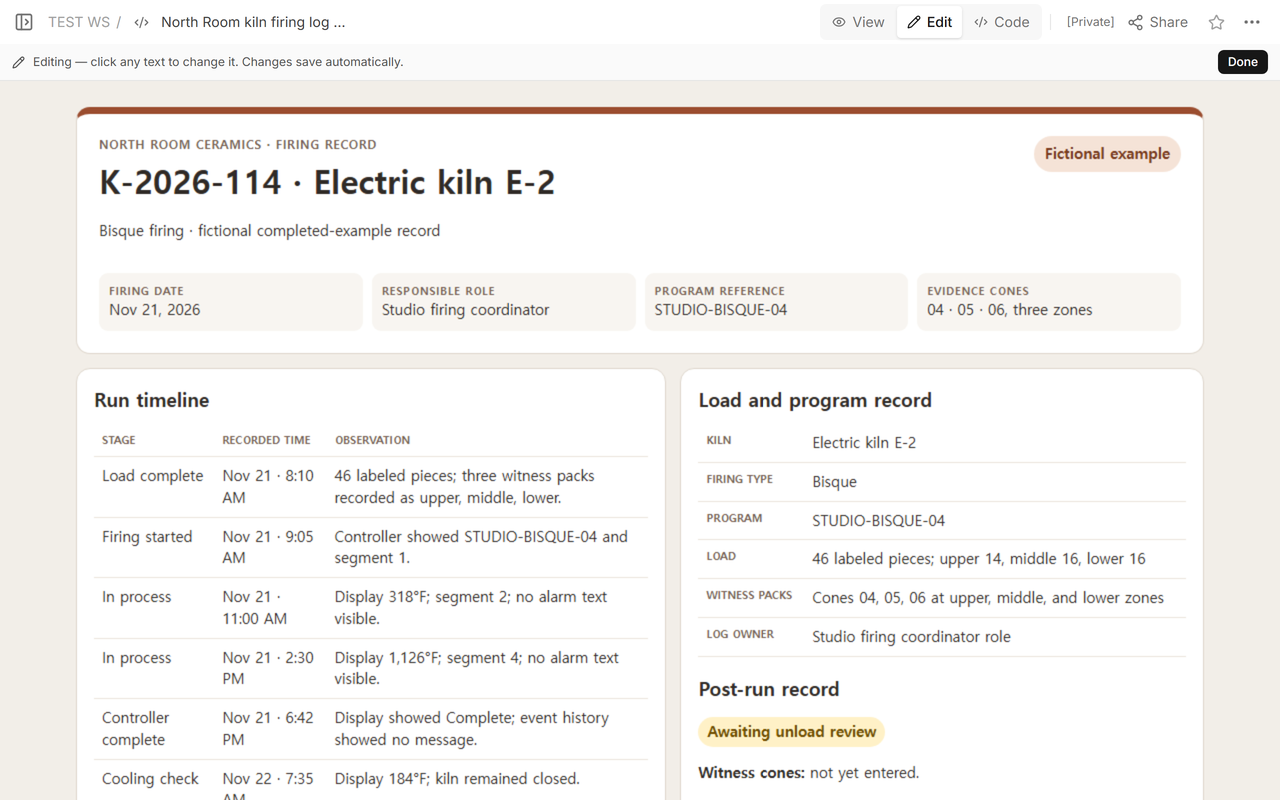
NOS can display a self-contained kiln firing log, open it in Code, View, or Edit, and provide a reader link. In the tested example, a post-run status and its observations were added to the existing page and appeared at the same reader address. NOS does not select a firing program, interpret evidence cones, approve operation, certify safety, or replace the manufacturer's instructions and the studio's rules.