In short
A one-page business case is an internal decision brief, not a product description or a business model canvas. State the decision first. Show at least one alternative, calculate costs from labeled assumptions, separate unverified benefits from evidence, name risks and controls, and finish with a recommendation plus a stop or review rule.
Download the completed one-page business case
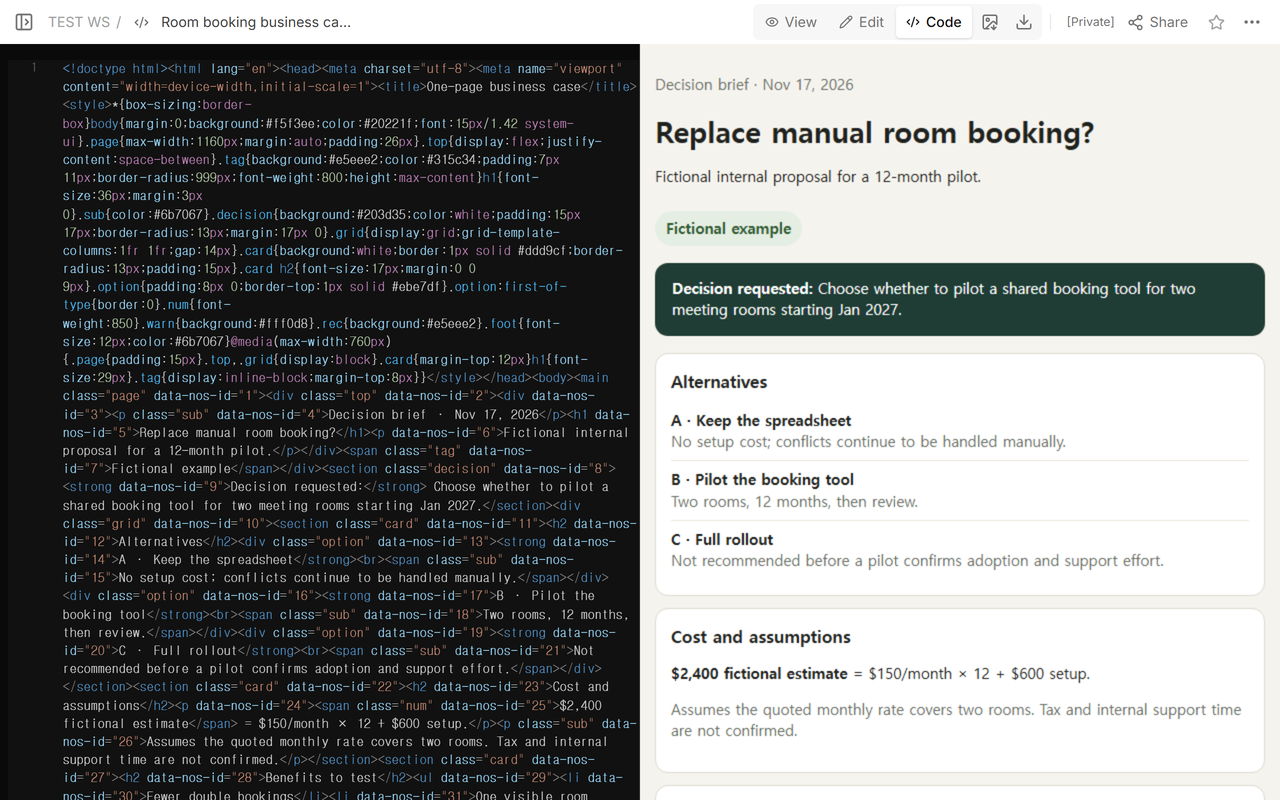
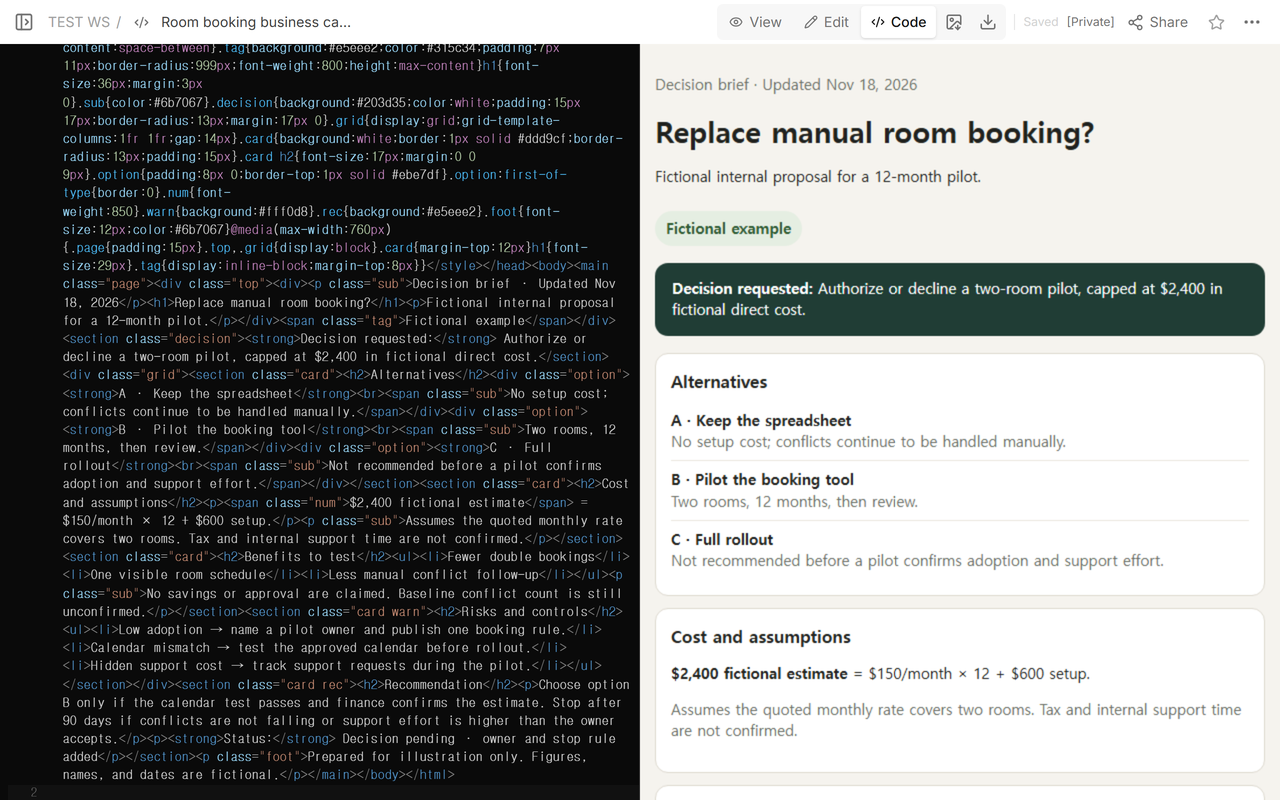
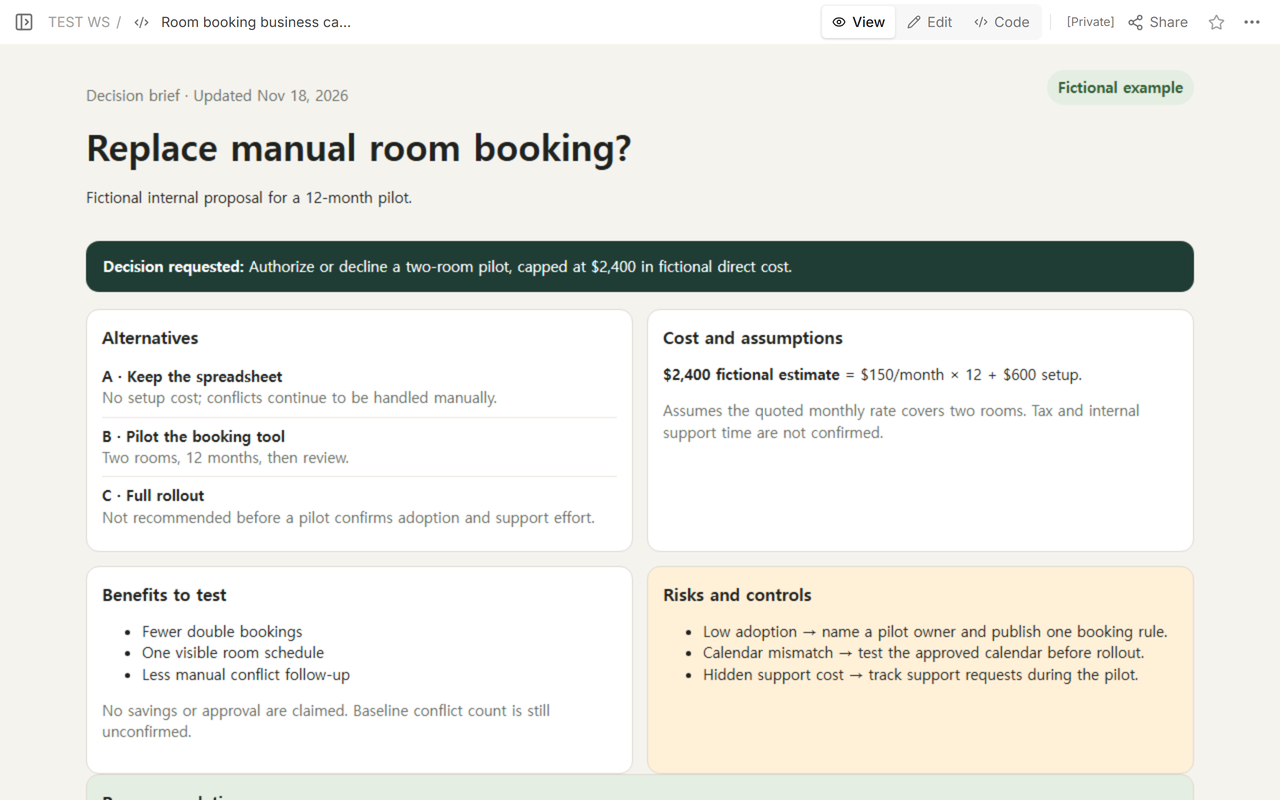
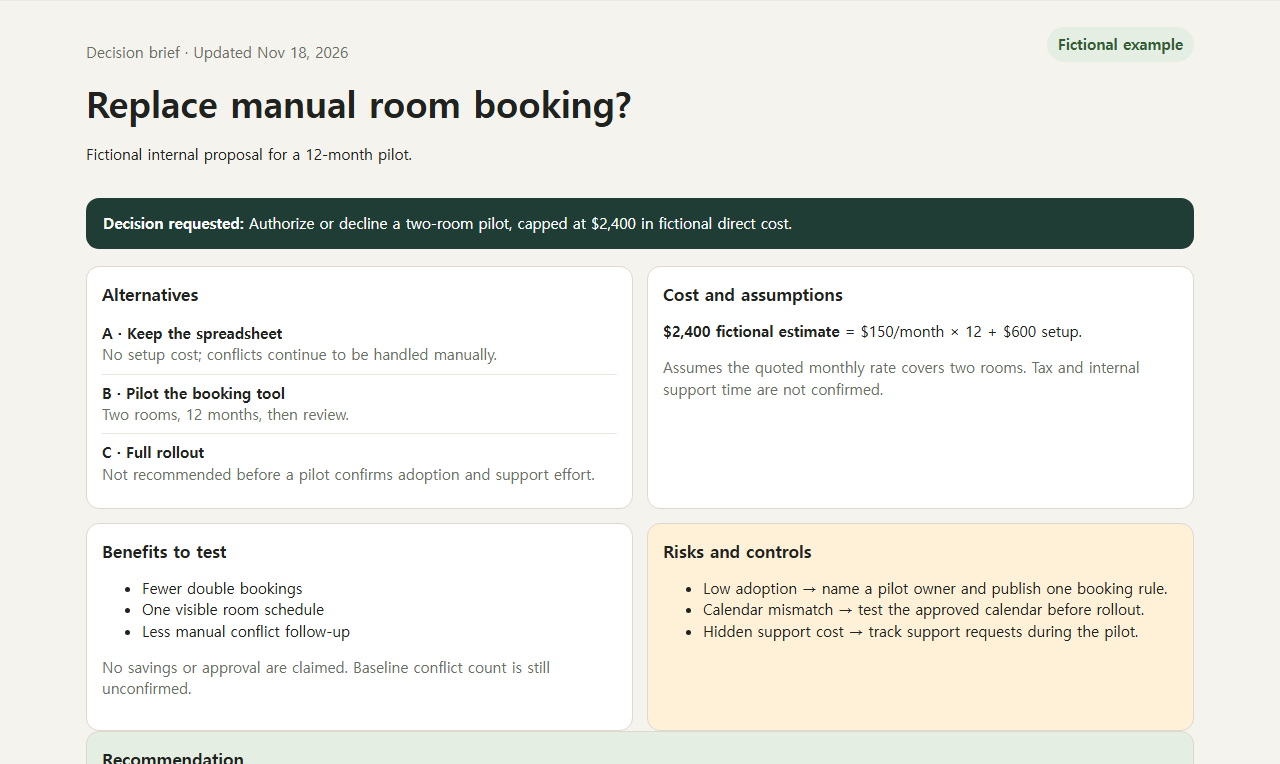
The completed example is a fictional proposal for a two-room booking-tool pilot. Every dollar amount is marked as fictional. The page does not claim approval, savings, adoption, or a measured effect. Its purpose is to make the decision and the unknowns visible at the same time.
What belongs in a one-page business case?
Open with the exact decision: authorize, decline, delay, or request more evidence. A heading such as “Improve room booking” describes a topic. “Choose whether to pilot a shared booking tool for two rooms” tells the reader what must be decided.
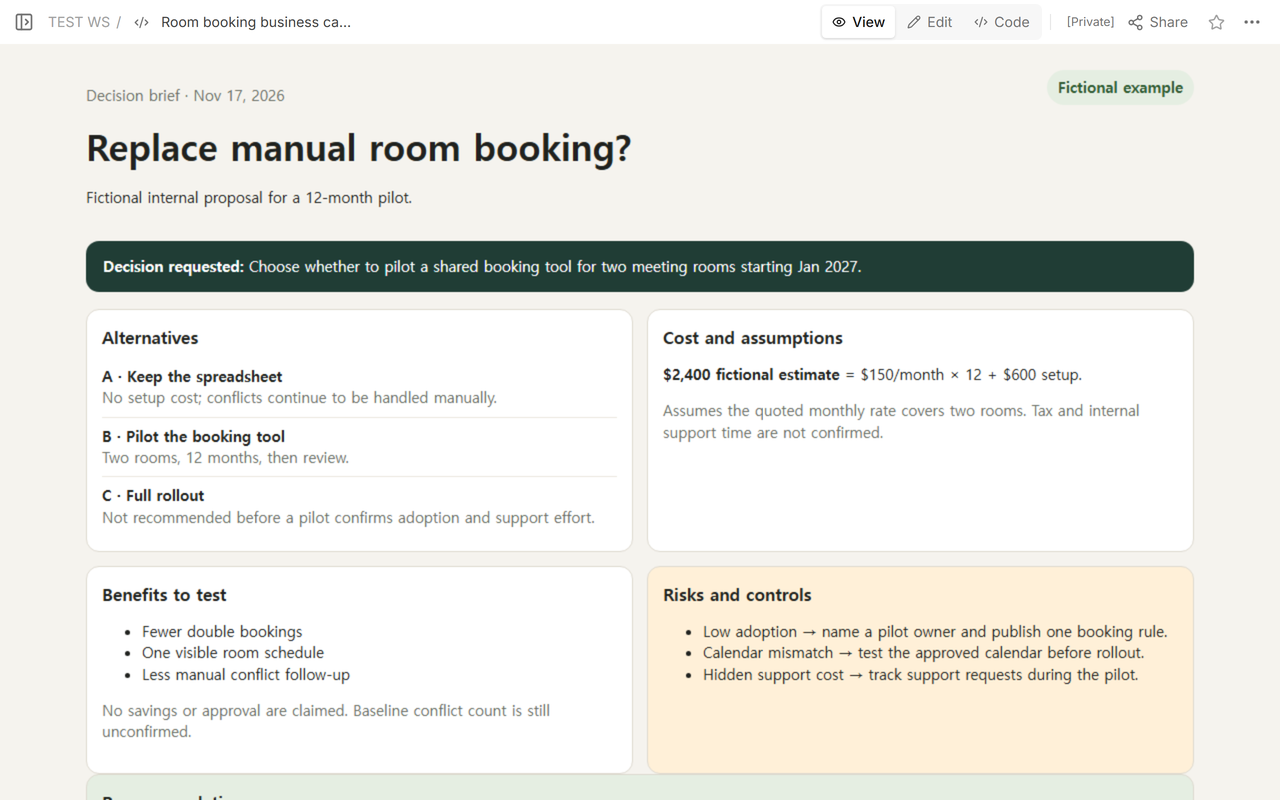
Put the alternatives next to the preferred route. The fictional example compares keeping the spreadsheet, running a limited pilot, and making a full rollout. This prevents the page from presenting the proposal as the only possible action.
How do you show costs without inventing precision?
Show the calculation and its boundary. The example uses 2,400 fictional currency units: 150 units per month multiplied by 12 months, plus 600 setup units. It then names what is missing: tax and internal support time. A reader can reproduce the arithmetic and see why the total may change.
Keep three labels separate:
- Known: a value supported by a current quote, contract, or internal record.
- Assumption: a value used for the decision but not yet confirmed.
- Unconfirmed: information that must be obtained before approval or launch.
Do not turn an estimate into a budget approval. Do not turn a desired benefit into revenue or savings.
How should benefits and risks be written?
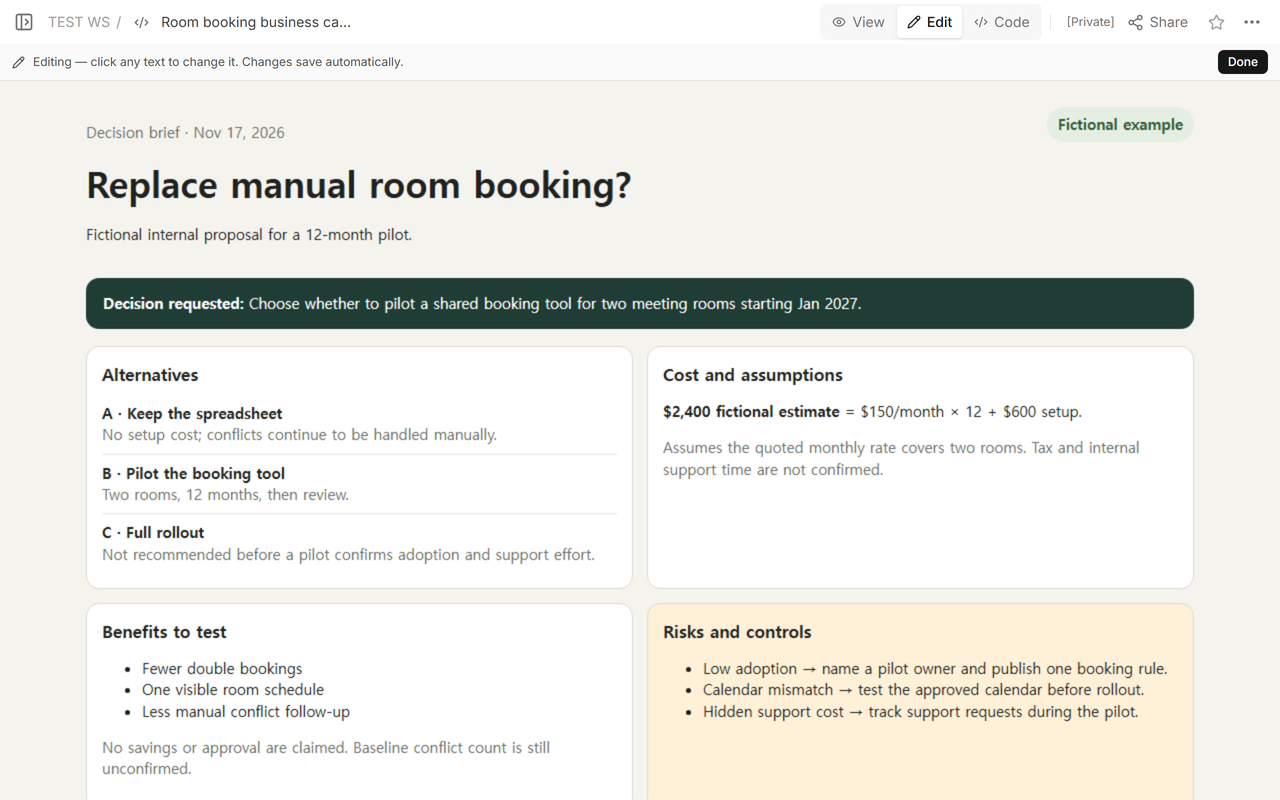
Write benefits as outcomes to test when no baseline exists. “Fewer double bookings” is a testable direction; “the tool saves 30 percent” would require measured evidence. Pair each important risk with a control: an owner for adoption, an approved-calendar test for compatibility, and support-request tracking for hidden effort.
The University of Nevada, Las Vegas describes a business case as justification for a project or organizational change and says its intent is to evaluate benefit, cost, risk, and alternatives while giving a rationale for the preferred solution. That is the job this one-page format preserves.
What changed in the final recommendation?
The first version said to run the pilot after the calendar and price checks. The final version makes the decision boundary sharper: authorize or decline a pilot capped at 2,400 fictional currency units in direct cost. It also adds a 90-day stop rule if booking conflicts are not falling or support effort is too high.
That is stronger than a generic “recommended” label because the decision-maker can see what must be confirmed, what will be measured, and what would end the pilot.
How do you replace the fictional values?
- Write one decision sentence with the scope and decision owner.
- Add the current route and at least one credible alternative.
- Replace the fictional equation with current source values and cite where each came from.
- Mark assumptions and unconfirmed inputs in plain language.
- Choose benefits that can be compared with a baseline.
- Add the largest risks, controls, review date, and stop rule.
When not to do this
Do not compress a regulated investment approval, procurement package, safety case, or complex financial model into one page when its required evidence will be lost. Use this page as the decision map and link to the controlled analysis. Do not use it as a marketing one-pager: a decision brief must show alternatives and downside, not only the preferred story.
Where NOS fits
NOS can display a self-contained decision brief, provide a reader link, and update the existing page after an assumption, recommendation, or review rule changes. The example confirms that the revised brief appears at the same reader address. NOS does not validate the fictional amounts or approve the proposal; the owner must verify source values and the decision-maker must record the actual decision.
Use the business model canvas template when the task is to map how a business creates and delivers value. Use the product one-pager when the task is to explain a product to an audience.