In short
Write the work, edition, movement and rehearsal mark on each passage row. Give the first and last bars played, then add the page, system and bar in each called part. Keep a proposed row on hold until you can point to both ends in the score and parts.
“Start at B” could send the strings to movement I and the winds to movement II. In our fictional Lantern Suite packet, both movements print a B. The next rehearsal needs both passages, plus a full-ensemble entry at C. The list makes the three calls distinct before anyone opens a part.
Download the blank passage list (HTML) · Download the completed fictional example (HTML) · Download the fictional score and part references (HTML)
What goes on an orchestra rehearsal passage list?
Start with the title and edition printed on the packet and the date of the next rehearsal. For each call, record the movement, printed mark, first bar, last bar and called parts. Give the row an ID so you can refer to it when someone finds a discrepancy. If a movement contains the same printed mark twice, add the occurrence and its printed measure. If movement labels repeat, use their order or subtitle as well.
The Duke String School rehearsal notes group practice spots by part and movement and sometimes use both a rehearsal letter and a measure. The Stoughton summer rehearsal plan gives practice ranges by measure. Use the labels printed in your own packet.
How do you distinguish two passages marked B?
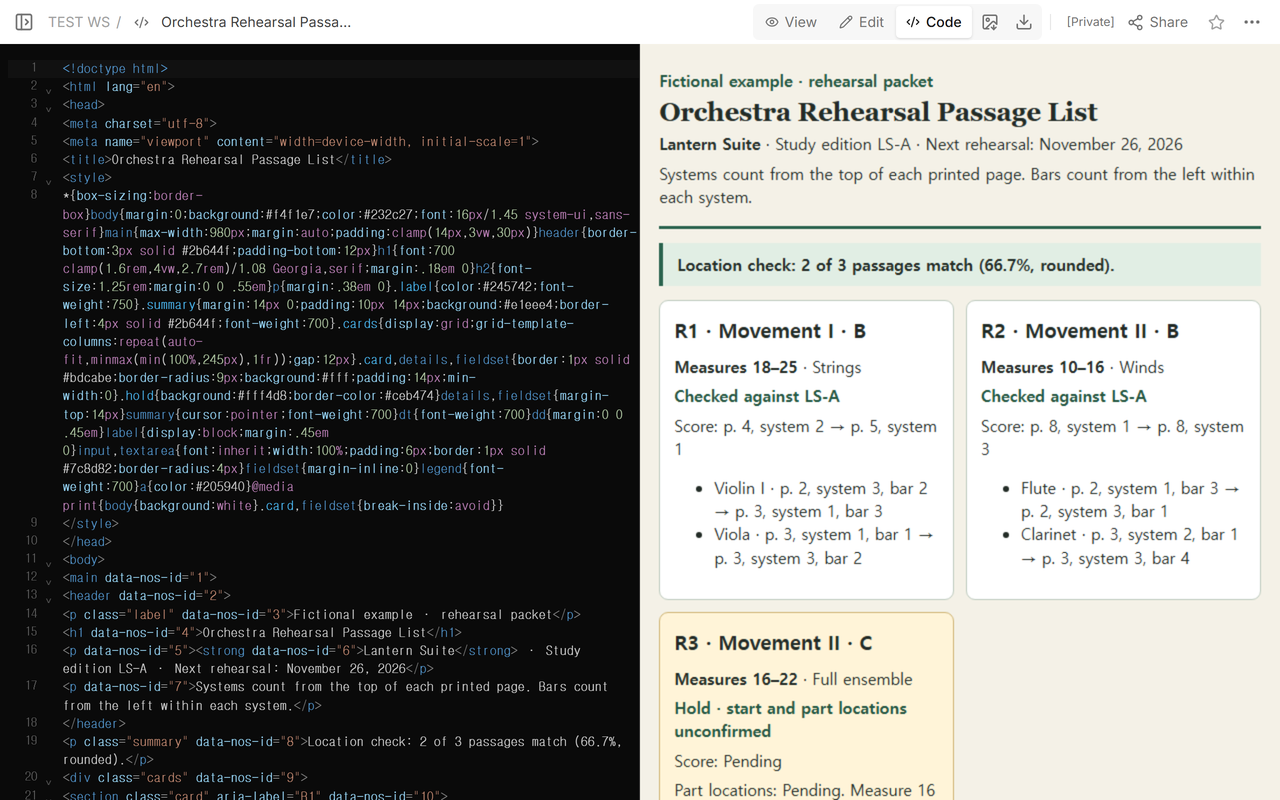
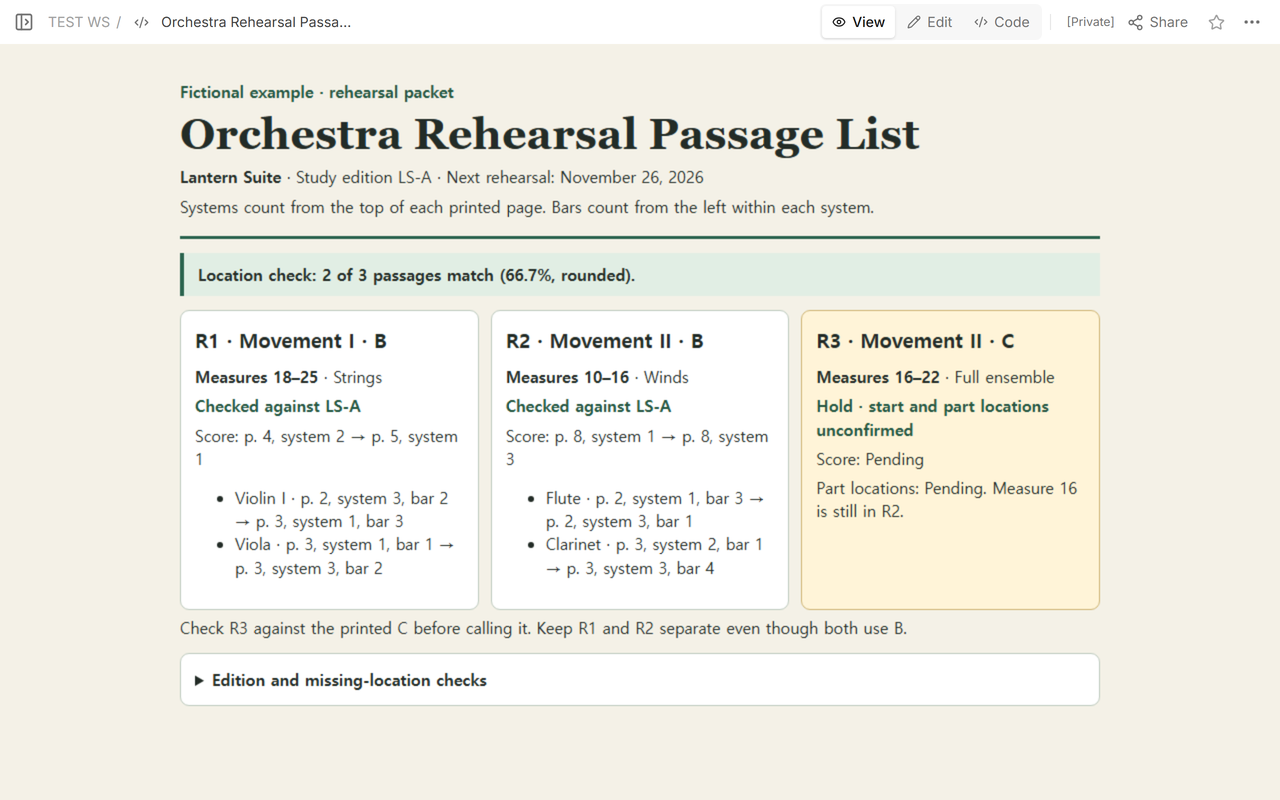
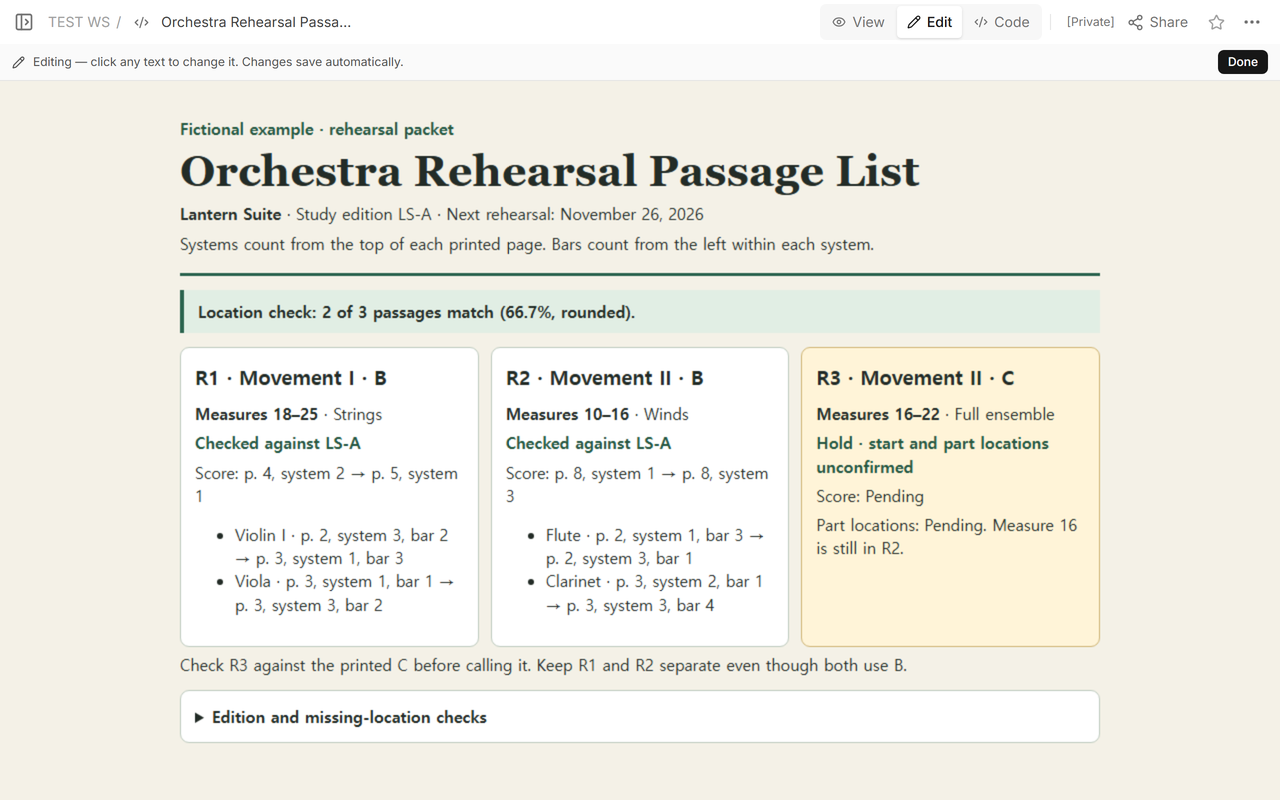
- R1, strings: LS-A, movement I, B, measures 18–25. Violin I starts on page 2, system 3, bar 2. Viola starts on page 3, system 1, bar 1.
- R2, winds: LS-A, movement II, B, measures 10–16. Flute starts on page 2, system 1, bar 3. Clarinet starts on page 3, system 2, bar 1.
- R3, full ensemble: LS-A, movement II, C. Check the proposed start at 16 against the mark in the score before sharing the call as ready.
A system is one line of music across the page. In the example, count systems from the top and bars from the left within the system. Use the part’s printed page number. Give both endpoints even when both players start on the same printed measure.
How do you check the start and stop in each part?
- In LS-A, find movement II. The last bar of page 8, system 3 is 16. It ends R2. Page 9, system 1 starts at C, measure 17.
- Find the last bar to play in the same score. In R3 it is 22, on page 9, system 2. Play through 22 and stop before 23. Counting both ends gives 22 − 17 + 1 = 6 measures.
- Find those same two bars in each called part. In the flute part, they are page 3, system 1, bar 1 and page 3, system 2, bar 2. The completed list gives both endpoints for Violin I, Viola, Flute and Clarinet.
- Ask each player to point to the two bars before marking their part checked. If the start falls inside a rest spanning several bars, write the rest location and the entry cue the player can find. Leave a missing locator blank and mark the part pending.
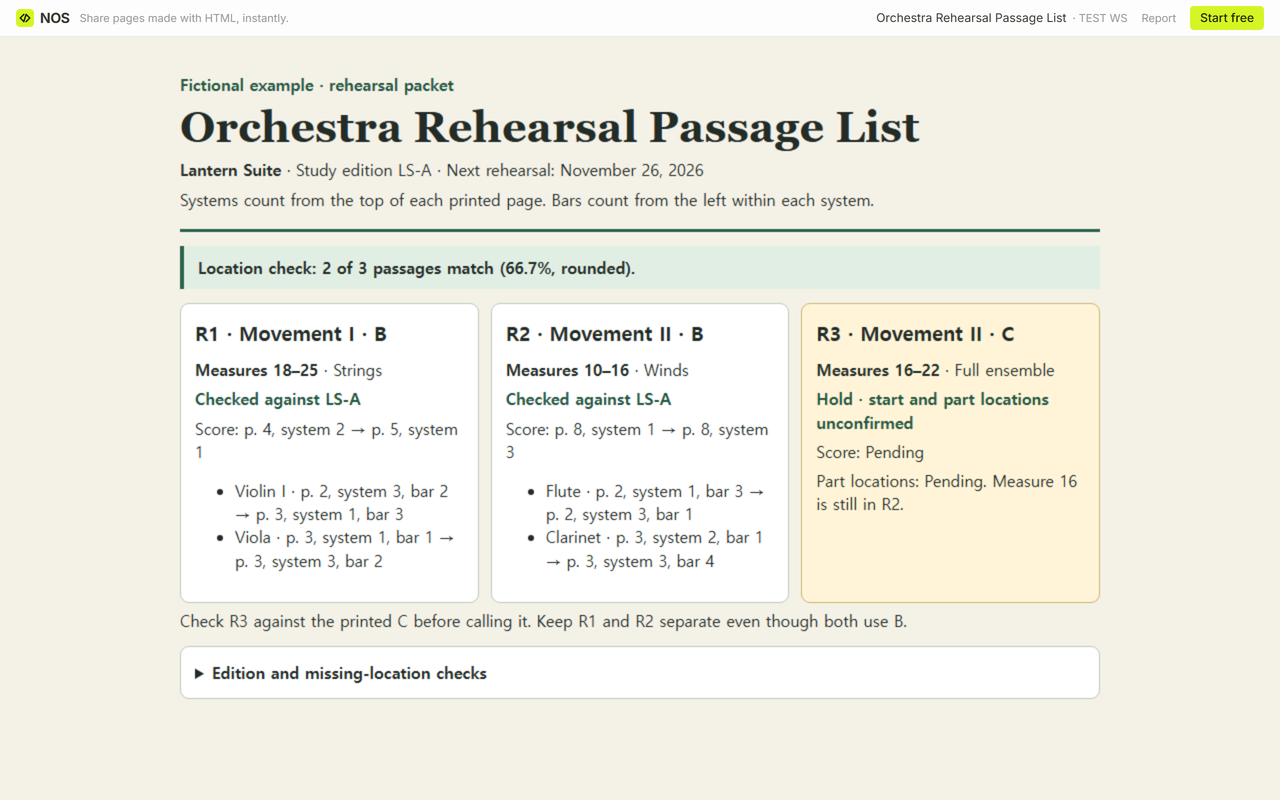
What changes after the location check?
Two of three proposed passages matched the fictional references before the check (66.7%, rounded). In R3 we corrected 16 to 17, kept the last bar at 22 and filled in the part locations. All three passages then matched (100%). The example measures agreement with the reference packet.
To try the check yourself, find 16 and 17 on the score strip, then use the Clarinet part reference to locate the first and last bars of R3. Compare your result with the completed passage list. The expected locations are page 4, system 1, bar 2 and page 4, system 2, bar 1.
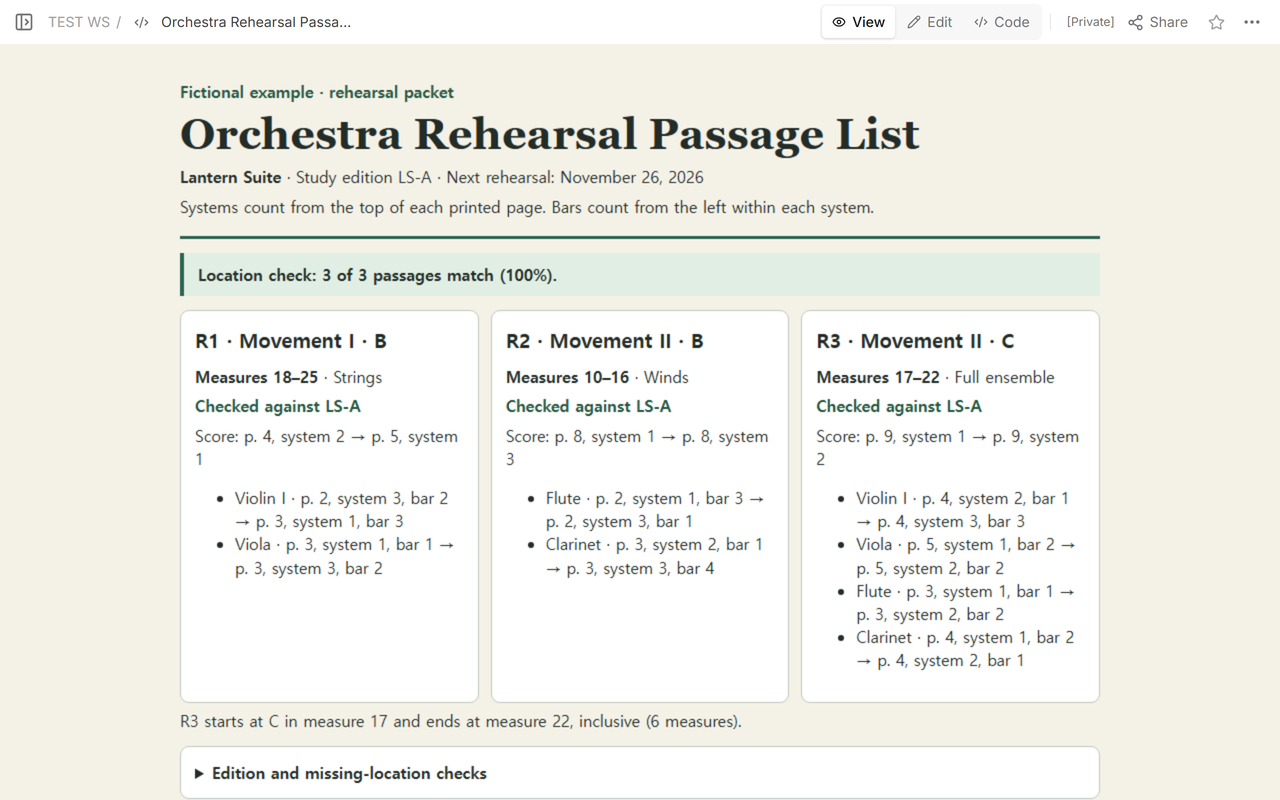
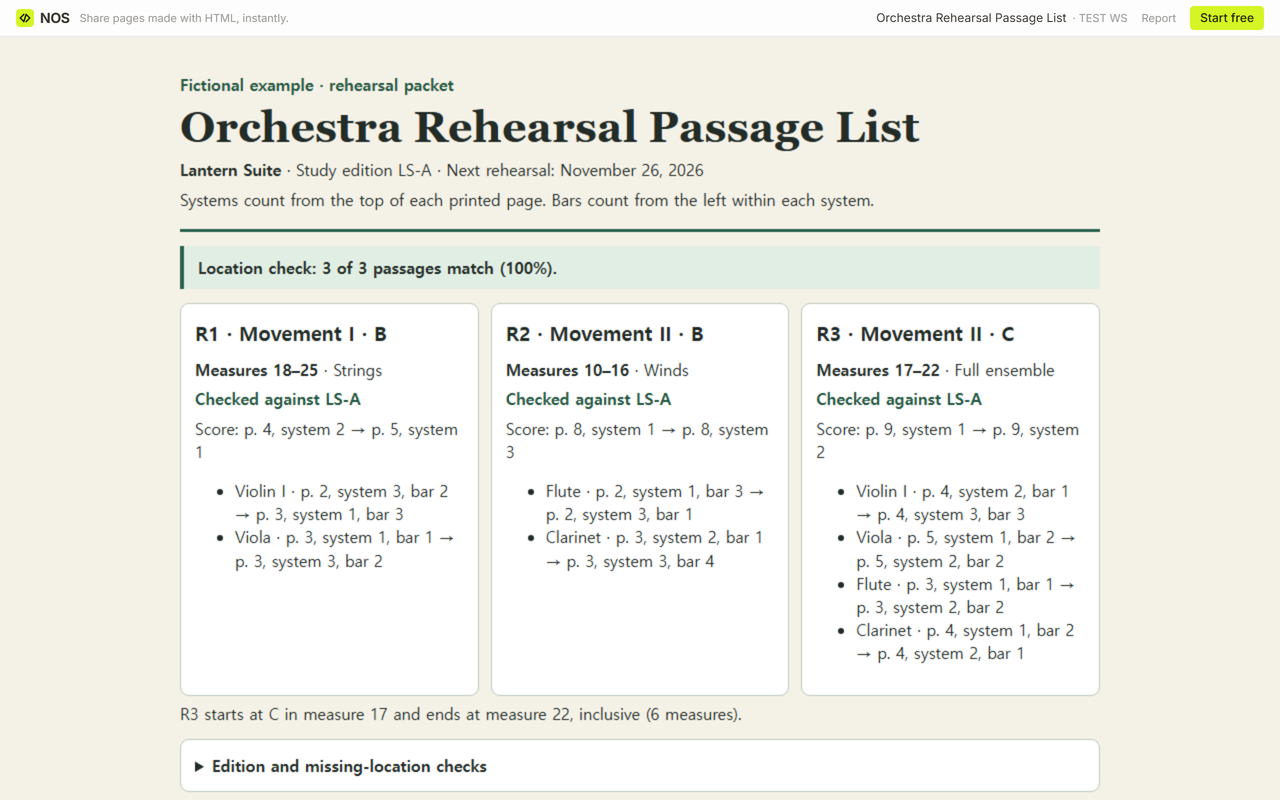
Open the checked fictional passage list. Use the blank download for your own packet. Fill the fields in a browser and print or save a PDF before closing. The blank page does not store entries.
When not to do this
Hold a row when a player’s edition differs. In the alternate LS-B excerpt, movement II prints C at measure 19. Its stop location and part locations are missing, so the LS-A call cannot clear LS-B. Find both endpoints in the edition people will use and record their locators before calling the passage. For a record of work already done at a theater rehearsal, use the stage manager rehearsal report. For a teaching activity, see the music lesson plan.
Where NOS fits
We opened the list in Code, View and Edit, then checked the reader link in Share. After saving the corrected HTML on the same page, we reopened that reader link while signed out and found the checked R3 row. The conductor and players still need to match the locations to their own copies.