In short
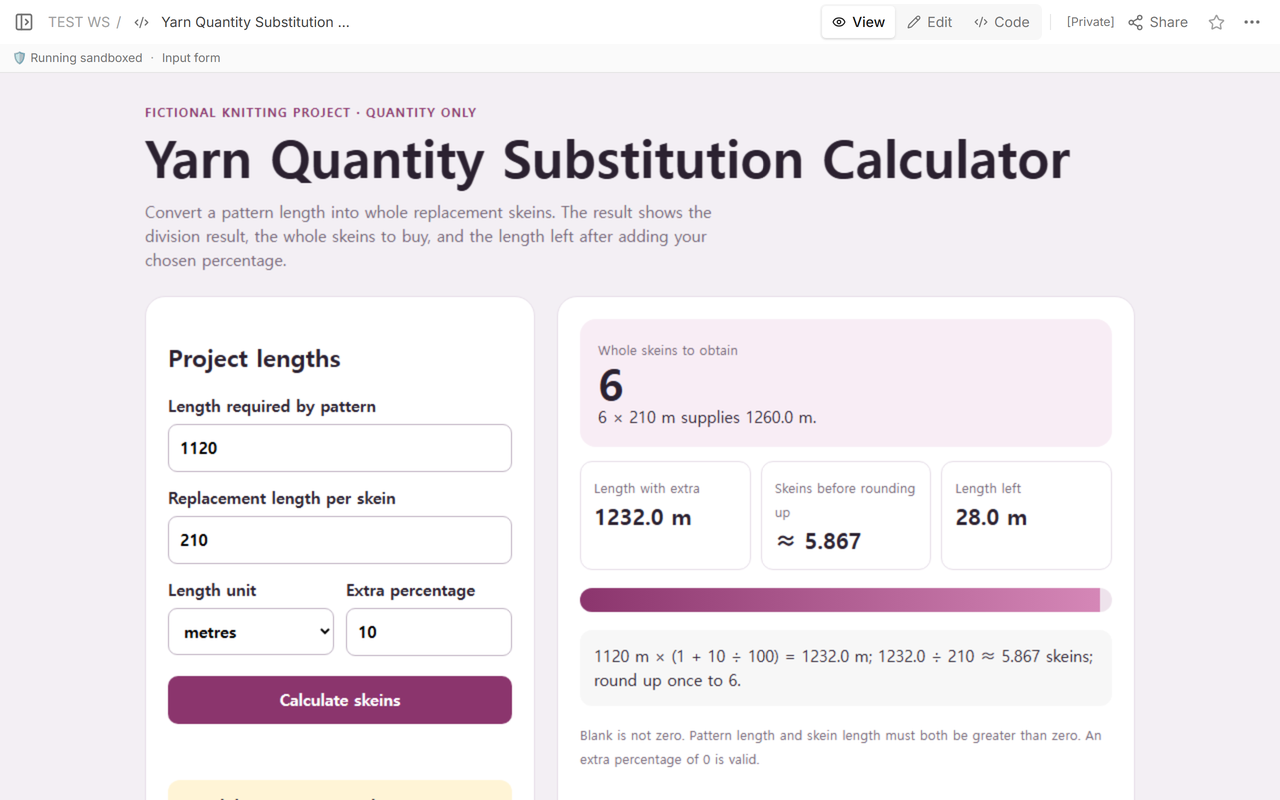
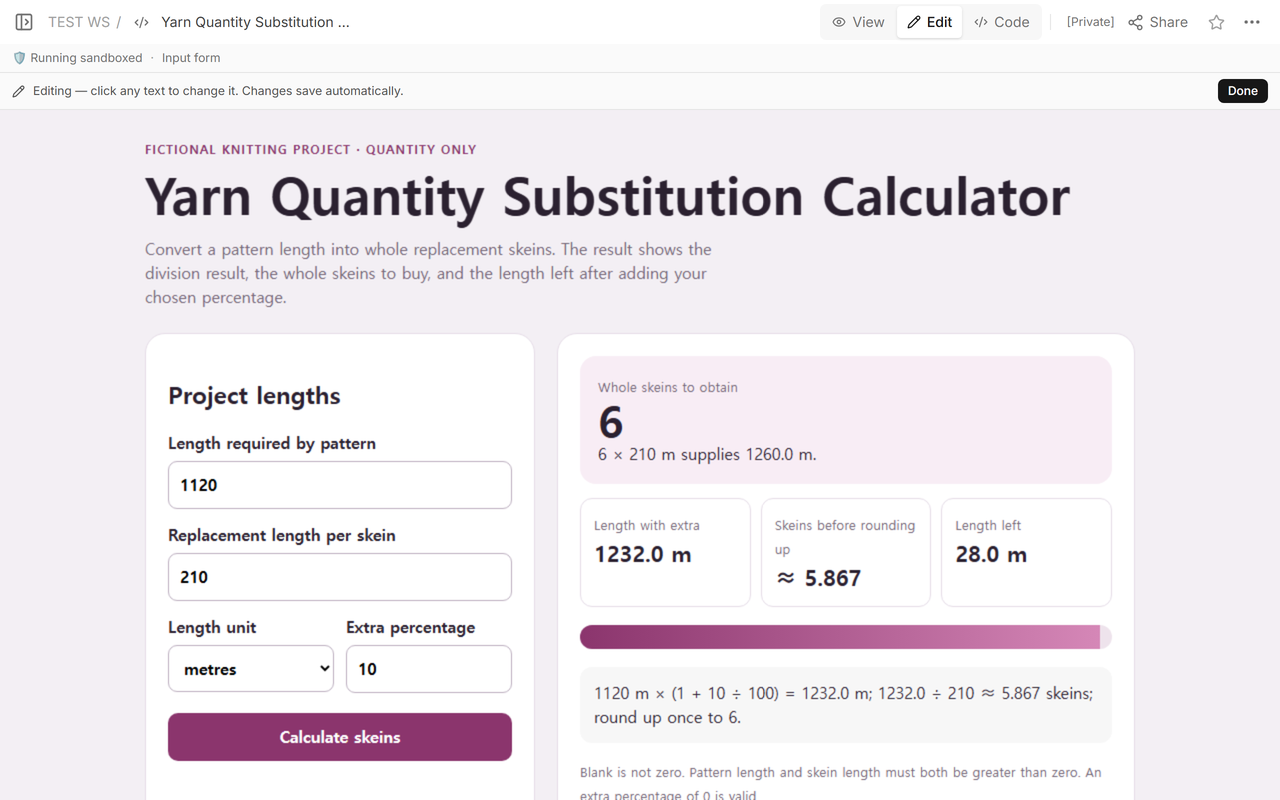
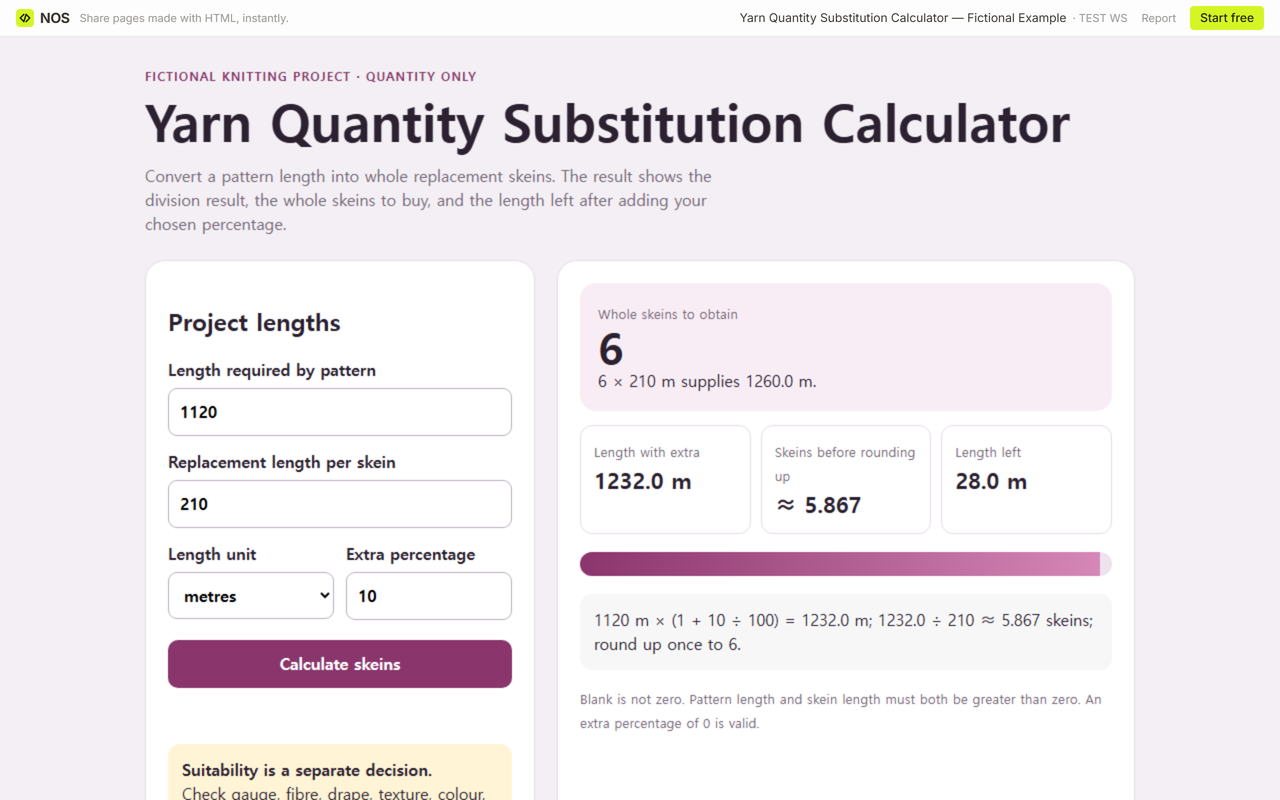
A fictional pattern needs 1,120 metres. A replacement skein holds 210 metres. With an explicit 10% extra, the project needs 1,232 metres, or about 5.867 skeins, so the buy count is 6 and the calculated leftover is 28 metres.
This is a quantity result, not a verdict that the replacement yarn will make the same fabric.
We made a complete length-based example for a fictional knitting project. The page starts with the pattern’s required length, not the number or weight of the original skeins. It then adds only the extra percentage the reader enters, divides once, rounds up once, and shows the remaining length. Download the yarn substitution quantity calculator to replace the three inputs with your own.
How many replacement skeins does the example need?
The pattern length is 1,120 metres. The reader chooses 10% extra, so the adjusted requirement is 1,120 × (1 + 10 ÷ 100) = 1,232 metres. Each replacement skein contains 210 metres.
Dividing gives 1,232 ÷ 210 ≈ 5.867 skeins. If you buy whole skeins, round that up to 6. Those six skeins supply 1,260 metres. The calculated remainder is 1,260 − 1,232 = 28 metres.
The calculator displays the division result to three decimal places. In the formula, ≈ means the displayed number is approximate, and = means it is exact. If rounding would hide which side of a whole number the result falls on, the display uses < or >. For example, exactly 1.000 or just under 1.000 calls for one skein. Just over 1.000 calls for two.
Why calculate by length instead of skein count?
Balls with the same weight can contain different lengths. Lion Brand’s yardage guide compares several 3.5-ounce balls that range from 120 to 306 yards and explains why ball weight can mislead during substitution. For quantity, use the total required length rather than copying the original ball count.
Lion Brand’s substitution example starts with four 120-yard balls. Divide the 480 yards by 110 yards per replacement ball to get about 4.36 balls. Round up to five. Yarn & Row’s skein converter gives the same sequence: multiply the pattern’s skeins by their length, divide by the replacement skein length, and round up.
If a pattern provides only “five skeins,” first find the length printed for that yarn and determine the total length the pattern used. Do not assume that five replacement skeins contain the same amount. If the pattern already states total metres or yards, use that total directly.
What happens when the extra percentage is zero?
Zero is a valid explicit choice. With no added percentage, the 1,120-metre requirement divided by 210 is about 5.333 skeins. The buy count still rounds to 6, but the calculated remainder becomes 140 metres because the adjusted requirement is lower.
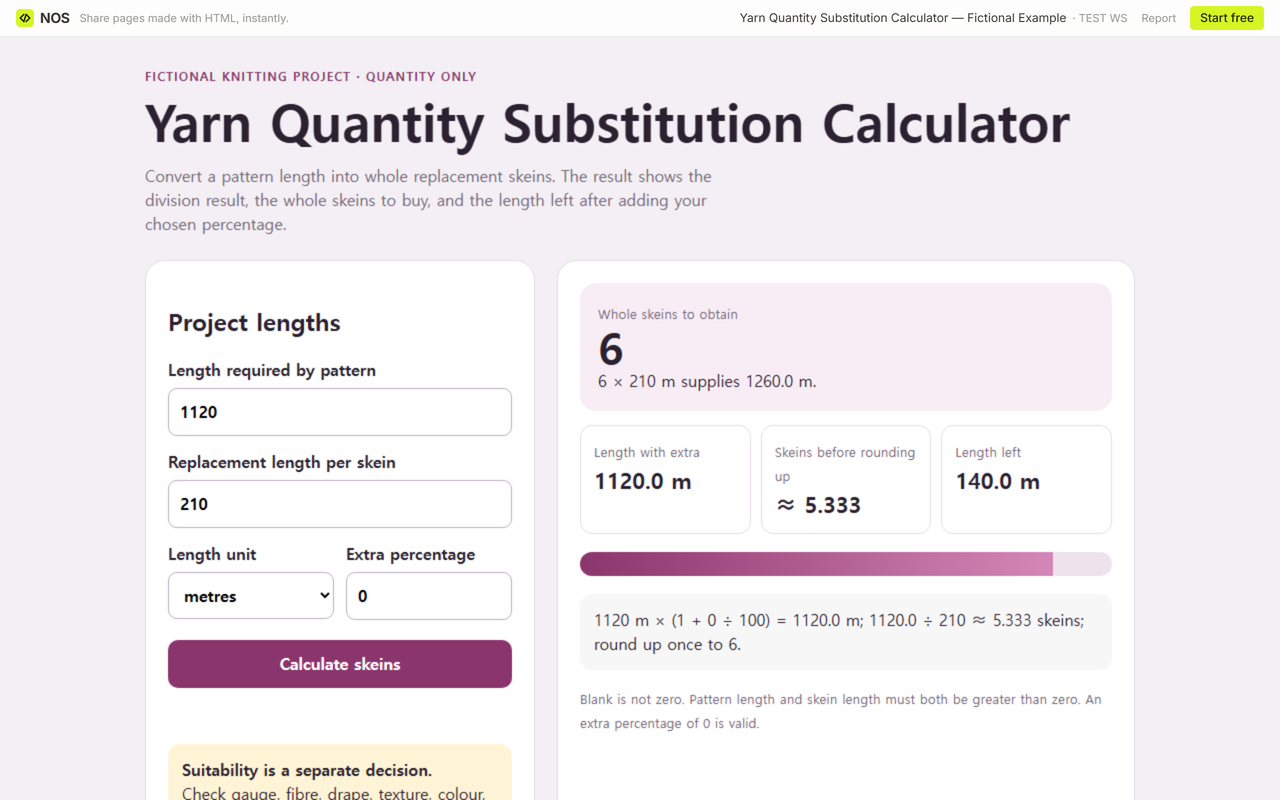
This comparison is useful because it exposes the allowance instead of embedding it in the answer. Choose an extra percentage deliberately from the project context. The calculator does not invent one, recommend one, or claim that it covers every swatch, tension, repair, or dye-lot need.
How do you use metres or yards without mixing them?
Select one unit and enter both lengths in that unit. If the pattern requirement is in yards and the replacement label is in metres, convert one before using the calculator. Changing the unit label alone does not convert the numbers.
The output keeps the selected unit beside the adjusted requirement and leftover length. That makes a mixed-unit entry easier to spot during review. The division result has no length unit because it is one length divided by another in the same unit.
How do you replace the fictional project with your own?
- Find the pattern’s total required length for the size you are making.
- Read the replacement label’s length per skein. Use the same length unit as the pattern total.
- Enter an extra percentage yourself. Enter 0 if you want to see the package rounding without an added allowance.
- Use Whole skeins to obtain as your purchase quantity. The division result shows where that number comes from.
- Compare the supplied and adjusted lengths to see the calculated remainder.
- Before obtaining yarn for the full project, make and assess the swatch required by the pattern.
Enter lengths and the extra percentage in steps of 0.1. Both lengths must be positive, and the extra percentage can be zero. Each field accepts values up to 1,000,000,000,000,000. If the inputs fall outside these limits or the answer would exceed 9,007,199,254,740,991 skeins, the calculator shows an error and clears the result.
What does this calculation not tell you?
Matching length answers how much packaged yarn is needed for the entered allowance. It does not establish gauge, fibre behaviour, drape, texture, colour, dye lot, needle or hook choice, or finished fit. Lion Brand treats weight, quantity, and drape as separate considerations, recommends similar fibre content, and asks the reader to assess a project-stitch swatch because a substitute can make firmer or looser fabric. Yarn & Row separately directs the reader to compare yarn category and thickness, then swatch and block.
The fictional example therefore avoids a “match” score. A 210-metre skein can produce the right arithmetic quantity and still produce a different fabric. Keep the pattern, yarn labels, and swatch as the sources for that suitability decision.
When not to do this
- Do not use the result as proof that two yarns have the same gauge, fibre behaviour, drape, texture, or finished fit.
- Do not substitute grams for metres or yards unless you have independently converted from a verified length-per-weight value.
- Do not mix metres and yards in the two length fields.
- Do not treat the entered extra percentage as a universal recommendation.
- Do not skip the pattern’s swatch and blocking instructions because the package count looks sufficient.
Using NOS for the quantity page
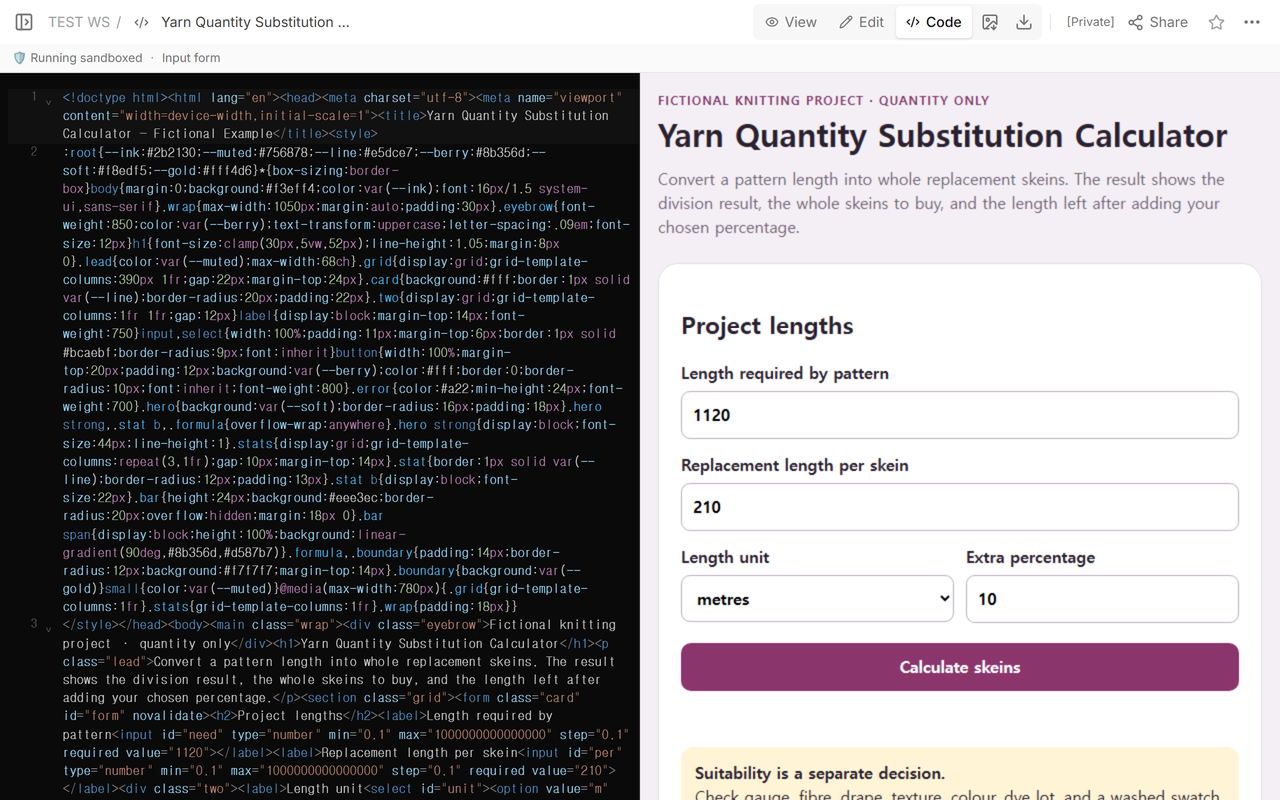
NOS displayed the full file in Code, rendered the working fields in View and Edit, and supplied the reader address used for both verified extra-percentage states. A reader can change the inputs without changing the maintained source. Plan information can be checked on the current NOS pricing page.
Related calculator guides
Use Calculator to Link when you need to share another one-file calculation. Read Area Converter Calculator for an example of keeping units and unrounded arithmetic visible. See Grams to mL Calculator for why a conversion needs a stated basis rather than a label change.