In short
Lead with one artwork, not a wall of biography.
Use the statement to connect materials, working choices, and the question driving the current work.
End with practical details and a contact route, then open the shared page on a phone before sending it.
NOS Team built a fictional artist statement page for Mara Vale and the invented work Tide Ledger No. 4. The task was narrower than making a portfolio: one artwork had to sit beside a focused explanation of what the artist uses, what the artist does, and what the current series is trying to understand.
The finished page included the artwork, three short statement paragraphs, a compact work-details section, and a fictional contact address. We marked the page as a fictional example on its first screen.
What should an artist statement page include?
Start with the piece that gives the statement something concrete to explain. In our example, the opening screen names the fictional artist, identifies the materials, shows one work, and gives the work a title and date. The statement follows the image instead of asking the reader to interpret an abstract introduction first.
We first pasted a version with an inline SVG illustration. The code was present, but the preview showed an empty rectangle. That was the useful failure in this build: a page is not finished because its source looks complete.
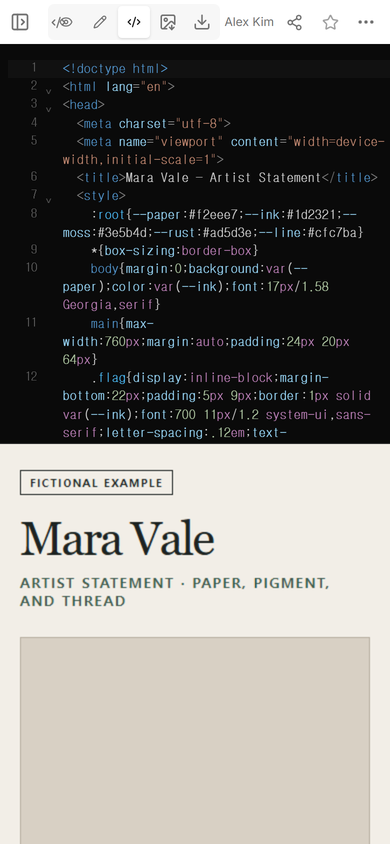
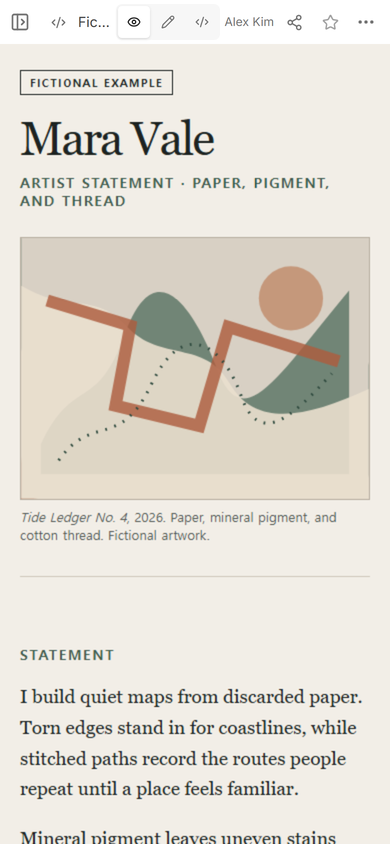
We replaced that illustration with a composition drawn by the page's own CSS. The revised View showed the rust line, green shapes, dotted path, and circular form without loading an outside image. We then kept the text tied to visible details: paper edges, mineral pigment, stitched routes, and changing landmarks.
How do I write an artist statement for a website?
Write in three passes. Each pass should answer a different question rather than restating that the work is meaningful.
1. What is physically here?
Name the materials and the action. The fictional statement begins with discarded paper, torn edges, and stitched paths. A viewer can return to the image and find the connection.
2. What choice does the artist make?
Explain one decision that changes the result. The next paragraph says the uneven mineral stains remain visible instead of being corrected. That sentence tells the reader what the maker accepts and what the maker refuses to smooth away.
3. What question is still open?
End with the present work, not a claim that settles everything. Our example asks how a remembered landscape changes when landmarks disappear, then names the sources being explored: tidal maps, ferry routes, and fictional field notes.
This structure keeps the statement separate from a portfolio caption. A caption identifies one piece. The statement connects repeated choices across the current work. If the reader needs a broader selection of projects, continue with the digital art portfolio guide or the more role-focused concept artist portfolio guide.
How do I share an artist statement page?
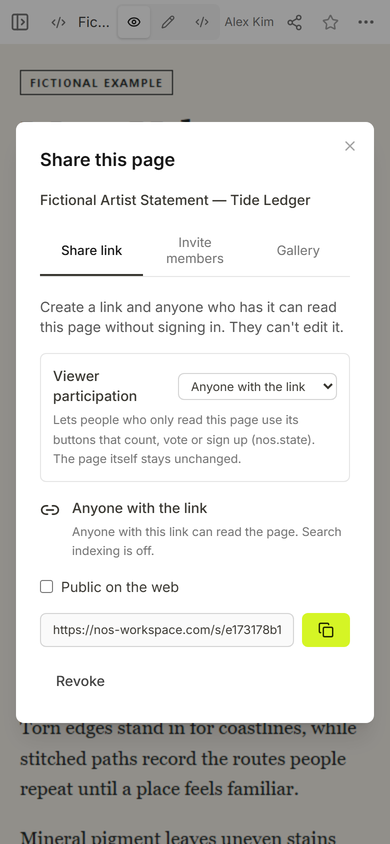
After the page worked in View, we opened Share and used its existing viewer link. The captured panel stated that anyone with the link could read the page without signing in and could not edit it. Search indexing was off in this panel.
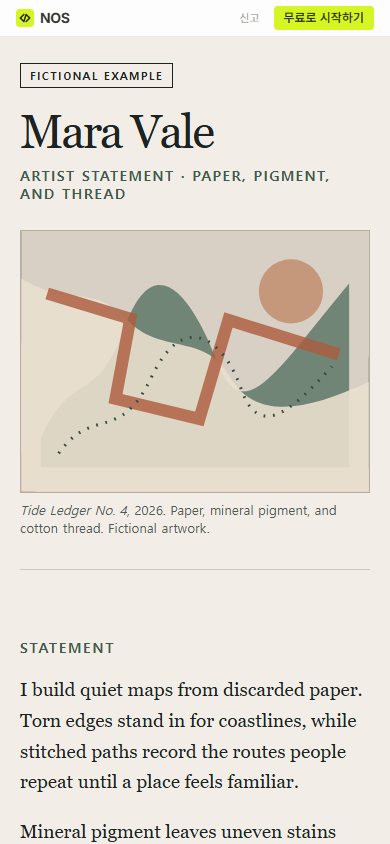
We opened that address at 390 pixels wide. The public page showed the fictional label, artist name, materials, artwork, caption, and the beginning of the statement in one reading flow.
If the goal is a larger collection rather than one focused explanation, use an HTML portfolio page. The statement page earns its place when the words help a viewer read recurring material and conceptual choices that the images alone do not name.
Can I revise the statement without making a new page?
Yes for the page tested here. We reopened the same NOS page after sharing it. Edit mode showed the existing visual page and a Done control. For the exact source repair, we used Code on that same page: the blank artwork was replaced and “shoreline maps” became “tidal maps.”
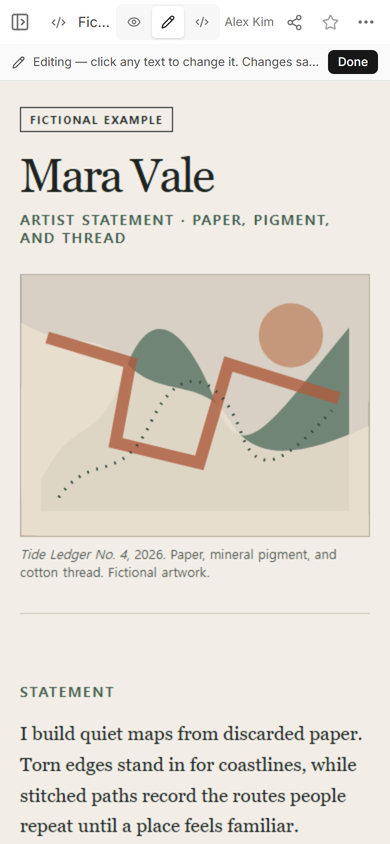
We then loaded the original viewer link again and moved to the revised paragraph. It showed “tidal maps,” followed by the same work details and contact block. No additional page or share address was created.
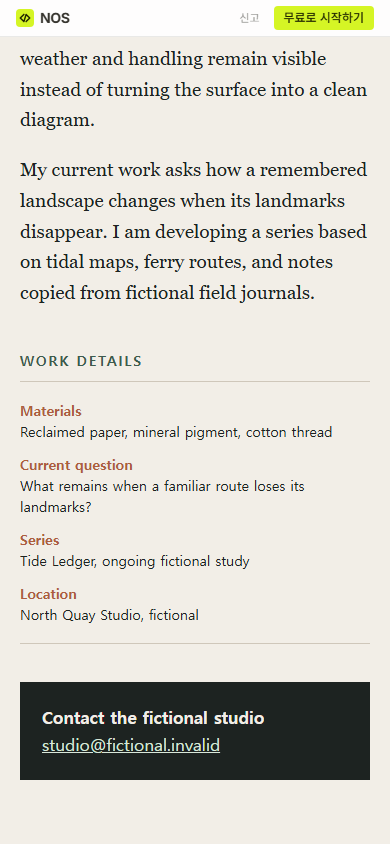
Finished result: one fictional page paired a visible work with a material-based statement, a current question, work details, and a contact route. The same viewer link showed the corrected wording.
How long should an artist statement page be?
We did not test a universal word count. For this example, three short paragraphs were enough to cover material, process, and the current question without repeating the biography or caption. The practical check is whether each paragraph adds a different piece of understanding while the work remains visible nearby.
Keep secondary facts scannable. We separated materials, current question, series, and location into a small details block. The contact route came last, after the reader had seen both the work and the explanation.
When not to do this
- Do not publish unreleased work, private client material, a home address, or a personal contact detail that should not be public.
- Do not force a statement onto a page when a caption already gives all the context the work needs.
- Do not use one statement page as a substitute for a portfolio when the reader needs to compare several projects.
- Do not treat the page as finished until the artwork, statement, and contact route are visible in the shared phone view.
Using NOS for the page
In this build, NOS accepted the complete HTML, provided Code, View, Edit, and Share screens, and created a viewer address for the fictional page. We used those screens to find the missing illustration, replace it, revise one phrase, and confirm the result at the same shared address. Current plan information is on the NOS pricing page.