A portfolio at your own address is the only version of your work that nobody else can restructure, deprioritise or remove.
Platforms still matter. They are where people find you. They are just a bad place to keep the thing they find.
This guide covers the split between discovery and home, speed, and commission information.
Discovery there, home here
Art platforms bring an audience. That is genuinely valuable and it is worth being present on them.
What they are bad at is being the permanent home of a body of work. Feeds change. Ranking changes. Layouts change. Accounts get suspended in error. Platforms close, and when they do, the work and everything attached to it goes with them.
So: post on the platforms, and point every one of them at one address you control. Over a few years that address accumulates the links, the bookmarks and the search position, and none of it depends on a company you have no relationship with.
The address is read out loud
Keep it short, keep it sayable, and use your name if you can.
It goes on a business card, in a bio, into a conversation at an event, and onto the corner of an image. All of those work better with something a person can remember after hearing it once.
A long path on somebody else's domain fails all of those tests, which is a practical reason to own it rather than a philosophical one.
| Platform profile | Own address | |
|---|---|---|
| Brings discovery | Yes | Not by itself |
| Layout under your control | No | Yes |
| Survives the platform closing | No | Yes |
| Accumulates search position | For them | For you |
| Short and sayable | Rarely | Yes |
Speed is the whole technical problem
Art portfolios are slow, always for the same reason: images served at working resolution.
Serve a screen-sized version on the page and the full-resolution version on tap. Load images below the fold only as the visitor reaches them.
Done properly, a portfolio of twenty pieces becomes usable in under a second. Done badly, the first image appears after four seconds and most visitors have already gone.
Keep the enlarged version genuinely large. People zoom into craft, and a portfolio that never shows detail reads as evasive.
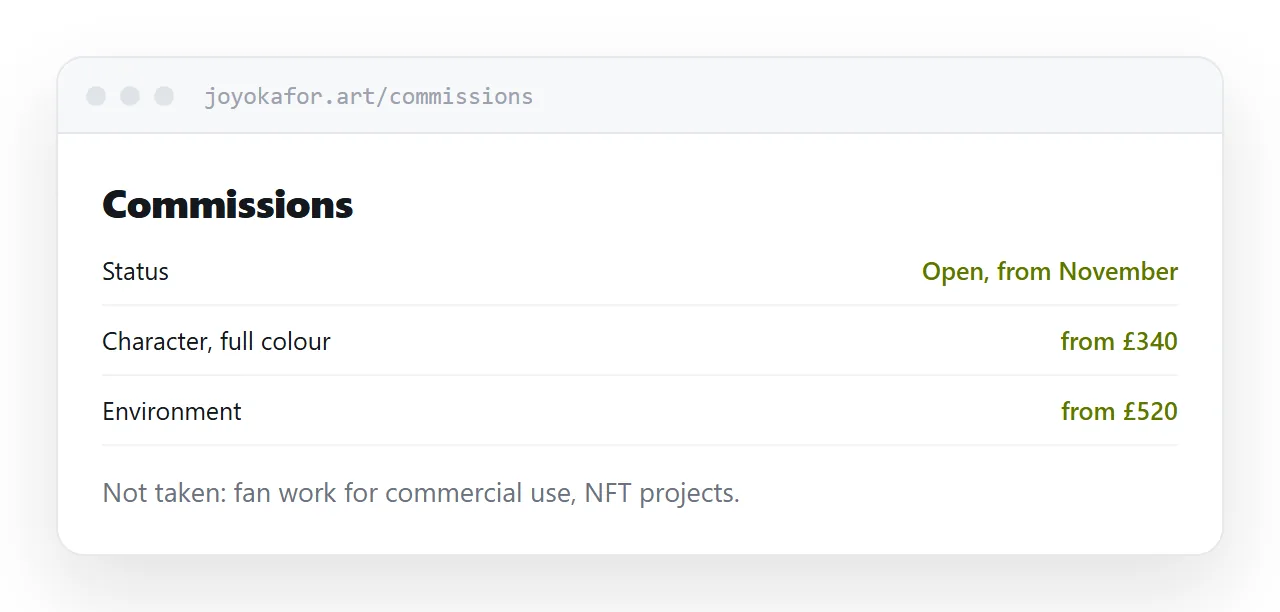
Commission information filters enquiries
If you take commissions, say so on the page, with three things.
Availability. Open, closed, or a waiting list, with a date so it is obviously current.
Rough pricing. A range is enough. This removes the enquiries that were never going to convert, which is most of them.
What you do not take. Subjects, styles, usage. Saying it once saves the same awkward conversation repeatedly.
Artists often leave this off out of a worry that it looks commercial. It reads as professional, and it turns a stream of vague enquiries into a smaller number of real ones.
Replace rather than accumulate
A portfolio is not an archive.
Every new piece that goes in should push a weaker one out, so the front of the portfolio is always the current standard. Otherwise the newest work sits at position twenty and nobody reaches it.
Keep an archive somewhere if you want the history. Keep it separate from the thing people judge you on.
Closely related: An HTML portfolio template that opens in seconds, and How to build a concept artist portfolio for the adjacent problem.
Put it at an address
Own the address and use platforms for discovery, keep it short enough to say aloud, serve small images with large ones on tap, state commission terms plainly, and replace rather than accumulate.
Then the portfolio is still yours when a platform changes its mind.