With no professional work to show, a portfolio has to demonstrate something else. That something is how you think, and it is visible only if you make it visible.
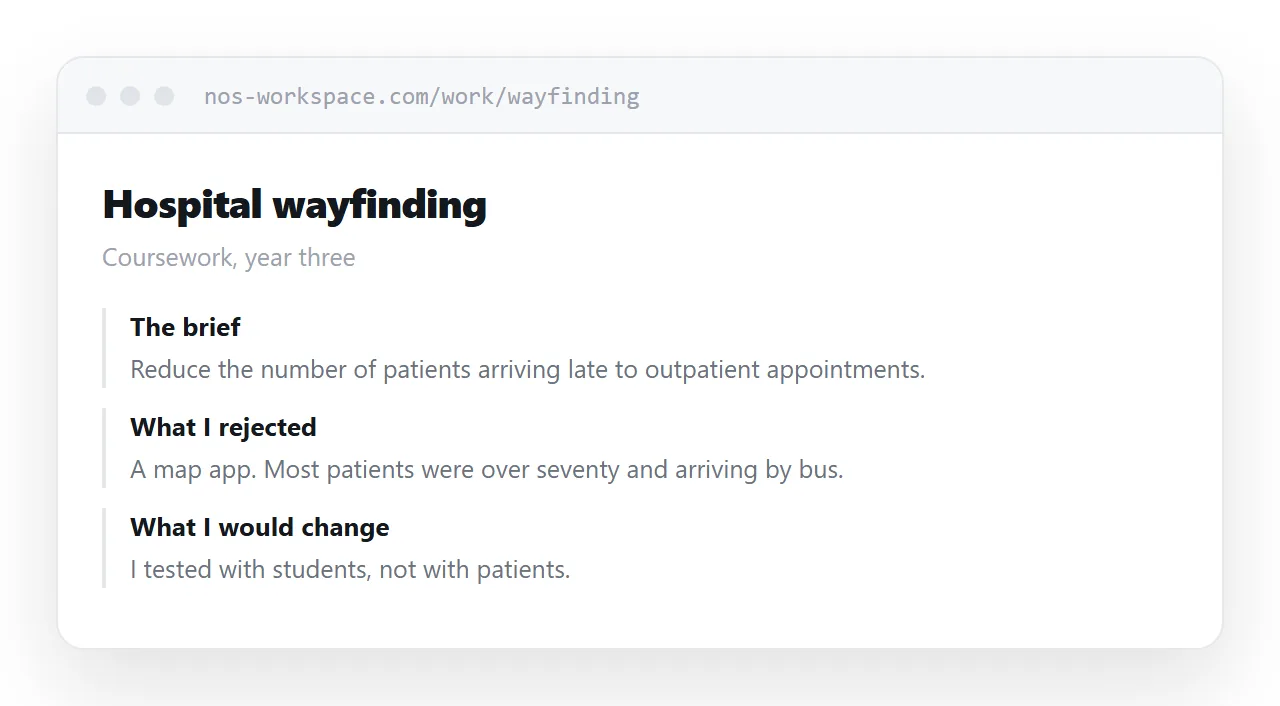
This guide covers what to include, what reviewers are actually assessing, and the address problem.
Reasoning is the thing being assessed
An employer looking at a graduate portfolio is not comparing outcomes against professionals. They know the difference.
They are trying to work out whether you can be given a problem and trusted with it. That is a judgement about process, and process is invisible in a finished piece.
So show it. For each project:
The brief. What you were asked for, or what you set yourself.
The constraint. What made it difficult. A word count, an audience, a technology, a deadline, an accessibility requirement.
What you tried. Two or three directions you explored, including the ones you rejected.
Why you chose this one. The reasoning, in a couple of sentences.
What you would do differently. This one is optional and it is the most persuasive thing in most student portfolios, because it demonstrates that you can evaluate your own work.
Coursework is fine
There is a widespread anxiety that coursework does not count. It counts.
Reviewers know where a graduate's work comes from. Presenting coursework as coursework, with the brief stated, is honest and completely normal.
What does not work is presenting it as client work, or leaving the origin vague in a way that implies something it was not. That is noticed and it undermines everything else on the page.
| Finished piece only | Piece with reasoning | |
|---|---|---|
| Shows craft | Yes | Yes |
| Shows judgement | No | Yes |
| Compares to professionals | Badly | On different terms |
| Reviewer learns how you work | No | Yes |
Do not invent clients
A fictional brand with a fabricated brief is recognisable, usually within a sentence.
The alternative is better anyway. Pick a real problem, give yourself a real constraint, and say it was self-directed. A student who set themselves a hard problem and solved it demonstrates initiative, which a fake client brief does not.
If you have done volunteer or society work, that is real client work. Use it.
Four to six, in depth
The instinct is to show everything, because there is not much.
Resist it. A reviewer reading one project fully learns more about you than from skimming ten. And the weakest project sets the floor, as it does in every portfolio.
Four to six projects, each with the reasoning, is a stronger portfolio than twelve pieces of coursework.
The address problem
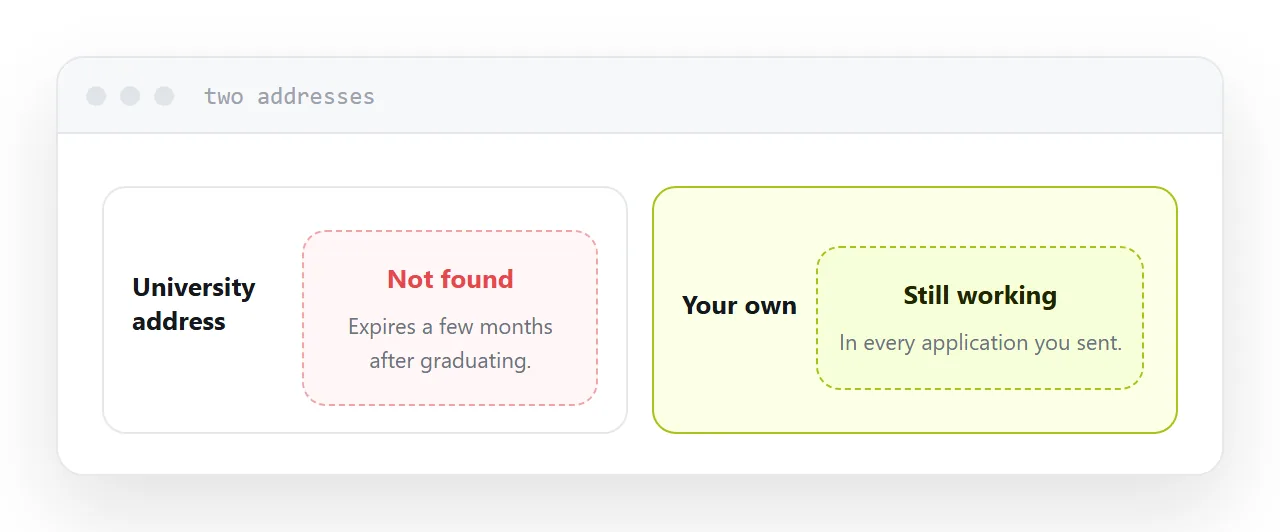
A university address stops working when you graduate. Usually a few months after, without warning.
By then it is in every application you sent, every email signature, every profile and every piece of coursework you shared. All of those become dead links at the exact moment you are looking for work.
Use an address you keep. Set it up before you start applying, not after.
If this is near what you are doing, An HTML portfolio template that opens in seconds and How to link a portfolio in a resume cover the cases on either side.
Put it at an address
State the brief for every project, show what you tried and rejected, keep it to four to six in depth, avoid invented clients, and use an address that survives graduation.
Then the portfolio shows how you think, which is what is being bought.