A thesis link is a web copy of a thesis kept alongside the deposited PDF, so a reader can open one chapter directly instead of downloading the whole document.
The deposited file is the record. The link is what makes the work readable by people who are not obliged to read it.
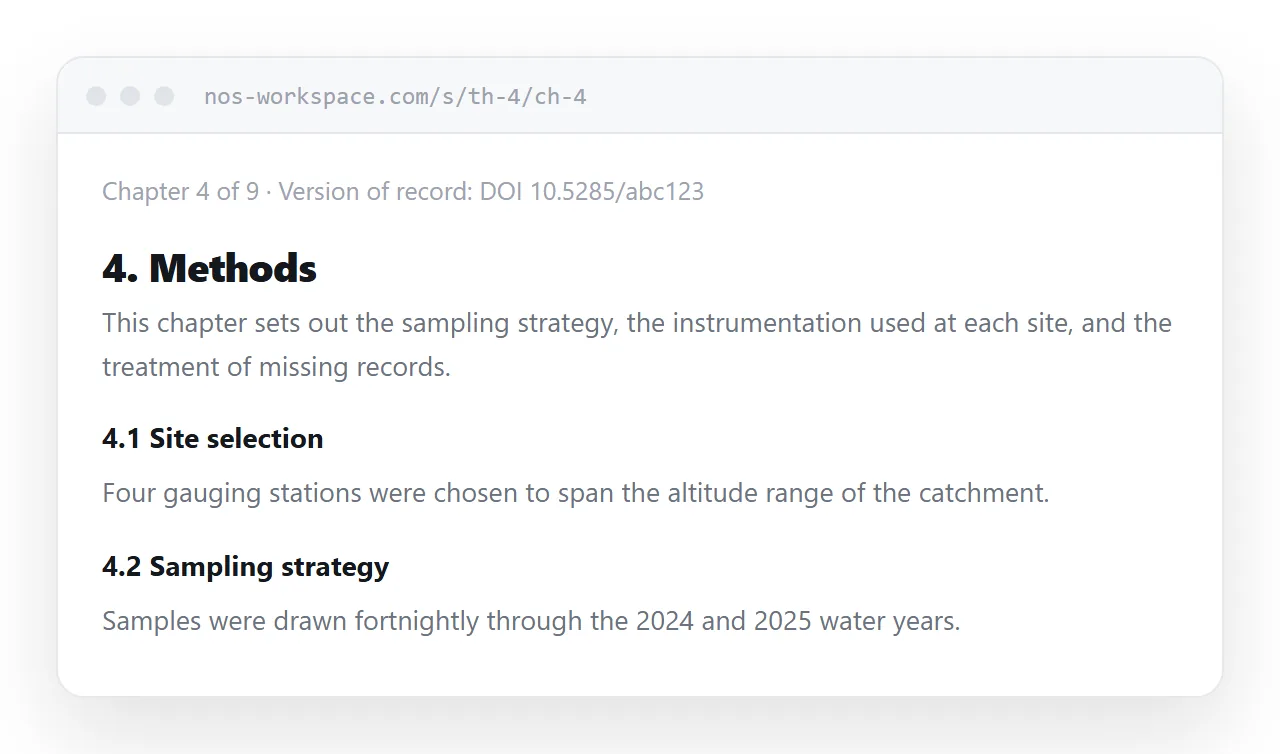
This guide covers linking to individual chapters, keeping figures legible, the relationship between the web copy and the citable one, and what to check before posting anything.
Almost nobody reads a thesis in order
Understanding who opens a thesis explains why the PDF is the wrong container for most of them.
| Reader | What they want | What the PDF gives them |
|---|---|---|
| A supervisor | The chapter they just commented on | The whole file |
| A collaborator | Your methods section | A download, then a search |
| A hiring panel | Evidence you can write | 200 pages, no entry point |
| Someone from a conference | One figure you showed | The file, and a hunt |
| A future student | The literature review | The file again |
Each of those is one link if the chapters have addresses.
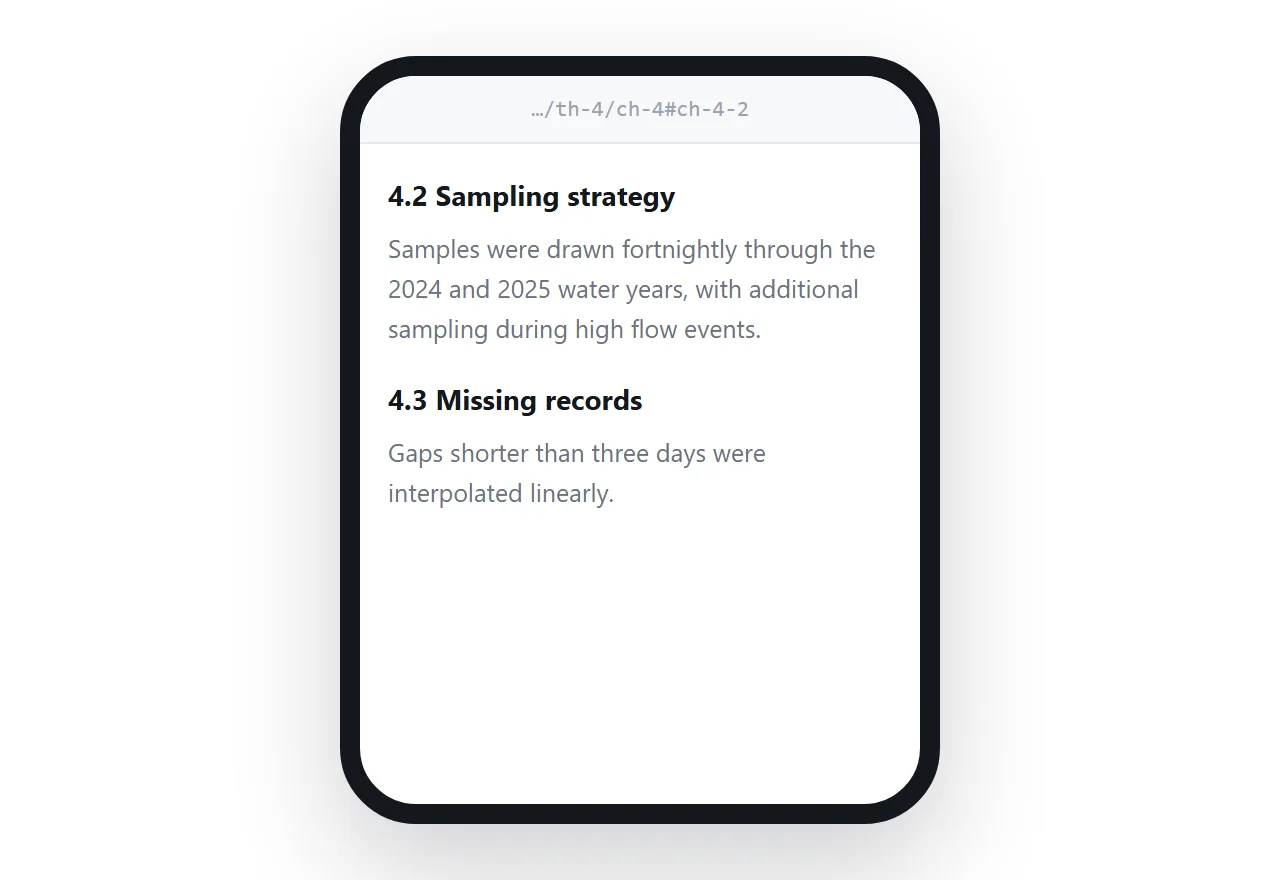
<section id="ch-4">
  <h2>4. Methods</h2>
  <section id="ch-4-2">
    <h3>4.2 Sampling strategy</h3>
  </section>
</section>
Now "the sampling strategy is in 4.2" becomes something you can send, and the reader lands on it.
A contents list is the whole navigation
A thesis without a contents list on the page is a scroll bar with 200 pages behind it.
Put the list at the top, link every chapter, and make it collapsible so it does not push the text below the fold on a phone. The pattern is in an HTML table of contents, and a details element handles the collapsing without any JavaScript.
Keep section numbering identical to the deposited version. A reader moving between the two should never have to work out which 4.2 is which.
Figures, at two sizes
This is where a web copy is clearly better than a PDF.
In a PDF, a figure is fixed at whatever size the layout allowed. On a page you can show it at a comfortable screen width and link the full-resolution original underneath, so a reader who wants to examine it can.
<figure>
<a href="/thesis/fig/4-3-full.png">
<img src="/thesis/fig/4-3.webp" alt="Sampling sites across the catchment, 2024-2025"
width="1200" height="820" loading="lazy">
</a>
<figcaption>Figure 4.3 — Sampling sites across the catchment.
<a href="/thesis/fig/4-3-full.png">Full resolution</a></figcaption>
</figure>
Write the alt text as a real description rather than "Figure 4.3". It is what a screen reader announces and what appears if the image fails.
Say which version is citable
This is the one thing that must be explicit.
The deposited thesis has fixed pagination and usually a permanent identifier. That is what anyone citing your work should reference. A web copy can be edited, so it cannot serve that purpose.
Put a line near the top naming the official record and linking to it. Something plain: "The version of record is deposited at the university repository, DOI 10.xxxx/xxxxx. This web copy is for reading."
That sentence takes ten seconds to write and prevents a citation problem that is tedious to unpick later.
Check before you post
Two things are worth verifying rather than assuming.
Embargo. If any chapter is under review at a journal, or a funder or industrial partner required a delay, posting can breach an agreement and in some cases blocks publication. Check your institution's policy and any agreements you signed.
Third-party material. Figures reproduced from other papers are usually licensed for the thesis rather than for republication. Either obtain permission, replace them, or leave them out of the web copy and refer to the original.
Keep it up
A thesis link that works in five years is worth far more than one that works this month.
Use a stable address and leave it alone. People find theses years later, often through a single figure or a methods section, and the ones that stay reachable are the ones that get used.
Put it at an address
Write the chapters as pages, paste them into a document, create a share link, and name the deposited version at the top.
Then when somebody asks about chapter four, send them chapter four rather than the whole thesis.