In short
Add every flour row before calculating. Their combined weight is the 100% basis.
Divide each ingredient by total flour to get its baker's percentage. Divide marked liquid by total flour to get hydration.
For a new batch size, multiply every ingredient by target dough weight divided by original dough weight.
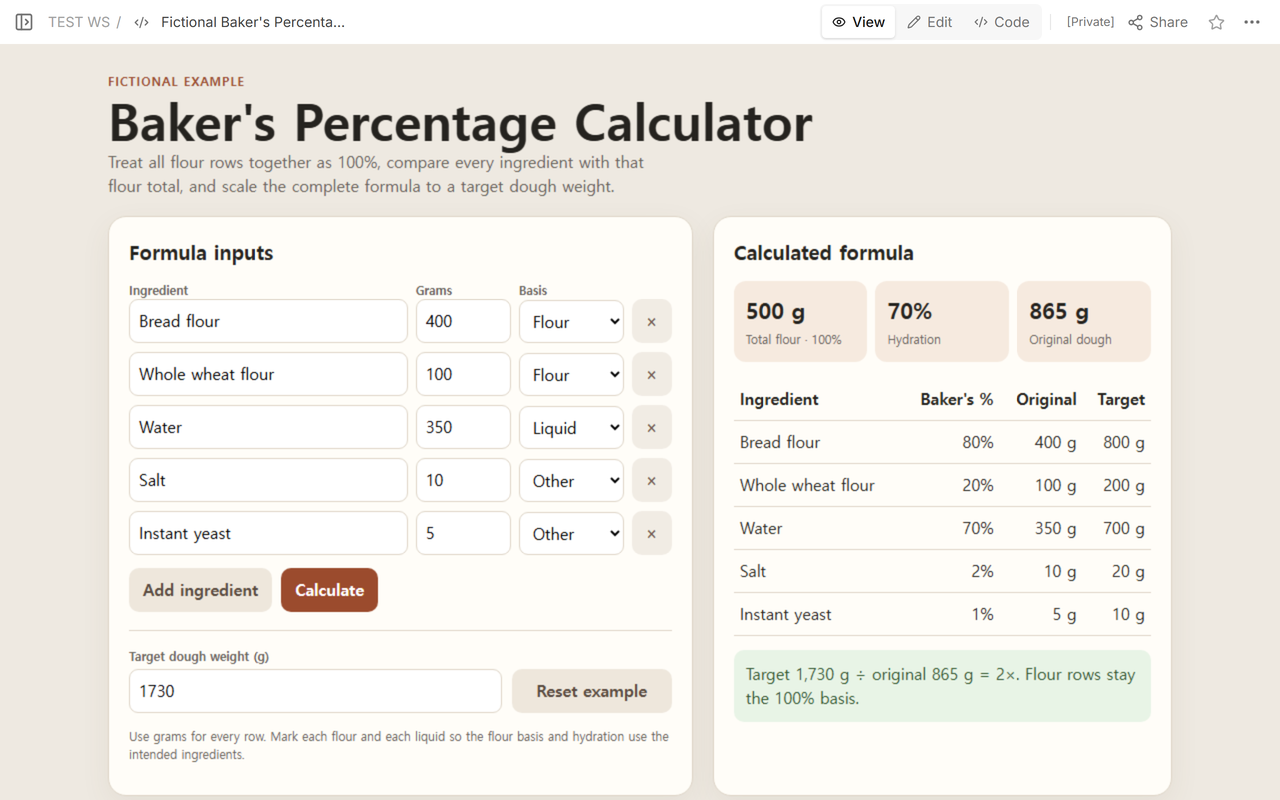
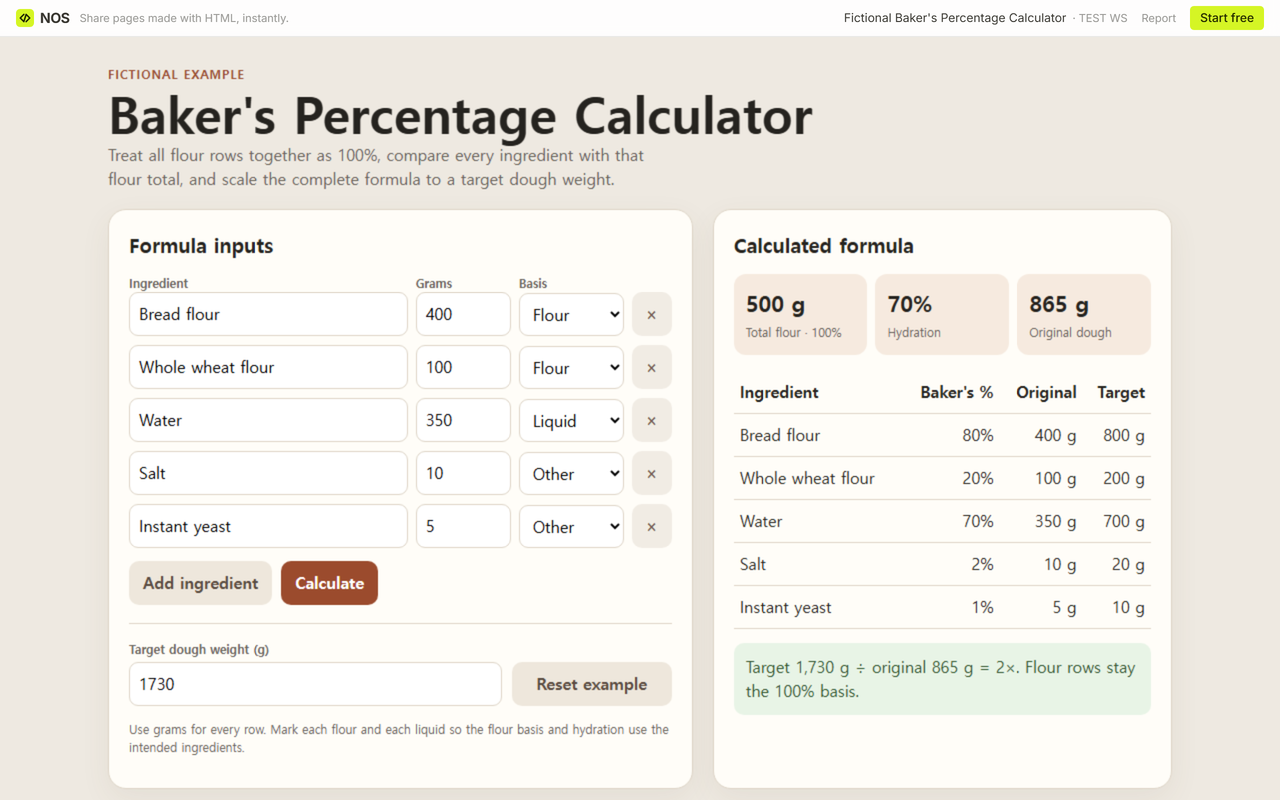
Here is the finished example first. The fictional formula contains 400 g bread flour, 100 g whole wheat flour, 350 g water, 10 g salt, and 5 g instant yeast. The two flours total 500 g, so they make the 100% basis. The calculator returns 70% hydration and 865 g of original dough. A target of 1,730 g doubles every ingredient.
How do you calculate baker's percentage with two flours?
Add the flour weights before dividing anything. In this example, 400 g bread flour plus 100 g whole wheat flour equals 500 g total flour. Bread flour is 400 ÷ 500 × 100 = 80%. Whole wheat flour is 100 ÷ 500 × 100 = 20%. The flour rows therefore add to 100%.
Every other ingredient uses that same 500 g denominator. Water is 350 ÷ 500 × 100 = 70%. Salt is 10 ÷ 500 × 100 = 2%. Yeast is 5 ÷ 500 × 100 = 1%. These percentages do not describe a share of the entire dough. They compare each row with the flour weight.
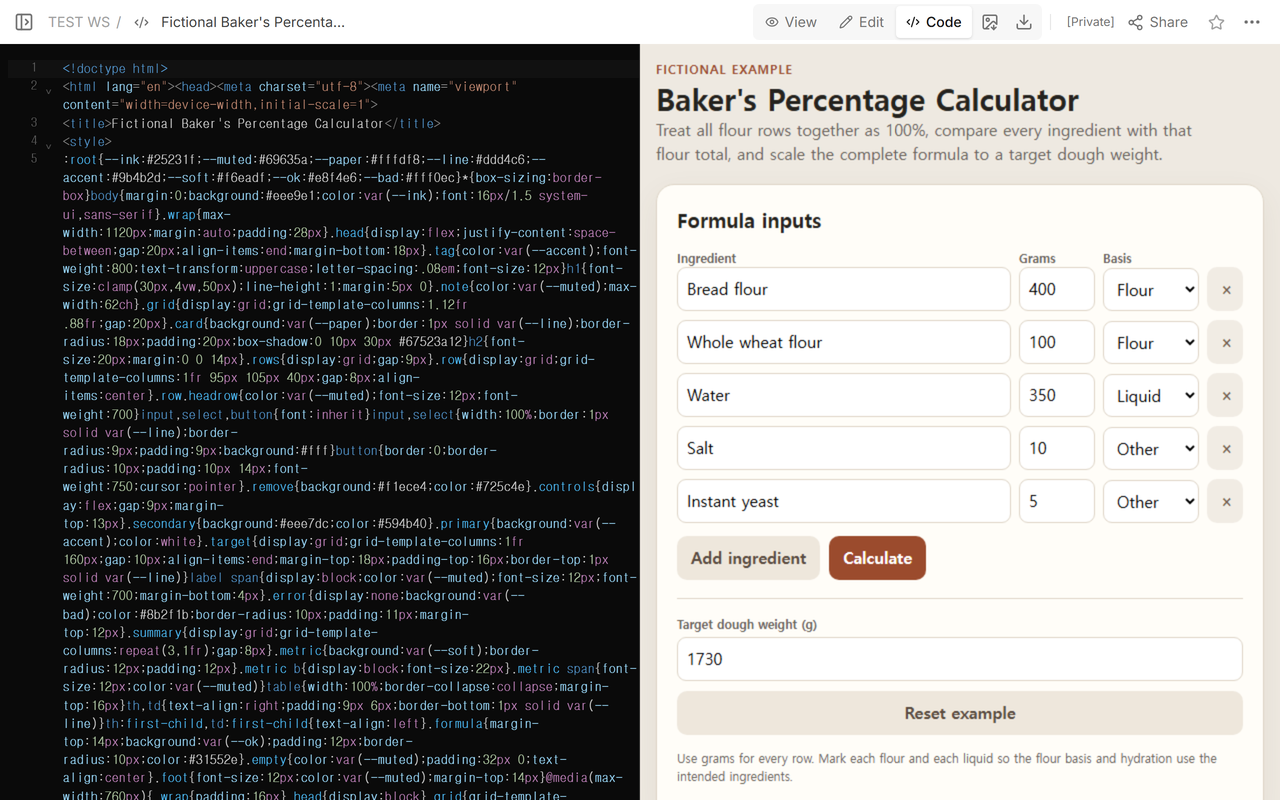
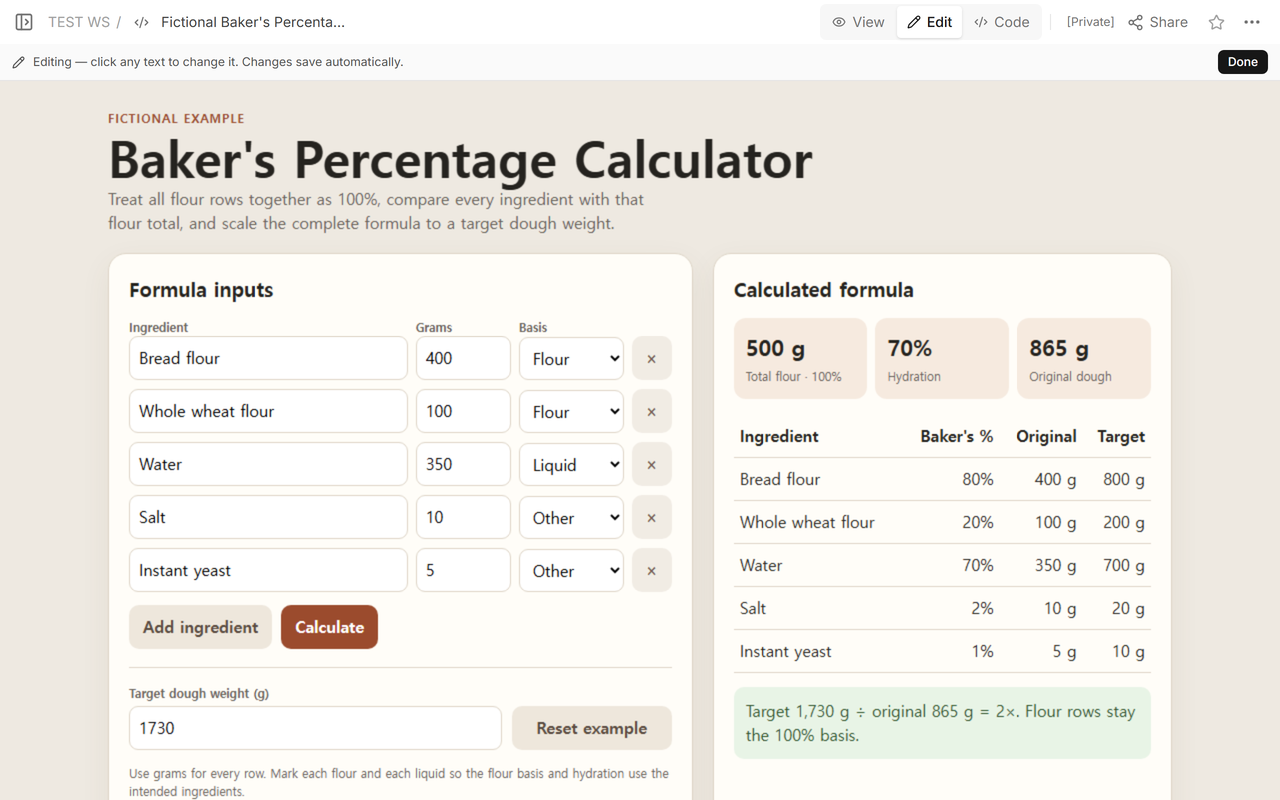
Marking the basis matters. If whole wheat flour is left as “Other,” the denominator falls to 400 g and every percentage changes. If a non-flour ingredient is marked as flour, the denominator grows incorrectly. Review the basis column before using the scaled weights.
What does 70% hydration mean?
For this calculator, hydration is marked liquid divided by total flour. The 350 g water row divided by 500 g flour gives 70%. A milk or other liquid row can count toward hydration only when you intentionally mark it as liquid.
The number is a formula ratio, not a promise about texture, handling, crumb, or finished bread. Flour type, preferments, inclusions, temperature, and process can change how dough behaves. If a preferment contains flour and water, break those components out before claiming an overall hydration figure.
How do you scale a formula to a target dough weight?
First total the original ingredients: 400 + 100 + 350 + 10 + 5 = 865 g. Then divide the target by that original total. For 1,730 g, the factor is 1,730 ÷ 865 = 2.
| Ingredient | Original | Baker's % | Target |
|---|---|---|---|
| Bread flour | 400 g | 80% | 800 g |
| Whole wheat flour | 100 g | 20% | 200 g |
| Water | 350 g | 70% | 700 g |
| Salt | 10 g | 2% | 20 g |
| Instant yeast | 5 g | 1% | 10 g |
Multiplying every row by the same factor preserves the percentages. Keep more precision while calculating and round only the weights you can actually measure. The calculator does not decide an appropriate rounding rule for a particular scale.
What should happen when the flour basis is missing?
A blank, negative, or non-numeric weight is not a usable ingredient value. A formula with no positive flour row has no valid flour denominator. In those cases, the calculator shows an error and clears the previous table instead of leaving an old answer beside new inputs.
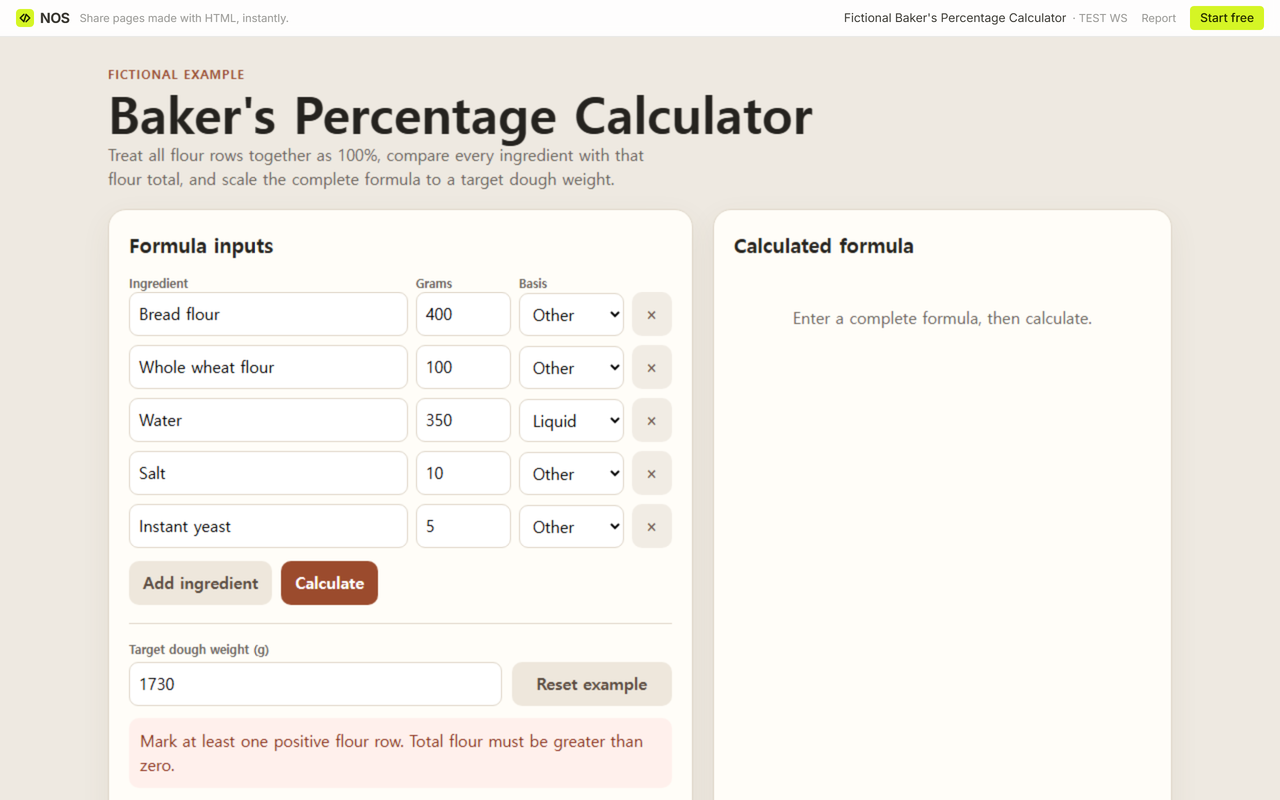
Zero can be valid for an optional ingredient, but total flour and target dough weight must both be greater than zero. The target is a requested batch total, not a serving count or an expected baked yield.
How can someone check the formula before using it?
- Confirm that every flour row is marked Flour and that flour percentages sum to 100%.
- Check that every ingredient uses the same unit. This example uses grams throughout.
- Add the scaled target weights and confirm that they return the target dough weight, allowing only declared rounding differences.
- Review hydration separately from total dough percentage.
- Test an invalid flour basis and confirm that no previous result remains visible.
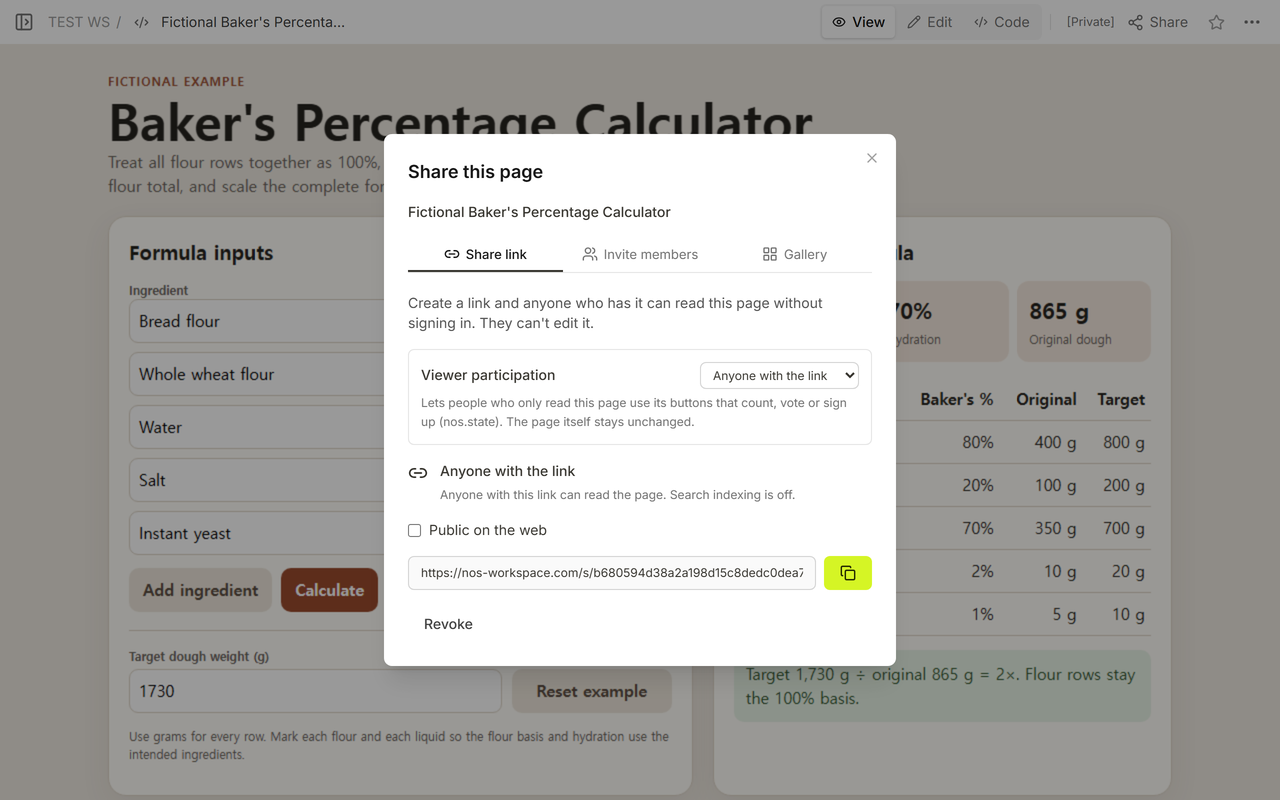
The public link was opened separately after sharing. It displayed the same 500 g flour basis, 70% hydration, and 1,730 g target that appeared in View.
Download the complete fictional calculator to inspect or adapt the example. It does not verify a commercial formula, production yield, fermentation schedule, food safety, or finished bread quality.
When not to do this
Do not use a simple ingredient-row calculator when a preferment must be decomposed but its flour and water are unknown. Do not assume fermentation or baking time doubles because ingredient weights double. Do not treat a mathematically scaled batch as proof that a mixer, container, oven, or process can handle it.
Where NOS fits
NOS held this self-contained calculator, displayed its result in View, opened the same page in Edit, and produced the reader link used for the normal and error checks. The owner can revise the existing page while readers keep using its shared address. To keep several formulas, yields, and ingredient lists together, see the online family recipe book. For one direct recipe page rather than a formula worksheet, see recipe website without stories.