Four pages, one stylesheet, your own domain. The building is a few hours and the writing is the rest of the day.
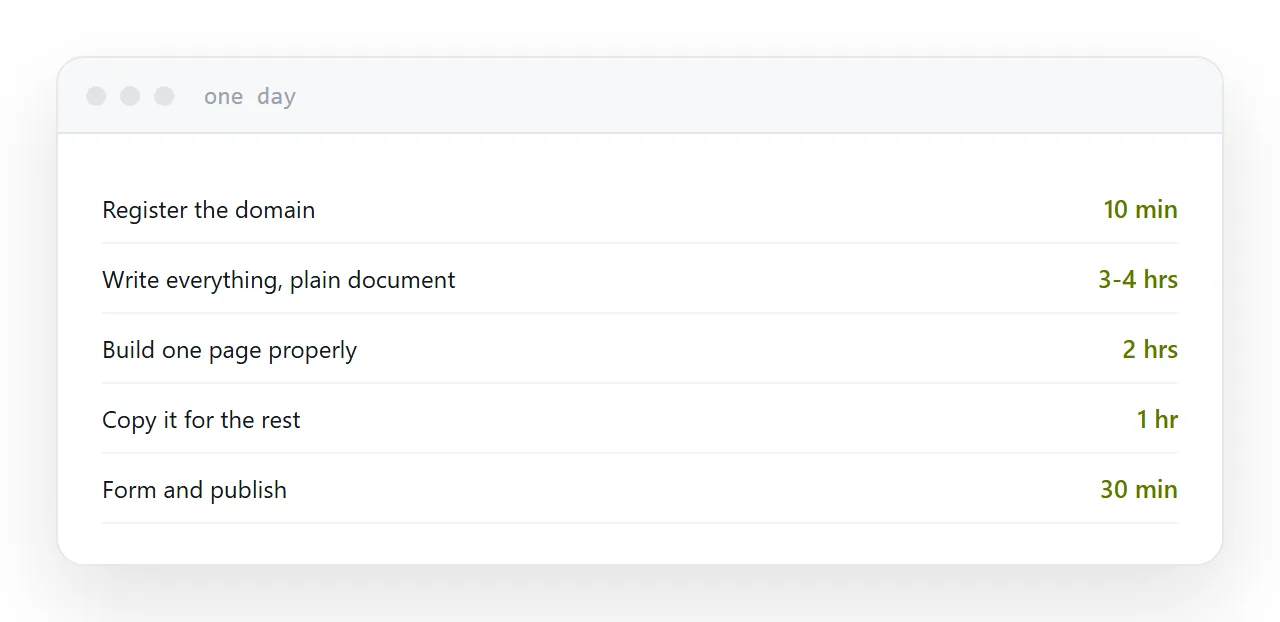
Order of work
Register the domain. First, before anything. Your own name if it is available.
Write the words. All of them, in a plain document. What you do, two project write-ups, who you have worked with, how to reach you.
Build one page. Completely, including at phone width. Get the typography, the spacing and the widths right once.
Copy it for the rest. Change the content, keep the structure.
Publish. The same day, even if two pages are thin.
| Task | Time |
|---|---|
| Domain | 10 minutes |
| Writing | 3-4 hours |
| First page, properly | 2 hours |
| Remaining pages | 1 hour |
| Form and publishing | 30 minutes |
Skip the framework
For four pages, plain styling wins.
A framework is a large download supplying a grid system, components and utilities, of which a four-page site uses a fraction. It also brings conventions you then work within, which is more constraint than help at this size.
A stylesheet you wrote is smaller, loads faster and is easier to change in a year when you have forgotten everything.
The writing is the site
Three things do the work.
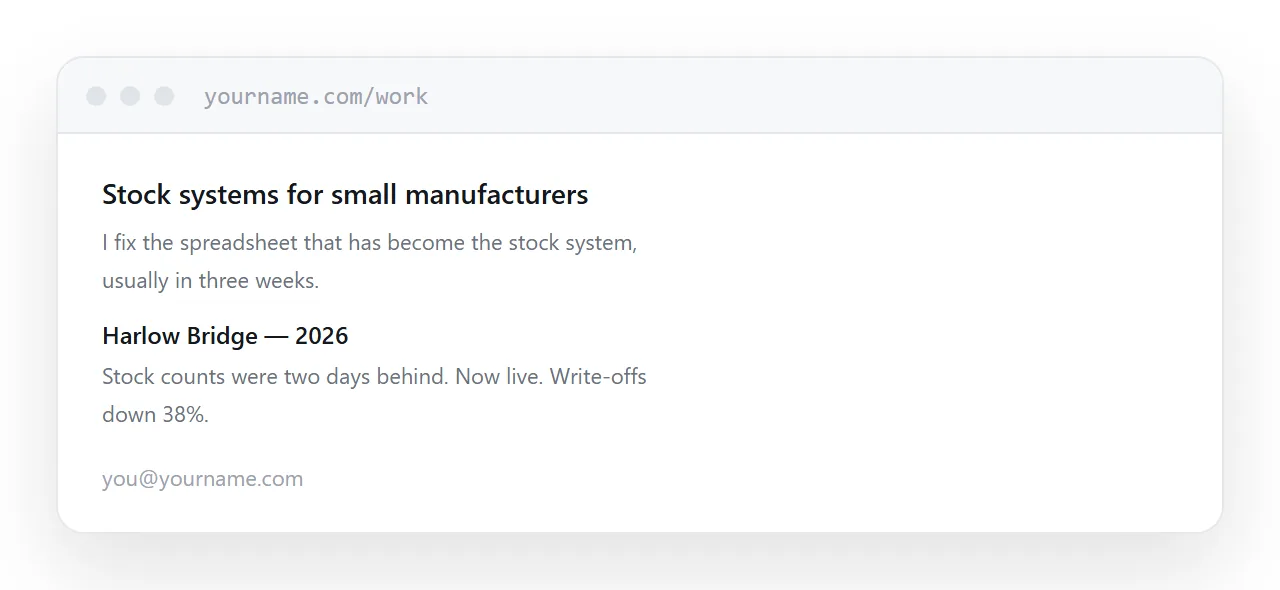
What you do, in a client's words. Not your industry's words. Somebody searching for exactly your service should recognise themselves in the first sentence.
Two projects, written up. The problem, what you did, the result. Numbers where they exist. Two written properly beat twelve thumbnails, because the thumbnails show what it looked like and the write-up shows what it was for.
Who you have worked with. Names or sectors. It answers the question nobody asks out loud.
Enquiries
A form posting to an outside form service, and your address written out as text.
Both, on every page. Some people fill in forms and some people write, and you want the enquiries from both.
Three fields on the form: name, address, what they need. Every additional field costs you submissions.
Skip
A blog you will not write. A testimonial carousel, which is three quotes in an animation nobody waits for. Live chat, unless you will answer it. A newsletter with no newsletter.
Every one of those is something to maintain, and maintenance on your own site loses to billable work every single time.
For the surrounding ground, see A freelance site that maintains itself and How to build a static site.
Put it at an address
Register the domain first, write everything before styling anything, build one page completely, copy it for the rest, and publish the same day even if it is not finished.