In short
Publish both on-site and online reporting routes, then separate immediate danger from non-urgent reports.
Explain confidentiality and anonymous-report limits before anyone has to rely on them.
Define acknowledgment, temporary measures, a conflict-free review, notice, a decision, records, possible outcomes, and follow-up.
Treat a completed template as a starting point for local review, not as legal approval.
A conference code of conduct is only useful when a participant can tell what to do next. A list of values does not answer where an online attendee reports a concern, who steps in when the usual contact has a conflict, or what the organizer may do while facts are reviewed.
We rebuilt the fictional Harborlight Practice Conference guide around those decisions. The example contains no real attendee, organization, address, incident, finding, or sanction. Its contacts use the reserved .example domain, and every deadline and role is an invented design value for this one guide.
Two public references helped us check the structure without copying their wording. The Conference Code of Conduct template tells events to publish their own reporting and support details. The Statistical Society of Australia example separates covered settings, response contacts, possible consequences, and limits on anonymity. Neither source turns Harborlight into a universal rule or a substitute for local review.
What should a conference code of conduct include?
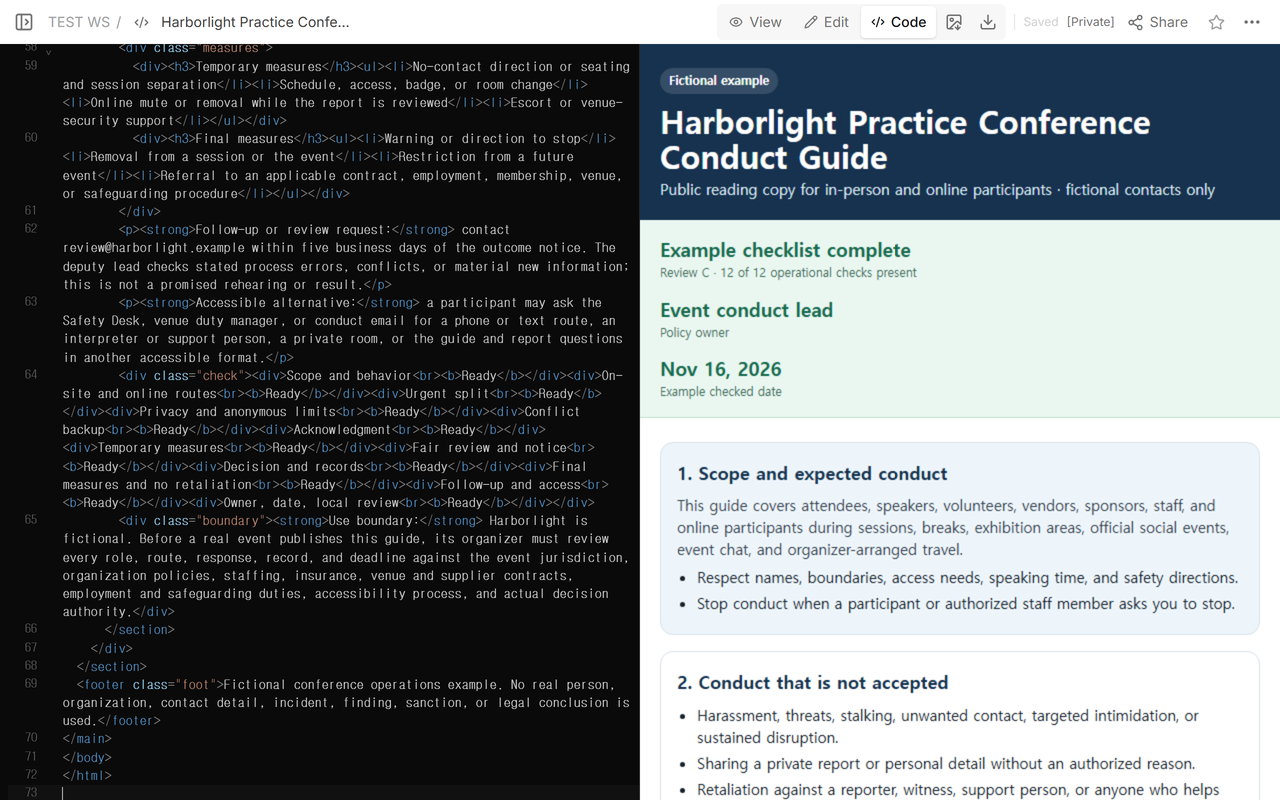
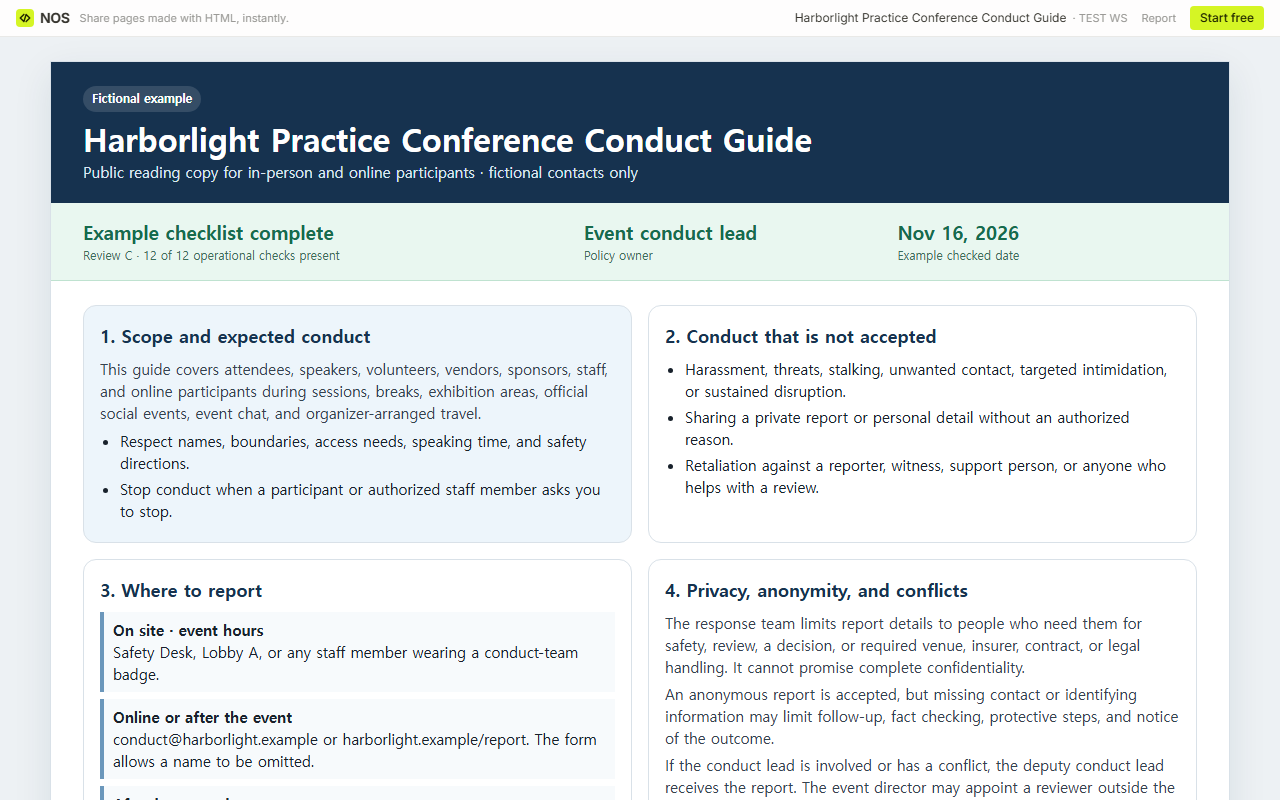
Start with the decisions a participant and response team will need. Harborlight uses twelve checks: scope and behavior; on-site and online routes; an urgent-risk split; privacy and anonymous-report limits; a conflict backup; acknowledgment; temporary measures; fair review and notice; a decision and protected record; final measures and no retaliation; follow-up and accessible alternatives; and an owner, date, and local review boundary.
The checklist is deliberately tied to visible details. A box is not ready because it contains text. It is ready only when the fictional role, route, limit, or step appears in the reading copy. A real organizer should use the same discipline, then replace every invented value with an approved and staffed one.
Where can an attendee report a concern?
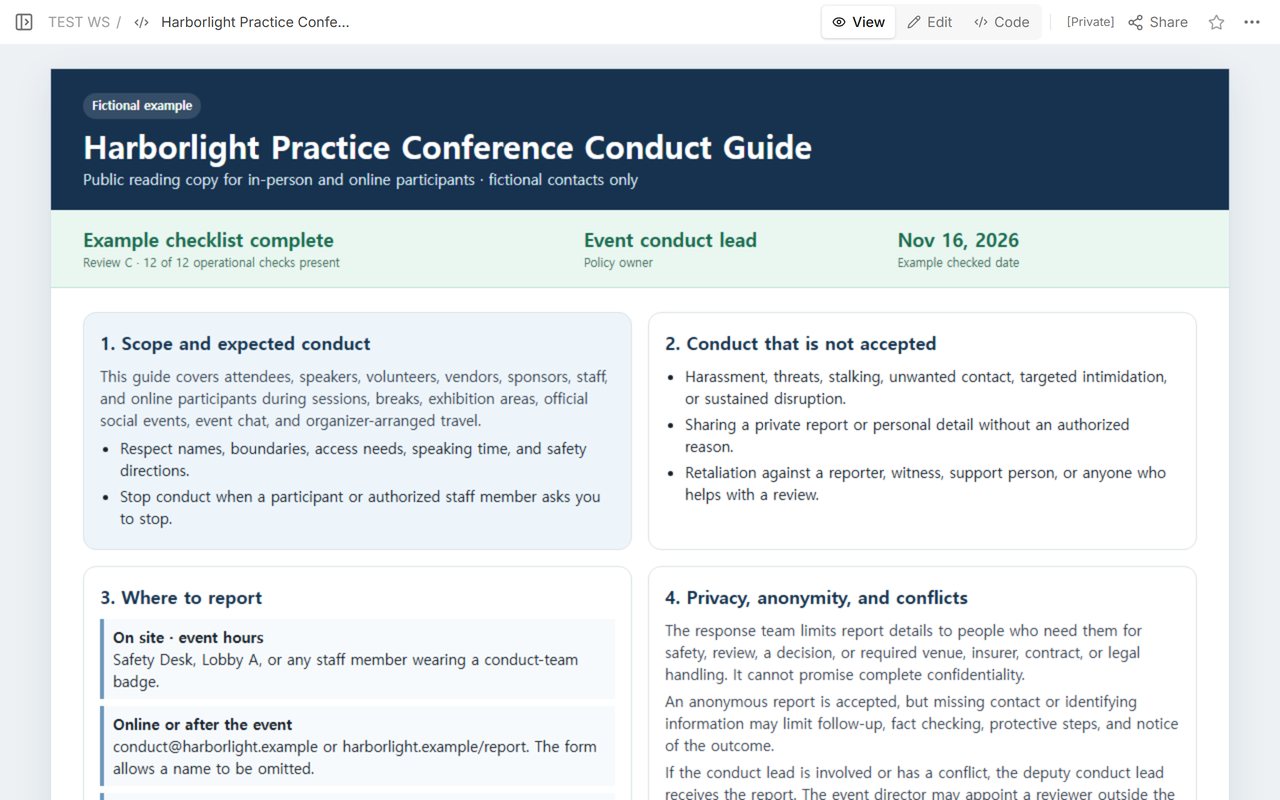
Give people more than a role name. Harborlight pairs its policy owner, the event conduct lead, with routes that work in different circumstances: the Safety Desk or a badged staff member during event hours, the venue duty manager after hours, and a fictional email or form for online participants and post-event reports.
The form allows a reporter to omit a name. The next sentence explains the tradeoff: without contact or identifying information, the team may be unable to ask follow-up questions, verify important details, offer some protective steps, or send an outcome notice. That is more useful than promising anonymity without explaining its operational limit.
The guide also separates urgent and non-urgent action. A person facing immediate danger is directed to local emergency services or venue security first. The conduct routes remain available for non-urgent reporting and event follow-up. This is a fictional routing choice, not advice about which emergency number, authority, or duty applies in every jurisdiction.
How should confidentiality and conflicts be explained?
Do not use “confidential” as an unlimited promise. The Harborlight example says report details are limited to people who need them for safety, review, a decision, or required venue, insurer, contract, or legal handling. That boundary tells a reader why information might have to move while avoiding a promise the fictional organizer cannot guarantee.
A policy also needs another route when its usual owner is involved. Harborlight sends that report to a deputy conduct lead and allows the event director to appoint a reviewer outside the organizing team. A real event must name people who are genuinely independent enough for its structure and must decide who can appoint or replace them.
What happens after a non-urgent report?
The example uses a four-stage operating path. First, the response team acknowledges receipt when it has contact details and records immediate safety or access needs. The next stage considers temporary measures. A reviewer without a conflict then gathers relevant accounts and records, gives each affected party notice, and offers a fair chance to respond. Finally, the authorized decision maker records the reasons, action, information shared with each party, and the protected case record.
This sequence distinguishes an interim safety choice from a final decision. It does not promise a finding, a fixed response time, a particular sanction, or the same information for every party. The real organizer must decide what fairness, notice, privacy, record retention, and decision authority mean under its own policies and obligations.
Which temporary and final measures can the policy name?
Harborlight lists possible measures instead of automatic penalties. Temporary options include a no-contact direction, seating or session separation, schedule or access changes, an escort, and online mute or removal while the report is reviewed. Final options include a warning, a direction to stop, removal from a session or event, restriction from a future event, or referral to an applicable contract, employment, membership, venue, or safeguarding process.
The policy prohibits retaliation against a reporter, witness, support person, or anyone who helps with a review. It also gives the deputy lead a fictional five-business-day route for a process-error, conflict, or material-new-information review. The guide does not promise a new hearing or a different result.
How do you provide an accessible alternative?
Do not make one form the only route. In the fictional guide, a participant may ask the Safety Desk, duty manager, or conduct email for a phone or text route, an interpreter or support person, a private room, or the guide and report questions in another accessible format. Those options still need real staffing, privacy handling, and advance testing before an event publishes them.
The bottom of the guide brings the operational checks together. It shows temporary and final measures, the follow-up route, accessible alternatives, all twelve ready labels, and the use boundary. That last boundary requires a real organizer to review the page against its jurisdiction, organization policies, staffing, insurance, venue and supplier contracts, employment and safeguarding duties, accessibility process, record duties, and actual authority.
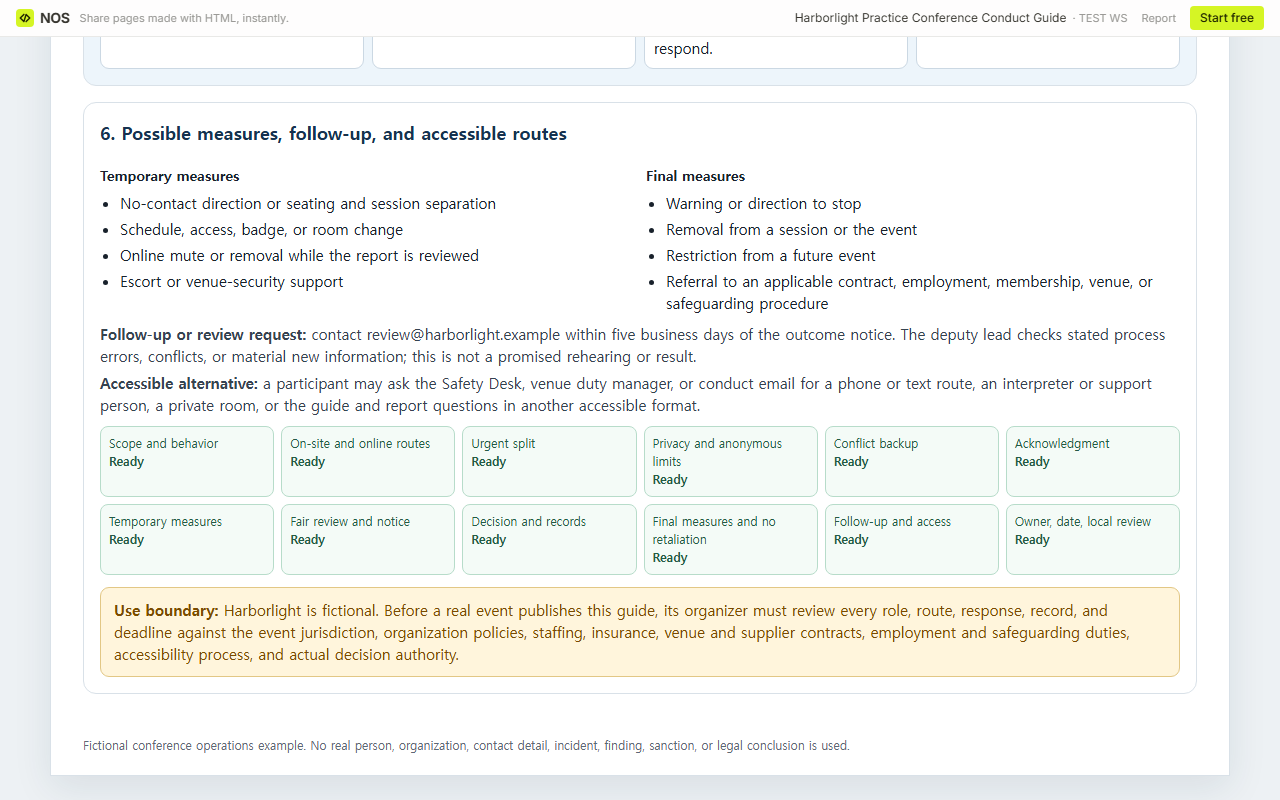
Finished result: Harborlight now has one fictional reading copy that covers in-person and online reporting, urgent and non-urgent action, privacy and anonymity limits, conflicts, acknowledgment, temporary steps, fair review and notice, a recorded decision, possible measures, no retaliation, follow-up, accessible alternatives, and local review. “Example checklist complete” means those twelve elements are present in this invented example. It does not certify a real event.
Download the complete fictional conference code of conduct, then replace every fictional role, route, measure, deadline, and review boundary before adapting it for a real event.
Can the policy be updated after sharing?
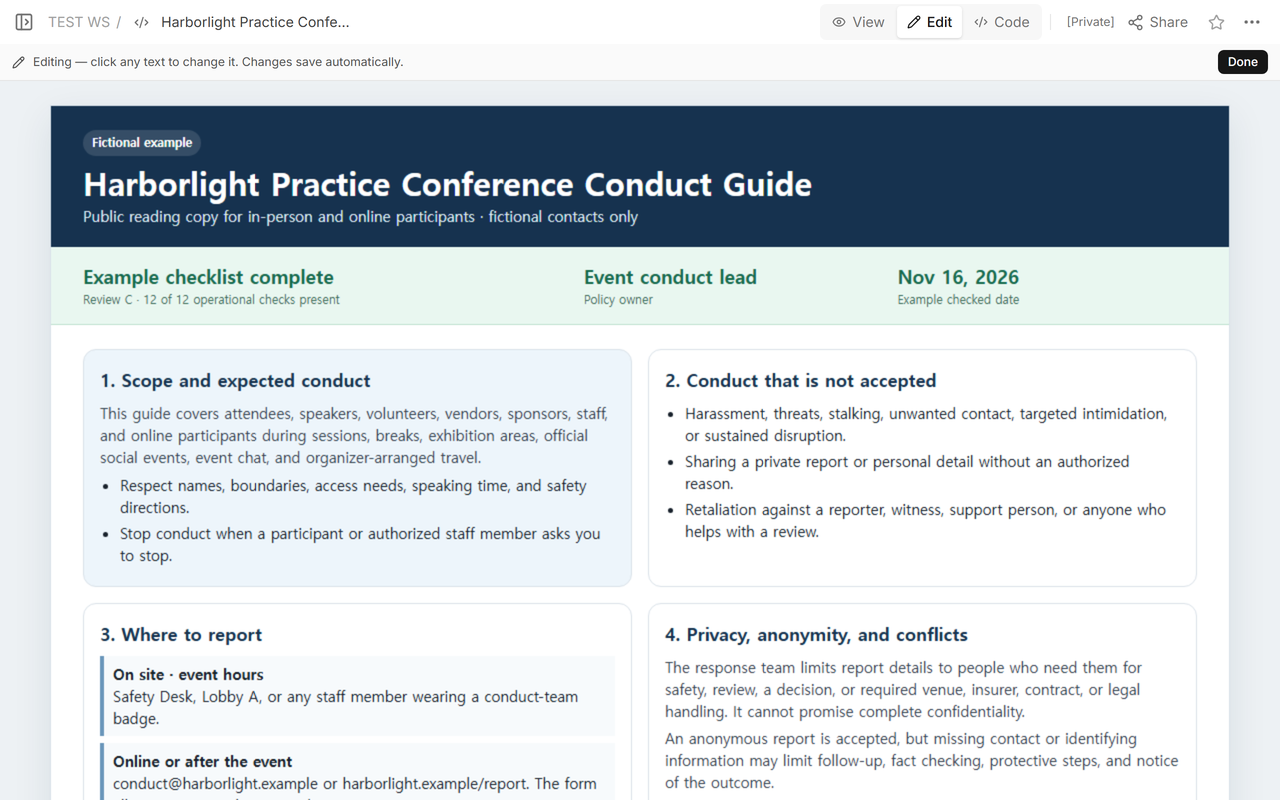
Yes, in this observed NOS example. We edited the existing document and reopened the same reader address. The link that previously showed the shorter five-check version now shows Review C, twelve checks, Nov 16, 2026, and the expanded operating details. A recipient does not need a replacement link to see the revised page.
When not to do this
- Do not collect reports, evidence, medical details, private contact information, or protected case records on the public reading page.
- Do not publish fictional contacts or copy this example without checking the event’s jurisdiction, organization, insurance, contracts, venue, staffing, accessibility, employment, safeguarding, and record duties.
- Do not promise confidentiality, anonymity, a response time, a finding, a sanction, or an appeal result unless the responsible organization has approved and can deliver it.
- Do not mark a section ready until the named role accepts the responsibility and each route and accessible alternative has been tested.
Using NOS for the conduct guide
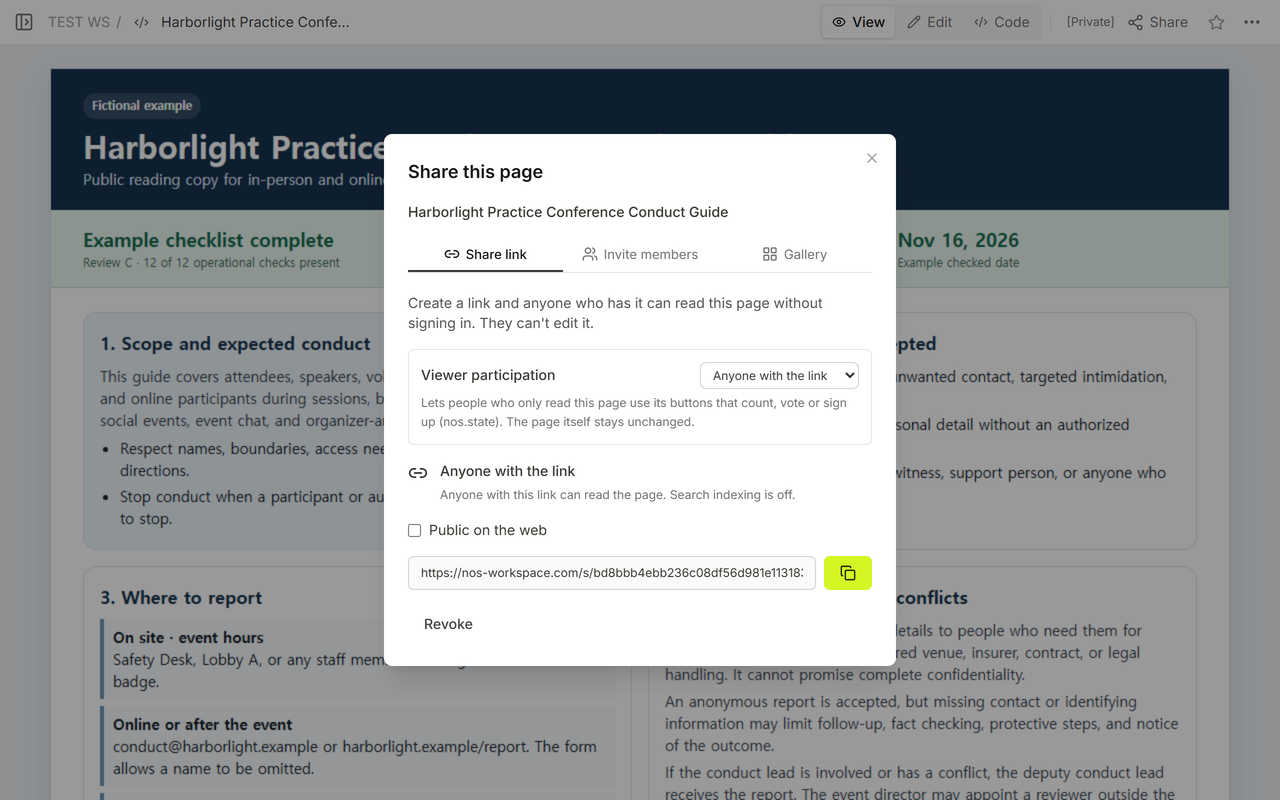
NOS Workspace held the fictional HTML, rendered the same document in Code, View, and Edit, and kept its reader address available through Share during this check. The observed Share panel said anyone with the link could read without signing in and could not edit. We changed that existing document and confirmed the expanded policy at its original reader address. Check the current pricing page when plan details matter.
Related conference pages
Keep session timing and room conflicts in the conference programme template. Use the event schedule template to separate attendee timing from staff cues. Put biographies, confirmed sessions, and public materials on conference speaker pages. Those pages support the event, but none replaces the conduct policy’s reporting and response boundaries.