In short
Record the documented quantities for the regular edition and each proof series. Then copy each print’s margin into a separate field and check it against the work, state, and catalog entry.
Use the blank worksheet for your own check, or compare the fictional source packet with the completed worksheet.
What goes in a print edition record?
Give the sheet a work ID and name the edition or state you’re checking. Put the quantities from the edition record in their own section. For each impression in the sample, record its inventory ID, margin location, exact transcription, and the source for that reading. Use separate fields for the catalog category and the two numbers, when present. That gives the next reader a way to check your interpretation without losing the original lettering.
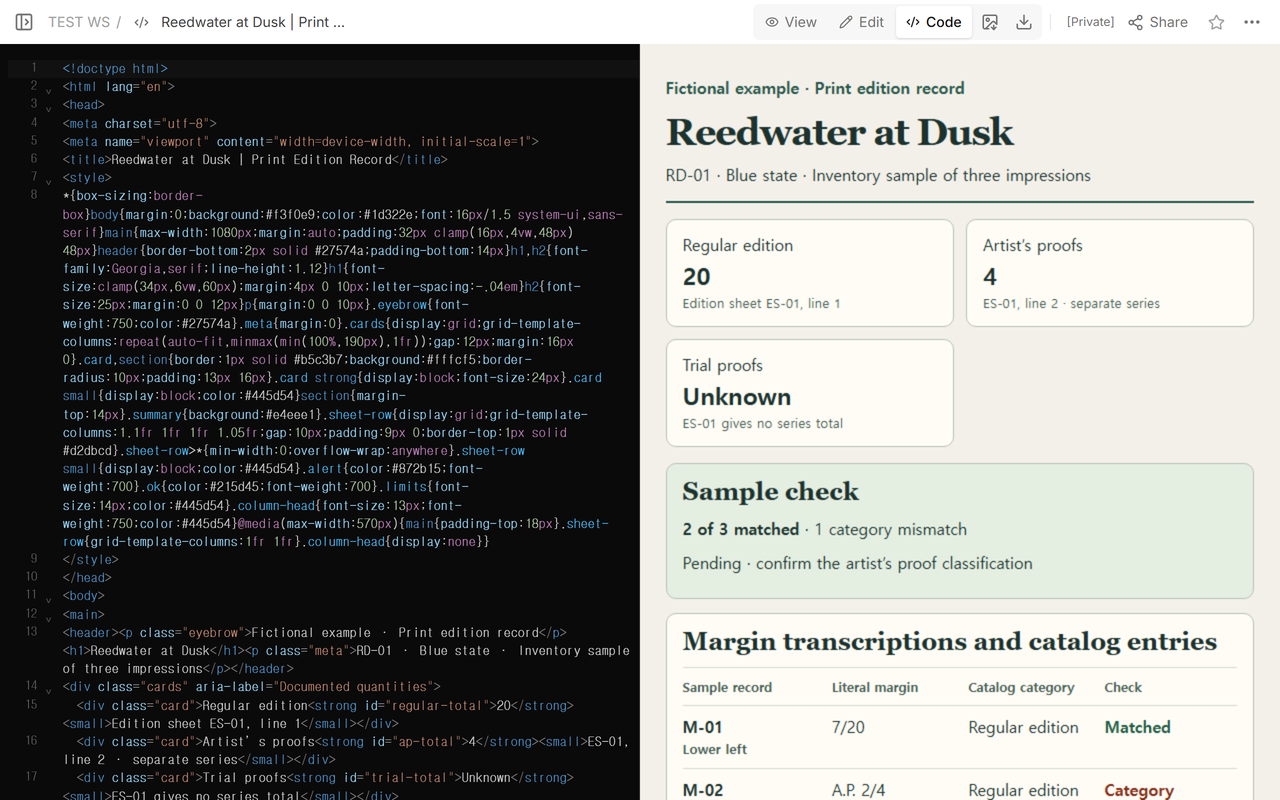
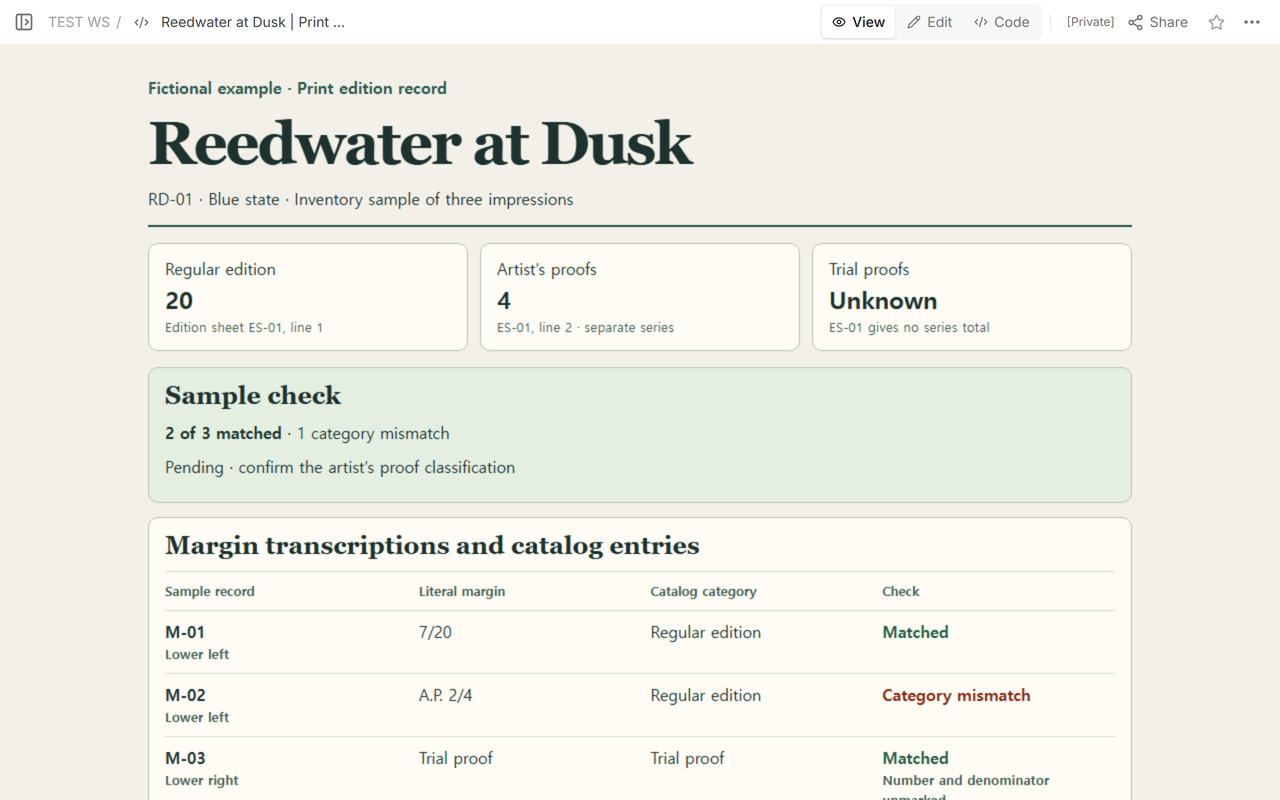
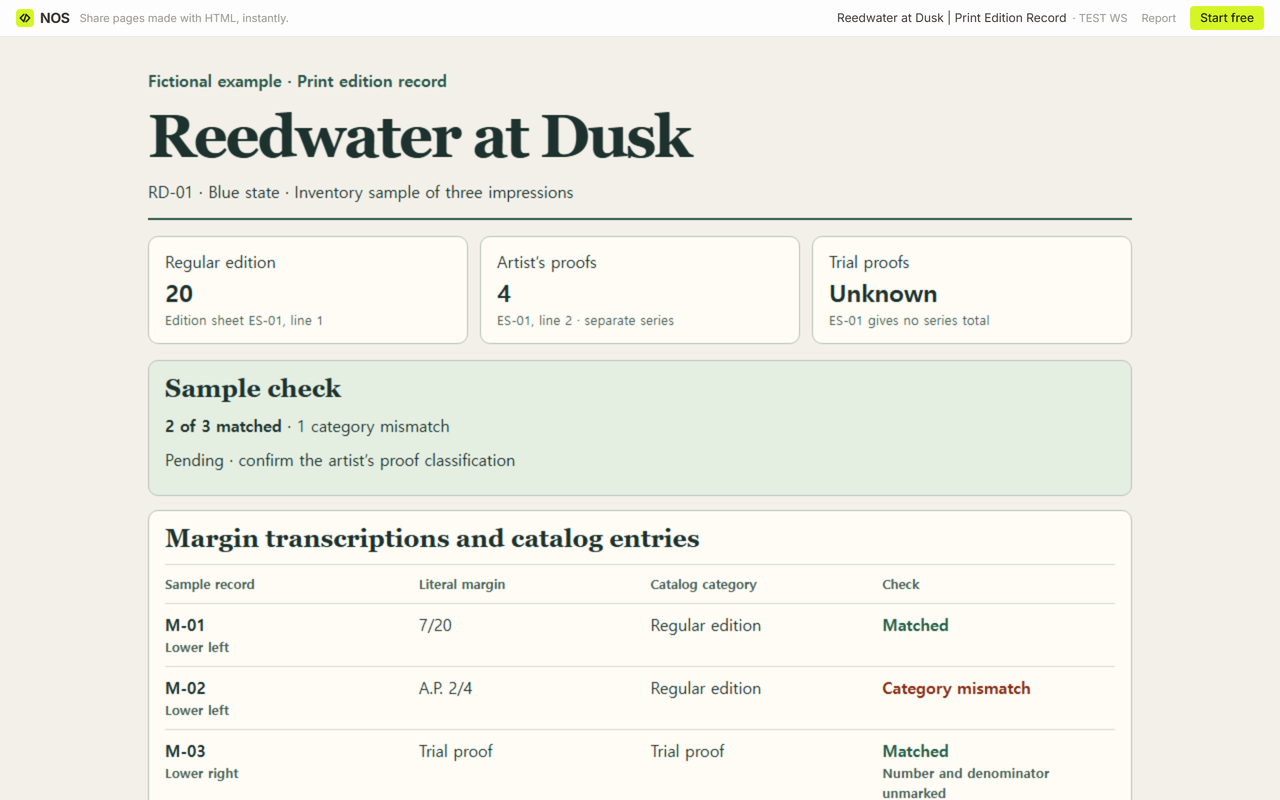
We used Reedwater at Dusk, an invented print with the work ID RD-01 and the state labeled Blue. The fictional edition sheet ES-01 gives 20 for the regular numbered series and 4 for a separate artist’s proof series. ES-01 gives no trial proof total. Its quantities describe the documented series. The inventory sample contains three records and tells us nothing about total holdings.
Tamarind Institute’s description of its printmaking process says the workshop documents numbered impressions and proofs, including trial proofs. The catalogue entry for Before the Mirror lists 100 in the edition plus 30 artist’s proofs. Its remarks explain why the earlier count of artist’s proofs changed. For your own sheet, cite the record that supports each count and keep its revision with the entry.
How do you match a margin inscription to the right series?
- M-01. MT-01 transcribes
7/20at the lower left. ES-01 line 1 gives 20 for the regular edition of Blue state. The catalog category and both numbers agree. - M-02. MT-02 reads
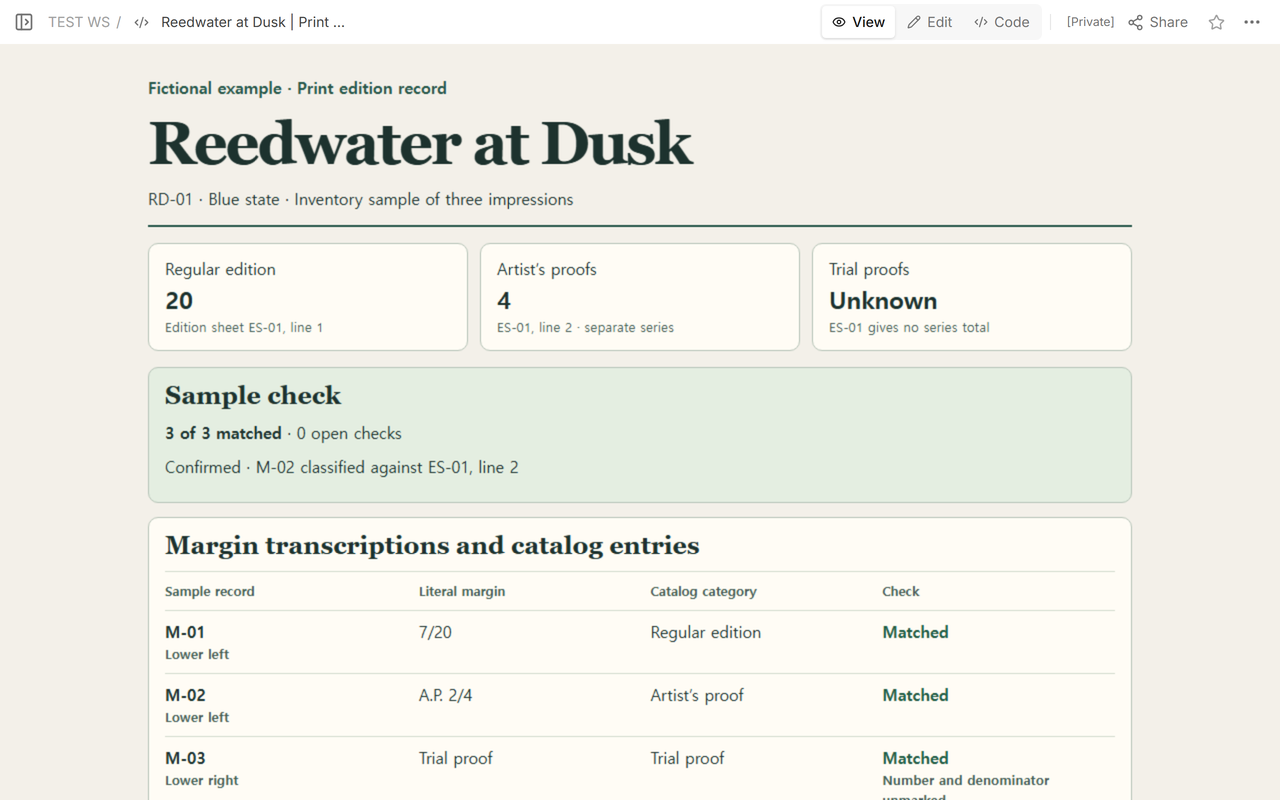
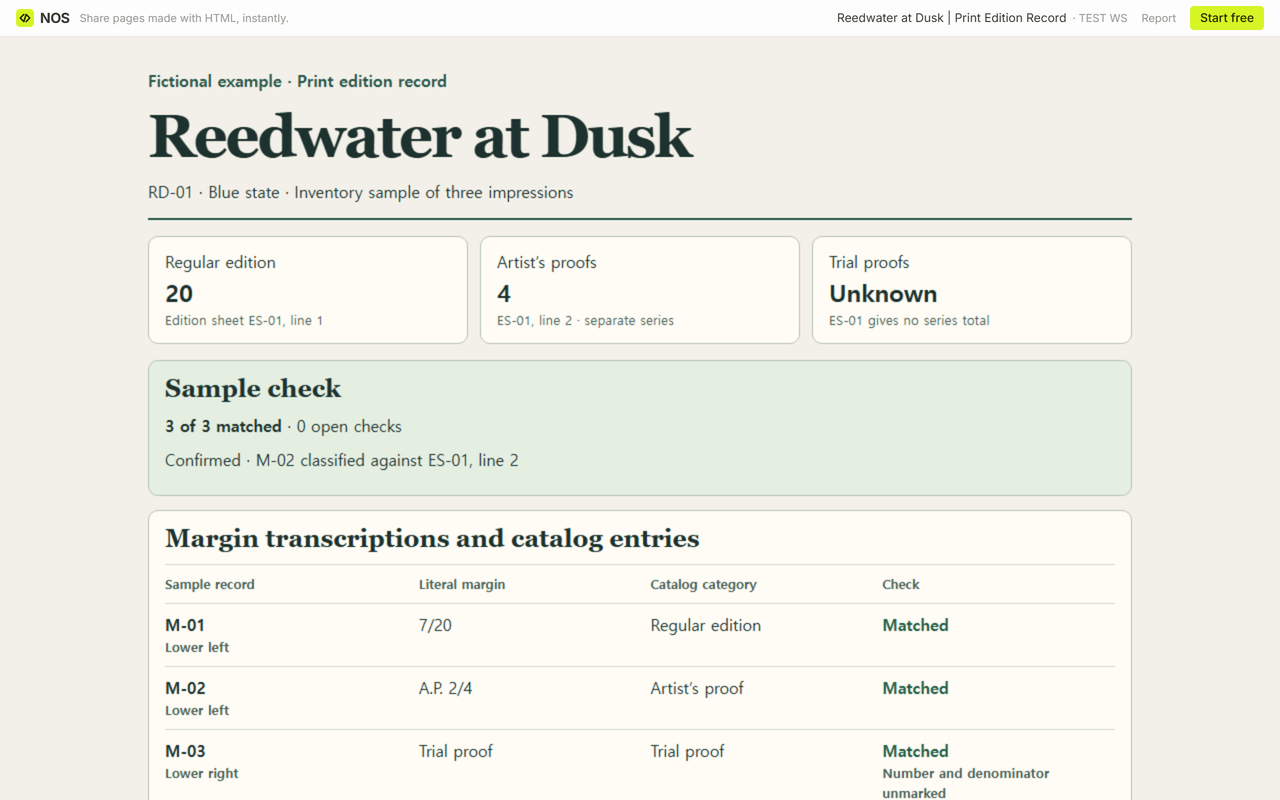
A.P. 2/4. The catalog initially put it in the regular edition. ES-01 line 2 assignsA.P.to the artist’s proof series and documents four. Change the category to Artist’s proof and cite line 2. Keep the original inscription and the numbers 2 and 4. - M-03. MT-03 reads
Trial proof. The category matches, and neither a number nor a denominator is marked in the transcription. Leave those two cells empty and set the denominator status to unmarked. The sample includes one trial proof. Its series total stays unknown.
If the margin reads A.P. 2/[illegible], enter the 2, leave the denominator empty, and record that it’s illegible. Use unchecked when you lack a margin reading. A denominator copied from the edition sheet belongs under documented quantities. If a transcription reads 7/25 and the record says 20 for the same state and series, keep both values, flag the conflict, and leave the check open.
How do you count matches and handle duplicate records?
Divide the number of distinct matched records by the number of distinct sample records in scope. Include open checks in the sample denominator. If the sample is empty or its size is unknown, leave the coverage blank. When one record has two transcriptions, attach both to that ID and count it once. If two IDs claim number 7 in the same state and series, flag the pair and ask for evidence that distinguishes them before counting either claim as a match.
Before the correction, M-01 and M-03 matched, giving 2 ÷ 3 = 2/3. After classifying M-02 against ES-01, all three matched, giving 3 ÷ 3 = 3/3. The two documented counts and the three-record sample stayed the same. Download the completed HTML record to see the resolved entry.
When not to do this
Keep a row pending when you can’t identify its edition or state, or when the available record and transcription disagree. For questions of authenticity or ownership, take the source records to the responsible registrar or specialist. Use an artwork information sheet for display and handling details, or an art gallery catalog to organize work for visitors.
How did we share the corrected record?
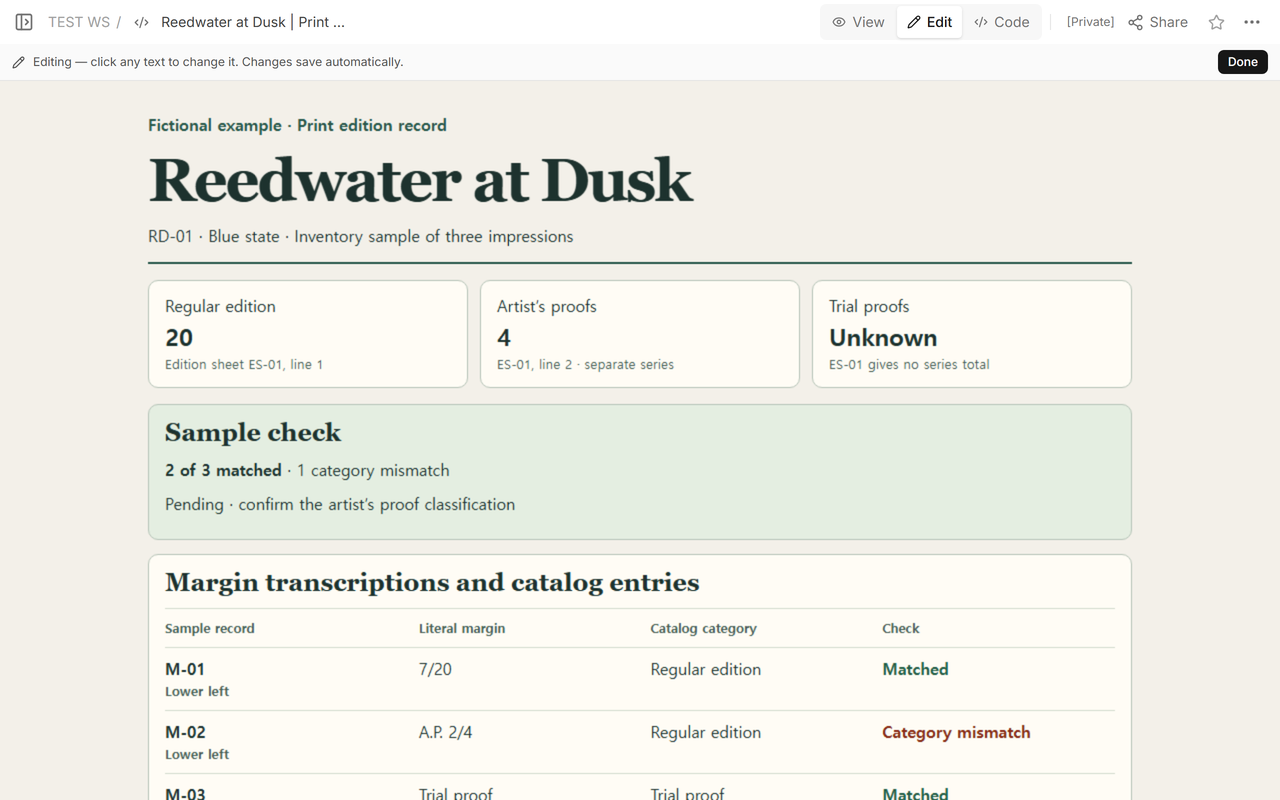
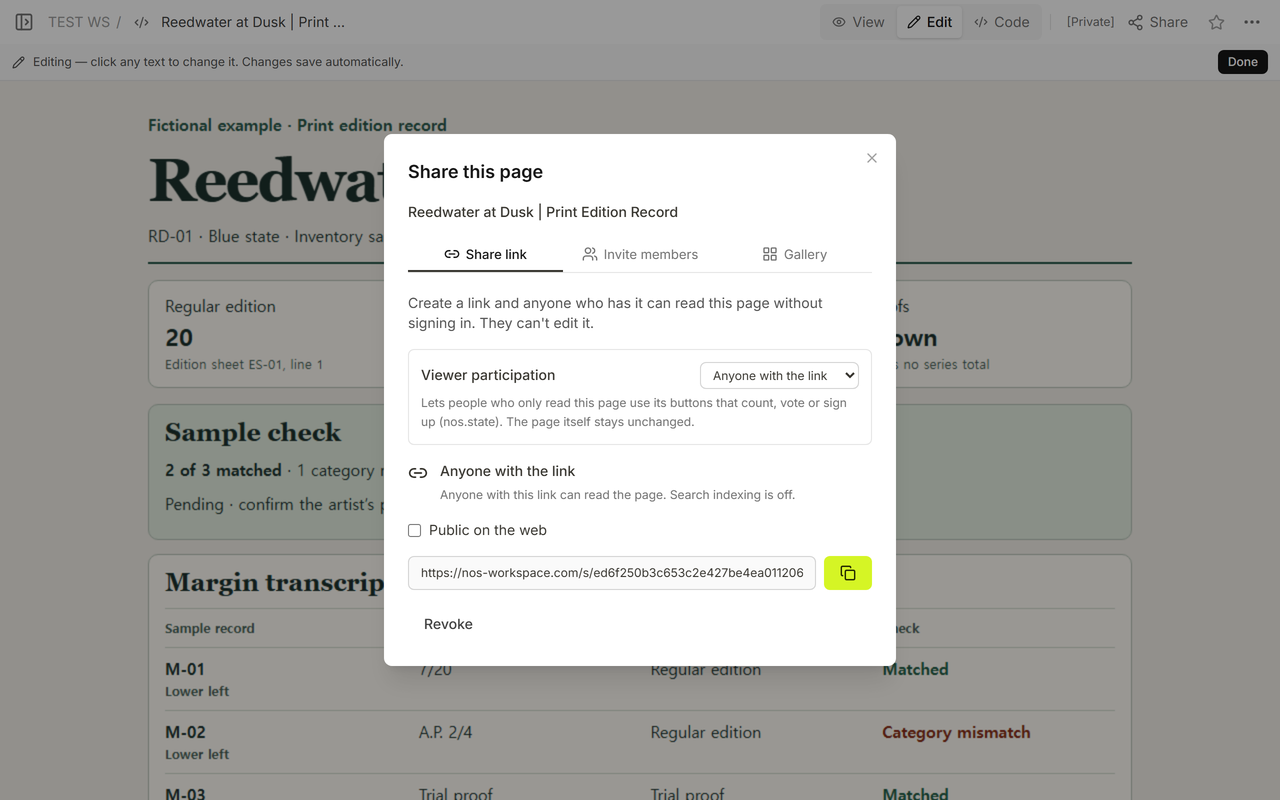
We checked the fictional sheet in NOS and opened the reader link from Share while signed out. It showed two matches and the open category check. We corrected M-02 on the existing page in Code. When we reopened the original reader link, it showed three matches, the same margin transcriptions, and the unknown trial proof total. Open the corrected fictional record in NOS.