A student can name the character, setting, and three events and still miss why the ending matters. The boxes are full, but the character’s problem has disappeared between them.
Build the map around what the character wants, what gets in the way, and which action changes the outcome. The short story and filled map below show how to keep those connections visible. You can then copy the blank version for your own reading passage.
Blank template and worked example

Open the complete example · Blank PDF · Worked PDF
Download the HTML version to adapt the browser page. The worked material is fictional. Use the blank PDF for a printed activity or record; the browser preview switches between versions.
For a lesson on why one event changes another, use a cause and effect organizer to examine one connection from the map more closely.
Copy a story map with space for evidence
Story title/source: [ ]
Character and goal: Who wants what? [ ]
Setting: Where and when does the story happen? Which detail matters? [ ]
Problem: What prevents the character from reaching the goal? [ ]
Attempts: What does the character try, and what happens after each attempt? [ ]
Resolution: What changes the situation by the end? [ ]
Evidence: Which line or event supports each answer? [ ]
Still uncertain: What does the story leave open? [ ]
A story-mapping resource uses character, setting, conflict, and resolution for reading and prewriting. The goal-and-attempt prompts here help a learner explain the relationships between those elements.
For an early retelling, use only Beginning, Problem and attempt, and Ending. Keep the evidence-rich version for a task that asks students to explain the story, rather than simply retell it.
Read this original practice story
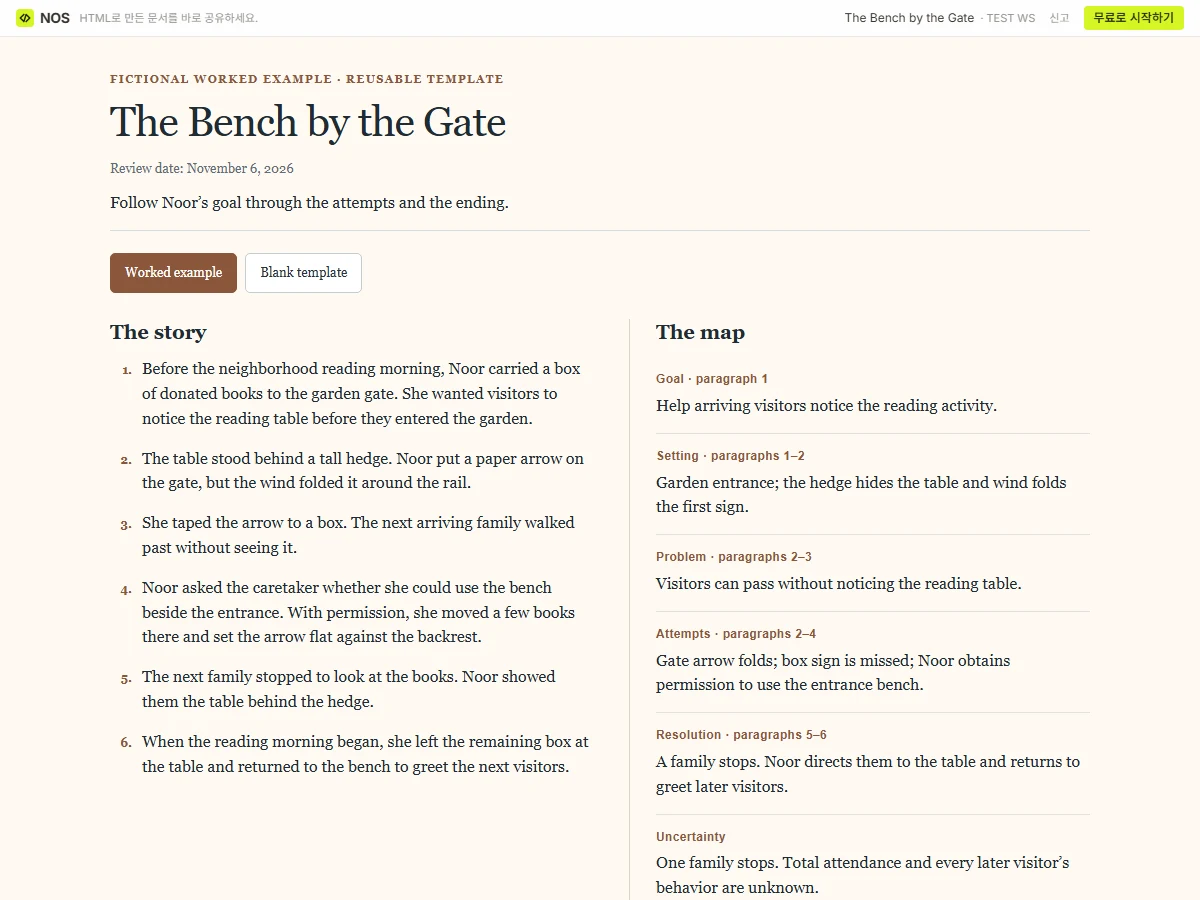
The Bench by the Gate
1. Before the neighborhood reading morning, Noor carried a box of donated books to the garden gate. She wanted visitors to notice the reading table before they entered the garden.
2. The table stood behind a tall hedge. Noor put a paper arrow on the gate, but the wind folded it around the rail.
3. She taped the arrow to a box. The next arriving family walked past without seeing it.
4. Noor asked the caretaker whether she could use the bench beside the entrance. With permission, she moved a few books there and set the arrow flat against the backrest.
5. The next family stopped to look at the books. Noor showed them the table behind the hedge.
6. When the reading morning began, she left the remaining box at the table and returned to the bench to greet the next visitors.
Follow the goal through the filled map
Character and goal: Noor wants arriving visitors to notice the reading activity. Paragraph 1 states that purpose.
Setting: The garden entrance on a windy morning. The hedge hides the table, while the wind interferes with the first sign. Those details affect Noor’s choices.
Problem: Visitors can pass the entrance without noticing the reading table. “The wind” is only part of the problem; fixing the sign alone does not yet establish that the table is visible.
First attempt: Noor puts an arrow on the gate. The wind folds it around the rail.
Second attempt: She attaches the arrow to a box. A family still walks past.
Action that changes the situation: She obtains permission to use the entrance bench, moves books there, and places the arrow against its backrest.
Resolution: A family stops, and Noor directs them to the reading table. She returns to greet later visitors.
Uncertainty: The story shows one family stopping. It does not tell us how many people attended or whether every later visitor found the table.
The resolution connects to the original goal. “She moves a box” is an event, but it leaves out the evidence that her new arrangement helps a visitor notice the activity.
Correct a map that lists events without explaining them
Suppose a learner writes:
Problem: Noor has too many books.
Solution: She puts them on a bench.
Ask the learner to point to the sentence that establishes “too many.” There is no such sentence. Then return to Noor’s stated goal and the family that passes the entrance.
A revised answer could be: “Noor needs visitors to notice the reading activity. Moving books beside the entrance gives the next family something to stop for.”
The map does not need to include every object. The bench matters because of where it is and what Noor does with it.
For a task about how tension builds or where the narrative turns, use a plot diagram. This story map focuses on the character’s goal, obstacles, and resolution rather than assigning every event a plot-stage label.
Adapt the map to the text you teach
Read the passage before choosing the boxes. A story may leave its conflict unresolved, follow several characters, or make the goal implicit. Let the map record those conditions.
If students are planning their own fiction, change Evidence to Detail I will write. That keeps a proposed scene separate from a detail already present in a reading text.
An AI-formatted worksheet can save layout work, but check that its teacher key follows the supplied story. An invented ending can make a completed map look convincing while changing the reading task.
Prompt for a blank map and a grounded answer key
Build a story-map activity for [grade/group] from this text: [paste the complete permitted text]. Purpose: [retelling / explaining character choices / planning original fiction]. Use fields for character and goal, relevant setting, problem, attempts and results, resolution, and uncertainty. For reading, produce a blank student map and a separate key with sentence or paragraph references supporting each answer. Label interpretations and unresolved questions. Do not invent motives, events, quotations, page numbers, or an ending. If the text has several possible goals or conflicts, explain the alternatives rather than selecting one without evidence. Return editable worksheet text. If requested, make a simple HTML teacher model with the story and map readable together.
Keep the worked model beside the story
Open this example’s NOS share link.
Use the blank document or printed sheet for the student activity. A browser page is useful when colleagues need to inspect the passage and the filled model together.
Save that HTML model in NOS to share a reading link. If you later change an overconfident answer to a more careful interpretation, correct the saved page and check the existing link. Keep the original passage visible so colleagues can judge the revision against the text.