In short
Start with the completed fictional example and replace its eight rows with the items in your own play.
Give every item a starting place, a clear path through the scene, and an end position.
Separate rehearsal versions from performance versions, and mark consumables and substitutes before the first full run.
After each performance, use the same list to count, clean, recharge, replenish, return, or reset every item.
Download the completed theatre props list
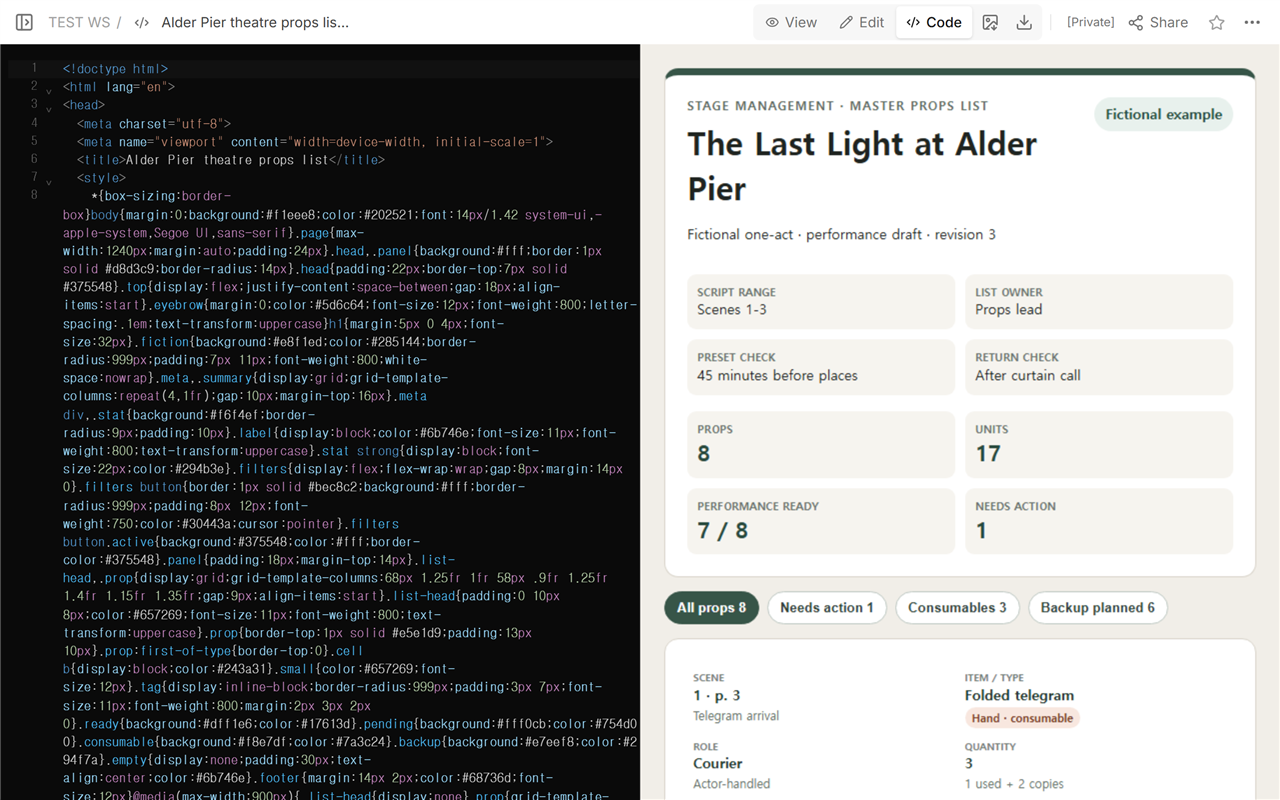
The download is a complete fictional list for The Last Light at Alder Pier, an invented one-act with three scenes. It contains eight props and 17 total units. Every title, character label, scene, page reference, location, and production detail was created for this example. It does not reproduce a published play or describe a real cast or performance.
How do you find every prop in a play?
Read the play once for the story, then read it again for objects that a performer handles, carries, gives, consumes, breaks, reveals, or leaves behind. Add set dressing only when someone must place, move, check, or reset it. Record the scene and page or cue beside the item instead of relying on memory.
StageAgent's public props-list guidance groups entries by scene, item, quantity, and notes. It also recommends recording where an item sits before and after use and whether it is actor-handled, breakable, or needs a backup. Theaterish describes the same list as a living production record: add items found in the play or during rehearsal, then track preset, travel, and post-show location.
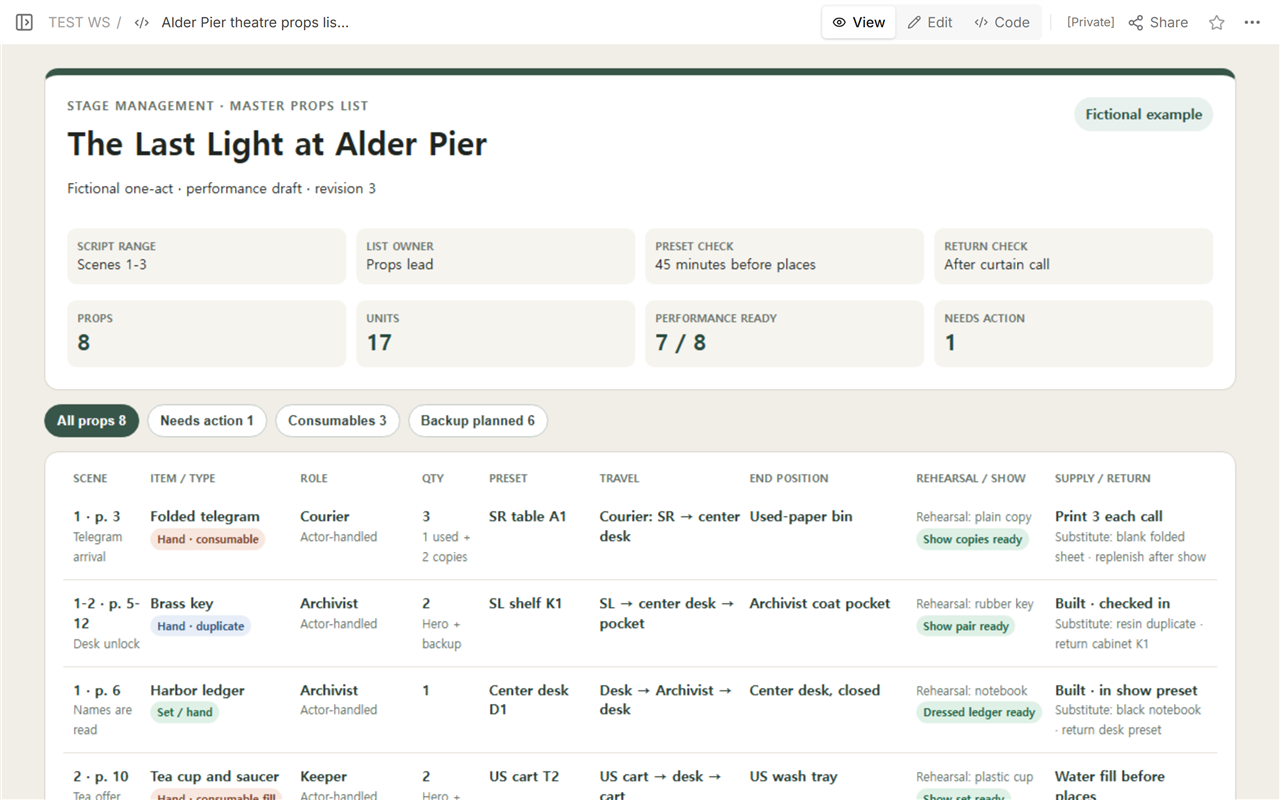
In the fictional example, the folded telegram appears in scene 1, page 3. The Courier collects it at the stage-right table, carries it to the center desk, and drops the used copy in the paper bin. That single row answers what the object is, when it appears, who handles it, where it starts, how it moves, and where it ends.
What columns belong in a theatre props list?
Use enough fields to complete a handoff, not just identify an object. This example uses the following set:
- Scene and page or cue: where the item enters the action.
- Item and type: hand prop, set prop, practical item, consumable, or another production label.
- Quantity: the number used plus any rehearsal or backup units.
- Performer role: the character or crew role responsible for the first pickup.
- Preset: the exact shelf, table, hook, pouch, cart, or entrance where the item starts.
- Travel: the path and handoffs that occur during the scene.
- End position: where the item is left when its action is complete.
- Rehearsal and performance versions: the working object and the show-ready object.
- Consumable, substitute, and status: what must be replenished, what can stand in, and whether sourcing or return work is still open.
Name locations so another person can reset them. “Backstage” is too broad. “SR table A1” and “props cabinet B2” point to one place and can be checked after the show.
How do preset, travel, and end position work together?
A preset is only the start. Follow the item until it stops moving. The battery lantern begins on the stage-right hook, travels to center in the Keeper's hand, and finishes on the dock crate. The suitcase begins at the stage-right entrance, pauses on the dock crate, leaves stage left, and finishes on the return mat.
When an item changes hands, name both the route and the receiving role. The glass-look compass travels from the Courier's pouch to the Archivist and then to the dock crate. Its final storage location is separate from its onstage end position: after curtain call, it returns to cabinet B2.
How do rehearsal props differ from performance props?
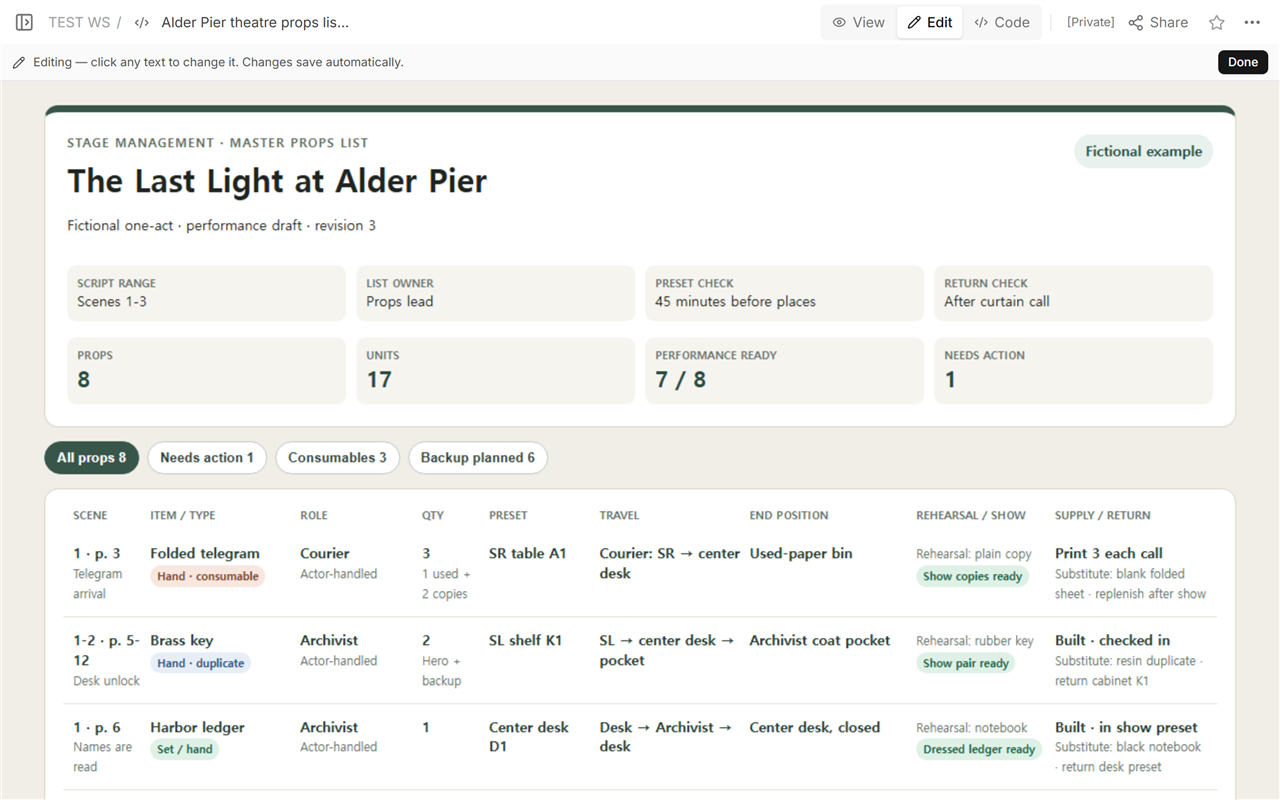
Track both versions in the same row so a working object is not mistaken for the show object. The fictional lantern uses a foam version in rehearsal and a charged battery pair in performance. The brass key uses a rubber rehearsal key and a show pair. The compass begins with a painted wood disc and later receives its glass-look performance copy.
The row should state which version is ready. “We have a lantern” is not the same as “the charged performance pair is ready.” If a working substitute changes size, weight, grip, timing, or placement, note that difference where the team can see it.
How do you track consumables and backups?
Write a repeatable quantity and a replenishment action. The telegram row calls for three copies at each performance: one used copy and two replacements. The red ribbon row calls for four cut lengths. The tea set keeps a spare cup and names the fill and wash steps separately.
Not every backup must look identical. A substitute is useful only when the list explains its limit. The painted wood disc can stand in for the compass during rehearsal, but the final list does not label it as the performance copy. The LED work light can preserve the lantern's handling path during a rehearsal, but it is not presented as the finished visual item.
What changed before the list was performance ready?
The first shared version showed seven of eight props ready. The compass still said “Performance copy pending,” its post-show location was undecided, and the Needs action filter contained one row.
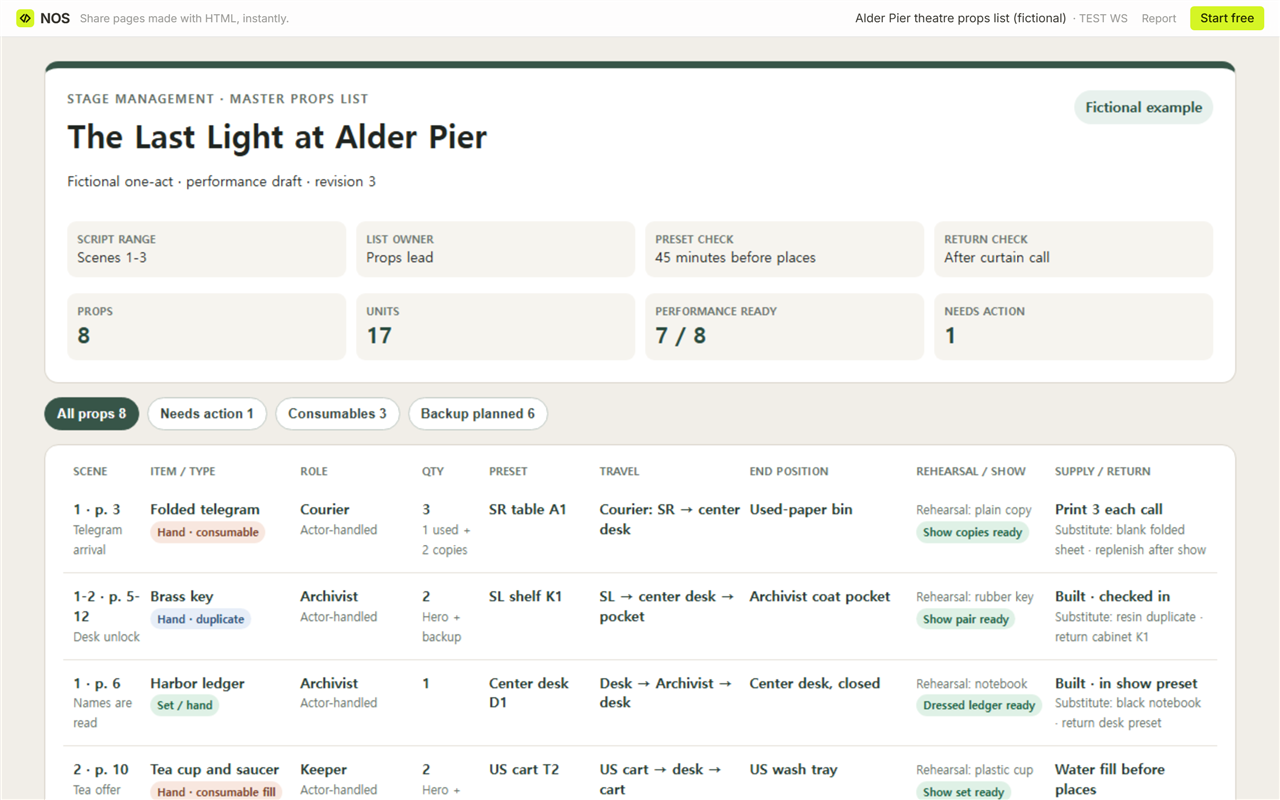
We updated the existing page after the show compass was checked in. Its status changed to “Performance copy ready,” and its return location became “Props cabinet B2.” The finished source and View then showed eight of eight ready and zero items needing action.
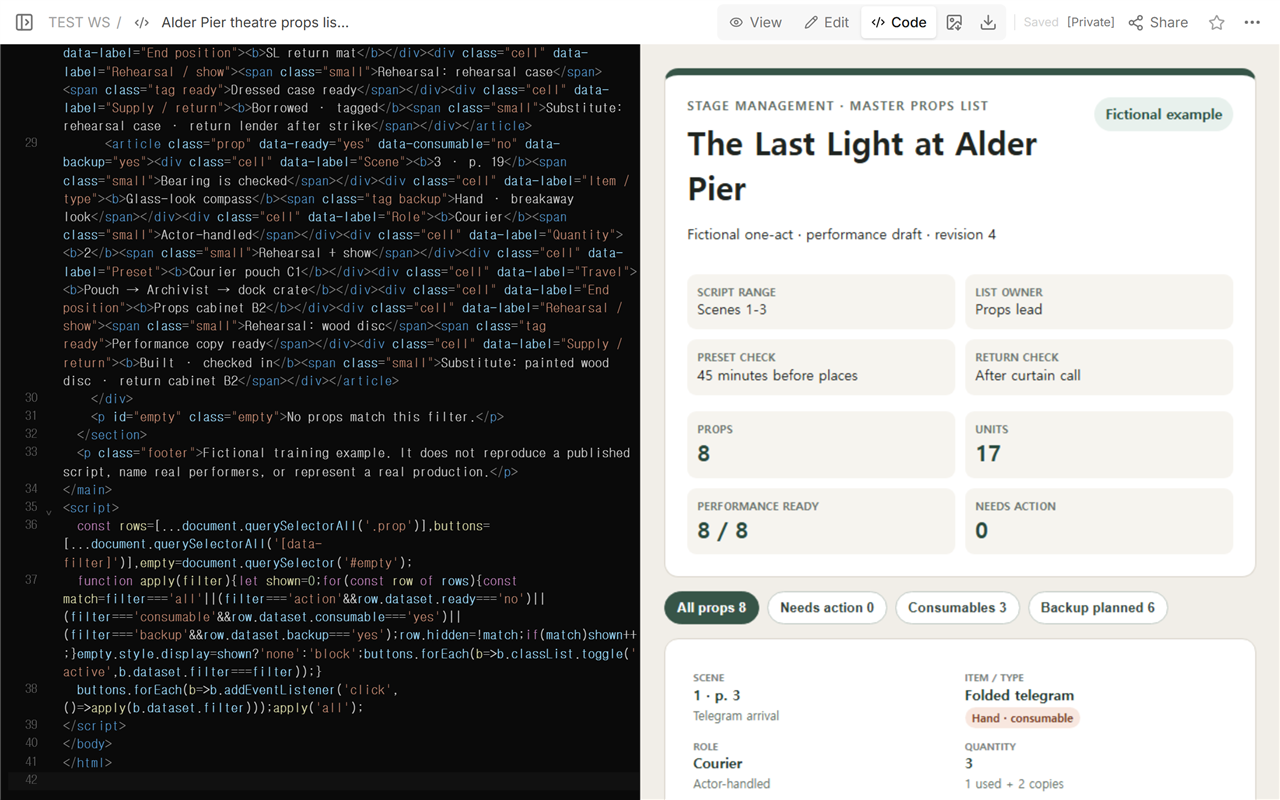
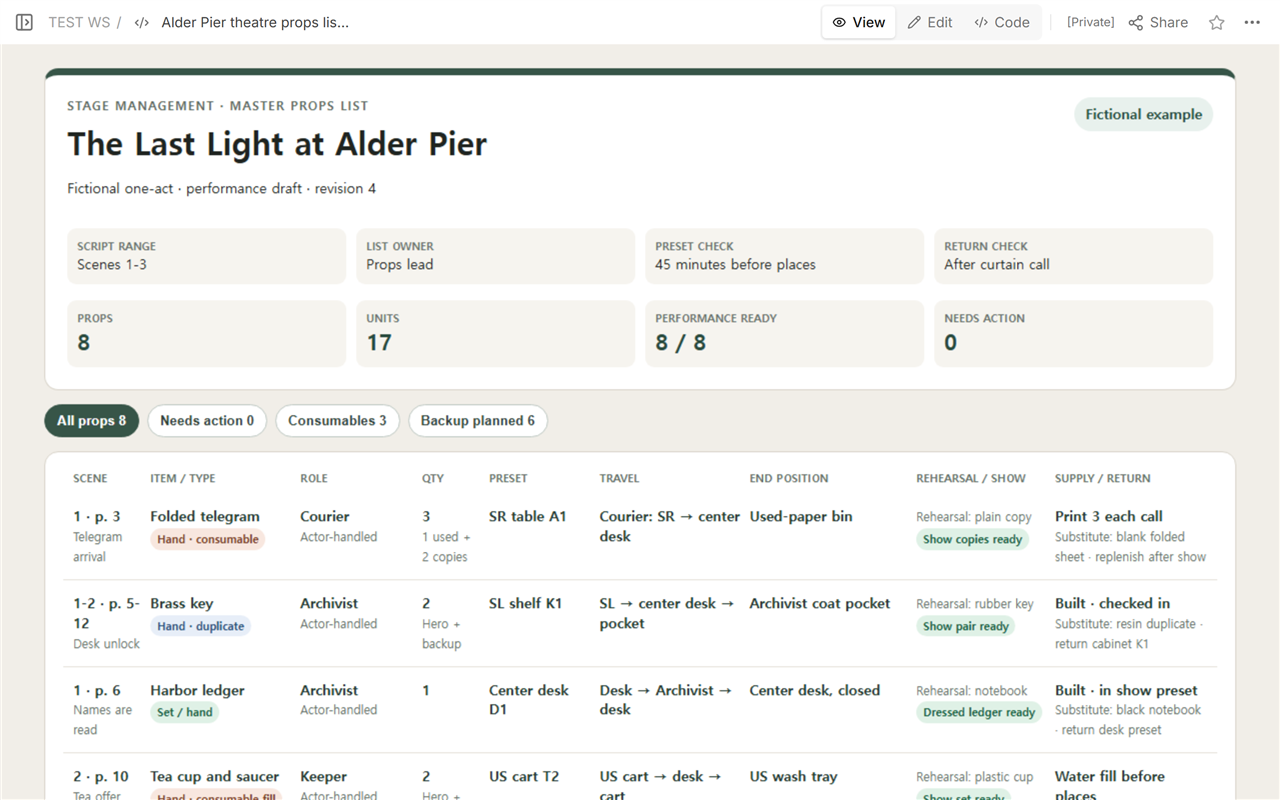
We reopened the original reader address and selected the Needs action filter. The label now showed zero, and the filtered list showed no matching props. The reader did not need a replacement link.
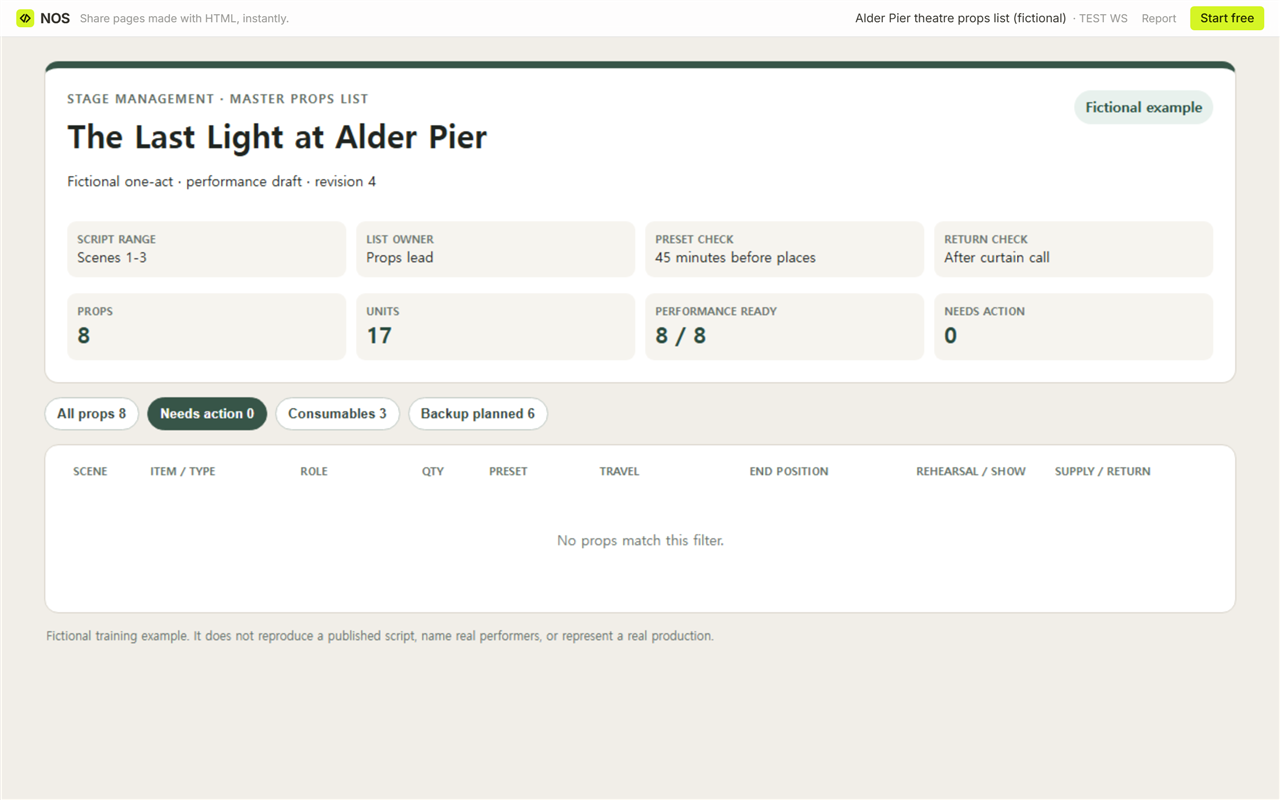
Result: the final fictional list accounts for eight props from first preset through onstage travel and post-show return. It also separates three consumable rows, six backup plans, and all rehearsal and performance versions.
What happens to props after the performance?
Read the list from the end-position column into the supply-and-return column. Used telegrams go to the paper bin and fresh copies are printed. Cups go to the wash tray before returning to cart T2. The lantern pair goes to the charging shelf. The borrowed suitcase rests on the stage-left return mat after the scene and goes back to its lender after strike.
Count consumables against the quantity needed for the next call. Check battery items, separate damaged pieces, and return borrowed objects under the production's own agreement. If an object is missing from its end position, leave its row open until the production's responsible role resolves it.
When not to do this
- Do not use a props list as a rehearsal report. A rehearsal report records one completed call and routes department notes; this list follows physical items across the whole play.
- Do not use it as a costume plot. Clothing changes, fittings, and wardrobe maintenance need their own record.
- Do not publish unsafe handling details, private contact information, restricted access instructions, or material you are not allowed to share.
- Do not replace a venue's required safety, borrowing, inventory, or incident process with this example.
Where does NOS belong in a props handoff?
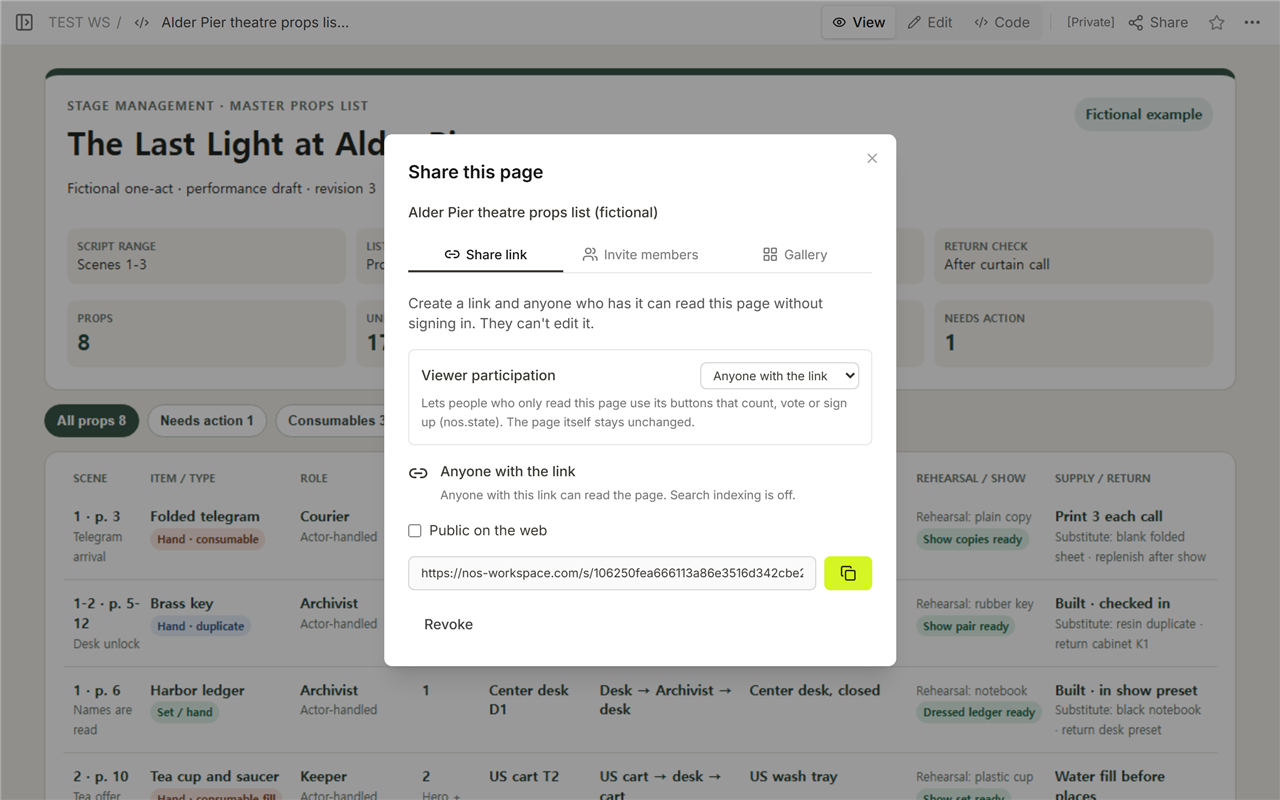
NOS displayed the self-contained fictional list in Code, View, and Edit and provided a reader link through Share. We completed the compass on the existing page and reopened the same reader address to check the revised totals and filter. NOS does not decide whether an item is safe, sourced, approved, or correctly returned; the production's designated people must verify those facts. The NOS pricing page lists the current plans.
Use the stage manager rehearsal report template when you need to record one completed call and department follow-ups. Use the film production files guide when the task is sharing changing call sheets, schedules, or review cuts rather than tracking stage objects. For a general check-in and return record outside theatre, see the rental inventory checklist.