In short
State the decision the visit must support before you set the route.
Assign visitor and host roles, then list access, parking, pre-read material, and equipment.
Give every stop a time, activity, place, movement note, and host preparation.
Finish with recorded observations and a decision log that names one owner, due date, and completion record for every open item.
A site visit agenda is more than a public timetable. It prepares people for a physical place, tells them what to inspect, and turns what they find into decisions. A general event schedule can stop when every attendee knows where to be. A site visit agenda is not finished until the team records what it saw and assigns the work that remains.
The complete example below is a fictional facilities-planning visit to Harbor Arts Center. Its purpose is to decide whether Workshop B can host a twelve-person evening ceramics program. The example contains no real visitor names, phone numbers, access codes, addresses, or emergency instructions.
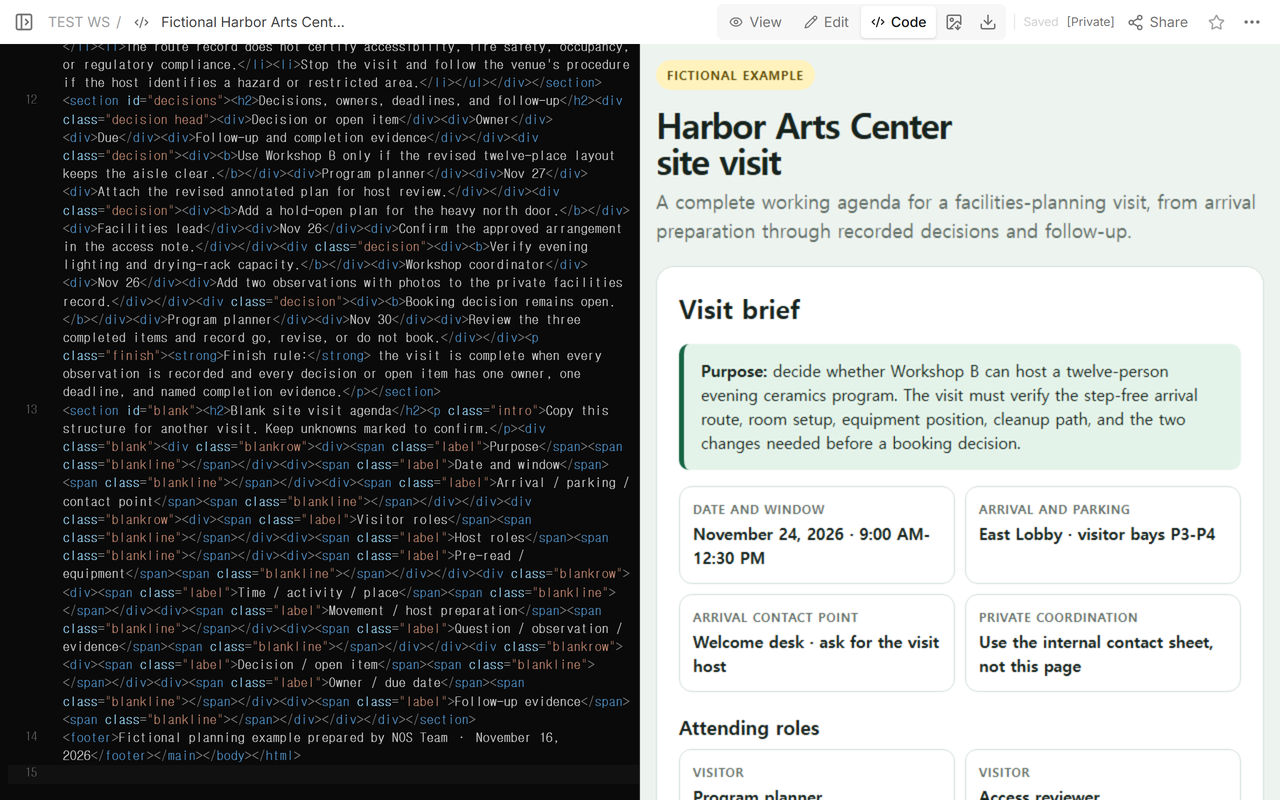
Copy the complete Harbor Arts Center example
Visit brief
- Purpose: Decide whether Workshop B can host a twelve-person evening ceramics program by checking the step-free route, room setup, equipment position, cleanup path, and two changes needed before booking.
- Date and time: 24 November 2026, 9:00 AM-12:30 PM.
- Arrival: East Lobby; visitor bays P3-P4; ask for the visit host at the welcome desk.
- Visitor roles: program planner and access reviewer.
- Host roles: facilities lead and workshop coordinator.
- Pre-read: draft room plan, program requirements, open questions, and the approved visitor and photography boundary.
- Equipment: tape measure, notebook, printed room plan, sample storage crate, host key, and visitor badges.
Timed route
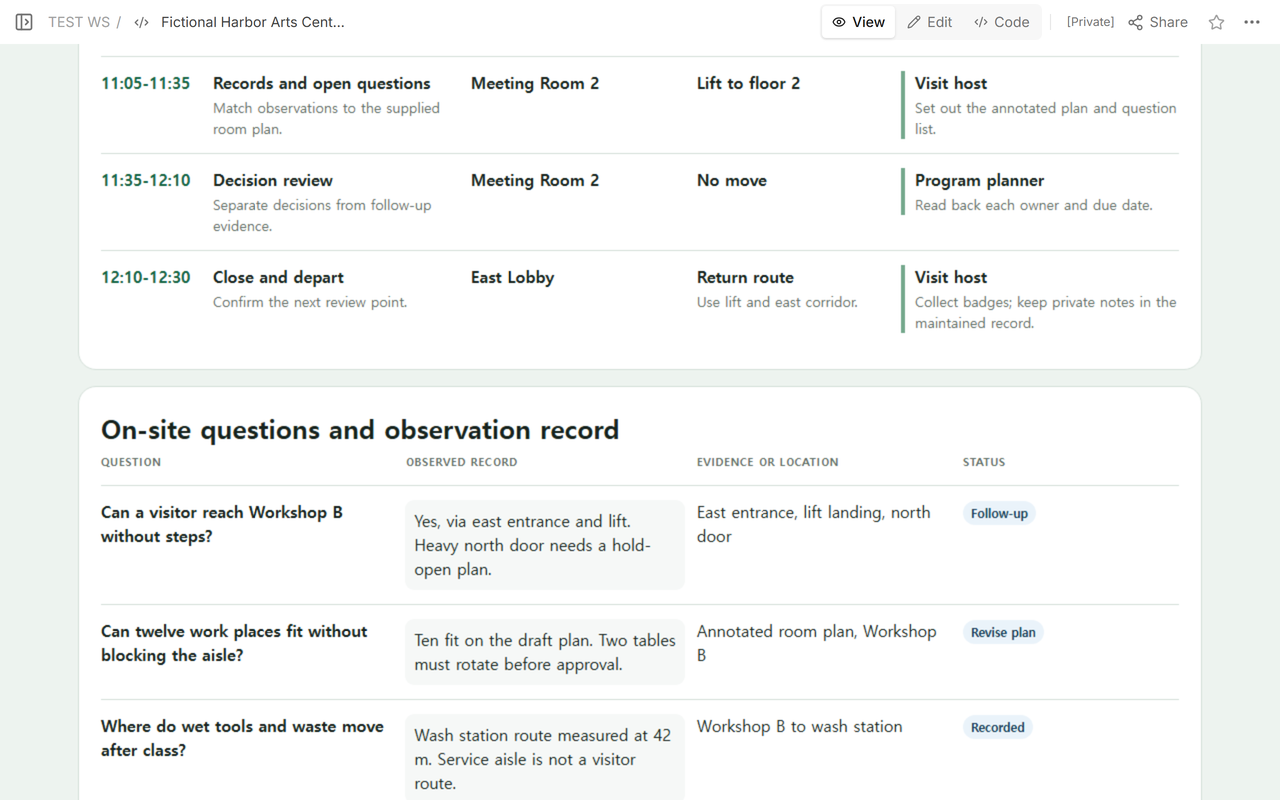
- 9:00-9:15, East Lobby: welcome and purpose check; arrive from visitor bays; host stages badges, route card, and the current access note.
- 9:15-9:35, east entrance to Workshop B: check the step-free route and pause at the lift landing; facilities lead keeps the route clear and opens Workshop B.
- 9:35-10:20, Workshop B: compare the room plan with the actual setup and enter by the north door; workshop coordinator stages the sample crate and identifies fixed equipment.
- 10:20-10:35, Workshop B to wash station: record the measured 42 m cleanup route; facilities lead unlocks the wash station and closes the service aisle to visitors.
- 10:35-11:05, wash station: interview the host about tools, waste, and drying racks; workshop coordinator brings the current cleanup checklist and rack plan.
- 11:05-11:35, Meeting Room 2: match observations to the supplied room plan after taking the lift to floor 2; host sets out the annotated plan and question list.
- 11:35-12:10, Meeting Room 2: review decisions without moving; program planner reads back every owner and due date.
- 12:10-12:30, East Lobby: close and depart by lift and east corridor; host collects badges and keeps private notes in the maintained record.
On-site record
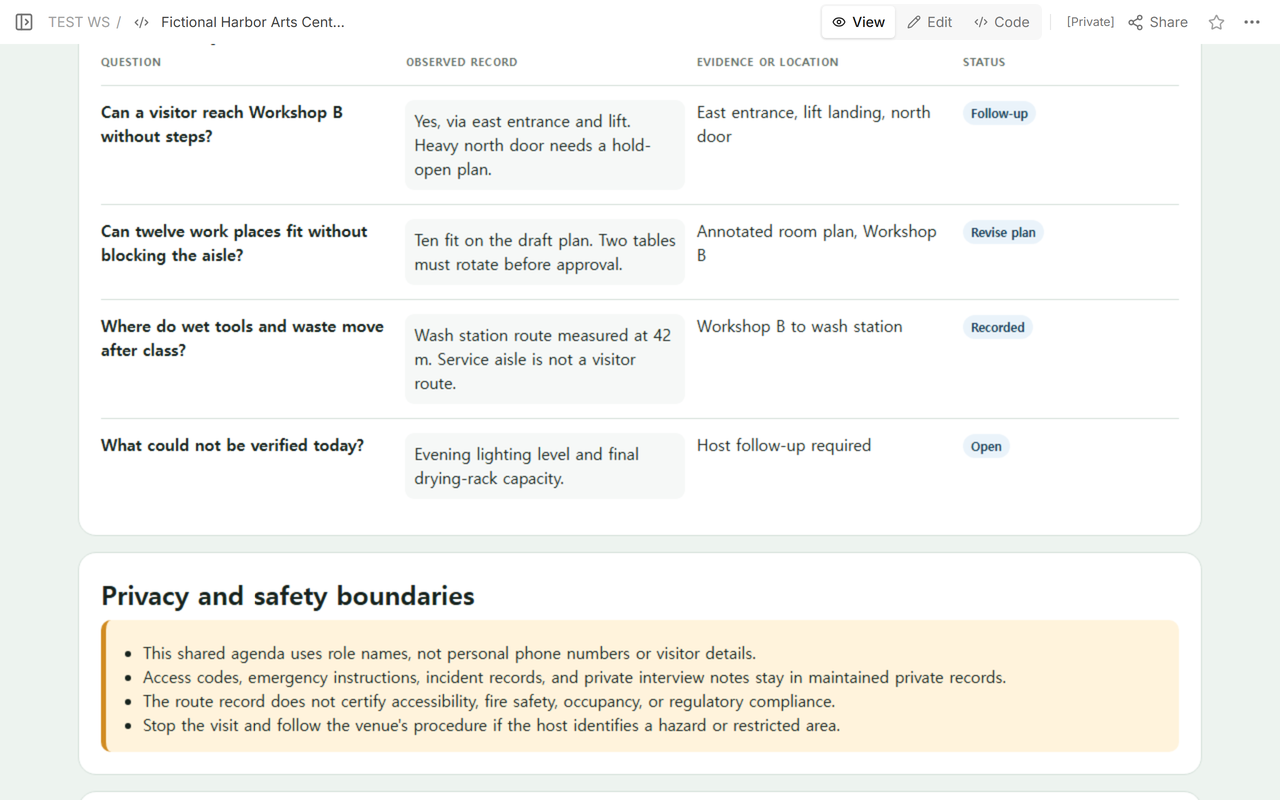
- Step-free route: the east entrance and lift reached Workshop B without steps, but the heavy north door needs a hold-open plan; follow-up.
- Twelve work places: ten fit on the draft plan and two tables must rotate before approval; revise the annotated room plan.
- Wet-tool and waste route: the route to the wash station measured 42 m, and the service aisle is not a visitor route; recorded.
- Unverified conditions: evening lighting and final drying-rack capacity could not be checked; host follow-up required.
Privacy and safety boundary
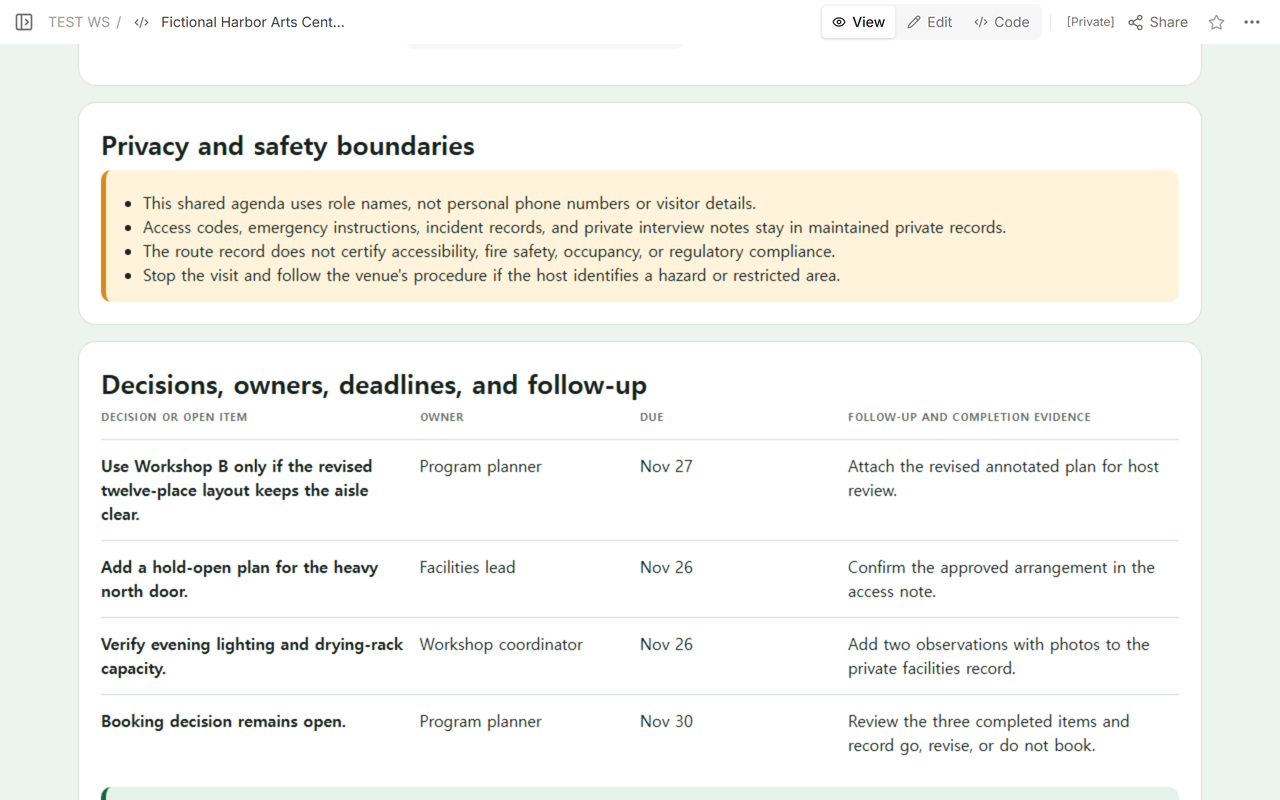
The shared agenda uses roles and a public contact point. Personal phone numbers, access codes, emergency instructions, incident records, and private interview notes remain in their maintained records. The visit records observations only; it does not certify accessibility, fire safety, occupancy, or regulatory compliance.
Decisions and follow-up
- Revised twelve-place layout: program planner, due 27 November; attach the revised annotated plan for host review.
- North-door hold-open plan: facilities lead, due 26 November; confirm the approved arrangement in the access note.
- Evening lighting and rack capacity: workshop coordinator, due 26 November; add two observations with photos to the private facilities record.
- Booking decision: program planner, due 30 November; review the three completed items and record go, revise, or do not book.
Finish rule: every observation is recorded and every decision or open item has one owner, one deadline, and named completion evidence.
What should you prepare before a site visit?
Start with one sentence that names the decision. “Review Workshop B” is too broad. “Decide whether Workshop B can host a twelve-person evening ceramics program” tells the team what the route, questions, and evidence must support.
Then fill the details people need before arrival:
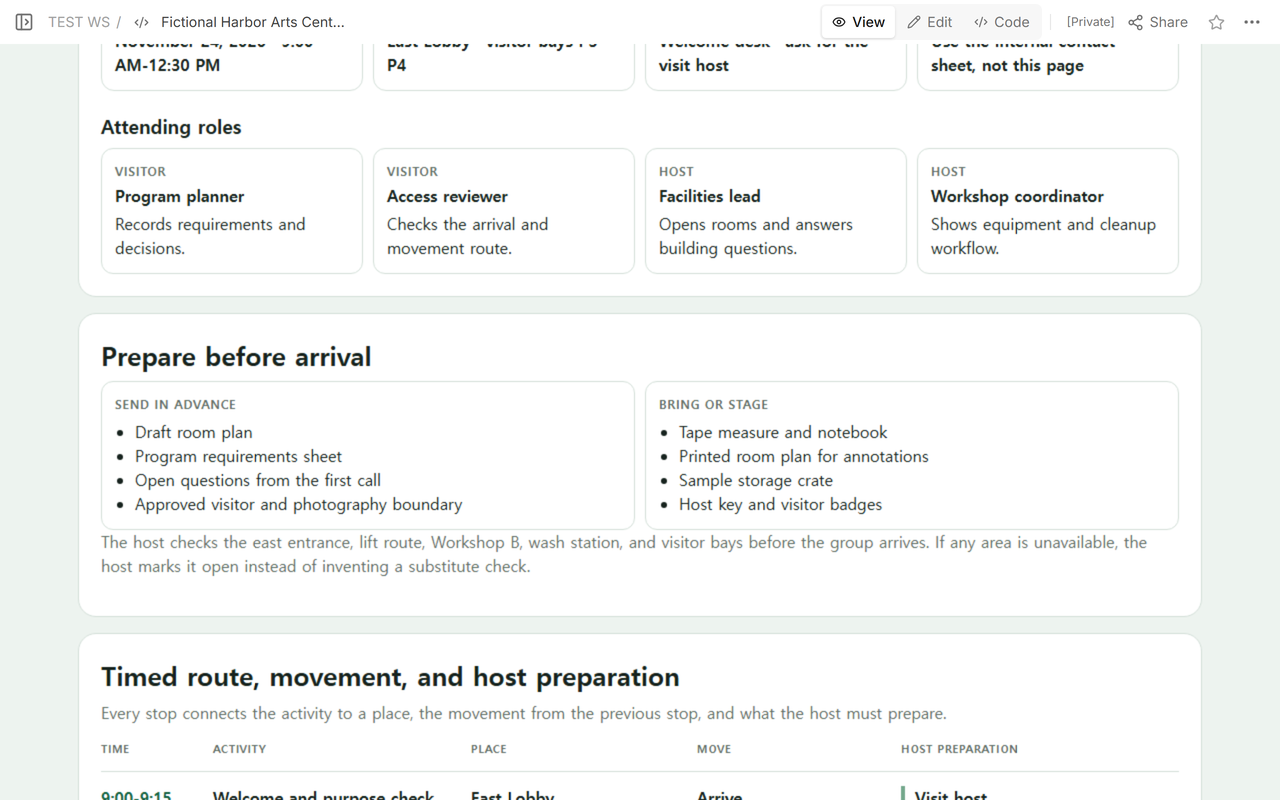
- Attending roles: who records requirements, checks access, opens rooms, and explains the work carried out there.
- Access and arrival: date, window, entrance, visitor parking, and a public contact point such as a welcome desk.
- Private coordination: the maintained record for personal phone numbers, access codes, and sensitive visitor details.
- Pre-read and questions: the room plan, program requirements, known gaps, and approved photography boundary.
- Equipment: what visitors bring and what the host stages before the group arrives.
The ACAHM Site Visit Manual, updated February 2026, separates the purpose of a visit, preparation, team roles, agenda development, interviews, observations, private team discussion, and report work. Those are accreditation-specific procedures, not universal requirements, but they show why a working site visit document needs more than times and rooms.
How do you run the visit without losing the purpose?
Use one chronological route. Each stop in the example has five fields: time, activity, place, movement from the previous stop, and host preparation. That keeps physical handoffs visible. The 10:20 AM move from Workshop B to the wash station, for example, is a separate route check rather than a note hidden inside the next interview.
The route should reserve time for the work that produces an answer, not just a tour. The IEDC AEDO guide gives one domain-specific example: its sample agenda includes evaluation of offices and facilities, staff and stakeholder interviews, a community tour, debriefing, and time to draft a preliminary report. Our fictional example adapts that practical sequence into room review, workflow interview, record matching, and decision review.
What should you record on site?
Write questions that can produce a visible record. The example asks whether a visitor can reach Workshop B without steps, whether twelve work places fit without blocking the aisle, where wet tools and waste move, and what could not be verified during the visit.
For each question, record the observation, the place or evidence behind it, and a status. Do not turn a partial observation into approval. The draft room plan fit ten work places, so the record says the two remaining tables need a revised plan. Evening lighting and drying-rack capacity were not checked, so they remain open.
Keep the shared agenda useful without turning it into the venue's private operations record. The example uses role names and a public welcome point. Personal contacts, access codes, emergency instructions, incident records, and private interview notes stay elsewhere. It also states what the visit does not certify.
How do you finish a site visit agenda?
End with decisions and open items, not a vague list of notes. Each row needs one owner, one due date, and the record that will show completion. In the example, the booking decision remains open until the revised layout, north-door arrangement, evening lighting, and rack capacity are reviewed.
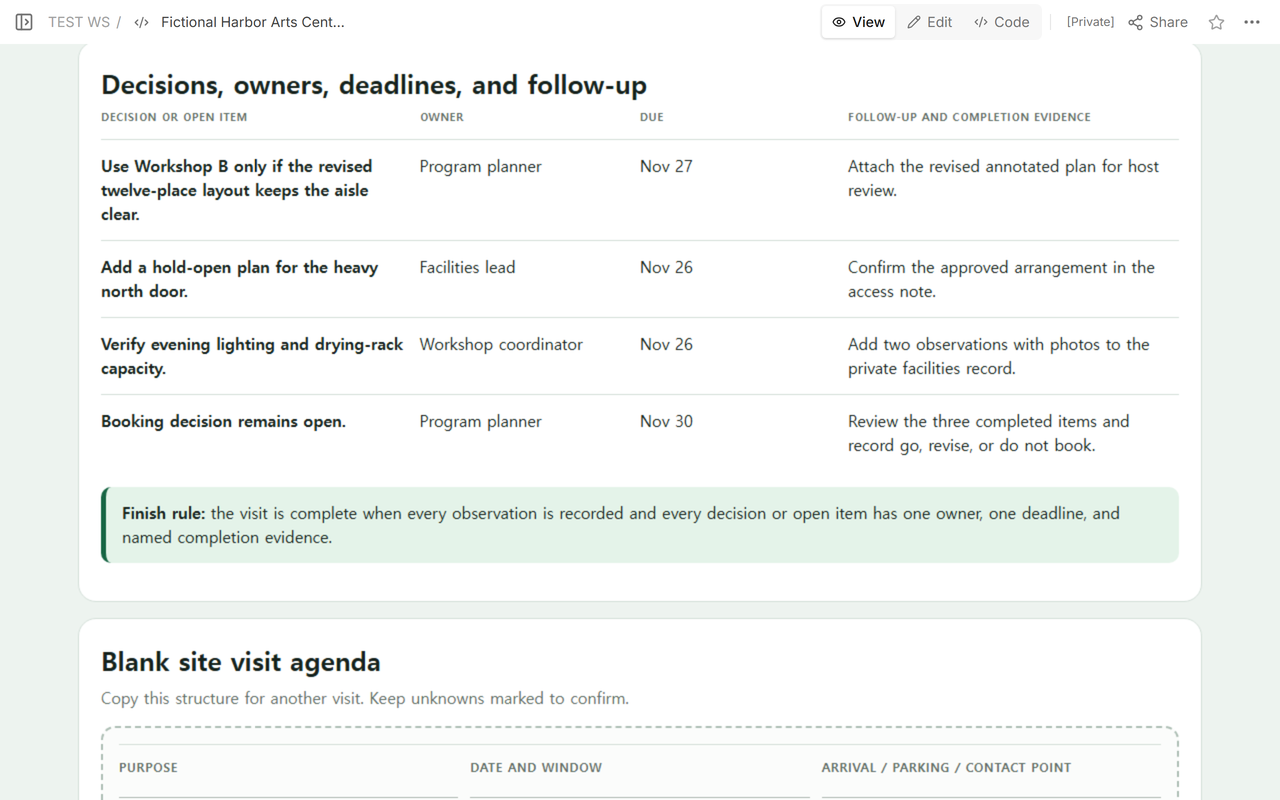
Result: the fictional visit ends with four traceable rows. Nobody has to infer who acts next, when the work is due, or what proof the final reviewer should inspect.
Can I copy a blank site visit agenda?
Yes. The blank form keeps the same sequence as the worked example: purpose and arrival, roles and preparation, timed route, on-site questions, privacy and safety boundaries, then decisions and follow-up. Unknown information should stay marked “To confirm” until the responsible person supplies it.
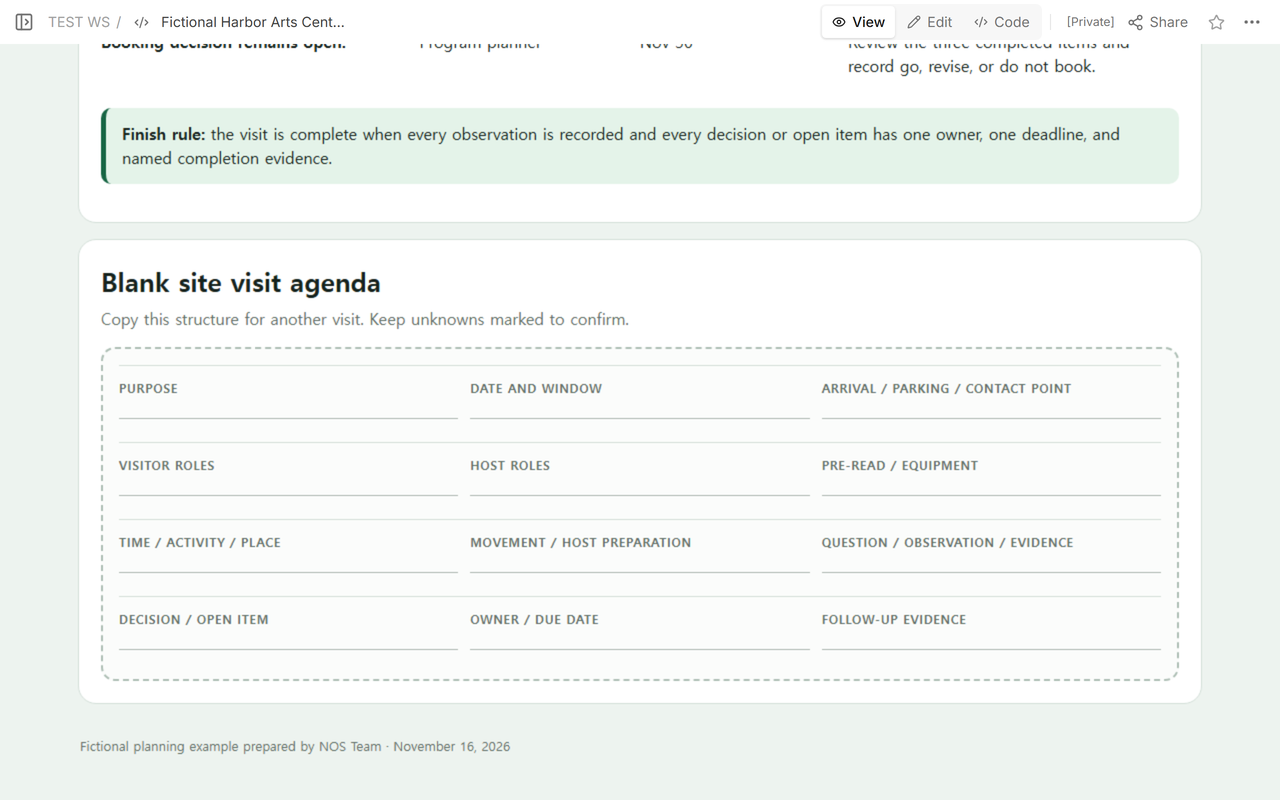
Download the blank site visit agenda
Which related agenda should you use?
Use the event schedule template when the main job is separating attendee timing from staff cues for an event. Use the project kickoff agenda when the meeting must settle scope, acceptance questions, reviewers, and dependencies before delivery. Use this site visit agenda when people must move through a physical location, record observations, and turn those observations into owned follow-up.
When not to do this
- Do not use a shared agenda as the maintained emergency, security, incident, or access-control record.
- Do not copy regulatory or accreditation requirements from the public examples without checking the rules that apply to your visit.
- Do not mark an observation verified when the relevant area, person, or evidence was unavailable.
- Do not close the visit while decisions or open items have no owner, deadline, or completion record.
Using NOS for the working agenda
NOS can keep the purpose, timed route, observations, decisions, and blank form together in one readable workspace page. Share only the agenda readers need, and keep private operational records in their maintained systems. Check the current pricing page for the plan details that apply when you create your own page.