In short
Identify the object before you research its history.
Give ownership, custody, exhibition, and publication their own dated rows.
Attach a source and confidence level to every row; show gaps instead of smoothing them over.
A provenance record supports research. It is not proof of authenticity, title, legality, value, or completeness.
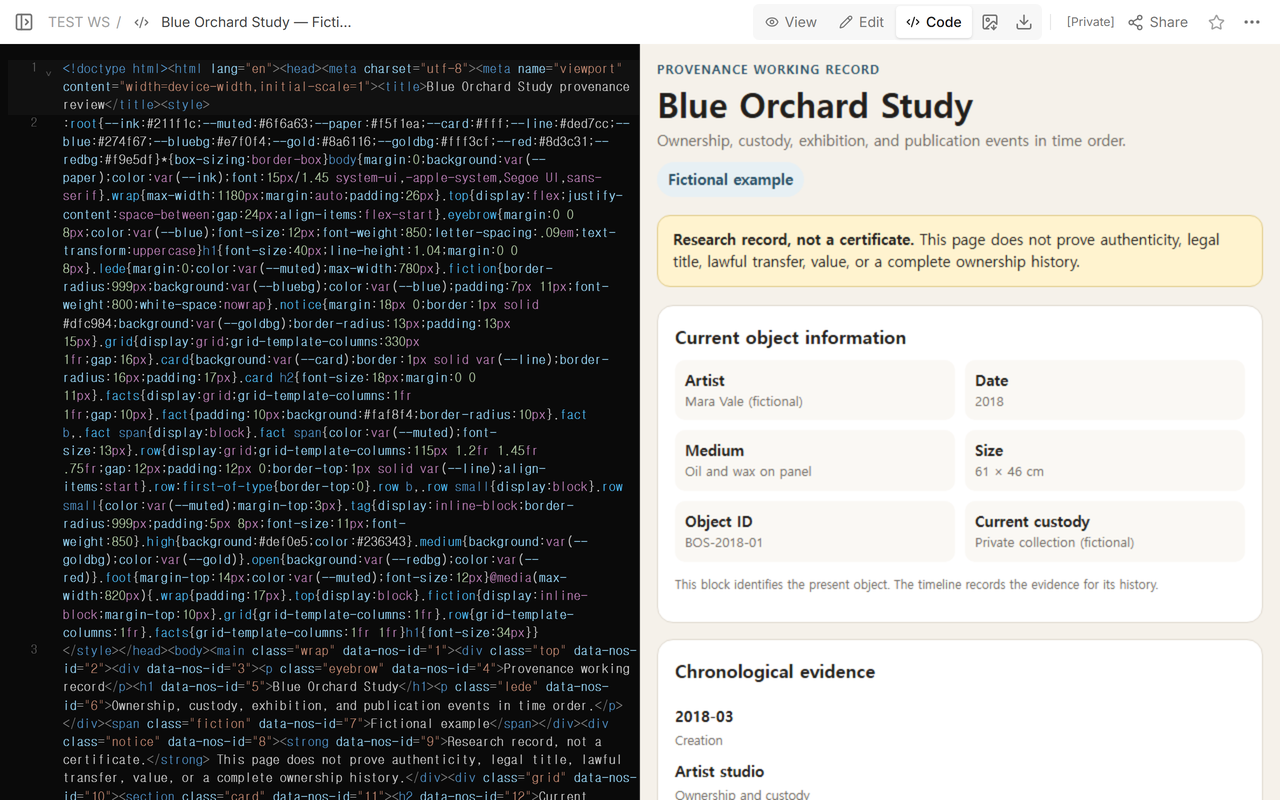
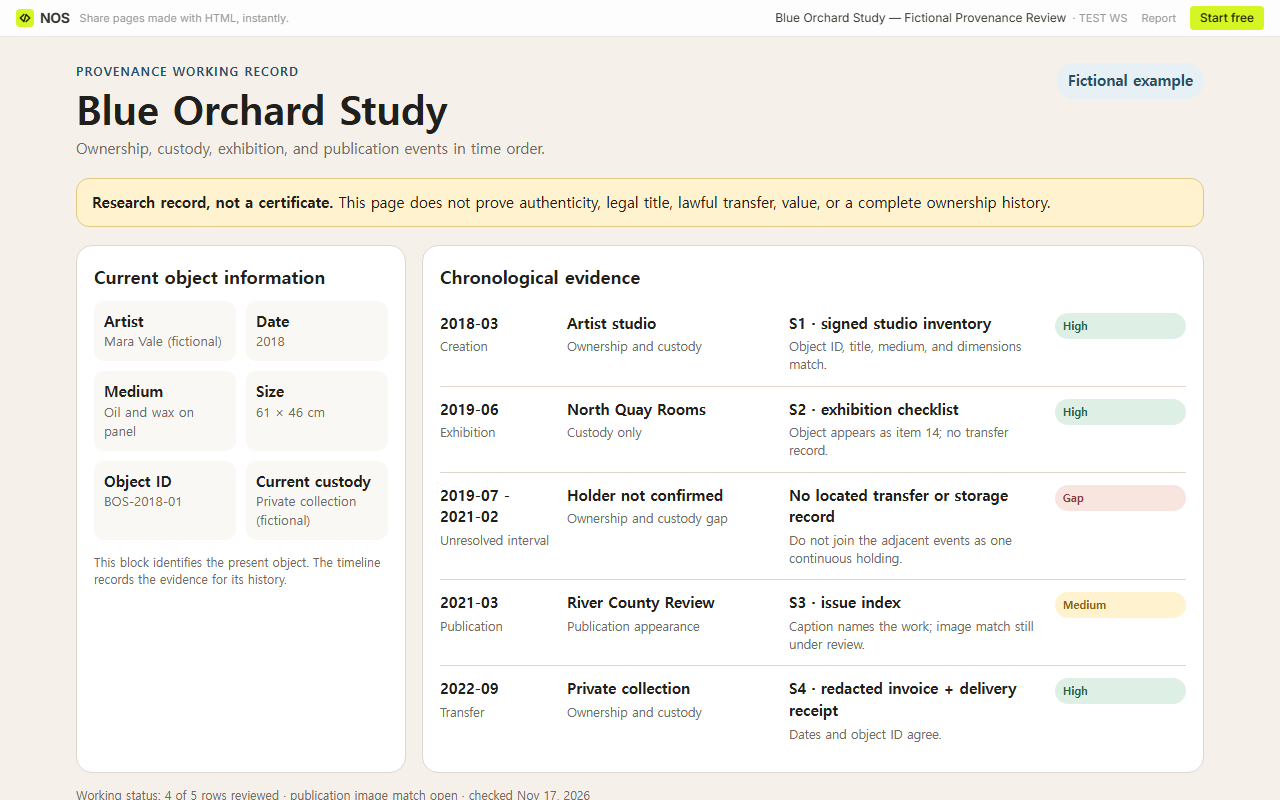
We built a fictional provenance record for Blue Orchard Study. The first version had five chronological rows, but the publication image match was still open. We then added the page reference and image match to that row, saved the revision to the same NOS page, and reopened the same reader address. The final example records separately when we can place the work at a location and when we can name its owner.
What is an artwork provenance record?
Provenance is the historical record of an artwork’s ownership. The International Foundation for Art Research notes that an ideal record includes owners, dates, methods of transfer, and places where the work was kept, while complete unbroken histories are rare. The useful result is therefore not a polished story. It is a sequence that lets a reviewer see what each source supports and where the chain stops.
This differs from an artwork information sheet. The information sheet describes the present object: title, artist, date, medium, dimensions, display notes, and current status. A provenance record asks a different question: what happened to this exact object over time, and what evidence supports each event?
What belongs in each provenance row?
Use one row for one event. Our example separates five fields:
- Date or date range. Use the precision the evidence supports. Do not turn a year into a day.
- Event type. Name creation, ownership transfer, custody, exhibition, publication, or an unresolved interval.
- Person, collection, or venue. Distinguish an owner from a dealer, auction house, borrower, or exhibition venue.
- Source reference. Point to the inventory, checklist, publication, invoice, receipt, label, or other record used for that row.
- Confidence and gap note. State why the match is high, medium, or unresolved.
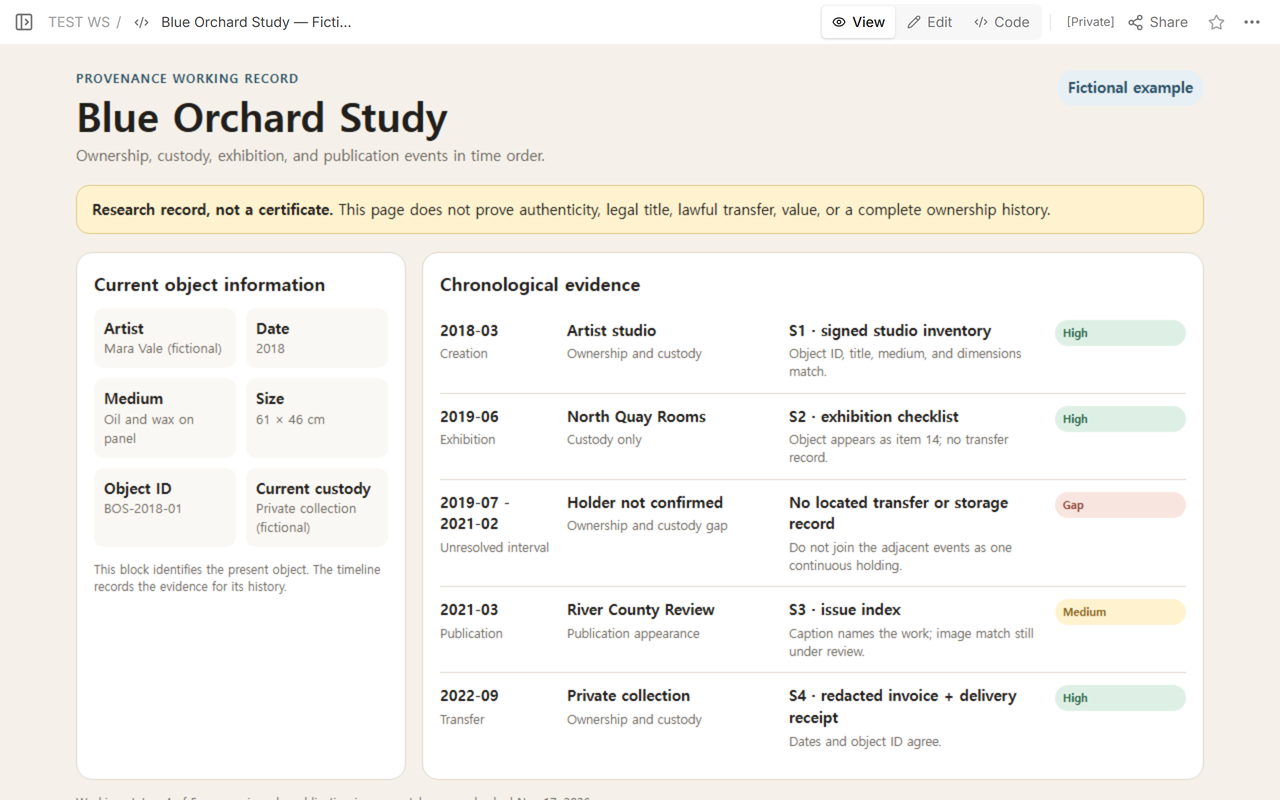
Start by marking the events you can place. In June 2019, the North Quay Rooms checklist puts the work at the venue during the exhibition. The owner is unknown. In March 2021, River County Review shows the work in print and leaves both the owner and the location unknown.
How do you show uncertainty without weakening the record?
Describe the missing evidence precisely. “Unknown” alone does not tell the next researcher what to look for. In this example, the March 2018 studio inventory is the last ownership evidence before the September 2022 acquisition. Custody is unconfirmed between the studio inventory and the June 2019 exhibition, then again from the end of that exhibition until delivery in September 2022. The March 2021 publication falls inside both open intervals.
Confidence labels need a reason. A signed studio inventory that matches the object ID, title, medium, and dimensions supports a stronger identification than an index that names the title but has not yet been matched to the reproduced image. The label should summarize the review, while the source note shows why it received that label.
How should exhibition and publication history be recorded?
Do not silently promote an appearance into ownership. An exhibition checklist can show that the object was listed at a venue during a period. A catalogue or journal can show that the work was published. Neither fact alone identifies who held legal title at that time.
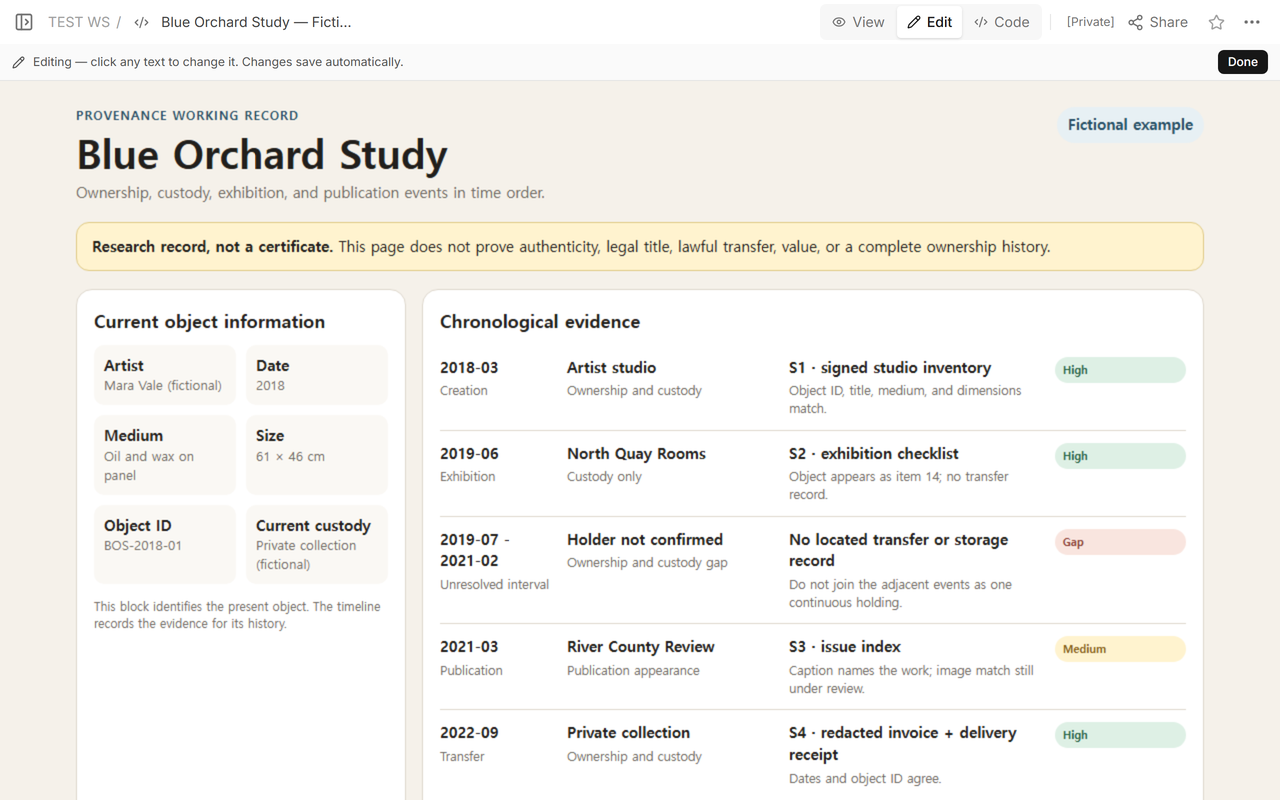
For the fictional publication row, the initial source note said only “issue index” and left the image match under review. We opened the existing page in Edit before the revision, keeping that uncertainty visible to the reader.
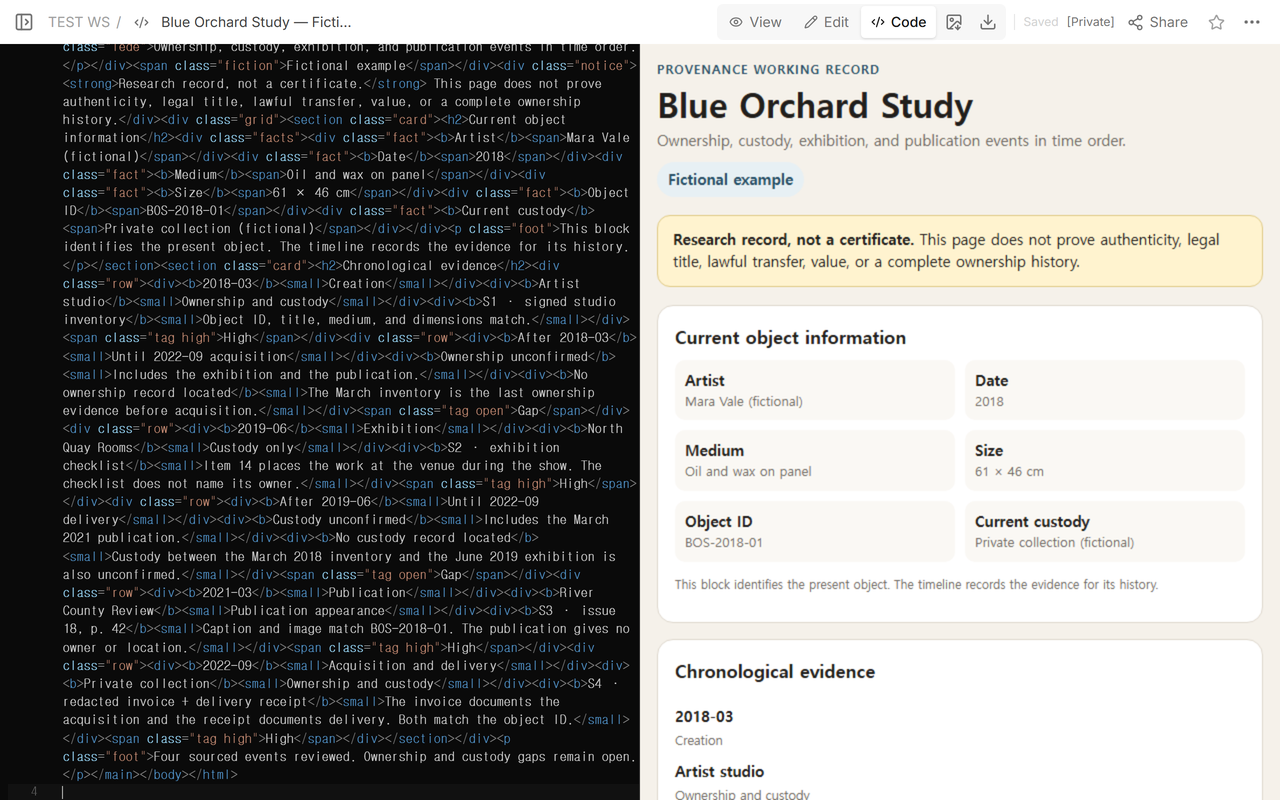
The revised row names issue 18, page 42, and records that the caption and reproduced image match the fictional object ID. That gives high confidence that the published image shows this work. It leaves the owner and custodian in March 2021 unknown.
How do you share a provenance review copy?
Share a review copy only after removing details that should remain private. In this example, the invoice is described as redacted and the current owner is identified only as a fictional private collection. The page contains no address, contact details, purchase amount, insurance value, or access information.
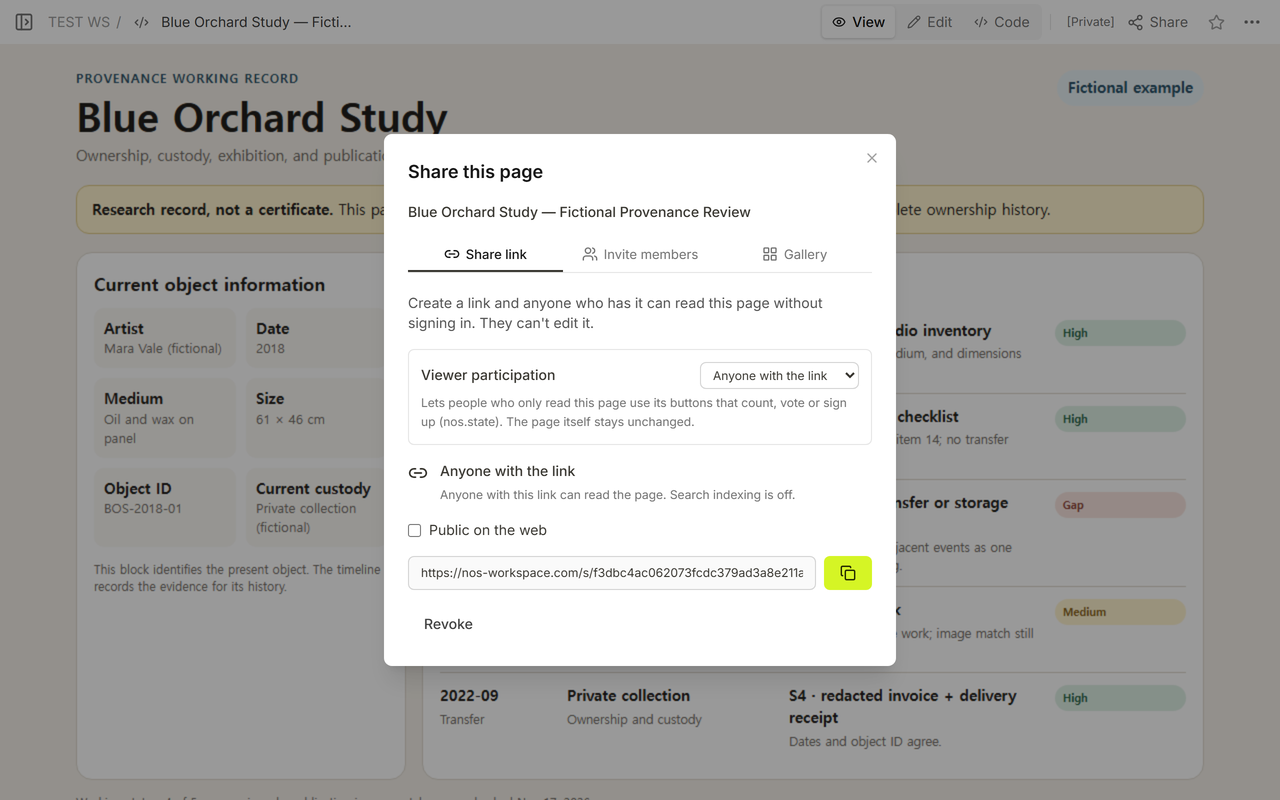
We opened Share and confirmed the reader permission shown for this page: anyone with the link could read without signing in and could not edit. That makes the address useful for review, but it also means the page should contain only material suitable for every person who receives the link.
The first reader copy left the publication check open. Open the finished provenance example at the same address to see the publication match and both gap notes.
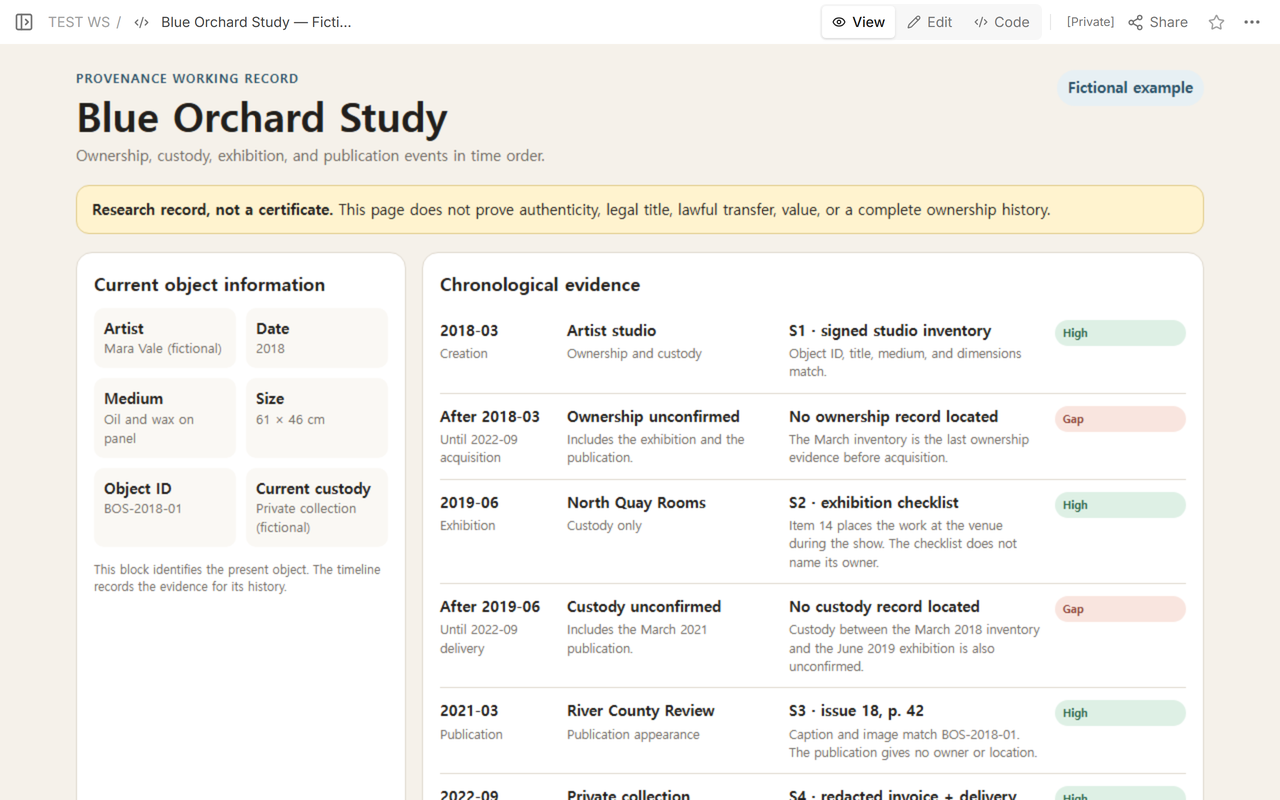
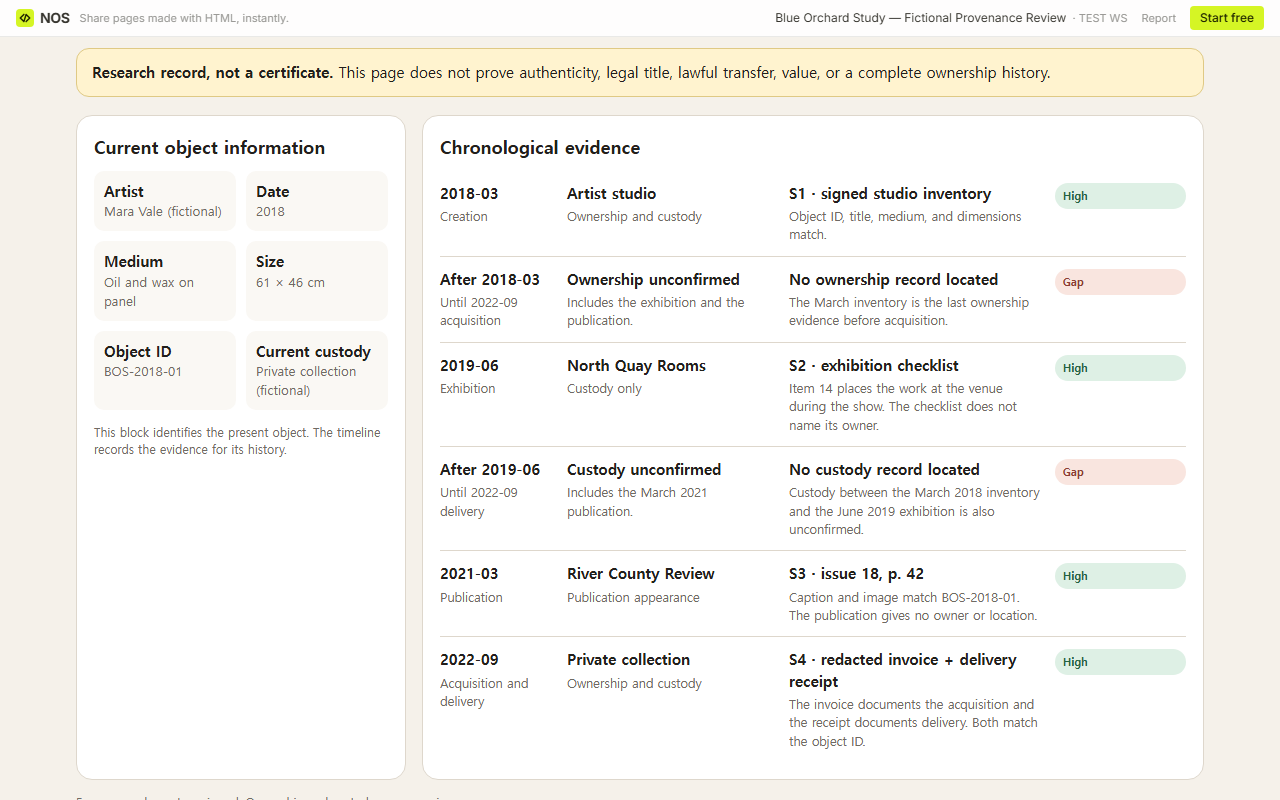
Finished result: the studio inventory, exhibition checklist, journal, invoice, and delivery receipt each support a specific event. The record shows exactly which stretches still need ownership or custody evidence.
Download the complete fictional provenance example
When not to do this
- Do not publish private owner identities, home or storage addresses, purchase amounts, access details, or unredacted transaction records.
- Do not use this page as a certificate of authenticity, proof of legal title, export clearance, valuation, or complete due diligence.
- Do not merge a dealer, auction house, borrower, exhibition venue, and owner into one “holder” field.
- Do not mark a gap as resolved until the source supports the missing date, party, and event.
Where does NOS fit?
NOS Workspace kept the complete fictional record, its rendered View, the editing state, and Share controls in one page. We revised the existing source and confirmed the result at the same reader address. NOS does not authenticate an artwork, decide legal ownership, search archives, or approve a provenance conclusion. See the current pricing page for plan details.
Related next steps
- Use the artwork information sheet guide for the present object facts and display instructions.
- Use the art gallery catalog guide to organize works within one exhibition.
- Use the museum exhibit guide when the reader needs a visitor route rather than an ownership history.
Sources checked
- International Foundation for Art Research: Provenance Guide (archived edition).
- The Metropolitan Museum of Art: Provenance Research, checked Nov 17, 2026.