In short
Give each expected signature a row. Record the mark and printed page range you actually see at that position. Keep the first observation beside the recheck so the next reader can see what changed.
Download the blank checklist CSV · Download the filled checklist CSV · Download the completed example page
What goes on a signature collation checklist?
At position 3 in the fictional Tidepool Pocket Guide, you expect C, pages 17–24. The first check finds B, pages 9–16. The booklet still has four folded bundles, so a count of bundles alone would miss the problem.
A signature is a folded group of printed pages within the booklet. The U.S. Navy printing training manual describes collating as checking that an assembled book contains all its signatures in the right sequence. The Canadian printing quality guide also calls for checking completeness and order. Here, the unit of work is one already-folded sample copy.
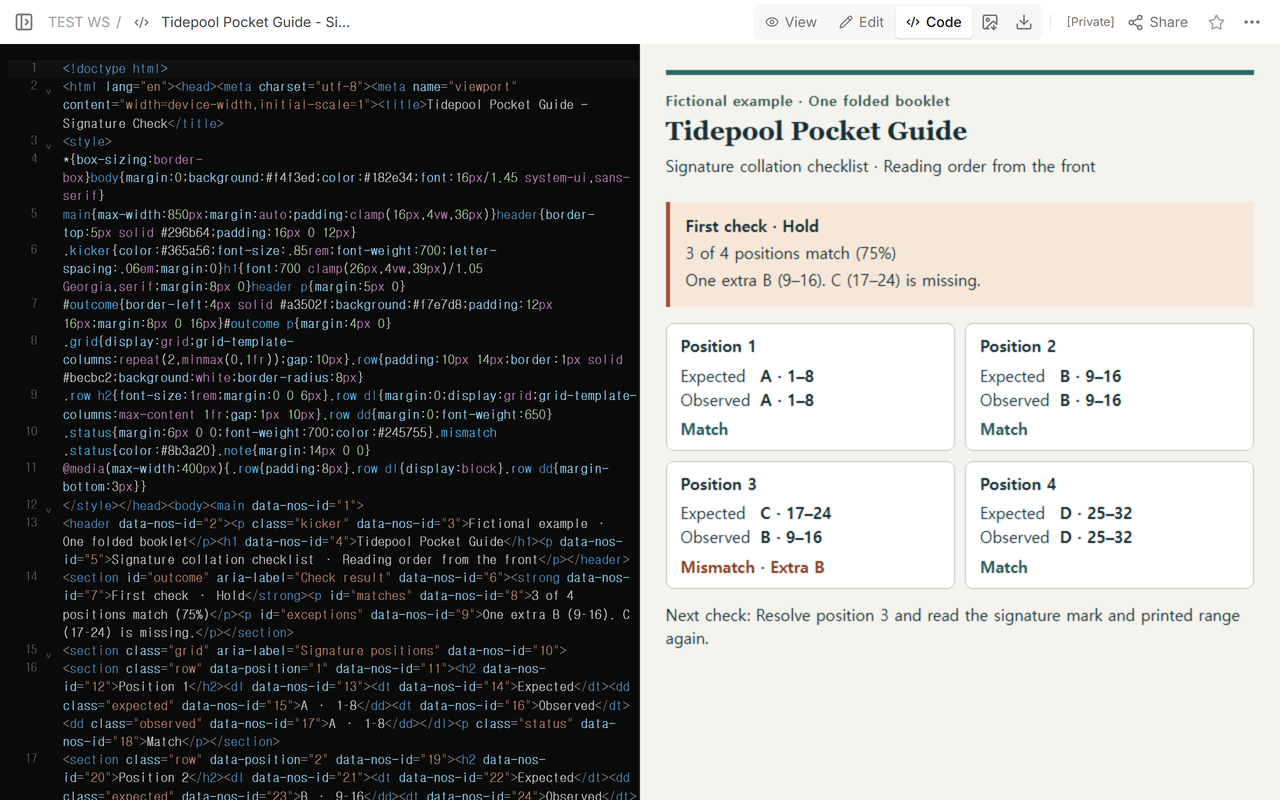
Start at the front of the booklet. Use its approved signature list to fill in the expected columns first. Give each position a number and write the expected mark and printed range. In the next columns, write what you see on the paper. Read the mark and page numbers separately. If the mark says C but the printed range says 9–16, record both and flag the discrepancy.
How do you catch the extra B?
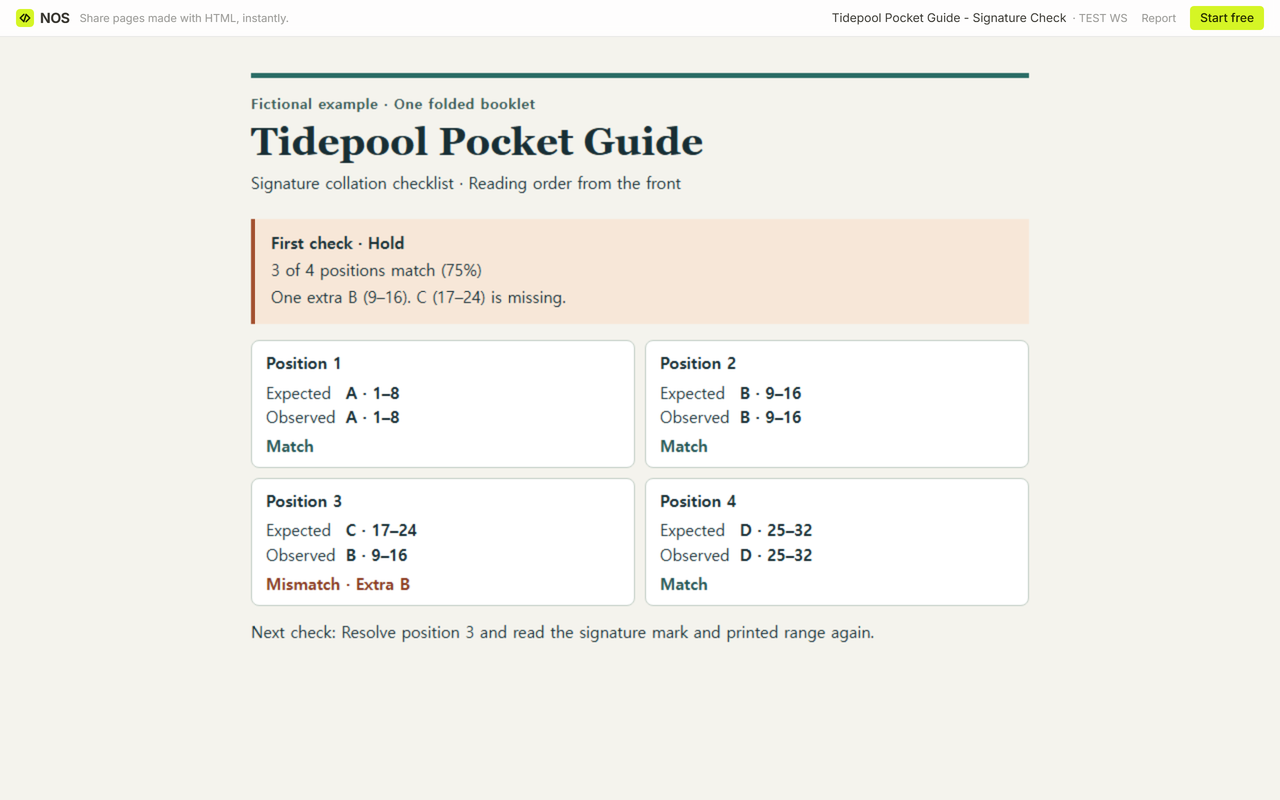
The four expected signatures and the first observations for the sample are below. Each range includes both endpoints.
- Position 1
- Expected A, 1–8 · Observed A, 1–8 · Match
- Position 2
- Expected B, 9–16 · Observed B, 9–16 · Match
- Position 3
- Expected C, 17–24 · Observed B, 9–16 · Mismatch
- Position 4
- Expected D, 25–32 · Observed D, 25–32 · Match
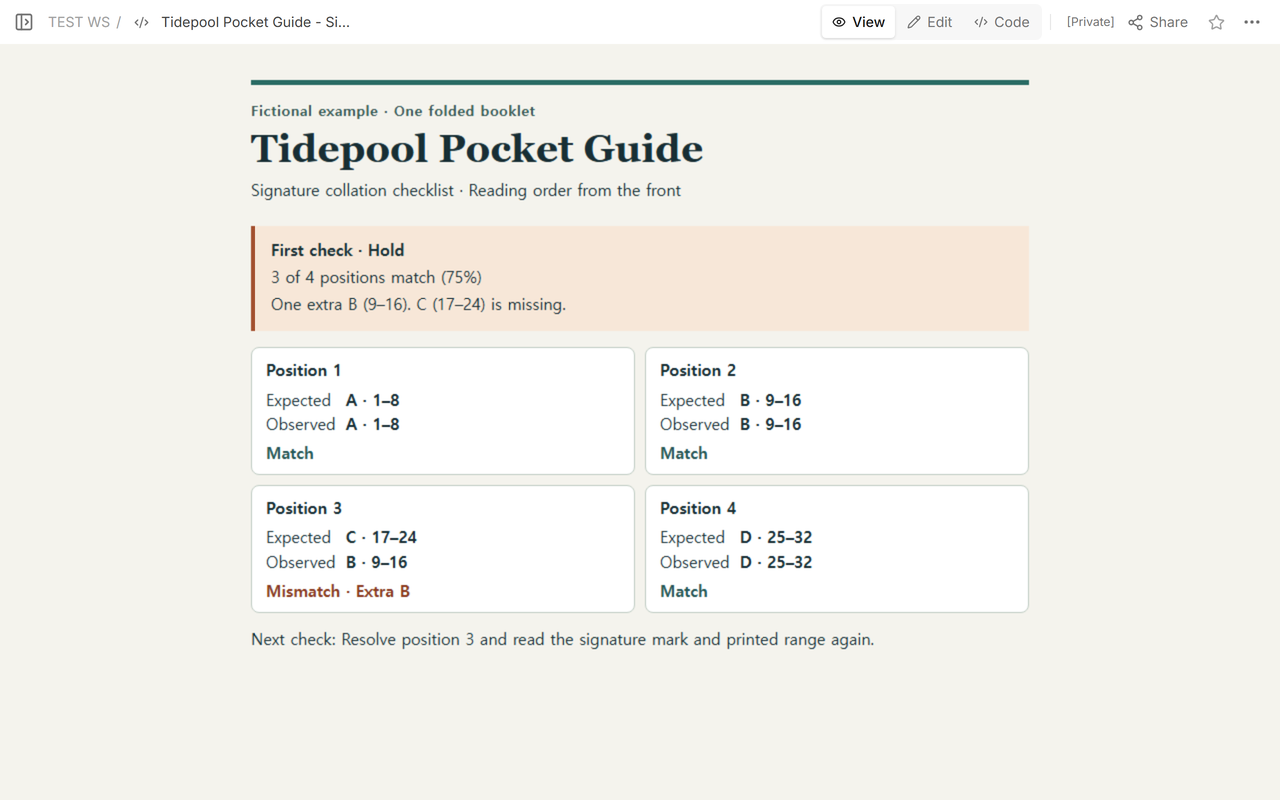
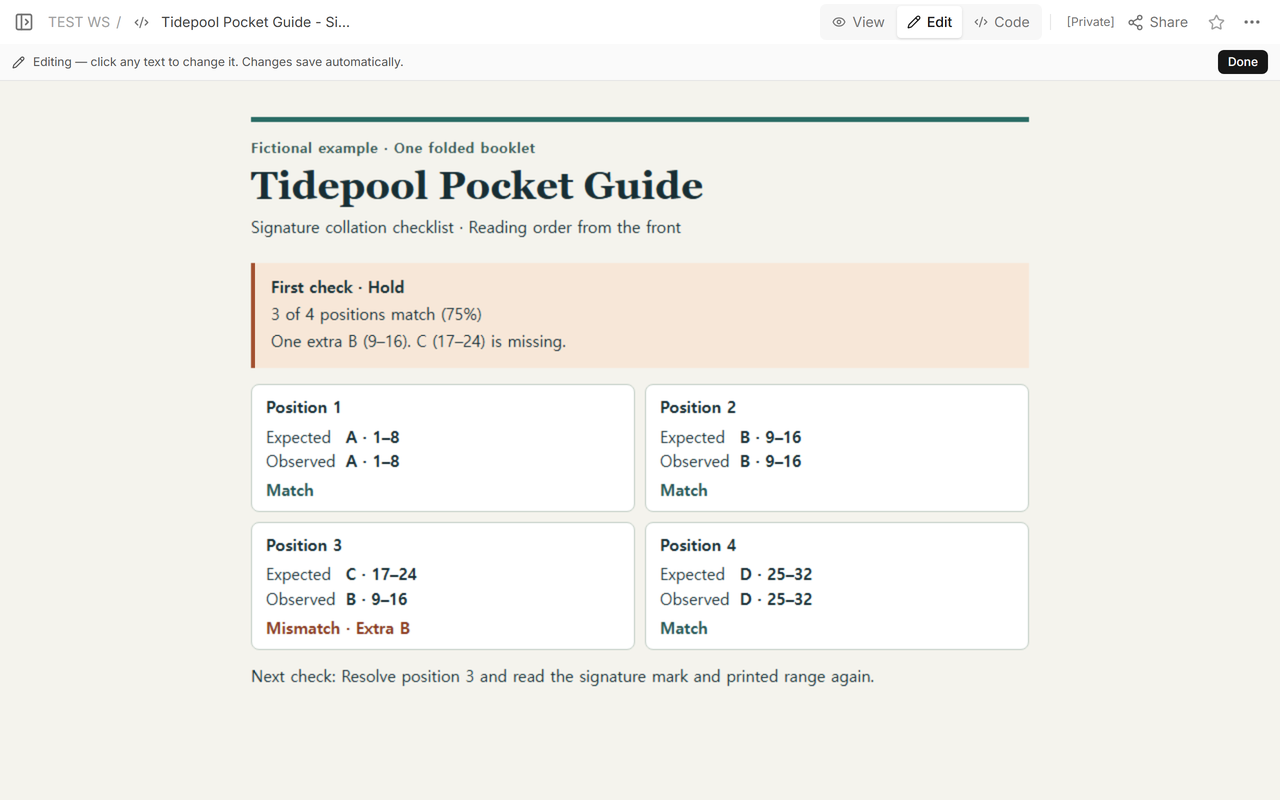
First check. A, B, B, D gives 3 matching positions out of 4. That is 3 ÷ 4 = 75% exactly. B occurs twice for one expected B, and C is absent from the checked copy. That leaves one extra B and one missing C. Pages 9–16 occur twice, and pages 17–24 are missing.
Keep the two checks separate. If both signatures are present but swap places, there are two position mismatches even though neither signature is missing. In the Tidepool example both the sequence and the signature counts flag a problem.
What should a blank observation mean?
Leave the observed mark and range blank if you have yet to inspect that position. If you see a signature but cannot read the mark or a page number, record the part you can read and flag the rest for recheck. Use “Empty on inspection” only if you inspected the position and found it empty. Confirm that a signature is missing only after checking the whole copy. None of those unresolved rows counts as a match. If a range is uncertain, put the estimate in the note and leave the unverified boundary blank.
If you report a percentage while the check is in progress, use all expected positions as the denominator and report how many are still unchecked. If you have no expected positions yet, leave the percentage unset. The worked example has four expected positions and uses exact percentages in both passes.
How do you close the recheck?
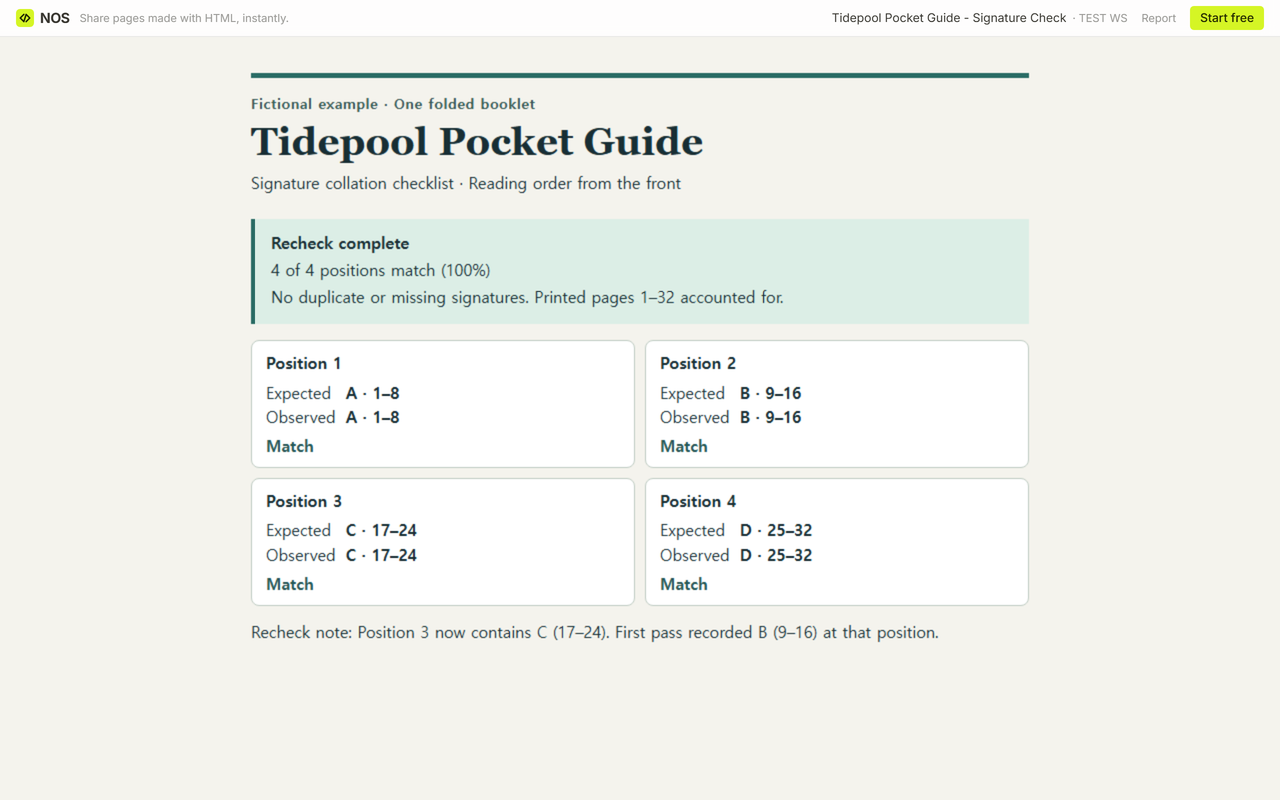
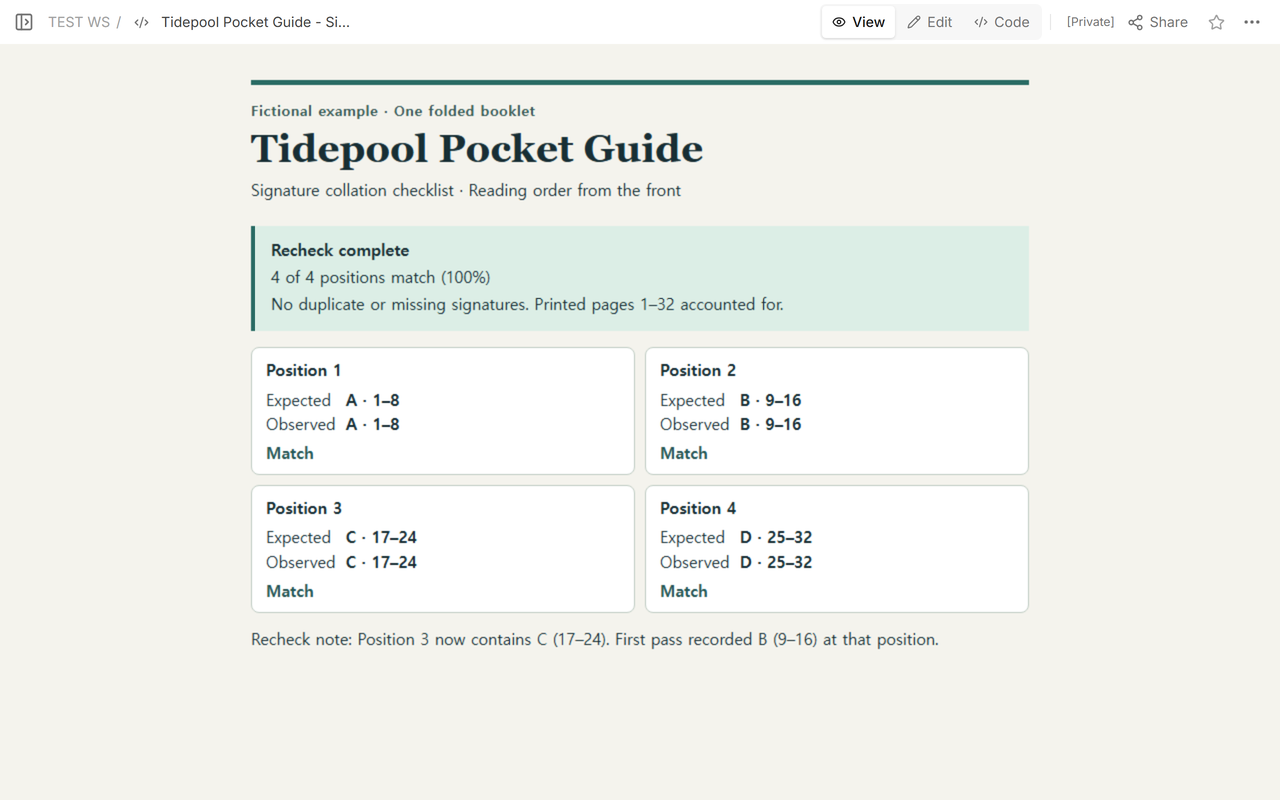
Keep the first-pass record for position 3. In the recheck columns, enter C and pages 17–24 after confirming them on the corrected sample. Read across the neighboring boundaries too: page 16 ends B, page 17 starts C, page 24 ends C, and page 25 starts D.
Recheck. A, B, C, D gives 4 matches out of 4. That is 4 ÷ 4 = 100% exactly. Each expected mark appears once. The duplicate count drops from 1 to 0 and the missing count drops from 1 to 0. Printed pages 1–32 are now accounted for on this copy.
To start your own check, save a copy of the blank CSV and replace its empty starter row with one row per expected position. Enter the booklet identifier on each row, then fill in the expected marks and the first and last printed page numbers. Keep the first-pass and recheck columns side by side. In the note, say what triggered the recheck and what you confirmed.
When not to do this
Use this for the order of signatures inside one sample copy. If you are handing off a print job with a file version and proof reference, use a print job ticket. If the task is to match illustrations and captions to the manuscript, use a manuscript art log.
How did we share the recheck in NOS?
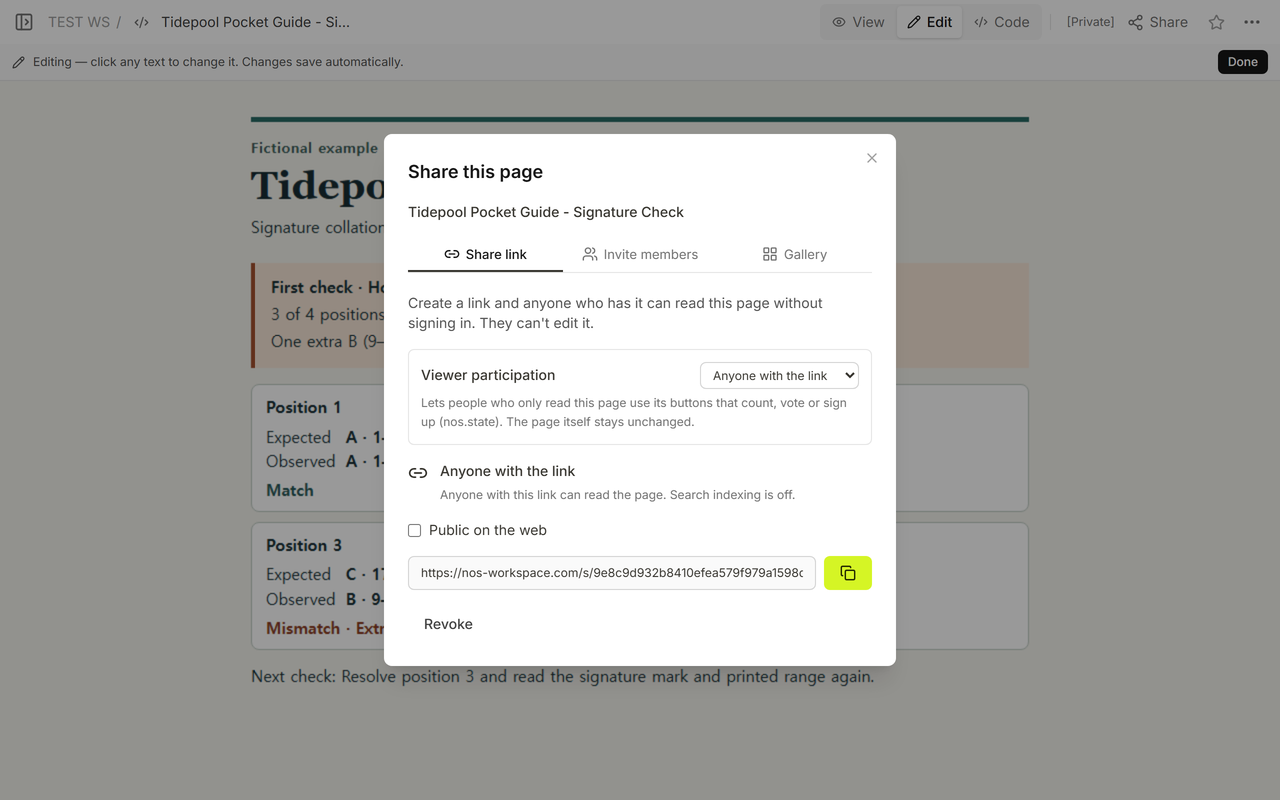
We kept the Tidepool checklist on the same NOS Workspace page and saved the rechecked observation for position 3. When we reopened the reader link while signed out, it showed C, pages 17–24, and the note preserving the first observation of B. Share the reader link when someone needs the current checklist for reference.