In short
This example is for Rhode Island and uses the Rhode Island Department of Health guideline last updated in October 2024.
Accept only the listed food in intact packaging, with the required ingredients and allergen information.
Keep the refrigerator at 41°F or below, remove dated refrigerated food on time, and clean and review it at least weekly.
Close donations when the fridge cannot meet the rule; do not import a different country’s safety values to fill a gap.
Harbor Street Community Fridge is fictional, but the operating values in its finished page come from one real jurisdiction: Rhode Island. We replaced an older generic review copy with a complete local example that names allowed and prohibited food, labeling, cold and hot holding, weekly checks, two community contacts, closure, overflow, and the Rhode Island food-protection contact.
Download the complete fictional Rhode Island community fridge page
Which authority controls this community fridge example?
The controlling source is the Rhode Island Department of Health’s two-page Safety Guidelines for Community Fridges, last updated October 2024 and checked again on Nov 17, 2026. The guideline says a Rhode Island food-business license may not be needed when all listed requirements, including allowed donations, are followed. “May not” is not an exemption promise. A real operator should ask the Department’s Center for Food Protection about its own setup.
We also read the current UK government page on community cooking and food banks. It says it applies to England, Northern Ireland, and Wales. None of its registration, temperature, date-label, or food-handling values were copied into this Rhode Island example. That comparison is useful because it demonstrates the rule that keeps this page safe: pick one jurisdiction and do not build a hybrid policy.
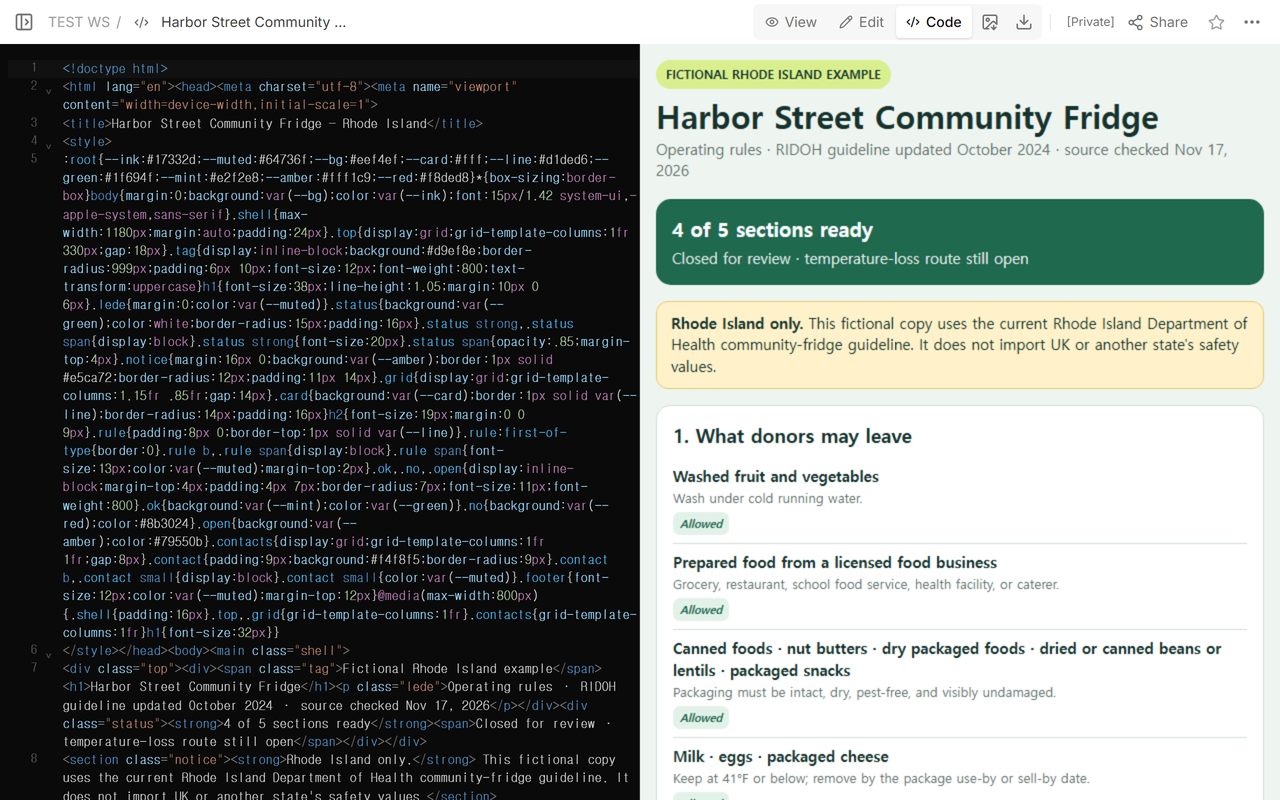
What food may go into this Rhode Island fridge?
The finished page gives donors a positive list instead of asking them to infer permission from a list of bans:
- washed fruits and vegetables;
- prepared food from a licensed food business, including a grocery store, restaurant, school food-service vendor, health facility, or caterer;
- canned foods such as soup, stew, fruit, vegetables, or tuna;
- nut butters such as peanut, almond, or sesame;
- dry packaged foods such as cereal, rice, or pasta;
- dried or canned beans or lentils;
- packaged snacks such as crackers, popcorn, granola bars, nuts, or dried fruit; and
- milk, eggs, and packaged cheese when the temperature and date rules are met.
Fresh produce must be washed under cold running water. Packaging must be intact: not torn or open, without water stains, visible mold, dirt, or other damage. Food must also be kept dry and protected from pests. Those conditions are checks, not decorative notes; a listed food still stays out when its condition fails.
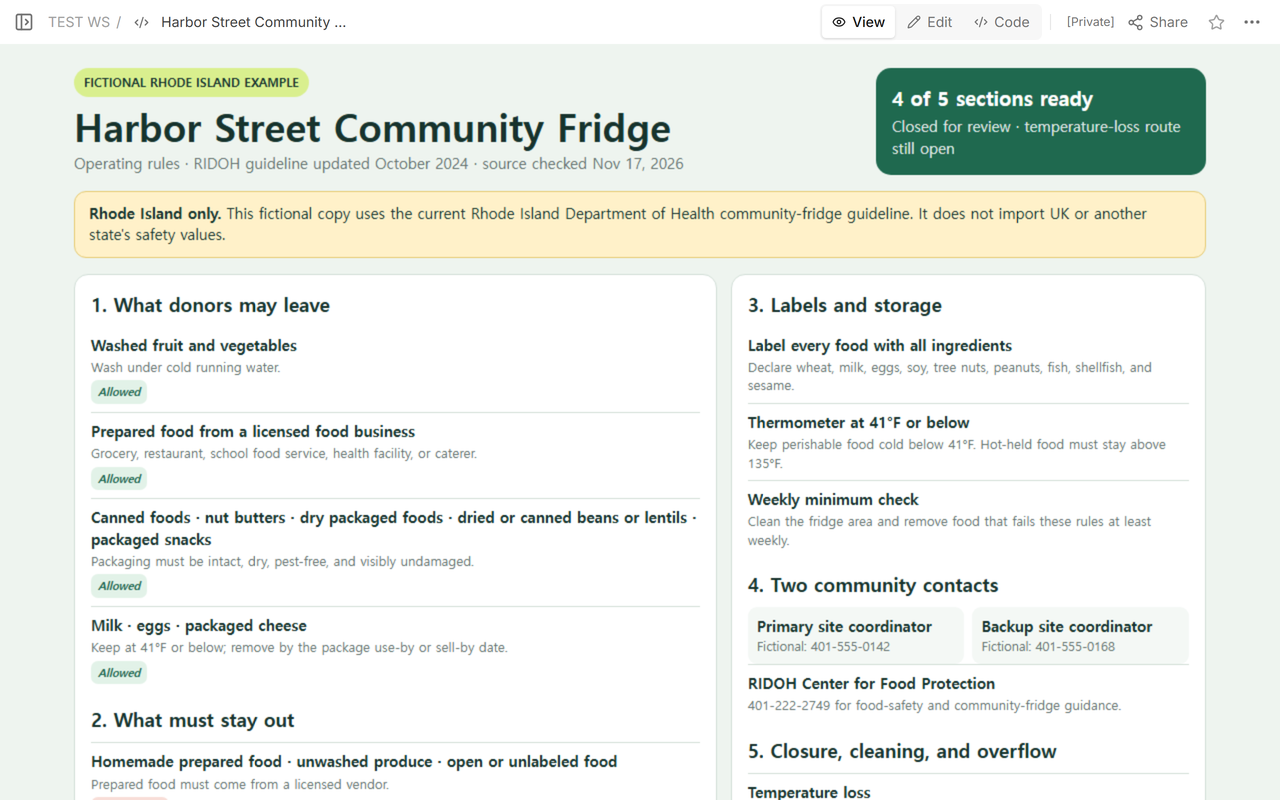
What food must the page reject?
Rhode Island does not allow homemade prepared food in this program. It also lists unwashed fruits and vegetables, open containers, unlabeled food, out-of-date refrigerated food, visibly contaminated food, and damaged food such as broken eggs as not allowed.
Perishable food has an additional time-and-temperature boundary. The state list rejects perishable food that has been above 41°F or below the 135°F hot-holding boundary for four or more hours. The example does not turn a shorter or unknown excursion into automatic permission. It closes donations and tells the coordinator to ask the Center for Food Protection rather than guess.
What must every label show?
Every food needs all ingredients on its label. The Rhode Island guideline also requires declaration of nine major allergens: wheat, milk, eggs, soy, tree nuts, peanuts, fish, shellfish, and sesame. “Contains allergens” is not a substitute for naming which ones apply.
Perishable food must be removed by the use-by or sell-by date shown on its package. The example does not substitute a UK best-before rule, invent a donation extension, or hide the package date in a private log. The public operating page tells both donors and cleaners which visible date controls removal.
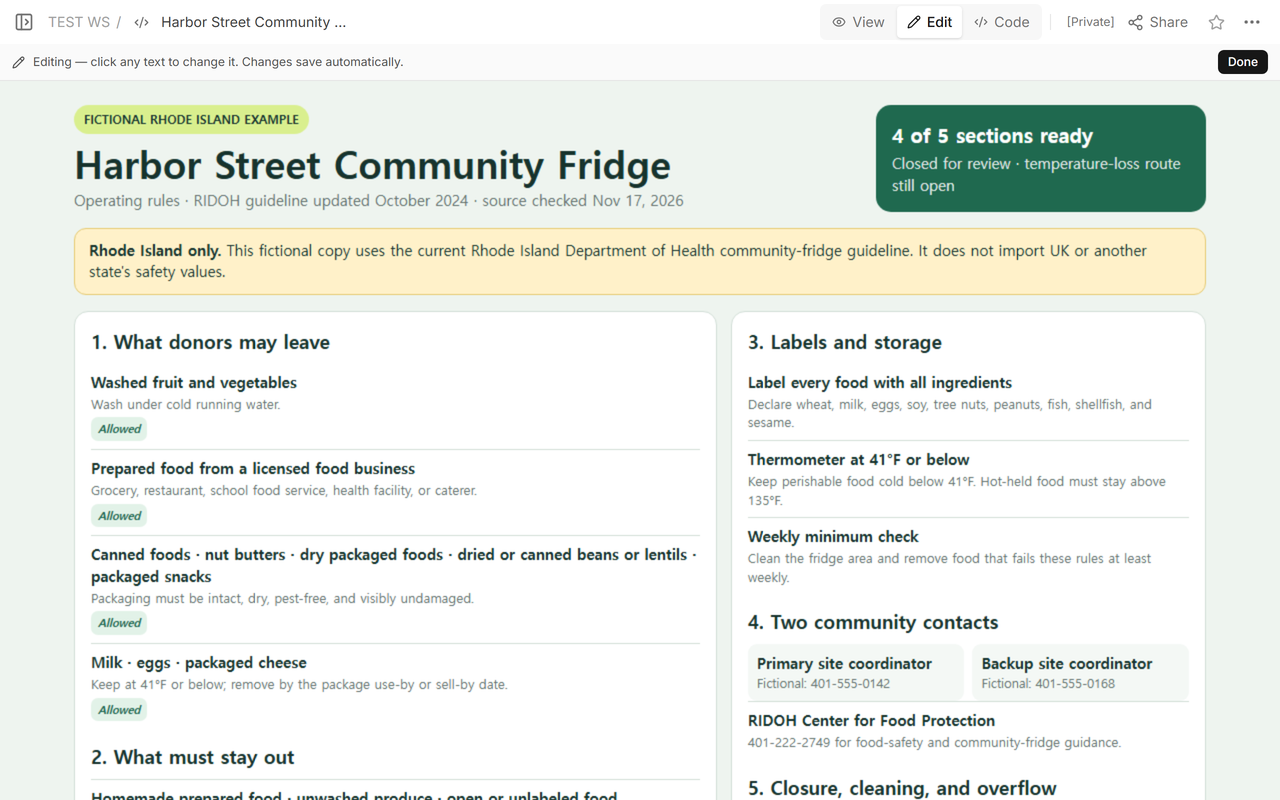
What are the storage and cleaning rules?
A thermometer belongs in the refrigerator, and the refrigerator must be maintained at 41°F or below. Perishable food that is hot-held must stay above 135°F. Harbor Street is presented as a refrigerator, so the cold limit is the normal visible check; the hot-holding value remains on the page only because it is part of the state’s temperature-control rule.
Volunteers must visit at least weekly to clean the area and remove food that does not meet the guideline. That is a minimum frequency, not a reason to leave a spill, pest problem, damaged unit, or unsafe item until the weekly visit. The example closes donations for those conditions and sends the issue to a coordinator.
The state guideline does not prescribe a sanitizer concentration or a refrigerator-specific disassembly method. The page therefore does not invent either one. A real site should attach its equipment and surface-cleaning procedure, then train the people who carry it out.
Who gets contacted when the fridge closes?
Rhode Island requires at least two community contacts who are available for food-safety or operational concerns. The fictional page uses two clearly marked 555 numbers: a primary site coordinator and a backup. Those numbers make the example complete without exposing a real person. A real operator must replace them with two monitored contacts before publication.
The page also carries the official Center for Food Protection number, 401-222-2749. It is the escalation route for questions about food safety and safe community-fridge operation; it does not replace the site’s two local contacts.
What happens during temperature loss, damage, or overflow?
The finished Harbor Street rule uses one conservative sequence:
- Close donations for a reading above 41°F, unknown temperature history, power loss, spill, damage, dirt, or pests.
- Contact the primary coordinator, then the backup if needed.
- Reject perishable food known to have been outside the state’s temperature boundaries for four or more hours.
- When the time is shorter or unknown, do not guess; ask the Center for Food Protection before redistributing the food.
- Reopen only after a coordinator confirms 41°F or below and completes the site cleaning check.
When the refrigerator is full, the answer is not a box on the floor or food left outside. The page stops new donations and asks the donor to contact one of the two coordinators. Food returns only when approved storage space exists.
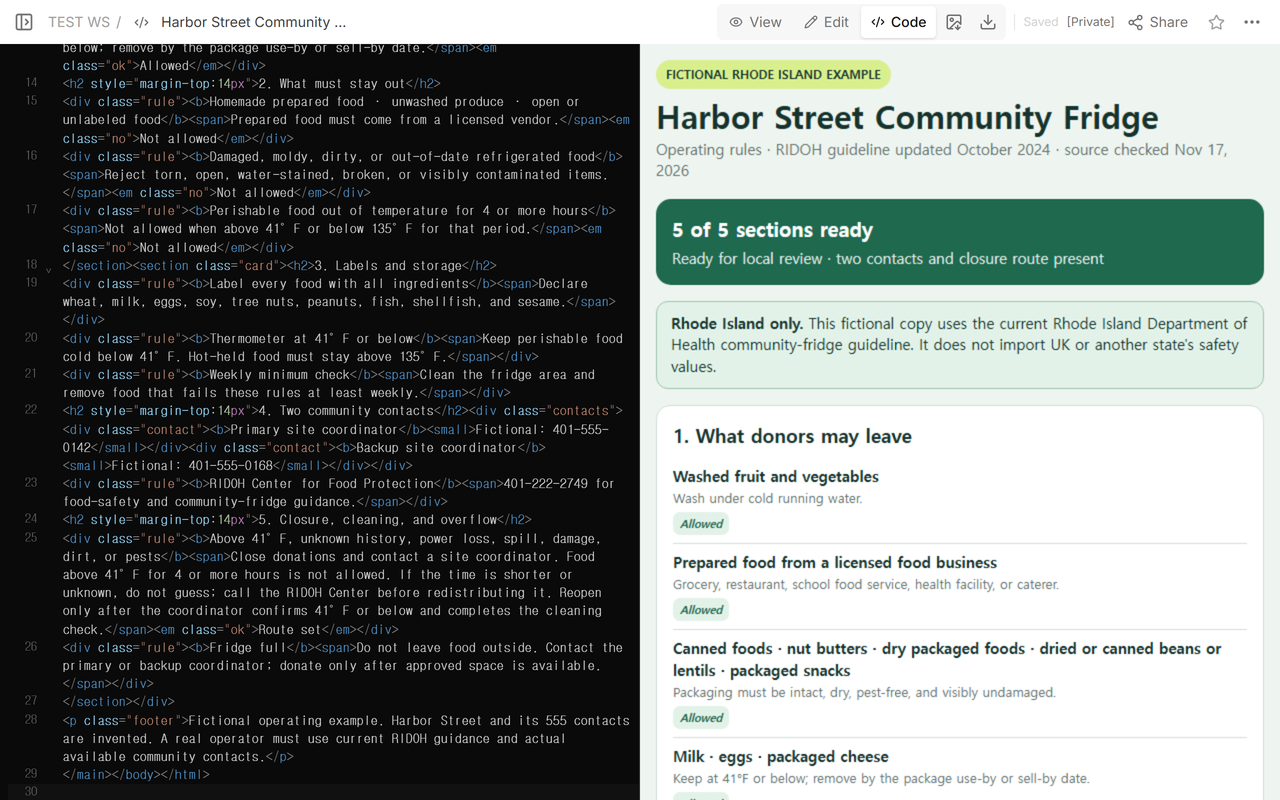
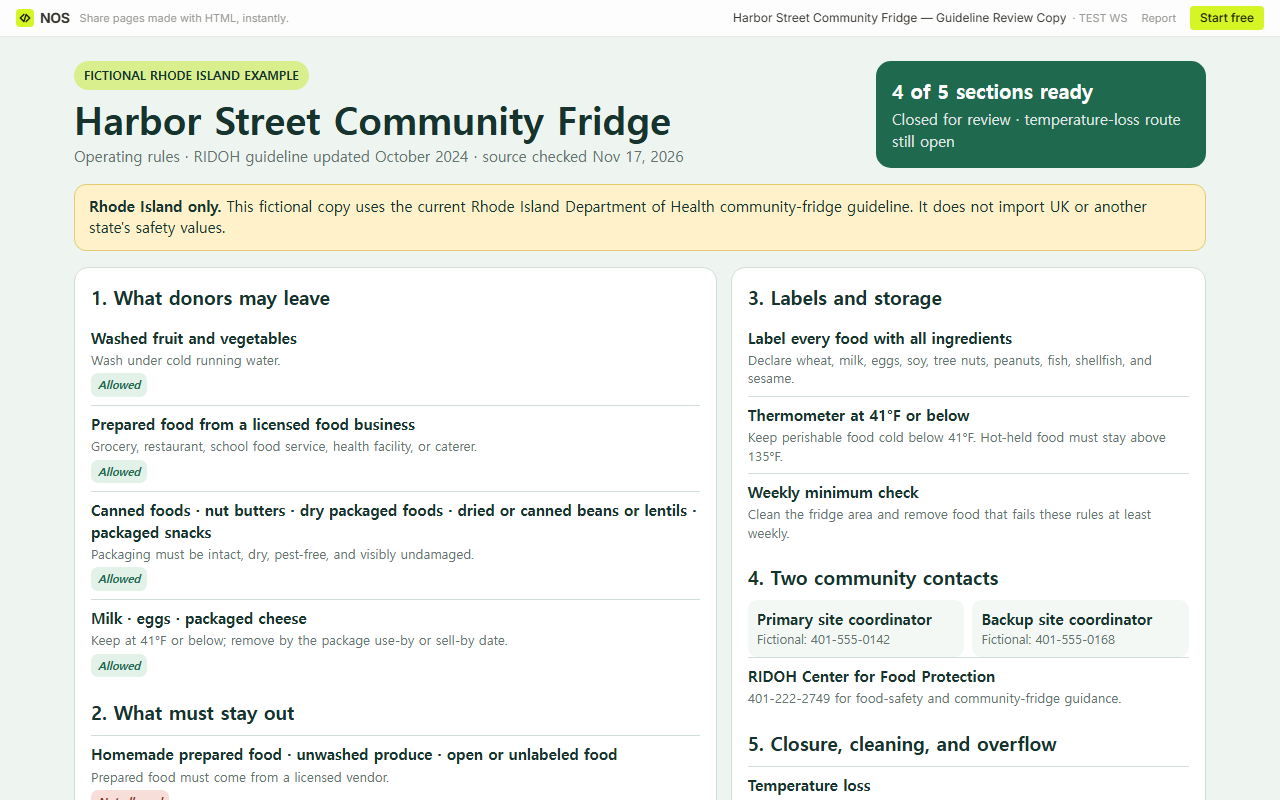
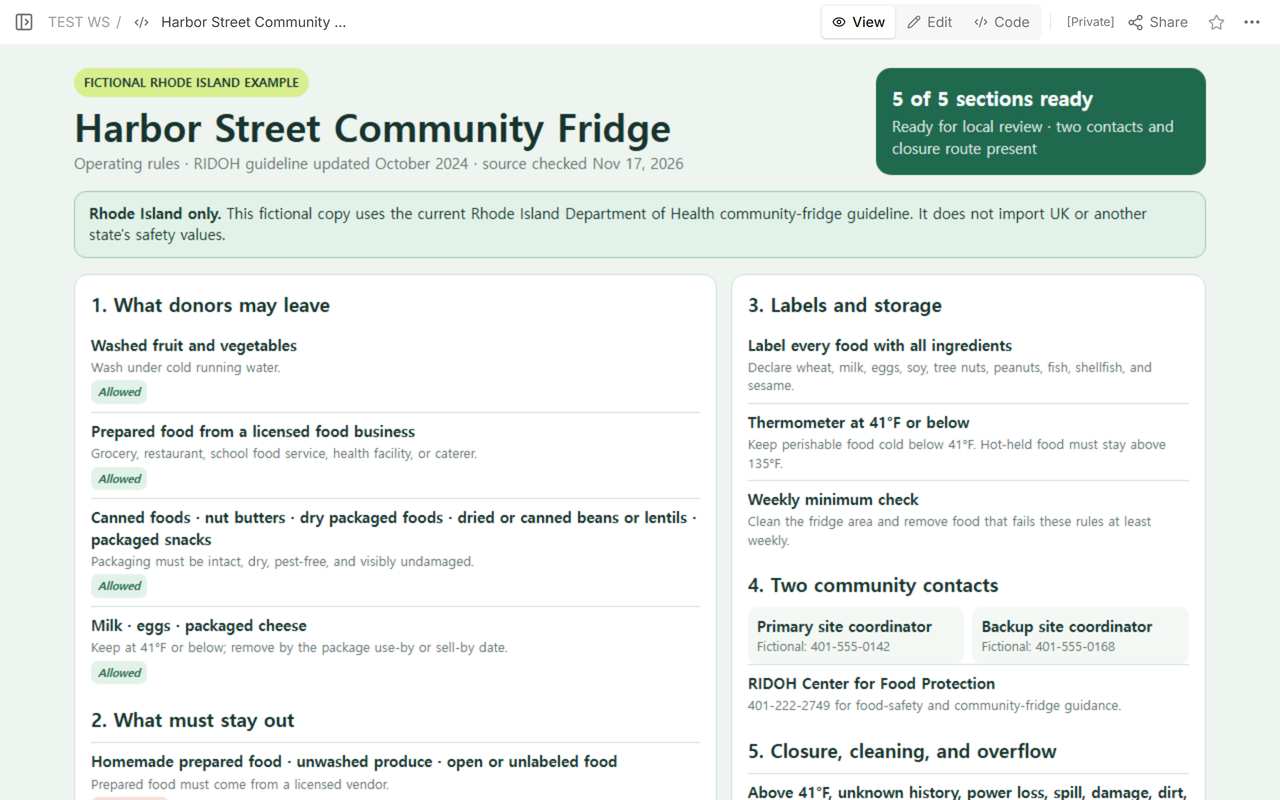
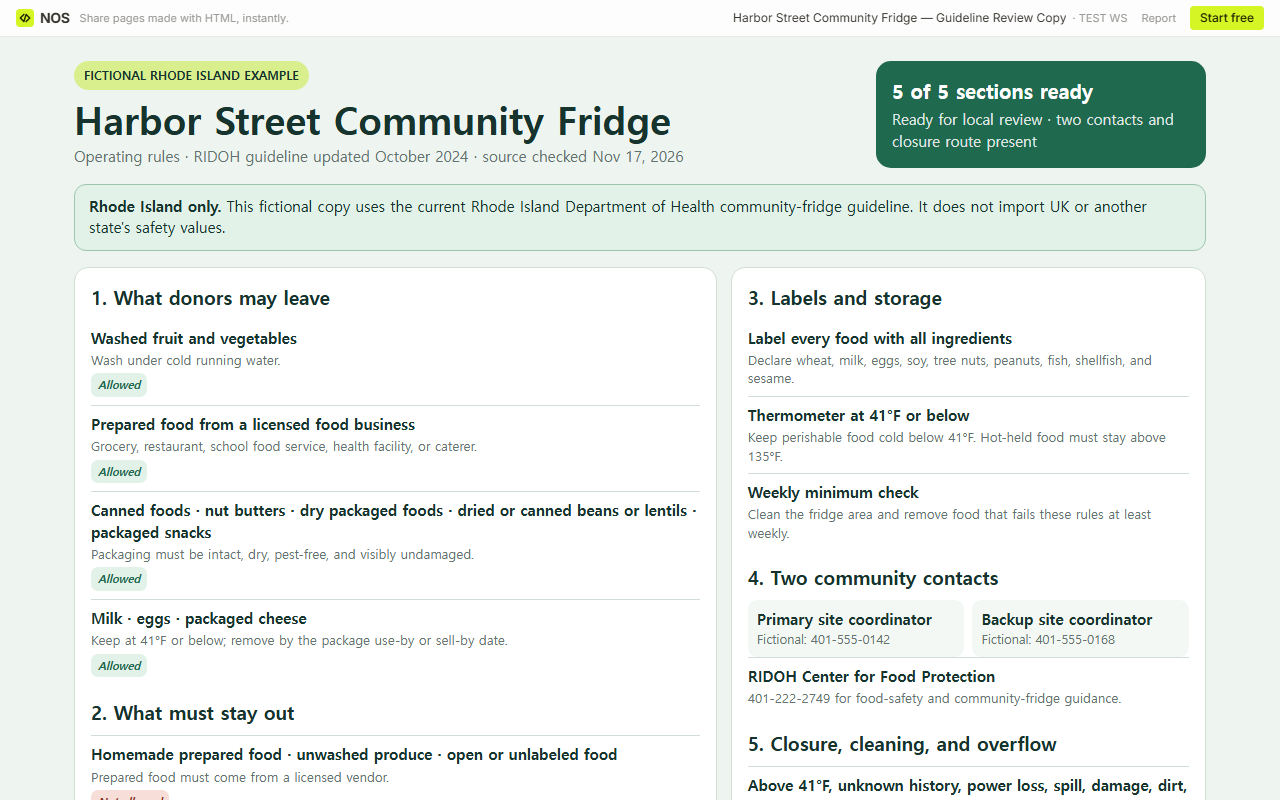
Finished result: the fictional page now tells a Rhode Island donor, cleaner, or coordinator what is allowed, what is rejected, which labels and temperatures apply, how often to review and clean, when to close, how to handle overflow, and which three contact routes exist.
When not to do this
- Do not use Rhode Island values for a refrigerator in another state or country.
- Do not publish the fictional 555 contacts as if they reach an operator.
- Do not treat “may not need a license” as a license exemption or approval.
- Do not accept homemade prepared food, open or unlabeled food, damaged food, or food that fails the stated temperature and date rules.
- Do not invent a safe-life extension for an unknown temperature history. Close and ask the controlling authority.
Using NOS for community fridge guidelines
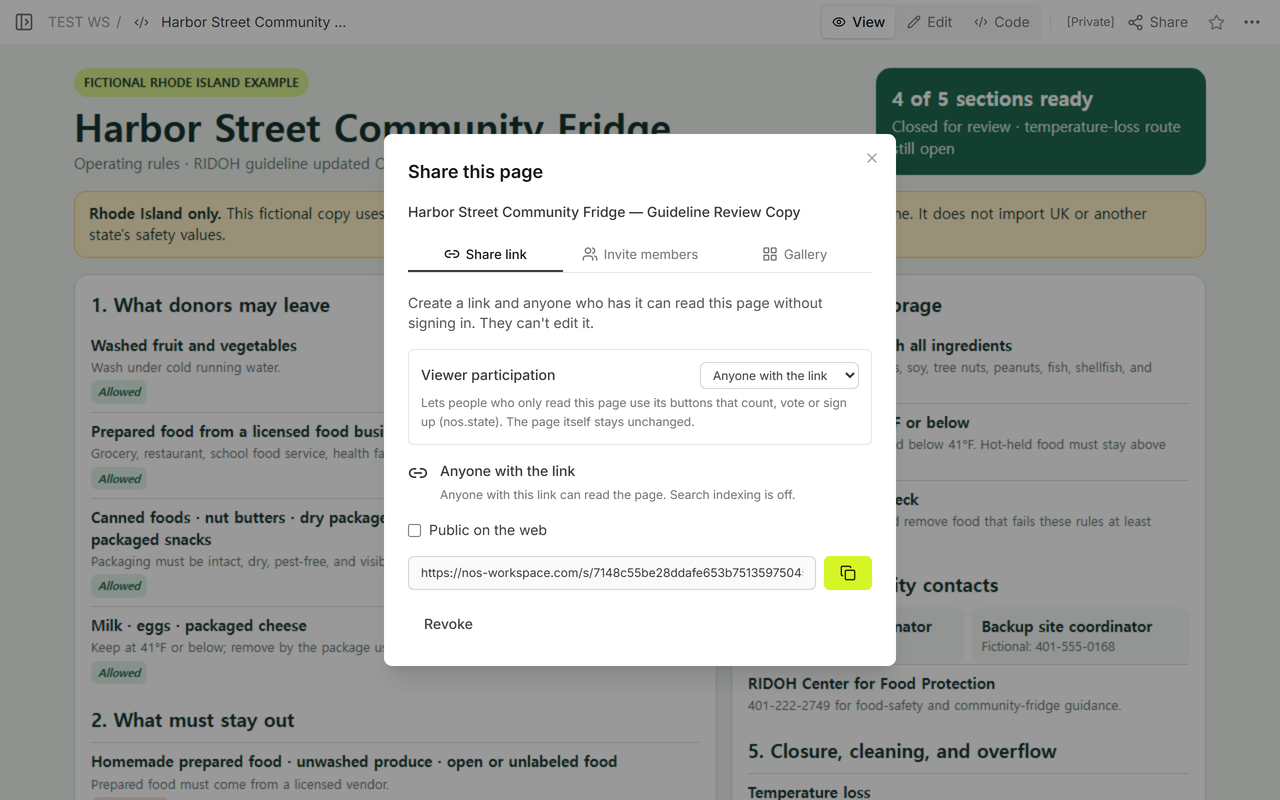
On this fictional page, NOS Workspace kept the operating sheet readable in Code, View, and Edit and exposed its reader address through Share. We revised the existing page, filled the unresolved temperature-loss route, and checked that revision at the original reader address. The workspace did not monitor the appliance, read its thermometer, inspect donations, approve a license, call RIDOH, or notify either coordinator. For current plan details, use the official NOS pricing page.
Related community pages
- Use the community resource page for a maintained directory of local services.
- Use the action plan template to assign a separate improvement project with owners and deadlines.
- Use the food truck menu guide for a vendor’s sales menu, not a donation-safety policy.
Sources checked
- Rhode Island Department of Health, Safety Guidelines for Community Fridges, last updated October 2024, checked Nov 17, 2026.
- UK Government, Food safety for community cooking and food banks, updated Aug 28, 2026, read only to confirm its separate jurisdiction and not used for Rhode Island operating values.