“I agree with your point” meets a reply count. It gives the next student almost nothing to answer.
For an online discussion, show students what a useful reply does: identify a specific idea, test it against the shared material, and move the question forward. Keep that quality judgment separate from the deadline and number of required posts. The rubric below is designed for an asynchronous thread, where students write at different times.
Blank template and worked example

Open the complete example · Blank PDF · Worked PDF
Download the HTML version to adapt the browser page. The worked material is fictional. Use the blank PDF for a printed activity or record; the browser preview switches between versions.
For a source-based paper after the discussion, use a research paper rubric to assess the written argument.
Put the discussion task above the rubric
Use these fields before assigning any levels:
Question and learning purpose: [ ]
Shared reading or case: [ ]
Initial-post window: [ ]
Reply window: [ ]
Minimum contributions and approved alternatives: [ ]
Where to post and how to ask for help: [ ]
Which criteria affect the grade: [actual course policy]
An online-discussion teaching resource recommends clear contribution criteria, examples, and explicit participation parameters. The original rubric here puts those elements into a short review format. It does not prescribe a universal post count or course-grade weight.
For a live, text-based seminar, use a Socratic seminar rubric instead. A written thread needs expectations for responding while classmates still have time to continue the exchange.
Copy this online discussion rubric
Use Demonstrated, Developing, and Not yet visible for this example.
Initial contribution
- Demonstrated: Answers the question with a reasoned position that another reader can examine.
- Developing: Gives a relevant position but leaves its main reason unclear.
- Not yet visible: Does not provide a position relevant to the question.
Use of the shared material
- Demonstrated: Uses an accurate detail from the supplied material and explains its connection to the position.
- Developing: Includes a relevant detail but does not explain the connection, or overstates what the detail supports.
- Not yet visible: Relies on unsupported statements or does not engage with the supplied material.
Reply that develops the exchange
- Demonstrated: Addresses a specific peer idea and adds evidence, a consequence, a qualification, or a question that can change the reasoning.
- Developing: Identifies a peer idea but mainly repeats it or offers a broad question without development.
- Not yet visible: Gives only agreement, disagreement, or a response unrelated to the peer’s idea.
Closing reflection
- Demonstrated: Explains whether an exchange changed or qualified the student’s position, with a reference to the relevant contribution.
- Developing: States that the position changed or stayed the same but does not explain why.
- Not yet visible: Does not connect the reflection to the discussion.
Use the final criterion only if a closing reflection is actually assigned. A rubric should not surprise students with an extra submission.
Add a separate completion check for the published windows and contribution requirements. Apply your stated policy when a requirement is missed; do not quietly turn a late contribution into a weaker reasoning score.
Compare two replies to the same post
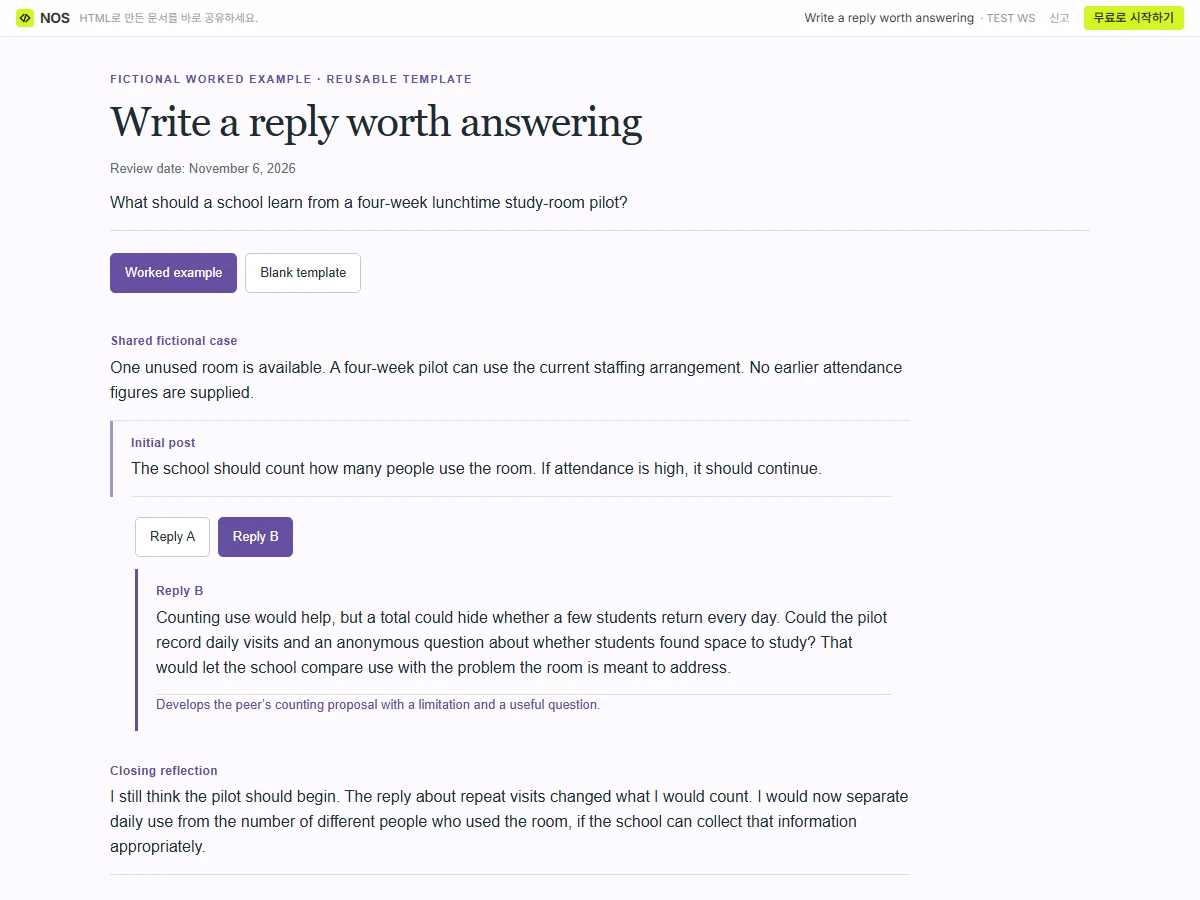
This is a fictional discussion case. The supplied information says a school has one unused room and can run a four-week lunchtime study-room pilot with the current staffing arrangement. It does not include attendance figures from a previous pilot.
Question: What should the school learn before deciding whether to continue the room after four weeks?
Initial post: “The school should count how many people use the room. If attendance is high, it should continue.”
Reply A: “I agree. A study room is a great idea and would help lots of students.”
Reply B: “Counting use would help, but a total could hide whether a few students return every day. Could the pilot record daily visits and an anonymous question about whether students found space to study? That would let the school compare use with the problem the room is meant to address.”
Reply B identifies the peer’s proposal and adds a limitation with a concrete question. It can demonstrate the reply criterion even though it does not settle whether the room should continue. Reply A expresses agreement but adds an unsupported benefit.
Do not turn Reply B’s suggested data collection into a requirement for your actual school. It is a reasoning example; use the school’s approved process for any real collection.
Show a reflection that keeps its original position
A student does not have to change sides to show learning. One possible closing reflection is:
“I still think the pilot should begin. The reply about repeat visits changed what I would count. I would now separate daily use from the number of different people who used the room, if the school can collect that information appropriately.”
The reflection explains a qualification. “My classmates taught me a lot” leaves the learning unspecified.
When marking, point to the actual contribution that meets or misses a descriptor. If a student had no peer post available to answer, record that condition and use the participation arrangements you announced. Do not invent evidence of a reply.
Prompt for a discussion-specific version
Design an asynchronous discussion rubric for [learner group/course]. Question: [ ]. Shared material: [paste permitted case or reading]. Required contributions, windows, and approved alternatives: [ ]. Grading policy: [ ]. Assess initial reasoning, accurate use of shared material, and replies that develop a specific peer idea. Include closing reflection only if assigned. Separate contribution quality from completion requirements. Write observable descriptors at [number] levels and create two clearly fictional replies to the same sample post, explaining the difference using the descriptors. Do not invent reading quotations, participation records, learning standards, or grade weights. Return editable instructor and student versions. Do not grade real students automatically.
Keep the expectations easy to revisit
Open this example’s NOS share link.
Put the final criteria where students can find them before they post, using the course platform required by your institution.
For a colleague-facing HTML model, NOS can hold the prompt, rubric, and fictional thread in one shared page. If you clarify an ambiguous reply descriptor, edit that saved page so the same link opens the corrected model. Real discussions, student identities, and grades belong in the course’s approved environment.