A student reads “evidence: developing” and adds another quotation. The paragraph gets longer, but the reasoning is still missing.
Make the rubric say what the reader should be able to see in the essay. Then attach the feedback to an actual sentence. The example below separates choosing evidence from explaining it, so “needs improvement” becomes a revision the student can make.
Blank template and worked example

Open the complete example · Blank PDF · Worked PDF
Download the HTML version to adapt the browser page. The worked material is fictional. Use the blank PDF for a printed activity or record; the browser preview switches between versions.
When the assignment assesses how several sources support an argument, adapt the research paper rubric to those source requirements.
Set the writing task before the criteria
This fictional Grade 8 assignment asks students to recommend one change to a school reading area. Students receive a short observation sheet and write an argument using that information. They must explain how their evidence supports the recommendation and address a practical concern.
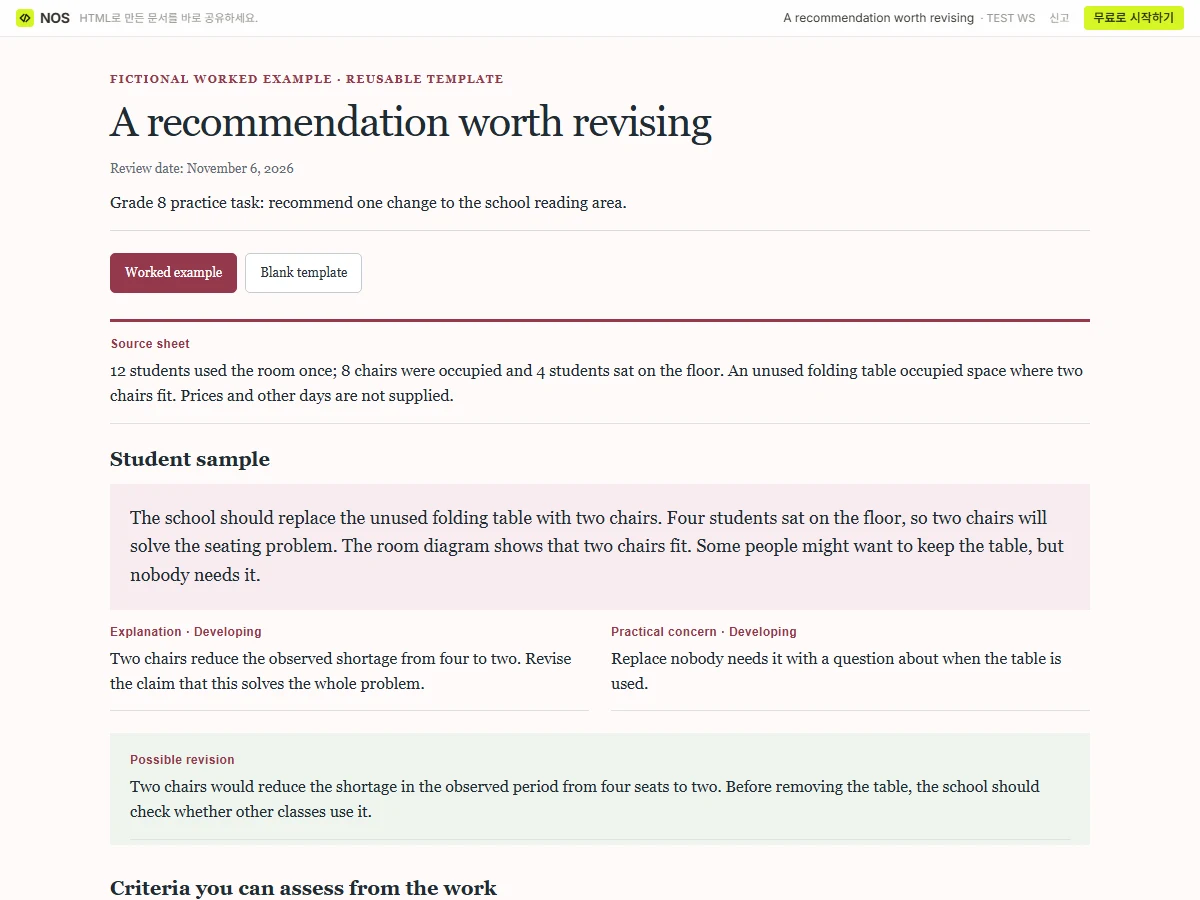
For the worked example, the supplied sheet says:
- Twelve students used the reading area during one observation period.
- Four of them sat on the floor because all eight chairs were occupied.
- A folding table stood unused beside the shelves.
- The room diagram shows space for two chairs where the folded table is stored.
- No purchase prices or observations from other days are supplied.
The task does not require outside research. Do not add “uses five sources” to its rubric simply because a different assignment does.
A published essay-rubric resource recommends explaining expectations when assigning the work and adapting criteria to the assignment. The descriptors below are original and specific to this practice task.
Copy this three-level essay rubric
Use Ready, Developing, and Starting as feedback labels for this example. They are not automatic letter grades.
Recommendation
- Ready: Names a specific change and keeps the argument focused on whether that change should be made.
- Developing: Names a change, but part of the essay argues for a different or broader proposal.
- Starting: Discusses the reading area without a clear recommendation.
Use of supplied evidence
- Ready: Selects accurate details from the sheet that bear directly on the proposed change.
- Developing: Includes a relevant detail, but misstates part of it or relies on information the sheet does not give.
- Starting: Relies on unsupported statements or details unrelated to the proposal.
Explanation
- Ready: Explains how the selected details support the recommendation and distinguishes an expected benefit from a demonstrated result.
- Developing: Explains the connection incompletely or claims more than the supplied evidence supports.
- Starting: Repeats the recommendation or evidence without explaining the connection.
Practical concern
- Ready: Identifies a relevant concern and answers it within the information available, including what still needs checking.
- Developing: Mentions a concern but dismisses it without explanation or necessary information.
- Starting: Does not address a practical concern.
Organization and readability
- Ready: Groups related ideas and uses sentences whose meaning can be followed without guesswork.
- Developing: The argument can be followed, but a jump between ideas or unclear sentence interrupts it.
- Starting: The order or wording prevents the reader from identifying the argument.
Add two feedback fields beneath the criteria: A sentence that shows the current level and The next revision to try. Keep any points or grade conversion separate until you have decided the scoring rules.
Score the work that is actually on the page
Consider this original sample paragraph:
“The school should replace the unused folding table with two chairs. Four students sat on the floor, so two chairs will solve the seating problem. The room diagram shows that two chairs fit. Some people might want to keep the table, but nobody needs it.”
The recommendation is specific, and the writer selects relevant seating evidence. The explanation overstates the result: two additional chairs would leave two of the four students without a chair under the observed conditions. “Nobody needs it” also goes beyond one observation of an unused table.
Feedback could read:
Explanation: Developing. In “two chairs will solve the seating problem,” compare the four students on the floor with the two proposed chairs. Explain the benefit the change can support without claiming it solves the entire shortage.
Practical concern: Developing. Replace “nobody needs it” with a question about when the table is used. The observation sheet covers one period.
This feedback follows the descriptors. It does not lower the evidence rating again for the same reasoning error unless the evidence itself is misstated.
Give a revision that preserves the student’s argument
One possible revision is:
“Two chairs would reduce the shortage in the observed period from four seats to two. Before removing the table, the school should check whether other classes use it.”
The revision keeps the proposal and makes its limit clear. It does not require an adult to rewrite the whole essay.
Before using the rubric with a class, have teachers apply it to the same short sample and discuss any different ratings. Adjust a descriptor when it leaves an important distinction unclear. For a revision conference without performance levels, a single-point rubric may be a better fit.
Prompt for adapting the rubric to your assignment
Draft an analytic essay rubric for this assignment: [paste exact task]. Learner group: [ ]. Materials students may use: [ ]. Learning goals: [ ]. Required criteria and any approved scoring policy: [ ]. Write observable descriptors at [number] distinct levels. Separate evidence selection from reasoning when both are assessed. Do not add source counts, formatting rules, grade conversions, or standards that the task does not require. Include space to quote a sentence from the student’s work and name one next revision. Test the descriptors against this anonymized sample: [paste sample]. Explain ratings using only visible evidence; mark anything that cannot be assessed from the sample. Return an editable teacher draft and a student-readable version. Keep final grading with the teacher.
Share the expectations before students write
Open this example’s NOS share link.
Give students the final rubric alongside the assignment and discuss a short example. If the rubric needs a substantive correction after work has begun, explain the change and how it affects the assignment.
For a browser-readable copy of the assignment, rubric, and practice sample, save an HTML page in NOS. The shared page can be corrected without distributing a new address. Keep submitted essays and individual grading in the school’s approved system; use the public-facing page for the expectations and fictional practice work.