A paper can meet the source-count requirement and still read like five unrelated book reports. Every paragraph has a citation, but no paragraph explains why the sources lead to the writer’s conclusion.
A research paper rubric should make that difference visible. Check the question, the use of sources, and the reasoning between them separately. The original rubric below gives teachers a starting point for an argument-based paper; it needs adapting for a laboratory report, literature review, or another assigned form.
Blank template and worked example

Open the complete example · Blank PDF · Worked PDF
Download the HTML version to adapt the browser page. The worked material is fictional. Use the blank PDF for a printed activity or record; the browser preview switches between versions.
For a shorter recommendation based on a supplied passage or observation, the essay rubric shows a smaller practice sample.
Write the assignment boundary at the top
Before the descriptors, record:
Research task and intended reader: [ ]
Required scope and source types: [ ]
Permitted research methods: [ ]
Citation style or submission rules: [ ]
Evidence students must submit: [draft, notes, source record, or other required work]
Scoring policy: [the actual course policy]
A research-paper assessment example distinguishes topic focus, depth, integration of sources, and citations. It also emphasizes adapting the rubric to the specific assignment. A source minimum from someone else’s course is not a requirement for yours.
An original rubric for a source-based argument
For this draft, use Demonstrated, Partly demonstrated, and Not yet demonstrated. These are descriptions of the submitted work, not automatic percentages.
Question and scope
- Demonstrated: Frames a question the paper can address within the assigned scope and keeps its claims within that boundary.
- Partly demonstrated: Has a question, but some claims exceed the material examined.
- Not yet demonstrated: Presents a topic without a question or position the paper investigates.
Source selection and understanding
- Demonstrated: Uses sources relevant to the question and accurately explains what each can establish.
- Partly demonstrated: Uses relevant sources but overlooks an important limit or treats one source as supporting more than it does.
- Not yet demonstrated: Uses material whose relevance or meaning the paper does not explain.
Synthesis
- Demonstrated: Brings sources together around a question, showing a meaningful agreement, difference, or gap.
- Partly demonstrated: Refers to several sources on the same point but leaves their relationship unclear.
- Not yet demonstrated: Summarizes sources separately without connecting them to a shared question.
Reasoning and limits
- Demonstrated: Connects the evidence to a conclusion and addresses a limitation or plausible alternative explanation.
- Partly demonstrated: Offers a conclusion, but a key inference is unsupported or its limit is missing.
- Not yet demonstrated: States a conclusion without reasoning from the evidence presented.
Traceable use of sources
- Demonstrated: Makes borrowed claims identifiable and lets the reader locate the cited source using the assignment’s required format.
- Partly demonstrated: Provides source information but leaves a borrowed claim or reference difficult to trace.
- Not yet demonstrated: Provides insufficient attribution to identify the basis of borrowed material.
Leave room for an excerpt, the reason for the rating, and one revision action. Assess the criterion from the material actually submitted. If a task requires a source record that was not provided, handle that under the stated submission policy rather than guessing what the student researched.
Calibrate with a small fictional source set
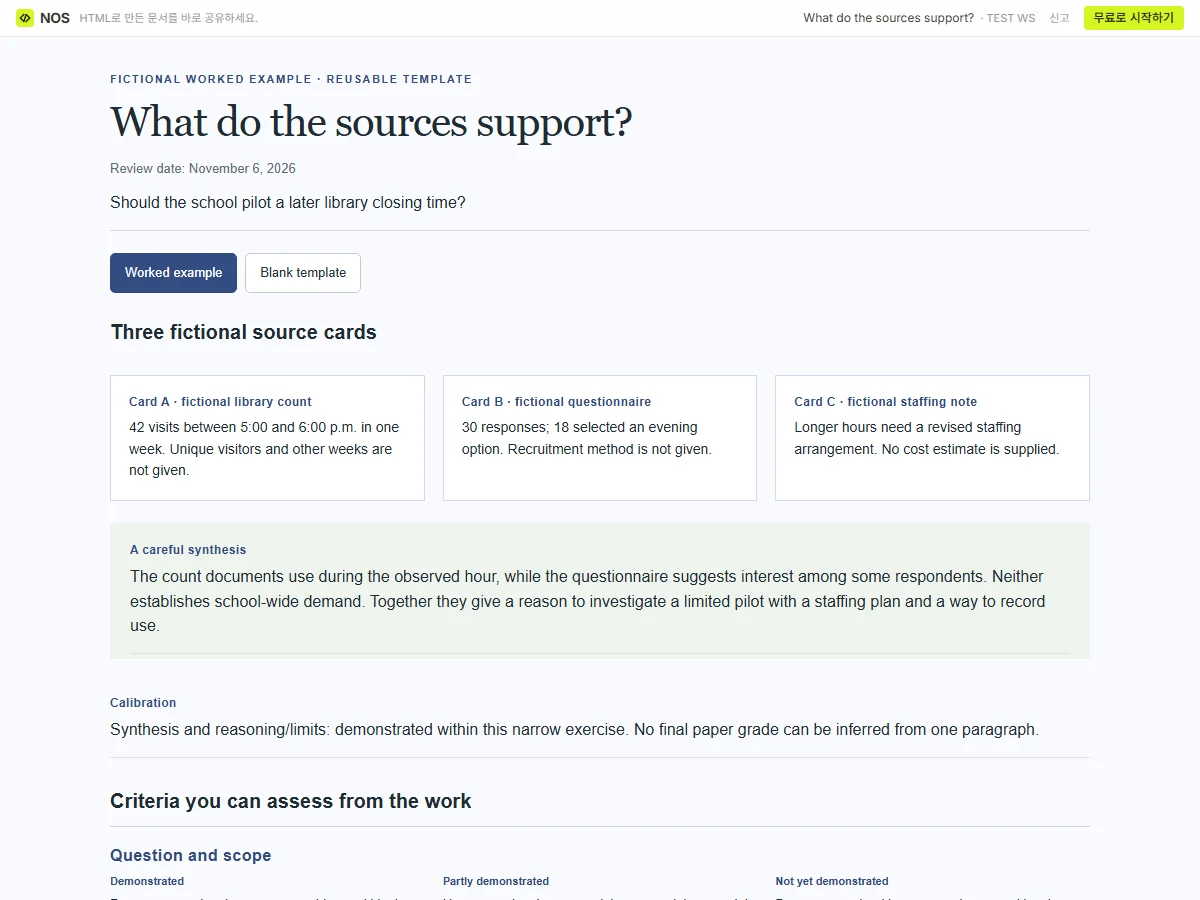
The following cards are invented teaching materials, not actual studies or references.
Card A: Library count: During one week, staff counted 42 visits between 5:00 and 6:00 p.m. The card does not identify unique visitors or compare other weeks.
Card B: Student questionnaire: Thirty students answered a question about preferred library hours. Eighteen selected an evening option. The card does not describe how respondents were recruited.
Card C: Staffing note: The librarian says extending hours would require a revised staffing arrangement. The note provides no cost estimate.
The practice question is: Should the school pilot a later library closing time?
A weak draft says: “The count shows 42 students need evening access. The survey proves most students want longer hours. Therefore the school should extend opening permanently.”
The paper has several sources, but its claims outrun them. Visits are not necessarily unique students, eighteen responses do not establish the preference of the entire student body, and a permanent extension is broader than a pilot decision.
Show what synthesis adds
A more careful passage might say:
“The count documents use during the observed late-afternoon hour, while the questionnaire suggests interest among some respondents. Neither establishes school-wide demand. Together they give the school a reason to investigate a limited pilot, with a defined staffing plan and a way to record use.”
That passage connects the sources and limits the recommendation. It does not turn the fictional cards into proof that a pilot will succeed.
For the rubric, mark Synthesis: Demonstrated for that passage. Mark Reasoning and limits: Demonstrated within this narrow exercise. Do not assign a final paper grade from one paragraph or pretend the invented cards meet a real course’s research requirements.
A research paper outline can help organize sections after the question is clear. The rubric checks what the completed paper does with the sources.
Adapt with AI without inventing research
Build a research-paper rubric for this exact assignment: [task]. Learner group: [ ]. Intended paper type: [ ]. Required source types, methods, and citation style: [ ]. Approved grading rules: [ ]. Use criteria for question/scope, accurate source use, synthesis, reasoning/limits, and traceable attribution; change them where the assignment requires. Write [number] observable levels with no invented source minimums or percentage conversion. Use this anonymized excerpt and supplied source notes for a calibration example: [paste both]. Distinguish what can be assessed from the excerpt from what needs the full paper. Do not invent publications, quotations, study results, reference entries, or evidence that a student read a source. Return editable rubric text, a student checklist, and questions the instructor must resolve.
Publish the task and rubric together
Open this example’s NOS share link.
Before students research, pair the rubric with the assignment’s actual scope and source rules. At revision, ask them to identify a place where two sources meet and explain what that relationship changes in the argument.
If you want colleagues to review the assignment and rubric as a page, an HTML copy in NOS can hold both together. Correct the saved page when a descriptor is unclear, then check the same shared link. Keep a dated copy of the criteria used for each assignment, so a later wording change does not blur which expectations students received.