A press kit is used under time pressure by somebody who is writing about you and needs four specific things. Anything slower than a tap gets left out of the piece.
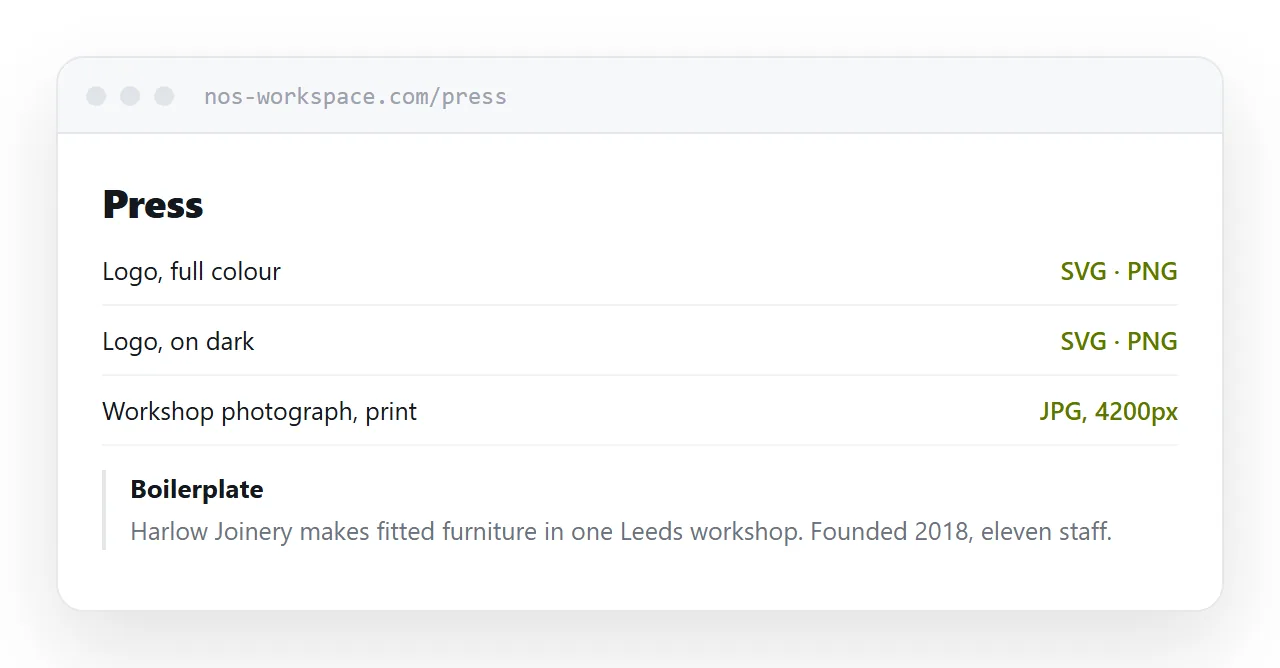
This guide covers the four things, resolution, and why there must be no form.
No form
The instinct is to gate the assets so you know who is writing about you.
A journalist forty minutes from filing will not complete a form to receive a download link by email. They will use whatever is available, and if that is a low-resolution logo pulled from your homepage, that is what appears.
Worse, they may use a competitor whose assets were immediately available, because the piece needed an illustration and yours required a process.
Open page, direct downloads, no account.
The four things they take
A logo. Several versions: full colour, single colour, on light, on dark. Individual downloads, clearly labelled, not a zip of everything.
A photograph. Product, premises or people. One good one used repeatedly beats twelve nobody chooses between.
The boilerplate. The paragraph that appears at the end of a piece describing who you are. Write it, and it appears as you wrote it.
The spelling of a name. Founders, executives, the company itself. Including whether it is capitalised unusually, because it will be got wrong otherwise.
| Behind a form | Open page | |
|---|---|---|
| Used on deadline | Rarely | Yes |
| Right logo appears | Sometimes | Usually |
| You know who took it | Yes | No |
| Competitor used instead | Often | No |
Print resolution
This is the one place where full resolution is correct.
A photograph sized for the web cannot be used in print, and the piece runs without an image or with one the publication found elsewhere.
Provide both: a screen-sized version for online use and a full-resolution version clearly labelled for print. Say the licence plainly, which is usually free use in connection with coverage.
Write the boilerplate
Journalists need a paragraph describing your company and they will write one if you have not.
The one they write is assembled from your homepage and may be wrong in ways that then get repeated by everyone citing that piece.
Write it yourself. Three sentences: what you do, for whom, and one fact that anchors it such as founding year or scale. Keep it current, because it appears verbatim for years.
A named contact
A generic press inbox is functionally no contact when somebody needs a quote in twenty minutes.
Name a person, give a direct address and a phone number, and make sure that person actually answers quickly. If nobody can answer quickly, say what the realistic response time is so the journalist can plan around it.
Keep it current
Press kits go stale invisibly. An old logo, a photograph of a premises you left, a founder who has moved on.
Review it twice a year. It takes ten minutes and it prevents the specific embarrassment of a publication using material you stopped using two years ago.
Closely related: How to share a press kit as a link, and How to share a media kit as a link for the adjacent problem.
Put it at an address
No form, direct downloads of individual assets, photographs at print resolution, a written boilerplate paragraph, and a named contact who answers.
Then the piece runs with your logo and your description of yourself.