In short
Enter 0.00 in for a checked dry day. Mark a trace T, and mark any day you missed Unobserved. Leave the numeric field empty for both. Give a multi-day reading its own dated row.
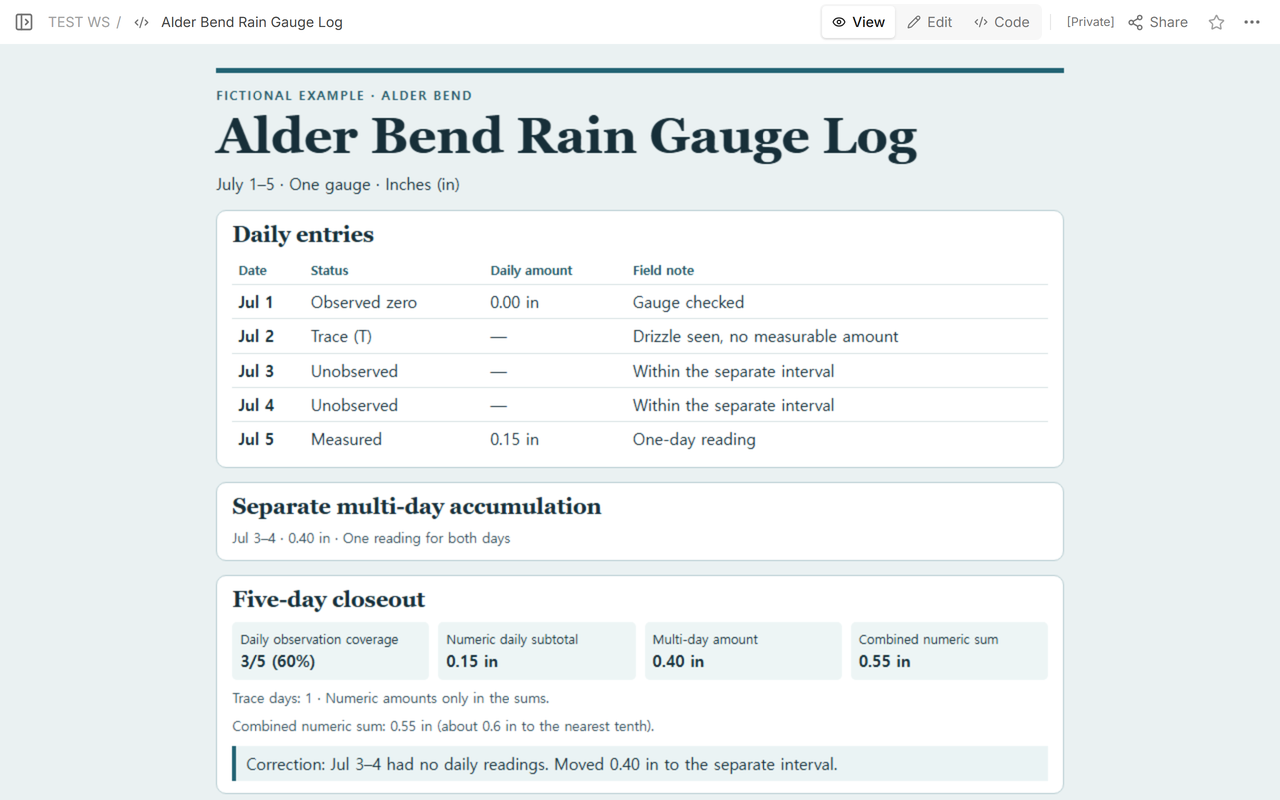
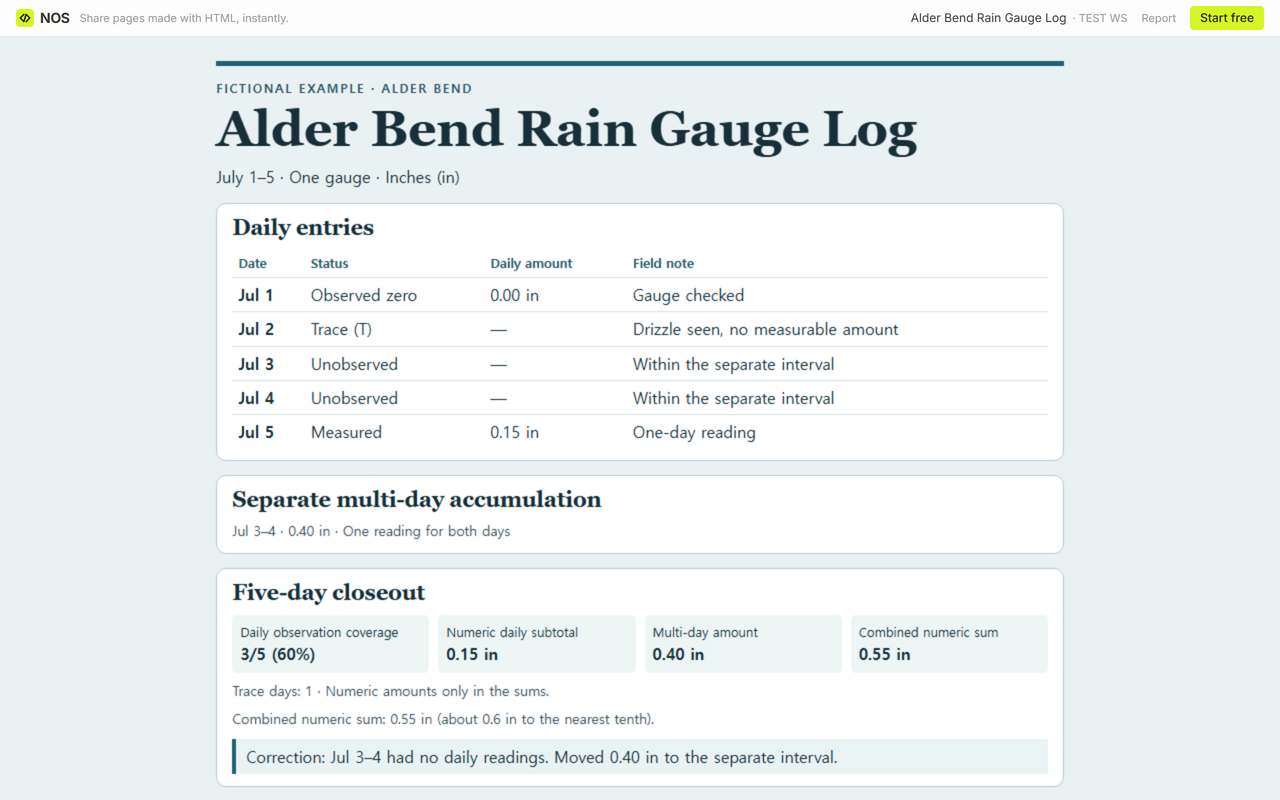
The corrected Alder Bend log has 3/5 days (60%) with daily observations. Its daily numeric subtotal is 0.15 in, its separate multi-day amount is 0.40 in, and the combined numeric sum is 0.55 in. One trace day stays on the record.
Download the completed Alder Bend example (HTML)
Download the blank rain gauge log (HTML)
What should each daily row say?
Start with the gauge, the five dates, and the unit. In the fictional Alder Bend log, the July 1 check found no precipitation, so the entry is Observed zero and the amount is 0.00 in. On July 2 the observer saw drizzle but had no measurable amount. That row is Trace (T). The dash in its amount cell shows that no number was entered. The CoCoRaHS data entry FAQ also uses T for precipitation that was seen or felt but could not be measured.
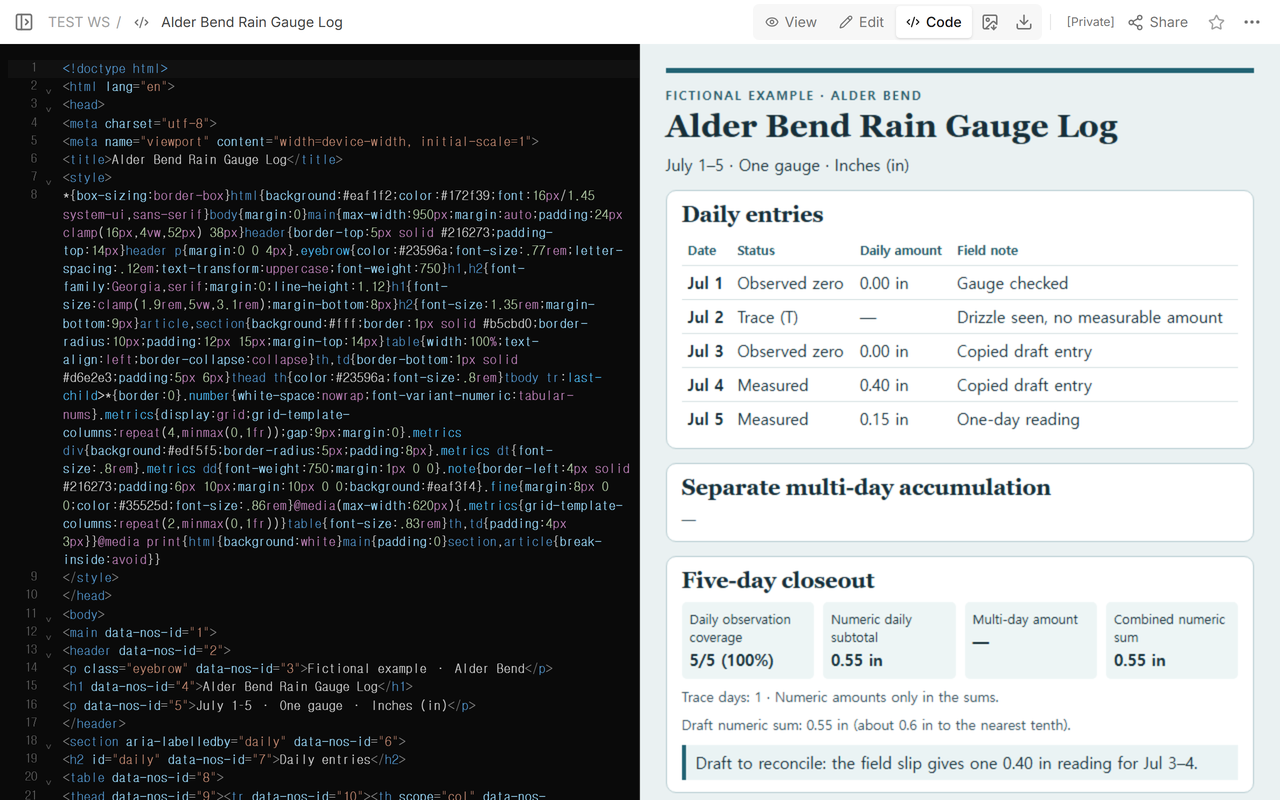
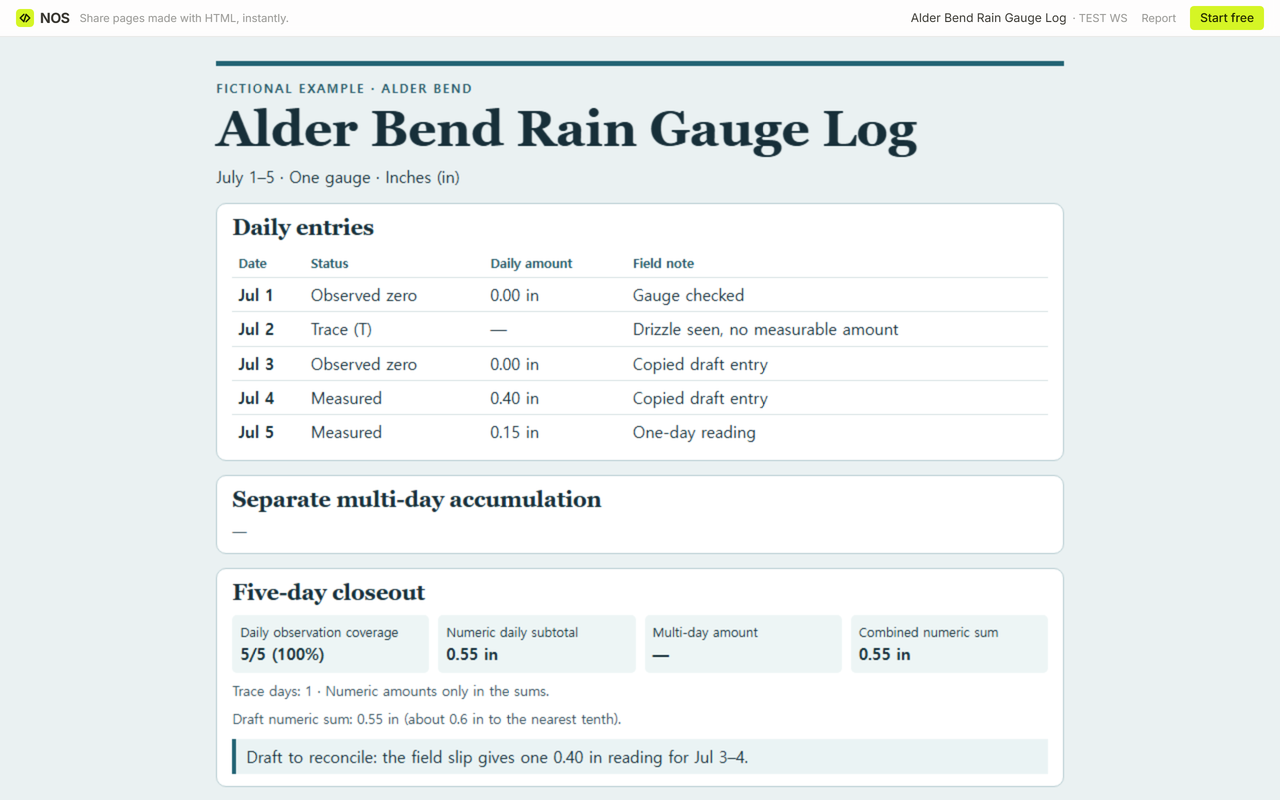
In the draft, July 3 had been copied as 0.00 in and July 4 as 0.40 in. The field slip actually gave one 0.40 in reading for July 3–4. There was no reading for either day on its own. July 5 had its own reading of 0.15 in and stays as entered.
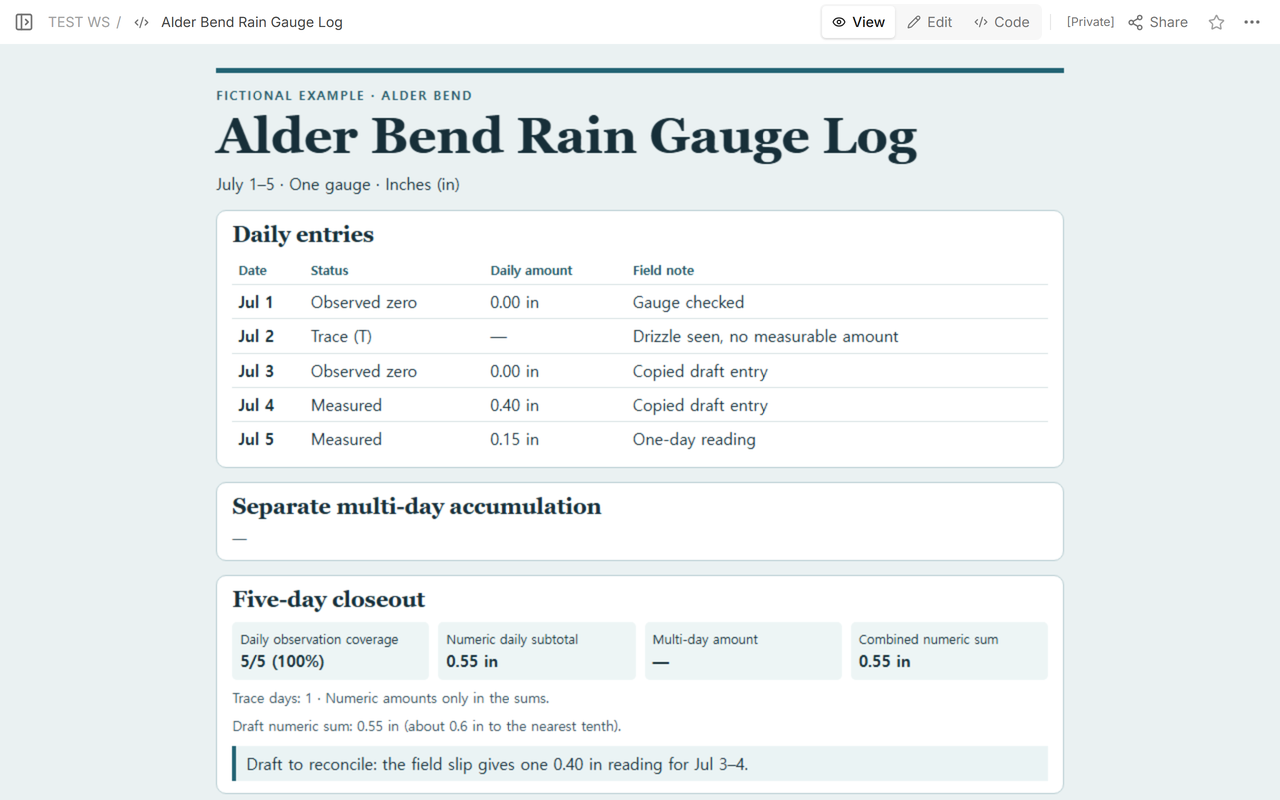
How do you reconcile one two-day reading?
Change July 3 and July 4 to Unobserved and clear their daily amounts. In the separate accumulation section, enter July 3 as the first date, July 4 as the last date, and 0.40 in for the interval. Keep the field slip’s span intact. It gives no basis for dividing the amount between the two dates.
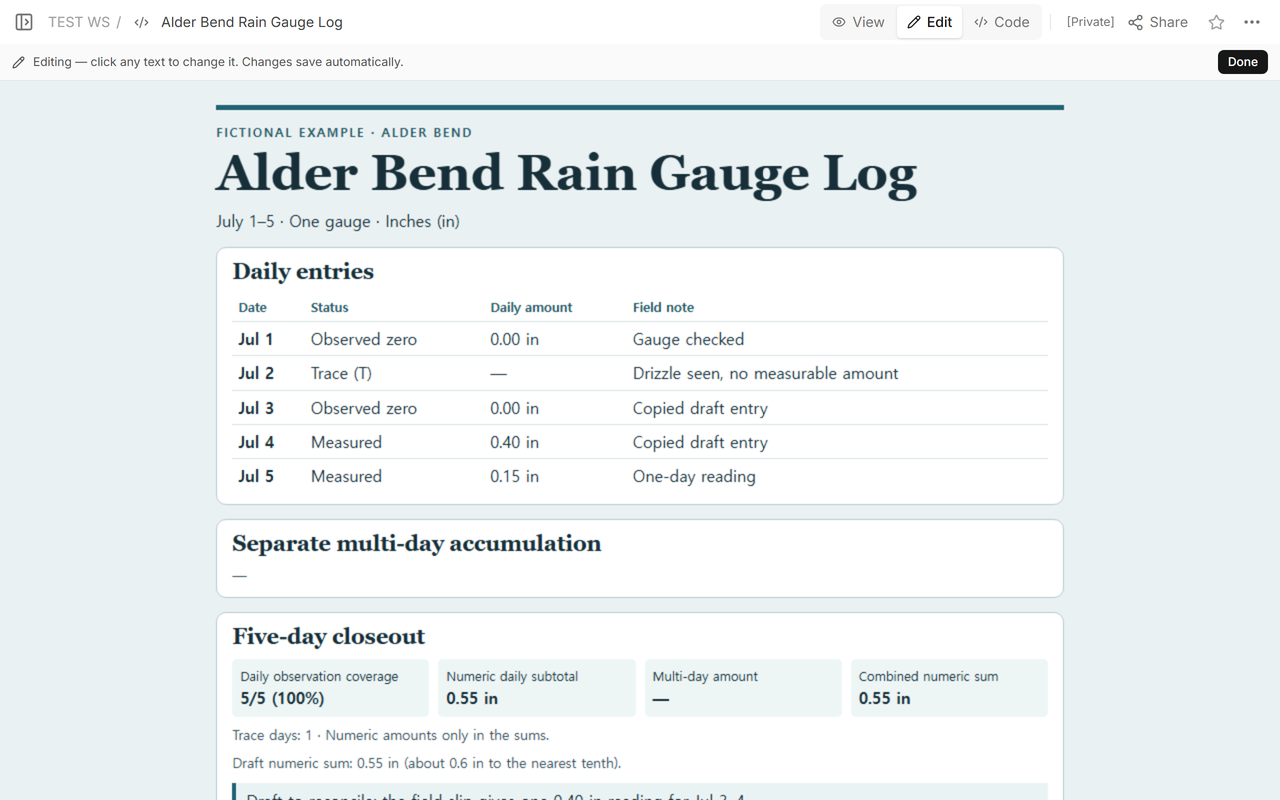
Next, work through the closeout by hand:
- Daily coverage: July 1, 2, and 5 have daily observations. Divide 3 by 5 and multiply by 100 to get 60%. July 2 counts toward coverage because someone observed a trace.
- Daily numeric subtotal: 0.00 + 0.15 = 0.15 in. Keep July 2 as one trace day outside that arithmetic.
- Combined numeric sum: July 3–4 overlaps none of the daily readings. Add 0.15 + 0.40 = 0.55 in. If you need a rounded figure for conversation, that is about 0.6 in to the nearest tenth. Keep 0.55 in in the record.
The draft happened to add to 0.55 in too. Compare the coverage and the two subtotals as well as the final sum. That is how you catch the misplaced amount.
How do you check what a reader sees?
We kept the fictional log on one NOS page. Its Share panel gave us the reader link. Before the correction, we opened that address signed out and found the draft coverage.
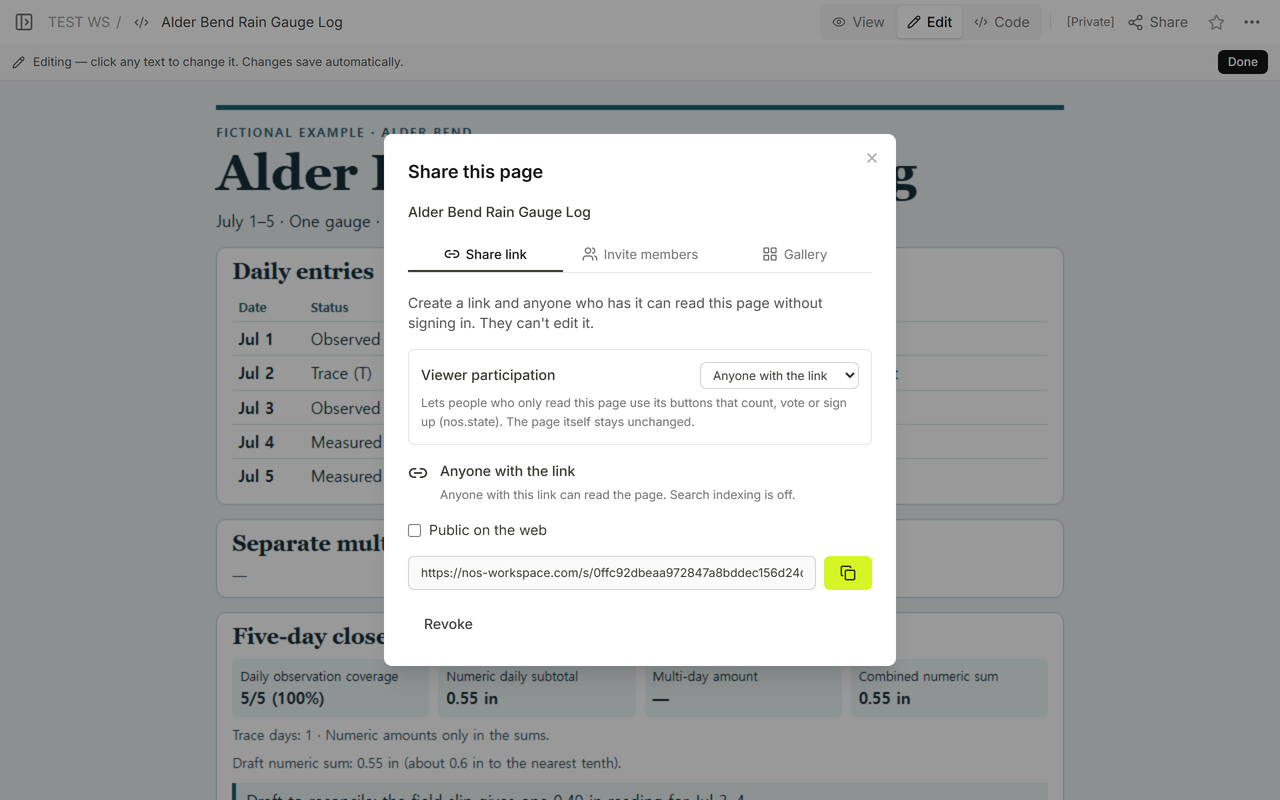
After the correction, View showed two Unobserved rows and one dated interval. We reopened the same Alder Bend reader link signed out and checked the corrected coverage and amounts.
When not to do this
Use the blank worksheet for your own record or to practice a closeout. The blank status means an entry still needs review. Fill the totals yourself, then print or save the filled page as a PDF to keep it. For a network submission, follow its own form. The National Weather Service’s Middle Tennessee CoCoRaHS FAQ describes a separate multi-day report with start and end dates. Use that guidance for that network.
For another field sheet with an explicit missed check, see the bird point count data sheet. The seed germination test record shows how to keep a cumulative figure tied to the last observation.