Pick the passage first, then one or two skills
One large free collection sorts its sheets two ways: by grade, from kindergarten through fifth, and by skill, with topics such as main idea, sequencing, context clues, inference, and cause and effect. That skill list is useful even if you never download anything, because it gives you words for what each question is actually practicing.
When you write your own, choosing one or two of those skills per sheet keeps the results readable for you as well as the student. If a child misses both cause-and-effect questions but gets the vocabulary item right, you know where to look next. A sheet that mixes six skills in six questions tells you less.
Your other options are real ones. A ready-made set saves the most time when any passage at the right level will do. A workbook hands you a sequence of passages already in order. Building your own takes more effort up front, and it pays off mainly when the text is fixed and the questions have to follow it.
What the sample worksheet does
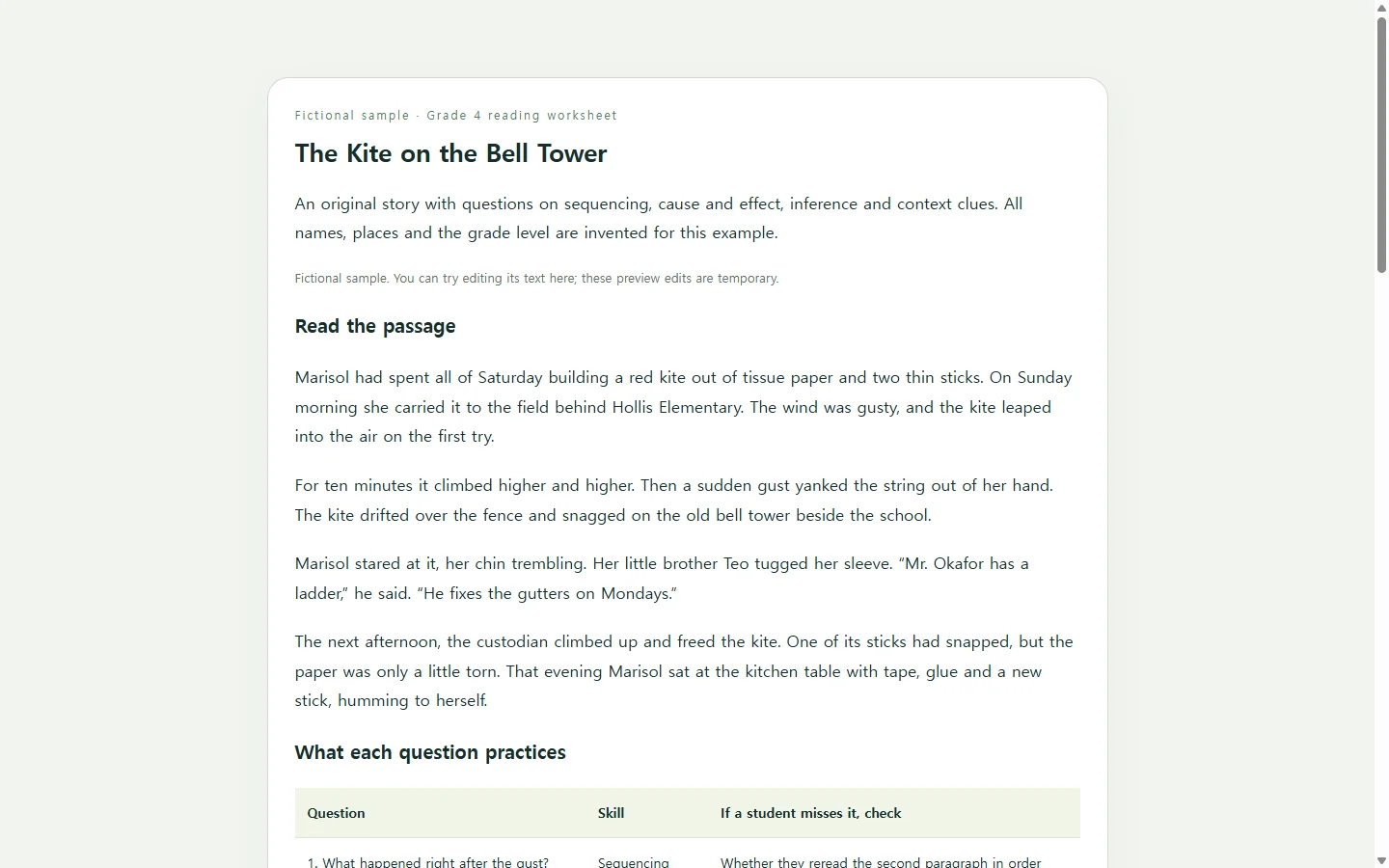
The sample on this page uses an original story, “The Kite on the Bell Tower,” about a girl whose kite gets stuck on the bell tower beside her school. The girl, her brother, the custodian and the school are invented for this example, and the fourth-grade label is our choice, not a measured reading level.
Two things are worth borrowing. Every question is labeled with the skill it practices, and each answer explanation points to a line in the story, so a wrong choice sends the student back to the text instead of to a guess. The one short-answer question also gets a three-level scoring guide.
That guide follows ordinary rubric advice: describe each level with things you can see in the answer, and skip vague words like “creative.” On a worksheet, that means full credit reads “names the ladder and connects it to Monday,” not “shows good thinking.”
Build your version with AI
You bring the parts AI shouldn't invent: the passage, the grade, the skills, and how many questions you want. The AI handles the drafting and layout, writing questions that fit your text and arranging everything on one page that reads well on a phone or a laptop.
The prompt asks for HTML, the format web pages are written in, so the result opens as a page instead of a document you have to format yourself. Swap your own passage in for the kite story and keep the skill labels if they help you.
Before any student sees it, read every question against the passage and confirm the marked answer is the one the text actually supports. If a wrong option could also be defended from the story, rewrite it or ask the AI for a replacement.
Sending it home, and fixing it after you've sent it
If your school wants worksheets as a printed packet or a PDF uploaded to its system, keep making that file. A link doesn't replace a required submission.
A link works when it's enough on its own, say for families practicing over a long weekend or students opening the page on a tablet. You can put the HTML page in NOS, which keeps notes and pages together in a workspace, and share it; families open the link without creating an account. The sample doesn't collect or send answers anywhere, so ask students to write their answers on paper or bring them to class.
Now suppose that on Sunday night you notice question 2 calls Teo Marisol's cousin. You can fix that word directly on the page, without asking the AI to rebuild the whole worksheet, and the link families already have stays the same, so anyone who opens it after your fix sees the corrected question.
Keep direct edits to wording. If you change which option is correct, don't count on the page's self-check following along; ask the AI to rebuild that question and check it against the passage again before students use it.
Next week's passage gets the same treatment: new text, the same prompt, and a sheet built around what your class is actually reading.
A prompt to adapt
Create one self-contained HTML file for a reading comprehension worksheet.

Passage (use exactly as written; do not change, shorten, or add facts):
[PASTE YOUR PASSAGE]

Title: [WORKSHEET TITLE]
Grade: [GRADE, e.g., 4]
Skills to practice: [SKILL 1, e.g., cause and effect], [SKILL 2, e.g., context clues]
Notes about readers (optional): [e.g., several students are English learners; keep question wording short]

Questions:
- [NUMBER, e.g., 4] multiple-choice questions, 4 options each, exactly one correct answer that is directly supported by a sentence in the passage. Wrong options must be plausible but contradicted by the passage.
- Label each question with the skill it practices.
- 1 short-answer question with a 3-level scoring guide (2, 1, 0 points). Describe each level with observable things the answer includes, not words like “good” or “creative.”

Self-check: when a student picks an option, show in text (not color alone) whether it is correct, plus a one-sentence explanation that quotes or points to the passage.
Do not save, send, or submit answers anywhere. No external scripts, fonts, images, or links.

Teacher section: put the answer key and scoring guide in a collapsed section at the bottom labeled “For the teacher.”

Accessibility: headings in logical order; dark text on a light background with strong contrast; every option usable by keyboard with a visible focus outline; feedback announced as text; base font size at least 18px; comfortable line length for the passage.

Mobile: single column; fits a 360px-wide screen with no horizontal scrolling; tap targets at least 44px tall.

Return only the complete HTML.