In short
Use separate criteria for the research objective, method, results and conclusion, figure evidence, labels and sources, viewing-distance readability, spoken explanation, and question response.
Beside every score, record what the reviewer observed and the next revision action. Do not hide unrelated strengths and failures inside one total.
Start with the complete fictional example below, then replace the marked assignment fields before using the blank rubric.
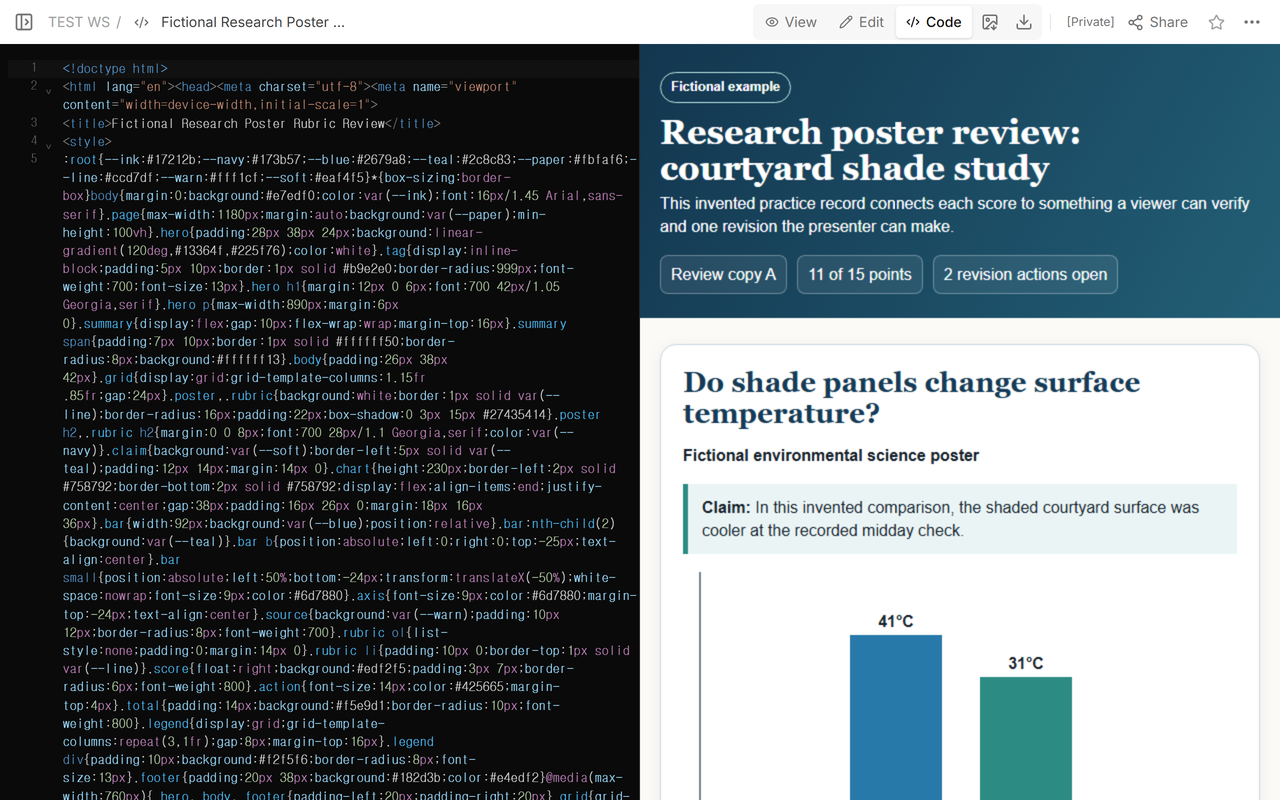
NOS Team tested the rubric with one invented environmental science poster. The poster compares two fictional courtyard surface readings. It is not a real study or student submission. The first review exposed two visible problems: the chart categories were too small at the planned viewing distance, and the figure had no source line. Those two observations became two edits and two rechecks.
What does the completed example include?
The revised example is a full practice record, not only a score table. Its poster states a narrow claim, a one-observation method, a result and bounded conclusion, figure values, category labels, the °C unit, a fictional source line, and a viewing-distance check. Beside it, the rubric scores eight criteria separately.
- Objective and significance: Can the viewer identify the question and why this comparison is being shown?
- Method: Are the locations, timing, and same-instrument condition visible?
- Results and conclusion: Does the conclusion follow from the displayed result without becoming broader than the evidence?
- Figure evidence: Can the viewer identify categories, values, units, and the boundary of the observation?
- Labels and source trail: Can the viewer read the labels and trace the figure to the stated record or source?
- Viewing-distance readability: Can the planned audience read the claim, figure, source, and limit from the actual viewing position?
- Two-minute explanation: Does the speaker name the question, method, result, conclusion, and limit while pointing to the relevant figure?
- Question response: Does the answer distinguish what the evidence shows from what it cannot establish?
This structure follows the common separation in current university materials. Penn State distinguishes objective and significance, method, results and conclusions, visual presentation, and the overall presentation including questions. The University of Kansas rubric separates significance, evidence, conclusions, and poster design. Cornell College also separates research presentation, visual presentation, and source documentation, and says its rubric must be revised for each specific assignment.
How do you write levels a reviewer can observe?
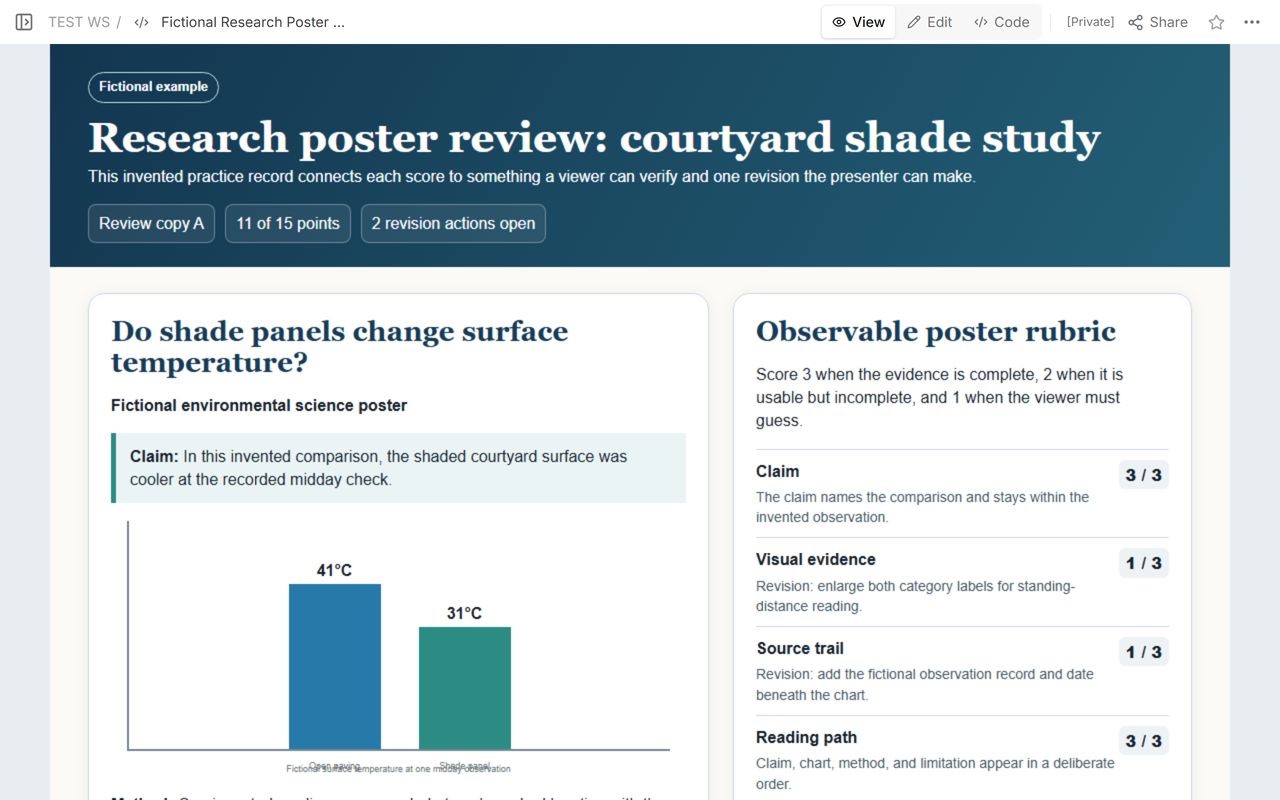
The example uses three levels: 3 when the viewer can verify the criterion, 2 when the required evidence is present but incomplete, and 1 when the reviewer must guess. The number is only a label for a descriptor. Each criterion still needs its own boundary.
For figure evidence, 3 means the categories, values, unit, and observation boundary are identifiable. A 2 could mean all four are present but one is difficult to read. A 1 could mean a missing unit or labels that prevent the viewer from knowing what the bars represent. For question response, the same numbers must describe a spoken answer rather than poster design.
Avoid “excellent,” “good,” and “poor” without observable differences. “Needs confidence” does not say what the presenter omitted. “The answer repeated the result but did not state the one-observation limit” identifies both the evidence and the next rehearsal action.
How do you record a score and the next action?
Use four fields for every criterion: score, observation, next action, and recheck evidence. In the first review, the useful record was not “Figure evidence: 1.” It was “Category labels cannot be read at the planned distance; enlarge both labels; recheck from that position.” The source entry used the same pattern: “No source line; add the required record label and date; verify that the figure traces to it.”
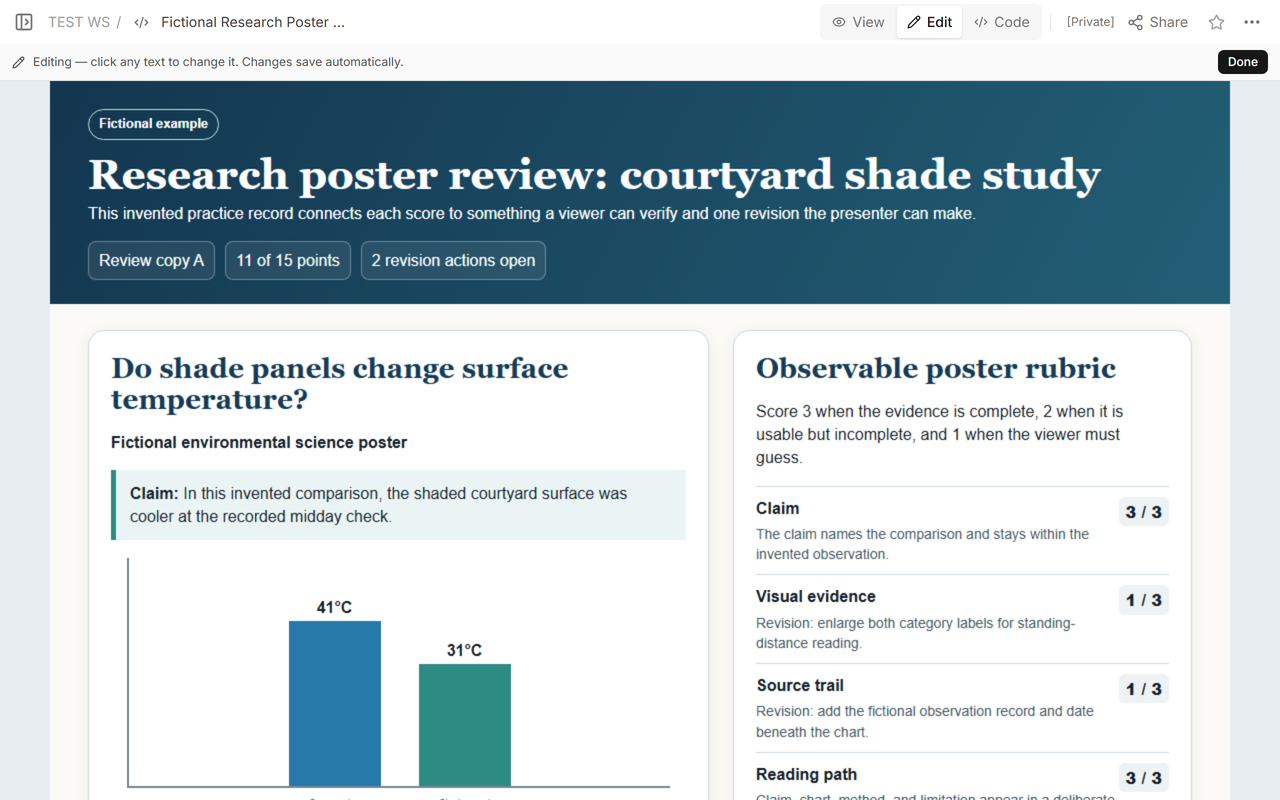
The worked reviewer-record download preserves the before and after entries. The blank download leaves the scores, observations, actions, and recheck results empty. Keep them empty until someone actually observes the poster or presentation.
What should the two-minute explanation cover?
The fictional talk is a rehearsal cue, not fixed wording to copy into another subject. It moves through five observable actions: state the question, point to the two locations and method condition, identify the values and unit, connect the difference to the narrow conclusion, and name the one-observation limit.
The example also includes one question: “Does this prove shade panels always cool paving?” A complete response says no, names the evidence boundary, and identifies what a broader conclusion would require. The reviewer records whether that boundary appeared in the answer. They do not infer question-handling skill from the printed poster.
If the assignment allows five minutes instead of two, replace the timing field and performance description. Penn State’s current exhibition guidance uses a different presentation length, while the KU poster guide describes a 2-3 minute poster talk. The assignment’s actual rule wins.
What changed after the low scores?
The same NOS page was revised. The category labels became larger, and the figure gained a dated fictional source record line. The expanded final copy also separated objective, method, result and conclusion, figure evidence, source labeling, readability, spoken explanation, and question response. It retained the narrow claim and the fictional status.
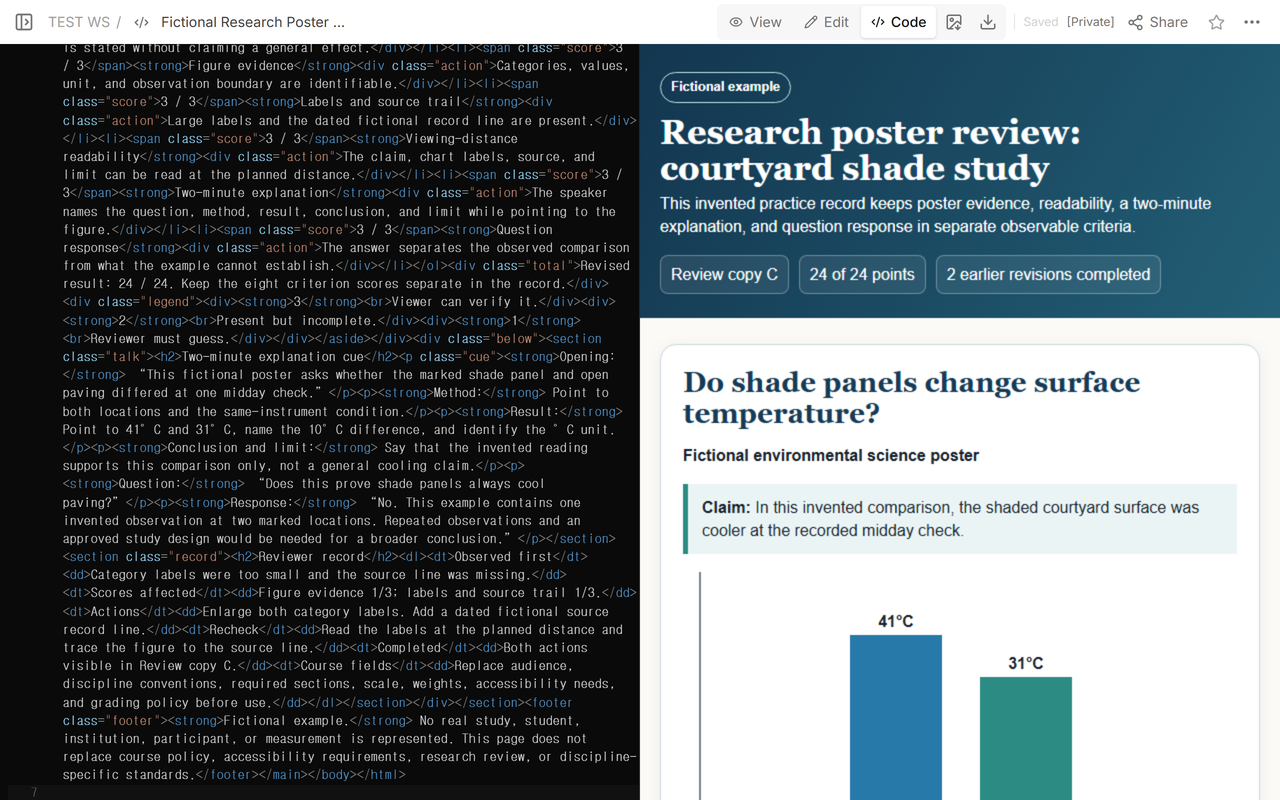
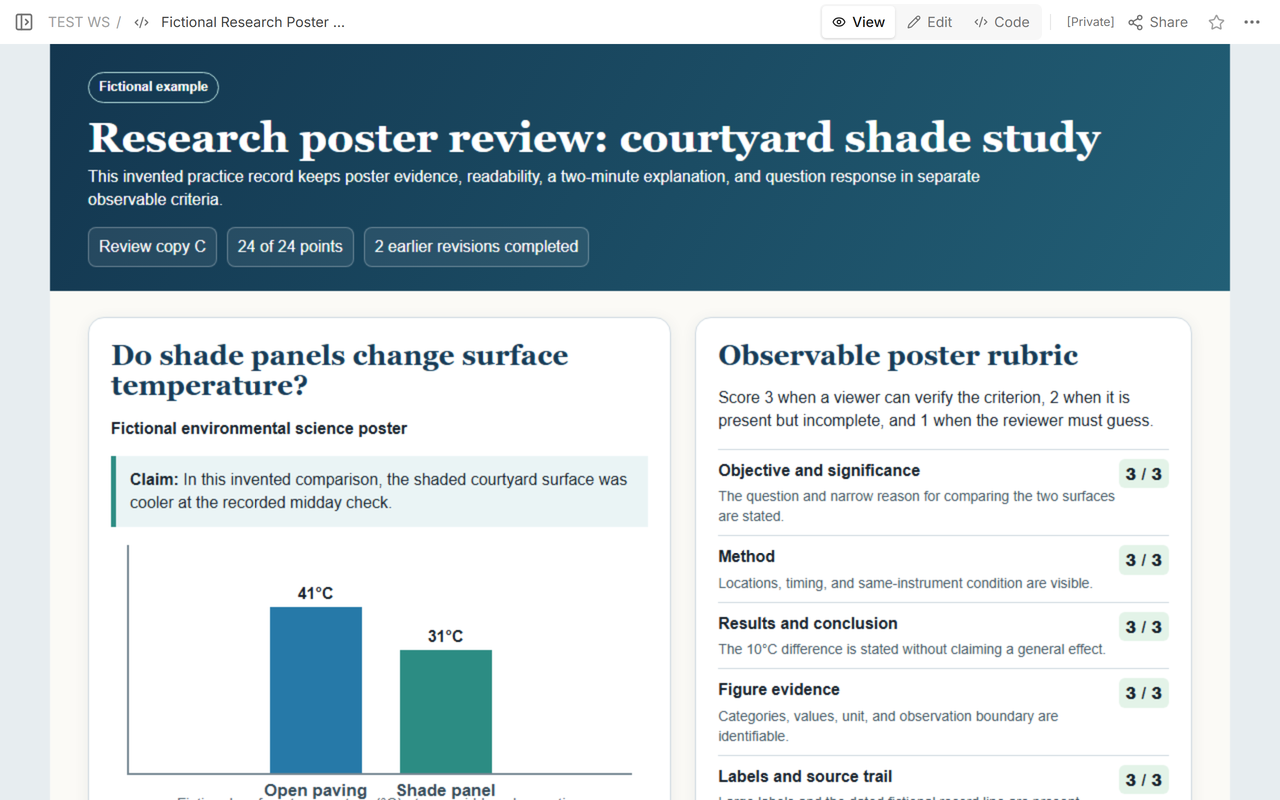
The total is 24 of 24 because all eight fictional criteria are shown as complete. The record still keeps each score visible. A real course may weight criteria differently or avoid points entirely; the download does not turn this fictional scale into a grading policy.
How can a reviewer share the same review copy?
After saving, we reopened Share on the existing page. The panel showed the reader link and the read-only condition. We then reopened that same reader address and checked the content inside the page: Review copy C, 24 of 24, the expanded criteria, and the two completed earlier revisions.
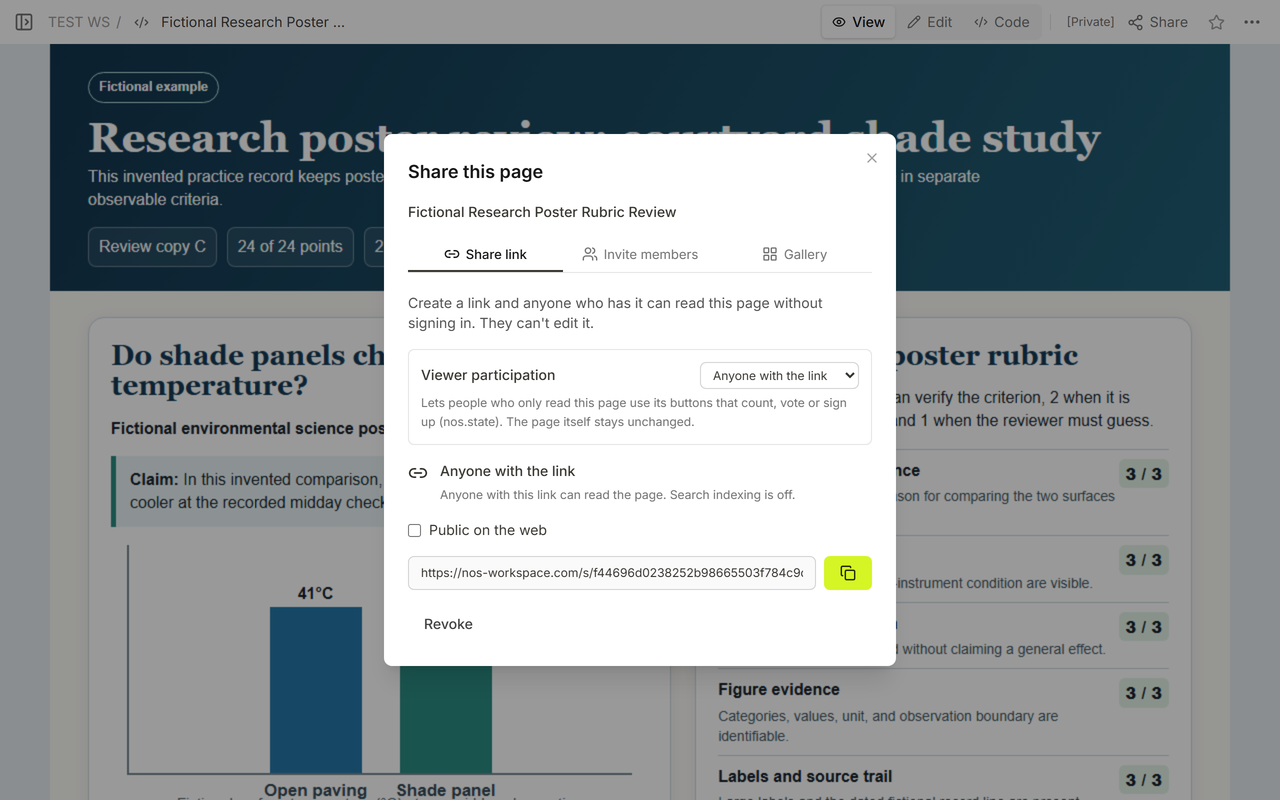
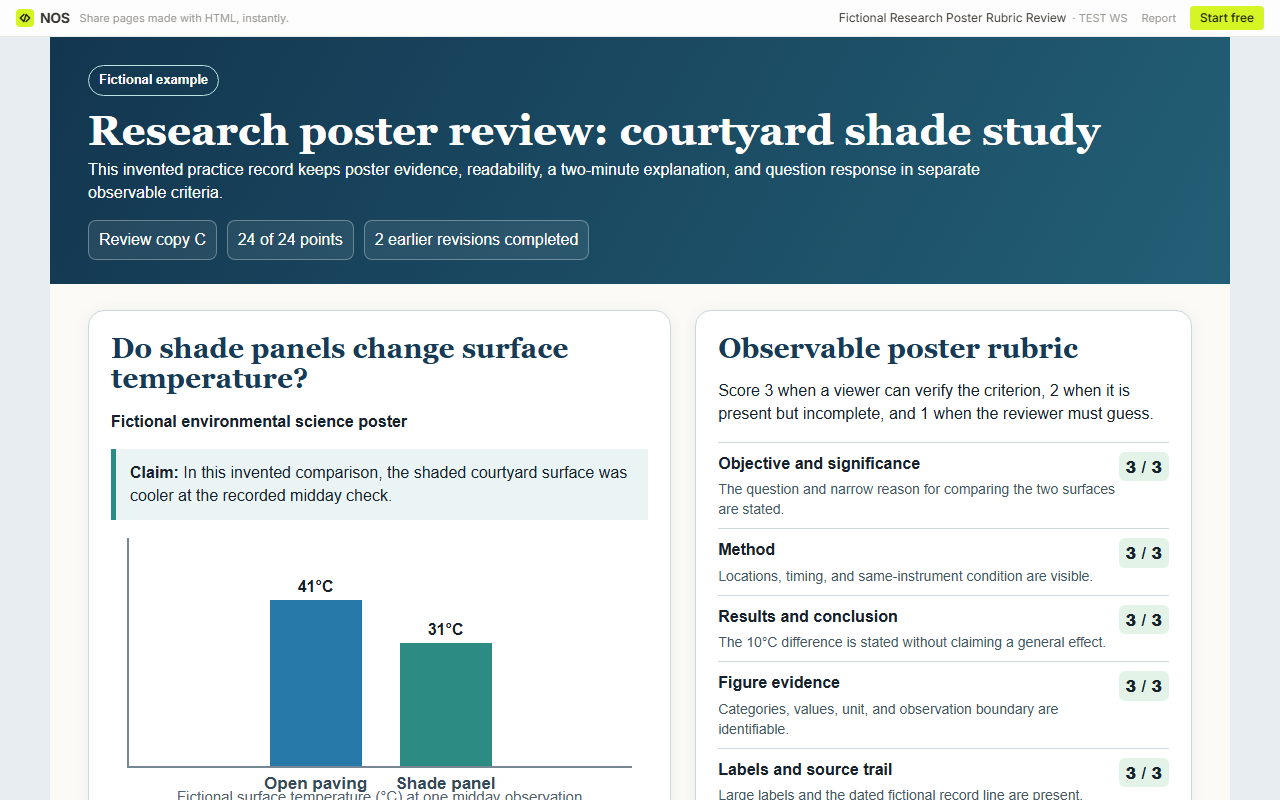
Result: two low observations produced two visible poster edits, while the expanded rubric kept content, method, conclusion, figure quality, readability, speaking, and question response separate. The reviewer can now see what changed and what still needs a real course decision.
Which fields must change for another course?
Replace the audience, discipline conventions, required poster sections, figure and source rules, viewing distance, accessibility requirements, spoken time limit, question-response expectation, scale, weights, missing-work policy, and official grade workflow. The adaptation download lists these fields without supplying answers.
Do not copy the fictional temperatures, source record, or equal weighting into a real assignment. A humanities poster may use archival images and interpretive claims rather than a chart. A design project may need process evidence. A laboratory course may require uncertainty, replicates, or a specific citation format. The rubric should name what that assignment actually requires.
How is this different from nearby rubrics?
The general presentation rubric focuses on what to rehearse across talk formats. The research paper rubric assesses how a written argument selects, connects, and attributes sources. The research poster QR code guide handles a companion page for material that does not fit on the poster. This guide is specifically for scoring the research poster and its spoken explanation together while keeping their criteria separate.
When not to do this
- Do not replace an instructor’s approved rubric or an event’s judging form with this fictional scale.
- Do not merge content, design, accessibility, and speaking into one opaque score when the policy requires separate decisions.
- Do not score a presentation behavior that no reviewer observed.
- Do not treat a readable source line as proof that the study, data, permission, or conclusion is valid.
- Do not publish confidential, embargoed, participant-level, or restricted research in a public reader page.
Using NOS for the review copy
NOS held the complete fictional poster review in one page, displayed it in Code, View, and Edit, and provided the reader address through Share. Updating the existing page changed what appeared at that same reader address in this test. The current pricing page has plan details; this guide does not copy a price or assume a paid plan.
Sources checked
- University of Kansas research presentation guides and rubrics, including its poster rubric and poster guide.
- Penn State Research Poster Presentation rubric and guidance.
- Cornell College poster presentation rubric example.