Build the plan around one question
One large museum collection of science lessons offers both short activities and full-period lessons. It lets teachers filter by grade and by tags that include practices such as asking questions, planning investigations, and analyzing and interpreting data.
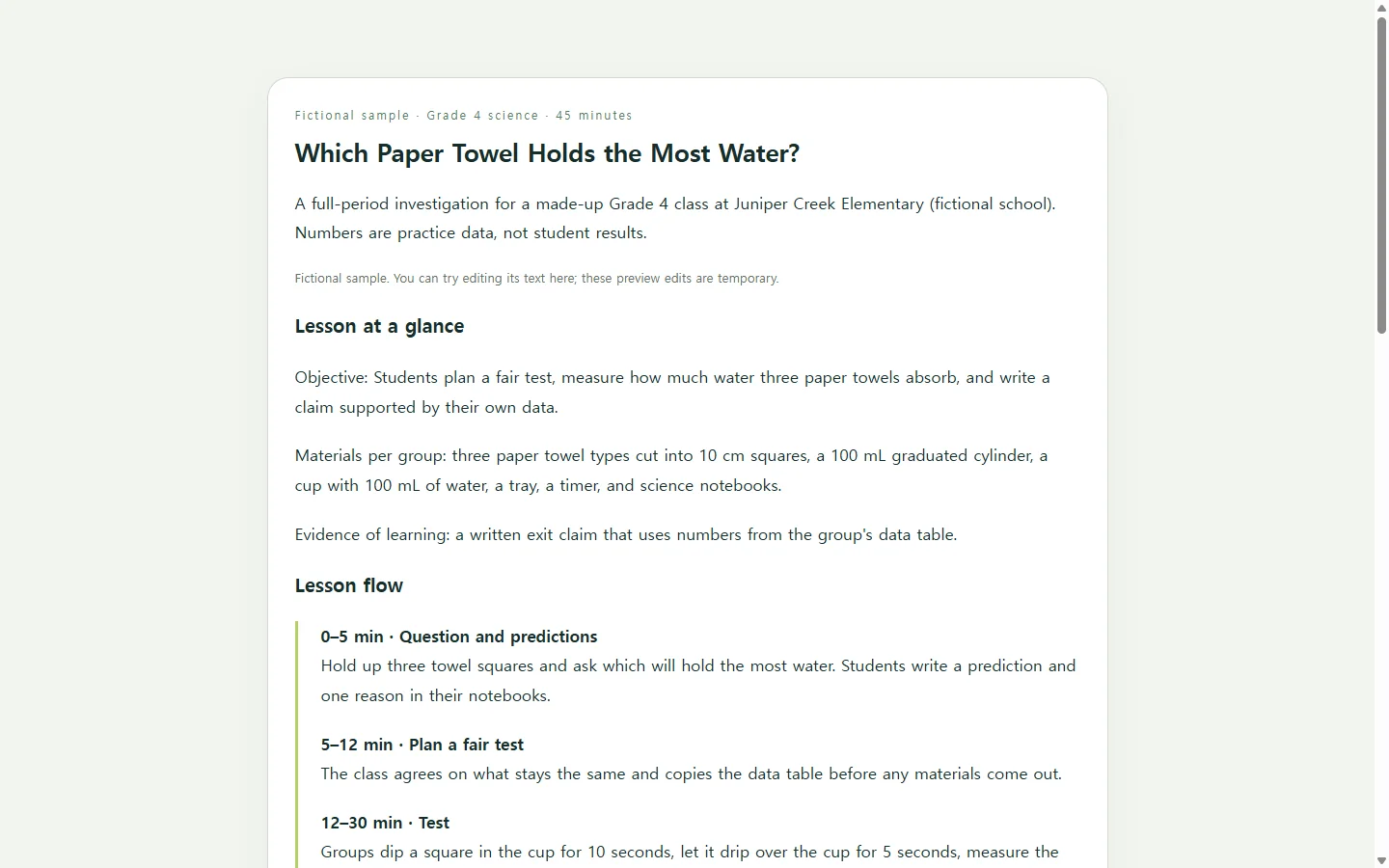
That split is a useful test for your own plan. A ten-minute demo is an activity; a full period needs a question students can answer by the end, something they do to answer it, and something they hand you as evidence. Some published lessons put the question right up front, such as asking why the moon looks different on different days.
Write those three pieces before anything else. If you can't name the evidence yet, keep planning before you format anything.
A fictional Grade 4 example: which paper towel holds the most water?
The sample is invented: a made-up school, a 45-minute period, and practice numbers instead of real student results. Paper towels work here because the materials are ordinary and the answer comes from students' own measurements, not from a fact you tell them.
Three choices do most of the work. The plan lists what stays the same, including towel size, amount of water, and soaking time, so students can explain why the comparison is fair. The data table is drawn before anyone touches water, so every group records the same thing. And the lesson ends with a short written claim backed by numbers from each group's own table.
Read the example for those decisions, not its exact wording. Your question might be about magnets, shadows, or ramps; the same three choices carry over.
Decide how you'll score the claim before you teach
A rubric is a scoring guide that spells out the parts of an assignment and what's expected for each. General teaching guidance suggests starting with one rubric for one assignment and swapping vague words like "creative" for indicators you can actually observe.
For this lesson, that means scoring three things a fourth grader can see on the page: a clear claim, numbers from the table, and a reason that mentions what was kept the same. Treat that as a suggestion for this example, not a required science standard. If your school or district uses a specific framework, borrow its language instead.
Build your own version with AI (optional)
You can write this plan in any document. If you'd rather have it laid out as a clean page, an AI chat tool can handle the design from your details. HTML is just the format web pages are written in; you don't need to read it, only save the file the AI returns.
Gather what only you know first: grade, minutes, question, the materials you really have, and any standard code or safety rule your school requires. The prompt in this section lets the AI handle layout and wording, but tells it to mark missing standards or safety rules as "[Teacher to confirm]" rather than invent them, and to leave the data table empty for your class.
When the page comes back, check that the timed steps add up to your period and that the materials match your cabinet. Those two details come from your room, so they're the ones to double-check.
After the first class: fix the words, keep the link
Plans change once they meet a real room. Say the store is out of one towel brand, or the soaking step runs long and you want to give it two more minutes. If a co-teacher or aide already has the page, you want to change those lines without rebuilding the plan.
In NOS, you can edit the text on the rendered page directly, so a new brand name or a revised time doesn't mean asking AI to regenerate everything. Once you publish a page, its sharing link stays the same after later edits, and the people you sent it to can open the updated version without an account.
Two limits to keep in mind. The sample page displays the plan and a data table; it doesn't collect student answers, so groups still record on paper or in notebooks. And if your school requires lesson plans as a PDF or Word file, submit that format; a shared page can sit alongside it, not replace it.
Start with your own question and your own materials, fill in the prompt, and share the page with whoever teaches the lesson with you.
A prompt to adapt
Build a one-page science lesson plan as a single self-contained HTML file.

My details (use only these; do not invent facts):
- Grade: [GRADE, e.g., Grade 4]
- Class length: [MINUTES, e.g., 45 minutes]
- Investigation question: [QUESTION, e.g., Which paper towel holds the most water?]
- Materials I actually have: [MATERIALS, e.g., three paper towel brands, 100 mL graduated cylinders, cups, trays, timers]
- What students hand in as evidence: [EVIDENCE, e.g., a written claim using numbers from their data table]
- Standard code my school requires, if any: [STANDARD CODE, or leave blank]
- Safety rules my school requires, if any: [SAFETY NOTES, or leave blank]

Include, in this order: a one-sentence objective; a materials list per group; a timed lesson flow whose minutes add up exactly to my class length; a short list of what stays the same so the test is fair; an empty data table with a column for each trial and an average; a three-row rubric (claim, evidence, reasoning) with observable descriptions for each score level; and a teacher notes section.

Rules:
- If the standard code or safety rules are blank, write "[Teacher to confirm]" instead of making them up.
- Do not add results, student names, testimonials, or quotes.
- No forms, submit buttons, external scripts, web fonts, images, or links. Inline CSS only.
- Accessibility: one h1, headings in order, real table markup with header cells, high text contrast, body text at least 16px, and never use color alone to carry meaning.
- Mobile: readable at 360px wide with no sideways page scrolling; wide tables scroll inside their own container.

Return only the complete HTML file.