What a sponsor should find quickly
One published template for this search is built around a cover, a sponsorship letter or executive summary, and a section on what makes the event hard to miss. It's written for nonprofits, charities, foundations and event managers looking for corporate partners. That's a workable skeleton, but the skeleton alone doesn't make the ask.
Name the business you're writing to and say why its customers overlap with your crowd. Describe the audience with figures you can stand behind, and say where they came from. If this is your first year, give planned capacity and label it that way instead of borrowing another event's numbers. Put each tier's price beside what the sponsor actually receives, and close with a reply-by date and one person to contact.
If the price of the middle tier takes digging to find, the reader is doing work the proposal should have done.
A filled-in example: a neighborhood night market
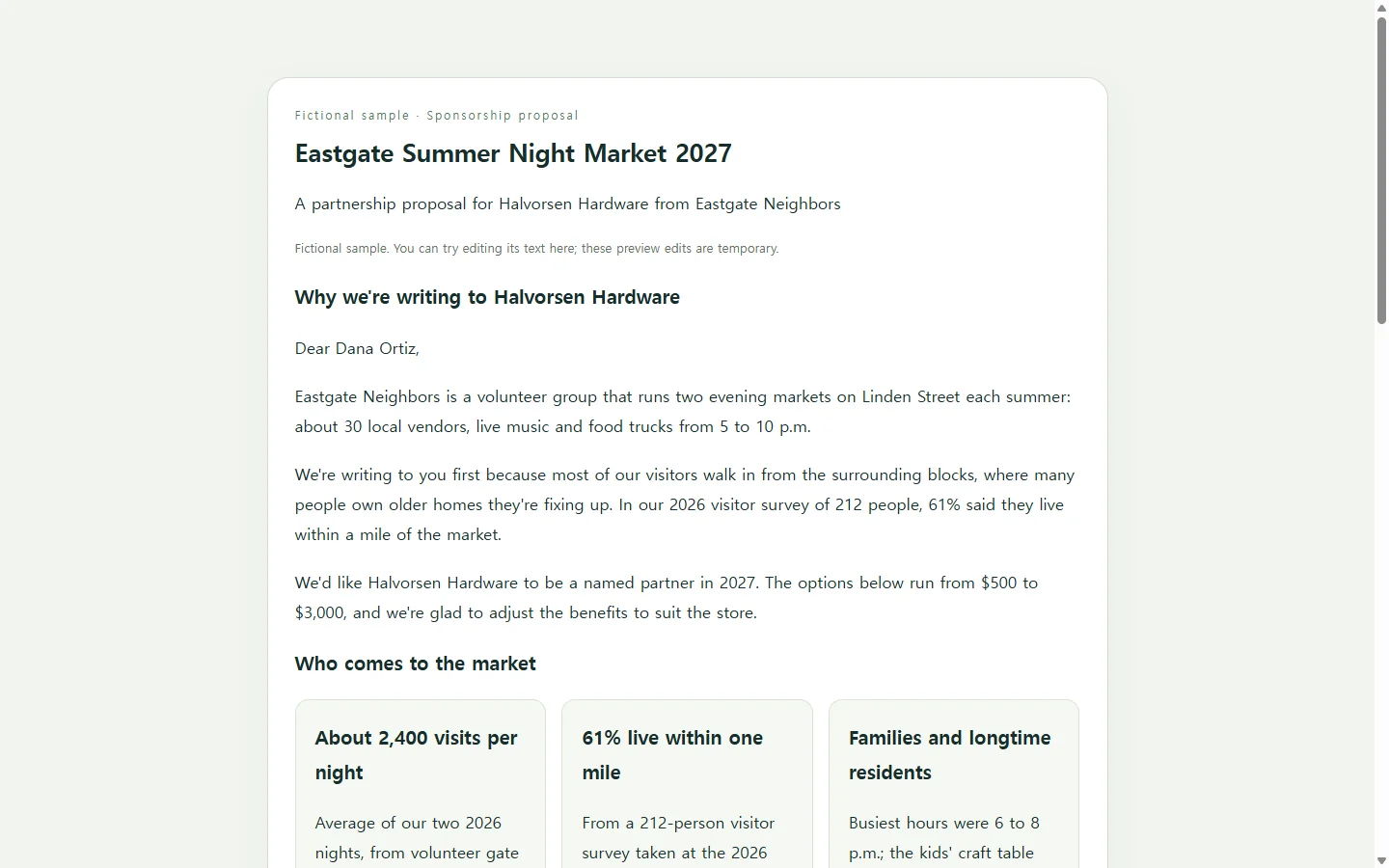
In the sample below, Eastgate Neighbors, a volunteer group, asks Halvorsen Hardware, a local store, to back two summer night markets. Every name, figure and date in it is invented, so replace all of them with your own.
Three choices are worth borrowing. The letter explains why a hardware store in particular: the market draws people from nearby blocks of older homes. The tier table puts price, benefits and open spots on one row, so the reader compares options without scrolling back and forth. And the timeline works backward from the banner print deadline, which gives the sponsor a concrete reason to reply by a specific day.
What it leaves out is just as deliberate: no long history of the group, no roster of volunteers. If the sponsor wants either, they'll ask, and you'll have a reason to follow up.
Building yours: a document template, a designer, or AI
If the business expects a Word or PDF attachment, start from a document template and fill in the same pieces. If the proposal is going to a large sponsor and has to match a strict brand look, paying a designer may be worth it. If you have the facts but not the time to lay them out, an AI chat assistant can draft the design.
The prompt below asks for a single HTML file, which is a web page saved as one file that opens in a browser. You supply the facts; the AI handles layout, spacing and the tier table. It doesn't know your attendance, prices or deadlines, so the prompt tells it to mark gaps instead of guessing. Check every number in the draft against your own records before it goes anywhere.
The prompt also asks for a layout that reads on a narrow phone screen and stays usable with larger text or a screen reader, since you can't predict where the contact will open it.
Send it the way the sponsor asked
If a business takes requests through an application portal or asks for a file it can forward internally, send exactly that. A link is not a substitute for a required PDF or Word document. The sample here also has no export, signup form or payment button; it's a page to read, and replies come back by email or phone.
When the terms change after you've sent it
Suppose the store manager replies asking whether the Neighbor tier could include a booth, and the same week the city moves the second market night from July 17 to July 24.
If the page lives in NOS, you can click into the rendered text and change that tier row and the date yourself, without asking AI to regenerate the whole layout. The shared link stays the same after the edit, so the manager reopens the address already in their inbox and sees the new terms. They don't need an account to open it. With an attachment, the fix is a revised file, and the earlier copy may still be the one that gets forwarded to the owner.
These are text edits; if your page calculates totals, recheck those figures after editing rather than assuming they updated.
You can keep each sponsor's version as a subpage in the same workspace, alongside your notes from each call. Then the next business gets a page that already answers the question the last one asked.
A prompt to adapt
Build a sponsorship proposal as one self-contained HTML file, with all CSS inside a single <style> tag. Do not use JavaScript, external fonts, external images, external scripts, forms, submit buttons, payment links, or download/export features.

Use only the facts below. Where a fact is missing or marked [TBD], show a visible placeholder such as [CONFIRM: attendance] instead of inventing a number, name, quote, testimonial, other sponsors' logos, or results.

Event: [EVENT NAME], [DATES], [LOCATION] (e.g., Eastgate Summer Night Market, June 19 and July 17, Linden Street between 3rd and 6th)
Organizer: [ORGANIZATION] - [ONE-LINE DESCRIPTION] (e.g., volunteer neighborhood group)
Sponsor I'm writing to: [BUSINESS NAME], attention [CONTACT NAME, ROLE]
Why they fit: [YOUR REASON IN ONE OR TWO SENTENCES]
Audience: [WHO ATTENDS] + [NUMBERS] + [WHERE EACH NUMBER COMES FROM, e.g., last year's gate count, or planned capacity for a first-year event]
Tiers (repeat per tier): [TIER NAME] - [PRICE] - [WHAT THE SPONSOR RECEIVES] - [SPOTS AVAILABLE]
Key dates: [REPLY-BY DATE], [LOGO/ARTWORK DEADLINE], [EVENT DATES], [RECAP DATE]
What I need from the sponsor to confirm: [LIST]
Contact: [NAME], [ROLE], [EMAIL], [PHONE]

Sections, in this order: a short letter addressed to the contact (under 150 words, specific to this business, no generic praise); audience; tiers table; timeline; what we need to confirm; contact.

Requirements:
- Semantic HTML: one h1, an h2 for each section, and a real <table> with <th scope="col"> column headers for the tiers.
- Mobile: readable at 360px wide with no sideways scrolling of the whole page; on narrow screens the tier table either becomes labeled stacked cards or scrolls inside its own container.
- Accessibility: body text at least 16px with line height around 1.5, strong contrast between text and background, visible focus styles on any links, and tier differences never shown by color alone.
- Language: plain and specific; no hype words and no claims of impact or return that I haven't provided.
- Print: add a simple print stylesheet so the page prints cleanly on letter-size paper.