In short
Start with the finished checklist below: six task checks for three roles in a fictional six-person parcel studio.
Each check shows what must be ready before practice, what the person performs, what an observer can see, who owns the decision, when it is due, and what happens next.
Attendance is logged separately. It does not turn an unobserved task into a passed skill check.
Keep private personnel, assessment, certification, and compliance records in the organization’s approved system, not on a public NOS page.
What does the finished staff training checklist look like?
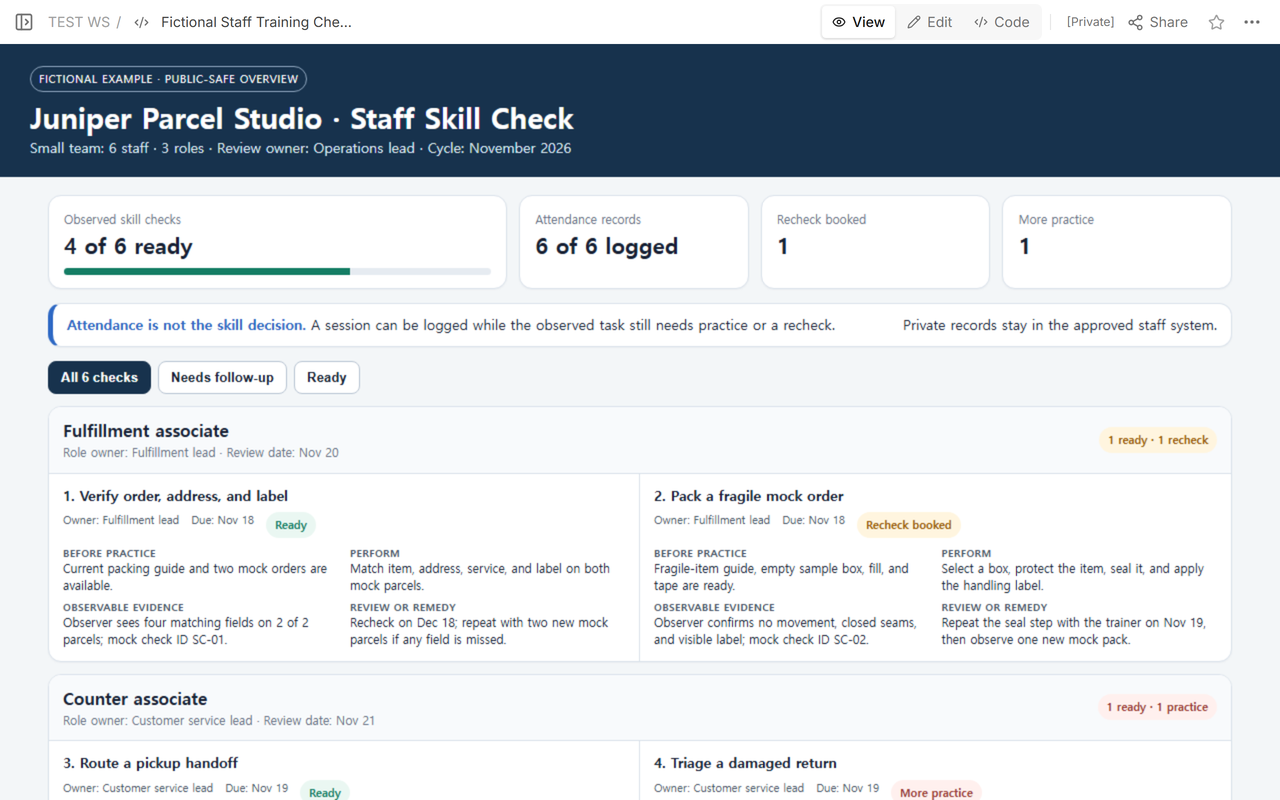
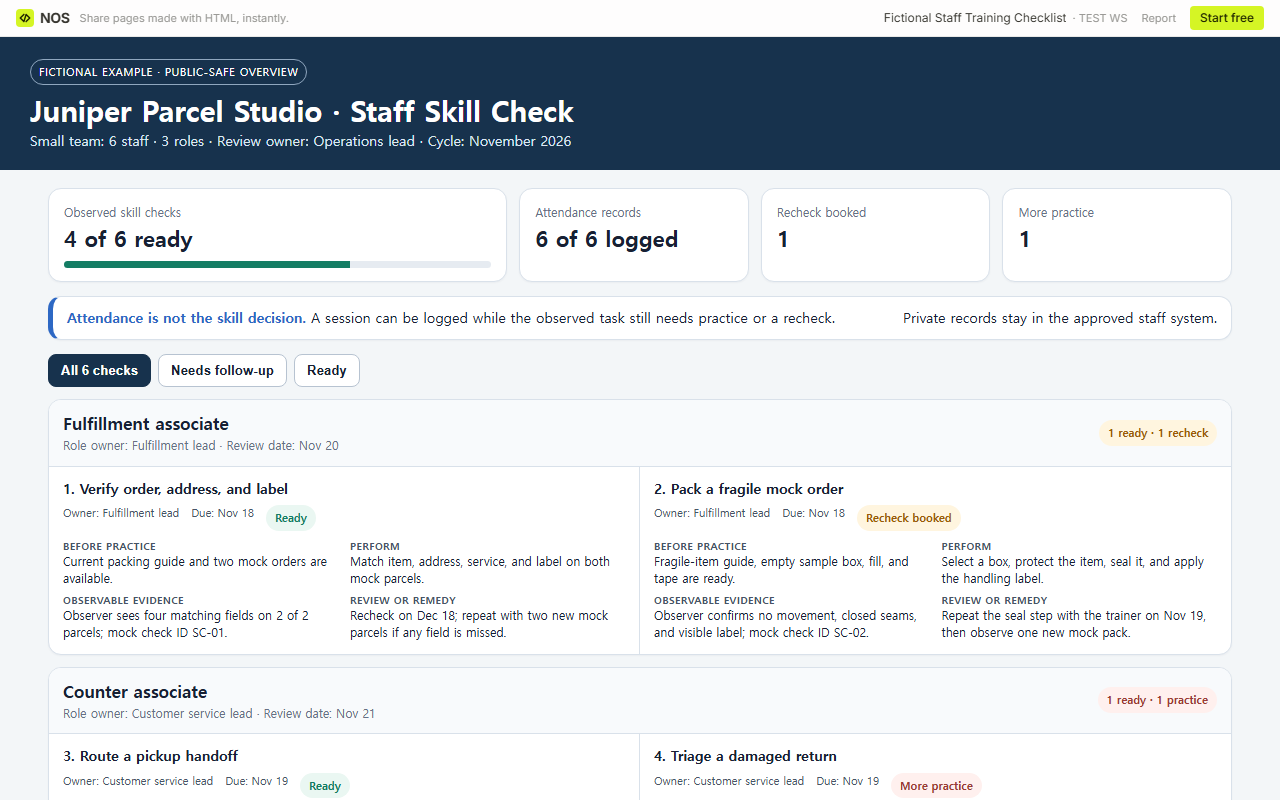
Here is the result before the build steps. Juniper Parcel Studio is fictional. It has six staff members across three roles. The public-safe overview contains role names and invented mock check references, not employee names or official records.
Fulfillment associate
Verify order, address, and label · Owner: Fulfillment lead · Due Nov 18 · Ready
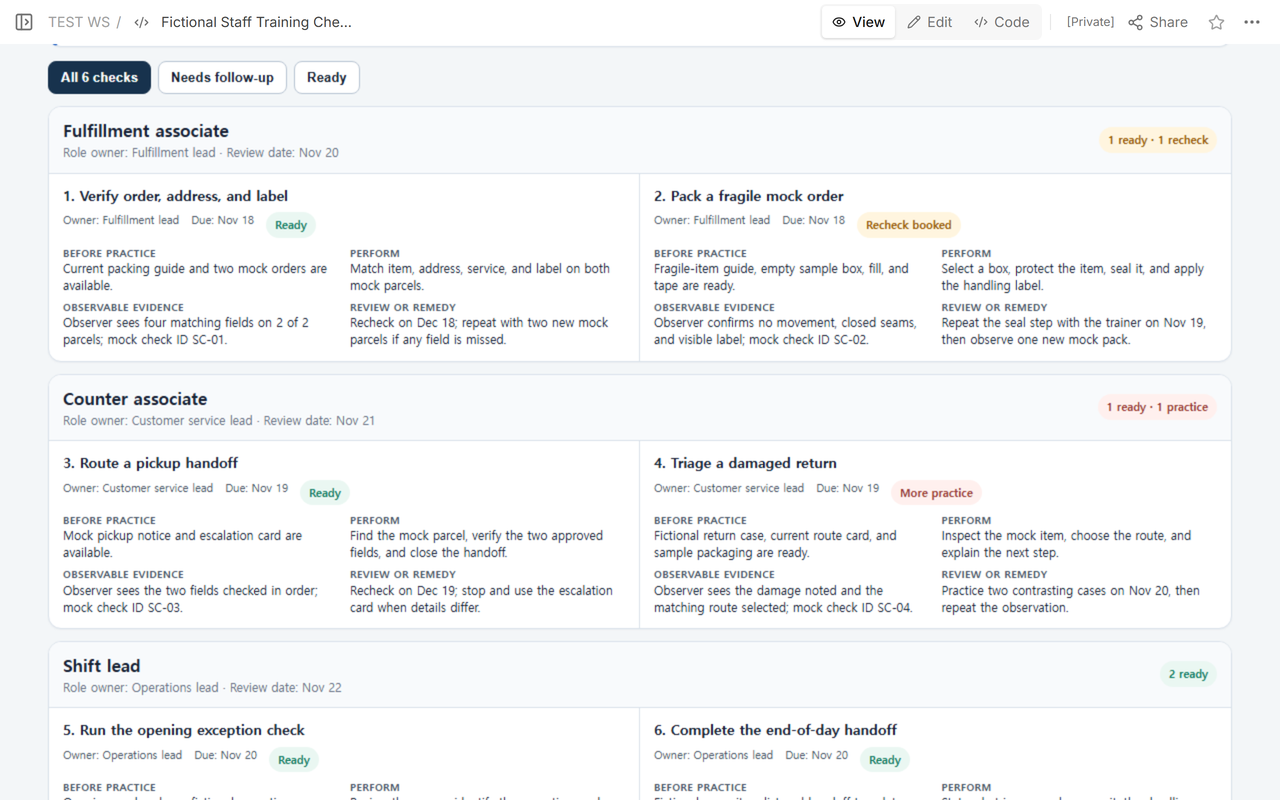
Before practice Current packing guide and two mock orders are available.
Perform Match item, address, service, and label on both mock parcels.
Observable evidence Four fields match on 2 of 2 mock parcels, recorded as mock check SC-01.
Review or remedy Recheck Dec 18; use two new mock parcels if a field is missed.
Pack a fragile mock order · Owner: Fulfillment lead · Due Nov 18 · Recheck booked
Before practice Fragile-item guide, empty sample box, fill, and tape are ready.
Perform Select a box, protect the item, seal it, and apply the handling label.
Observable evidence No movement, sealed seams, and a visible handling label in mock check SC-02.
Review or remedy Repeat the seal step on Nov 19, then observe one new mock pack.
Counter associate
Route a pickup handoff · Owner: Customer service lead · Due Nov 19 · Ready
Before practice Mock pickup notice and escalation card are available.
Perform Find the mock parcel, verify the two approved fields, and close the handoff.
Observable evidence The two approved fields are checked in order in mock check SC-03.
Review or remedy Recheck Dec 19; use the escalation card whenever details differ.
Triage a damaged return · Owner: Customer service lead · Due Nov 19 · More practice
Before practice Fictional return case, current route card, and sample packaging are ready.
Perform Inspect the mock item, choose the route, and explain the next step.
Observable evidence Damage is noted and the matching route is selected in mock check SC-04.
Review or remedy Practice two contrasting cases on Nov 20, then repeat the observation.
Shift lead
Run the opening exception check · Owner: Operations lead · Due Nov 20 · Ready
Before practice Opening card and one fictional exception are prepared.
Perform Review the queue, identify the exception, and assign the next action.
Observable evidence An owner, action, and due time are present in mock check SC-05.
Review or remedy Review Dec 20; coach immediately when an exception has no owner.
Complete the end-of-day handoff · Owner: Operations lead · Due Nov 20 · Ready
Before practice Fictional open-item list and handoff template are available.
Perform State what is open, who owns it, the deadline, and where the next lead should look.
Observable evidence Open item, owner, deadline, and location are present in mock check SC-06.
Review or remedy Sample one handoff Dec 20; redo it if any field is missing.
Finished result: attendance is 6 of 6 logged, but observed skill is 4 of 6 ready. One task has a recheck booked and one needs more practice. The open work is visible instead of being hidden inside a single completion percentage.
Why does attendance need its own result?
A person can attend a session without demonstrating the task. That is why the example has two totals. Attendance answers whether the session record exists. The skill check answers whether someone performed the task and the named evidence was observed.
This distinction is also practical when follow-up is needed. “Recheck booked” sends the trainer to a new observation. “More practice” sends the trainer back to guided work first. Neither state is quietly counted as ready.
What belongs in every training check?
- Before practice: name the current instruction, mock case, equipment, or material that must be ready.
- Perform: use a verb and a visible task. “Understand returns” is not observable; “inspect the mock item, choose the route, and explain the next step” is.
- Observable evidence: state what the reviewer can see or find. Do not use a vague label such as “proof attached.”
- Owner and due date: assign the person or role that must make the next decision and when it is due.
- Review or remedy: set the next review date or the exact practice and reassessment required when the check is not ready.
Acas says an induction checklist can help the worker and manager see what was covered and when, but the process should not become box-ticking. Its template also recommends adapting tasks and dates for different roles and reviewing training needs. Our checklist carries those ideas into task-level observation.
Copy the blank checklist
Role and task: ____________________
Before practice: ____________________
Perform: ____________________
Observable evidence: ____________________
Owner: ____________________
Due date: ____________________
Review or remedy: ____________________
Status: ____________________
Download the blank CSV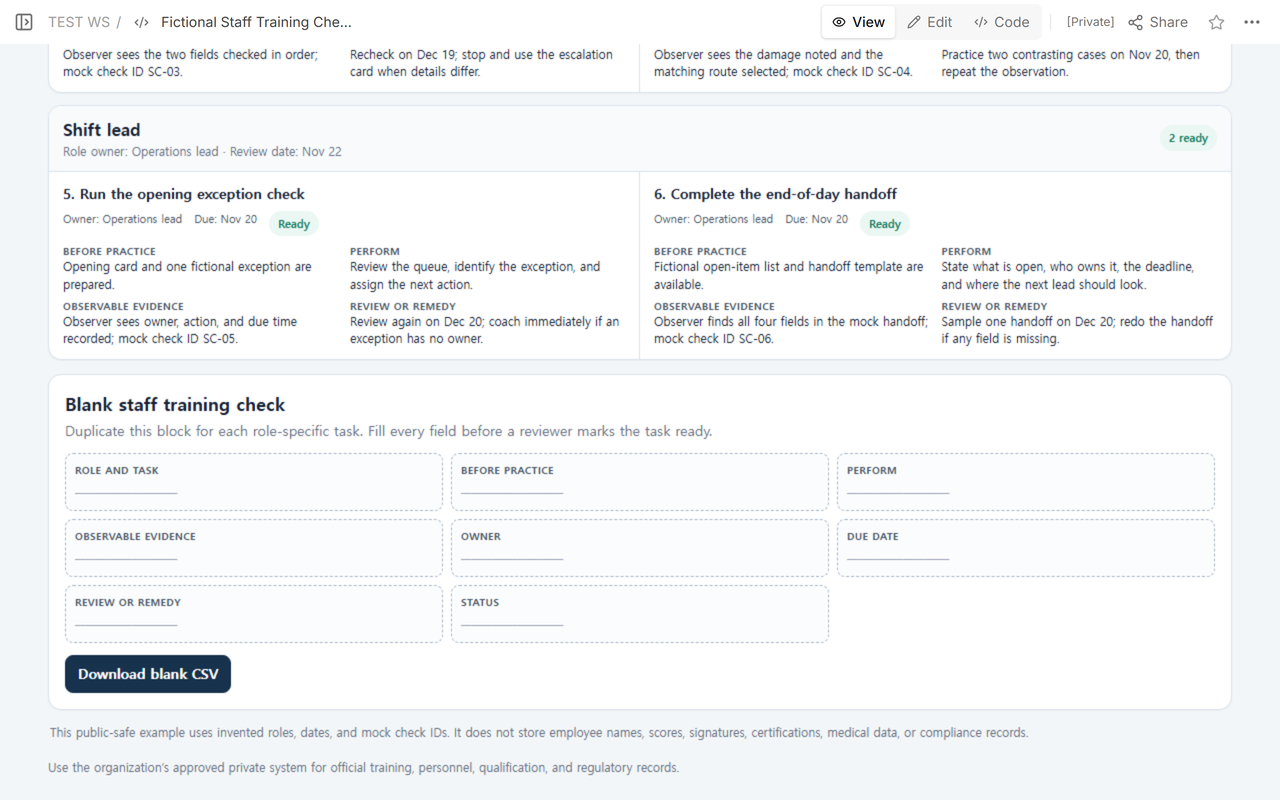
How do you build the checklist in the right order?
- List the roles in the small organization. Do not start with a generic course catalog.
- Choose the tasks each role must actually perform.
- Write the observable evidence before choosing a status label.
- Add the responsible reviewer and due date.
- Define the recheck date or corrective practice for an incomplete observation.
- Log attendance in a separate field or system.
- Remove names, scores, signatures, qualification records, and regulated information from the public-safe copy.
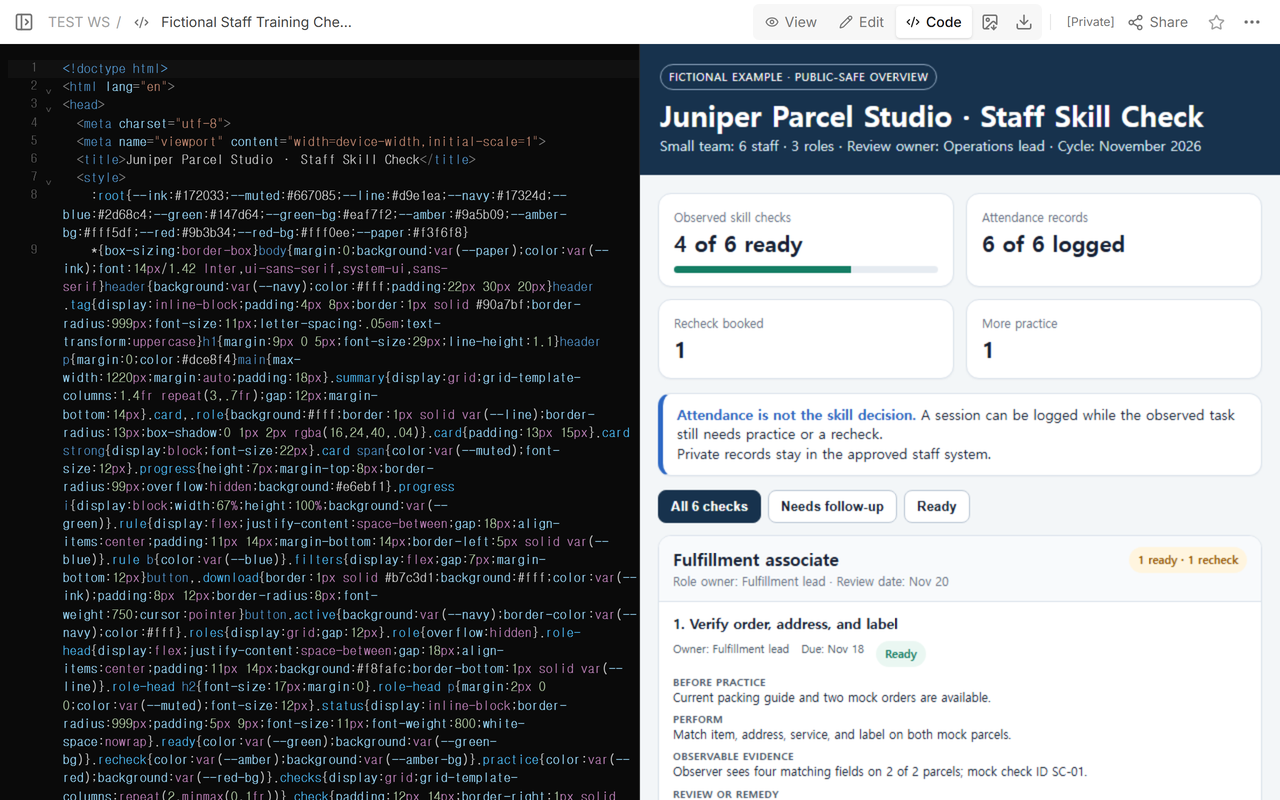
- Open the finished page in Code and View, then check the same reader address in Share.
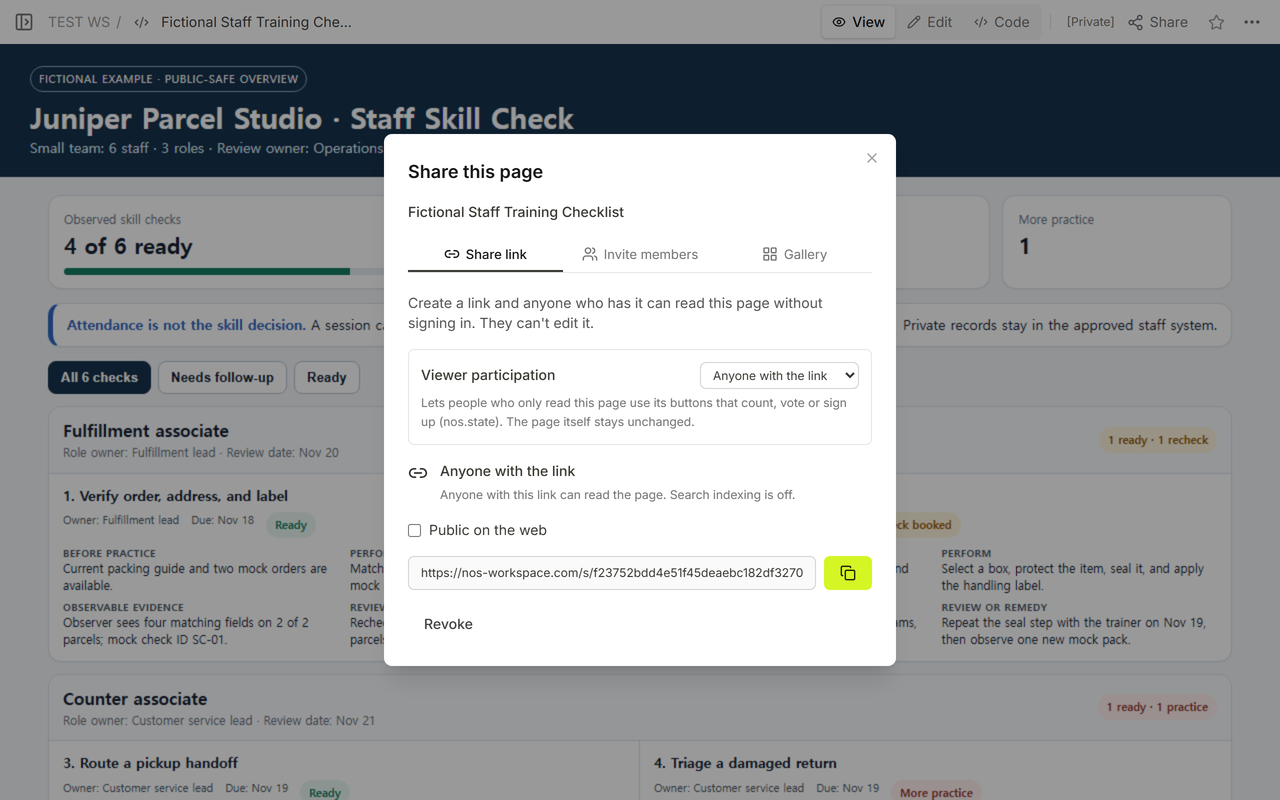
How do you review the work that is still open?
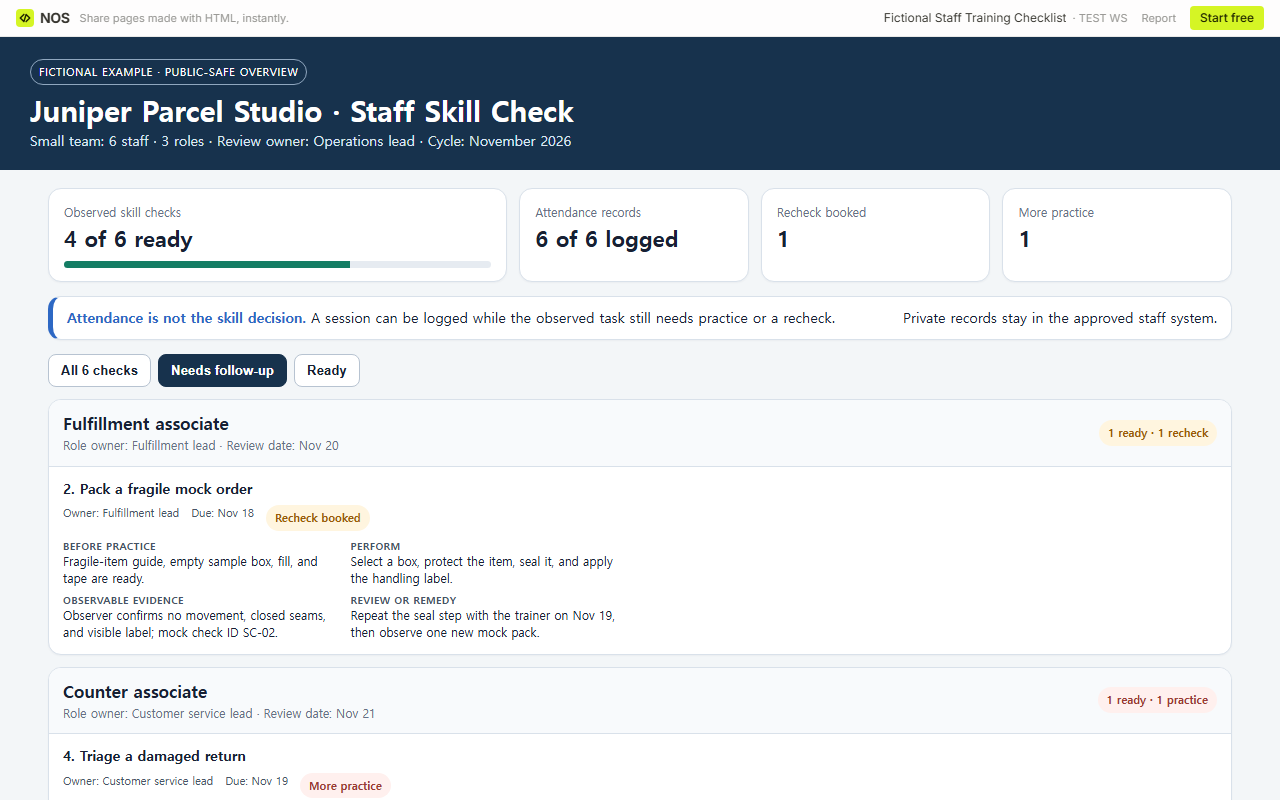
Open the reader address and choose Needs follow-up. In our actual check, the full page showed six tasks. The filtered page kept only the fragile-pack recheck and the damaged-return practice item. Their owners, due dates, evidence, and next actions stayed visible.
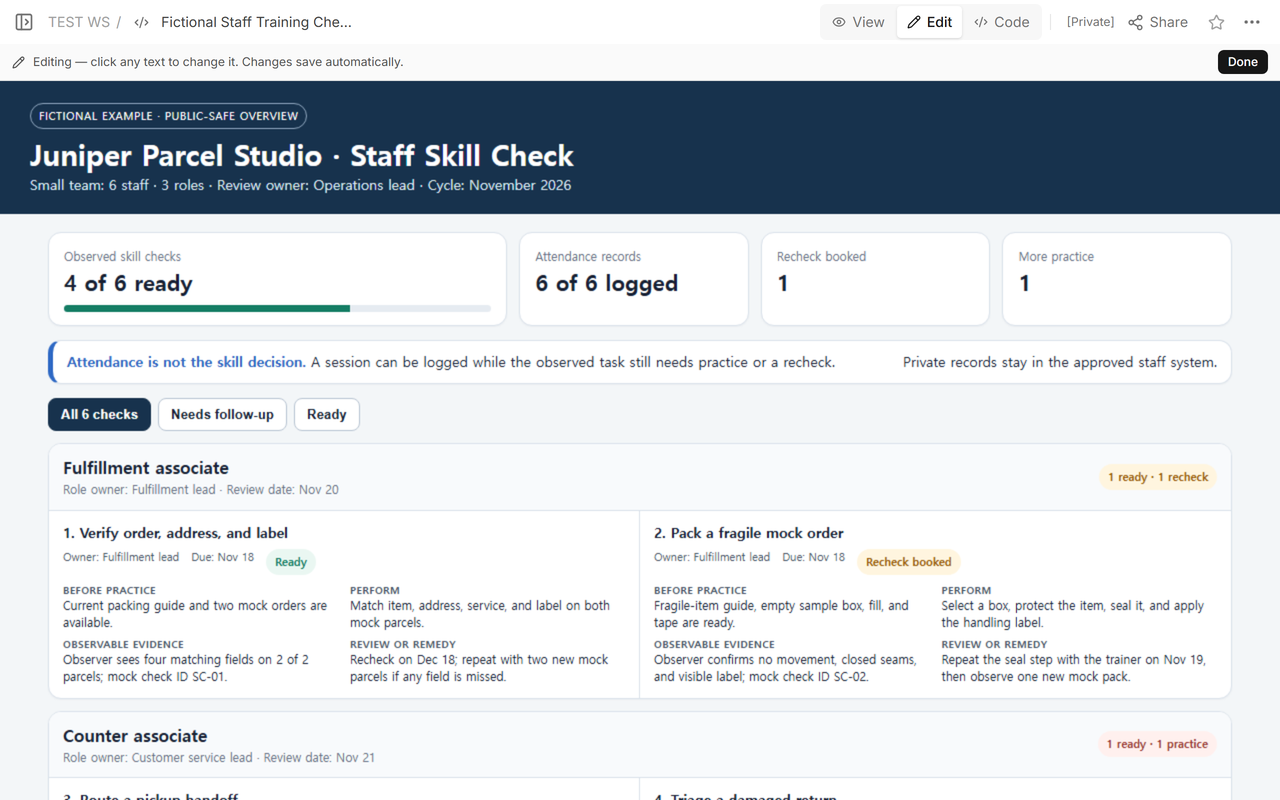
Open Edit when the checklist needs a correction. Click the title, totals, or role-based task text to change it; the Edit bar shows that changes save automatically.
When not to do this
- Do not collect employee names, scores, signatures, medical information, access credentials, disciplinary notes, or private assessment comments on a public reader page.
- Do not treat this overview as a certification, licence, personnel file, or compliance record.
- Do not invent evidence or mark a task ready because the session was attended.
- Do not replace an organization’s required form, learning system, approval route, or current legal guidance with this example.
- Do not use the same tasks for every role when the work, risks, equipment, or required records differ.
How does NOS fit this workflow?
NOS keeps the checklist’s HTML, rendered View, Edit mode, and Share panel on one document. After you save a correction, readers can reopen the same Share address to see the updated checklist. Use that public-safe page only for invented or non-sensitive status; official records still belong in the approved private system. See the current NOS pricing page for plan information.
Which related template should you use next?
Use the training plan template when you need the broader schedule of sessions, practice, and review. Use the training guide template when a staff member needs the instructions for one task. Use the checklist template guide when you need to rewrite vague completion criteria as observable checks.
Source checked Nov 15, 2026: the Acas induction checklist template.