Generating a plausible layout from a description is a real capability and it is the first ten minutes. The decision is about everything after.
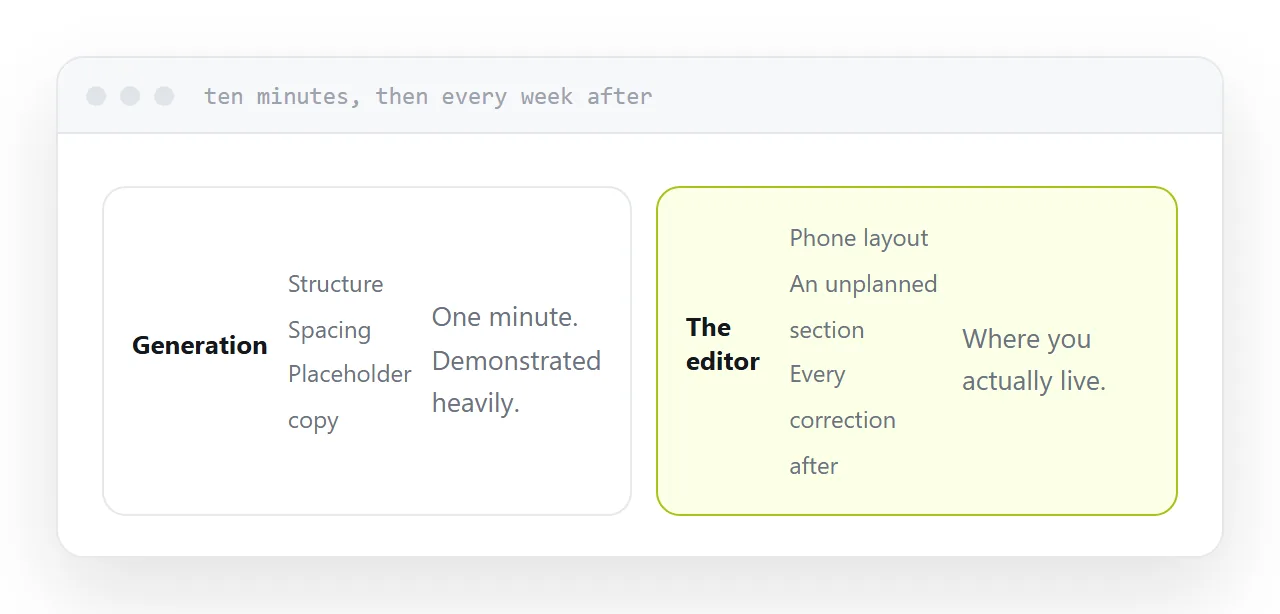
What generation is good at
An empty canvas is genuinely the hardest part of making a page. Generated output removes it: a structure, a hierarchy, sensible spacing, placeholder content in roughly the right places.
For a landing page, an event page or a simple site, that is a real head start over starting from nothing, and over a template you then fight.
What it does not do is finish. The generated draft is a draft, and the remaining work happens in the editor.
So judge the editor
You will spend a hundred times longer in the editor than in the generation step, and demonstrations are built around the generation step.
Change a heading. Move a section. Adjust spacing on a phone layout specifically. Add a section the generator did not produce. If those feel awkward in the trial, they will feel awkward every week.
| Check | Why |
|---|---|
| Editing a phone layout | Where builders diverge most |
| Adding an unplanned section | Templates resist this |
| Export of a real page | Tests the portability claim |
| Custom domain setup | Where the address is decided |
| Page title and description | Some builders hold these |
The export question
Ask whether you can take the site with you, then test it rather than accepting the answer.
Export a real page and open it. Often the output is generated markup with mechanical class names, technically portable and unpleasant to maintain by hand. That is still better than nothing, and it is not the same as owning a site.
If the answer is no export at all, the work exists only while the subscription does. That may be fine, and it should be a decision rather than a discovery.
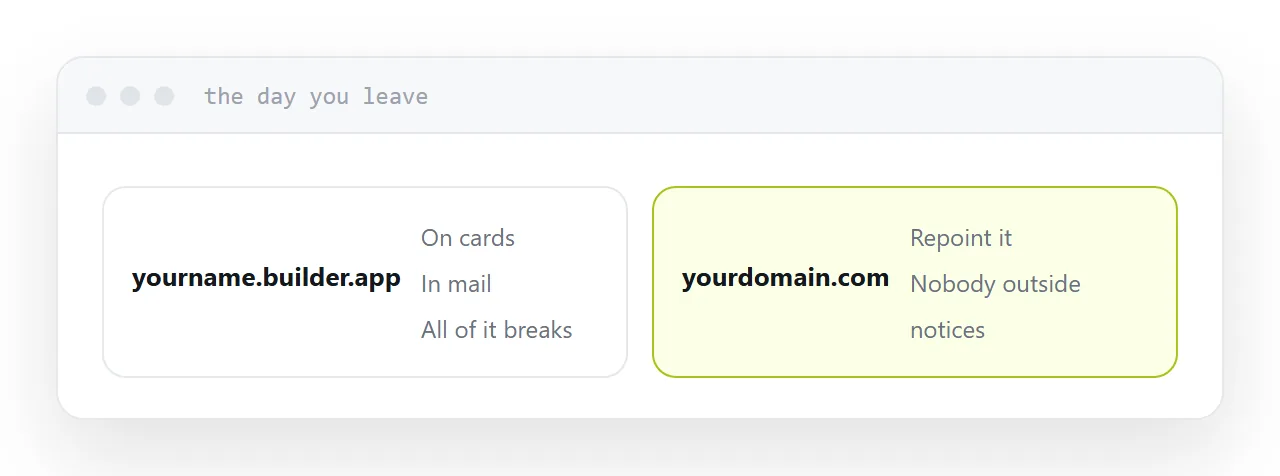
The address
Default addresses are on the builder's domain.
That address goes into mail, onto cards, into other people's records. When you leave, all of it breaks, and there is no way to reach the people holding it.
Connect a custom domain before circulating anything. Then leaving means repointing the domain, and nobody outside notices.
Search visibility
Check three things: that pages are rendered on the server rather than assembled in the browser, that you control the title and description per page, and that you control the address structure.
Builders vary substantially here, and the ones that hold all three are hard to rank with regardless of what you write.
When it is too much product
For one page, one brochure, one document, a builder is a subscription, an account and an editor wrapped around a file.
Publishing the page directly is faster, costs less, and leaves you holding the file. Builders earn their place when there are many pages, a navigation structure, and somebody maintaining them weekly.
For the surrounding ground, see Prompting or a no-code builder and Choosing a landing page builder.
Put it at an address
Generate a draft and then judge the editor, export a real page before committing, connect a custom domain before circulating the address, time one correction, and skip the whole category for a single page.