A one page site is a small amount of content with a job to do. Builders make that fast to produce and slow to take with you.
This guide covers what builders are good at, what portability costs, and what the page actually needs.
What builders do well
Twenty minutes from nothing to live. No technical knowledge, no hosting decision, no file to upload.
The output looks reasonable on a phone, which is not trivial, and the editor makes changes immediate.
For someone who needs a page this afternoon and is not going to write markup, that is genuine value.
What portability costs
The page lives inside the product.
There is no file. There is a design in an editor, rendered by their software, served from their infrastructure. If the product changes its pricing, changes its terms, or closes, you have a design and no page.
This is not a criticism of any particular service. It is the shape of the arrangement, and it is worth knowing before you build something you depend on.
| Builder | Your own page | |
|---|---|---|
| Time to live | Twenty minutes | Longer first time |
| Needs technical knowledge | No | Some |
| Page exists as a file | No | Yes |
| Survives the product closing | No | Yes |
| Editing later | Their editor | A file |
| Address portable | With your domain | Yes |
The export is a safety net, not a handover
Some builders offer an export. What comes out is generated markup: deeply nested containers, machine-named classes, styles inlined or in one large file.
It works when served, and editing it by hand is unpleasant. It is a way to keep the page alive if the service disappears, not a way to continue working on it elsewhere.
Check what the export produces before you need it, rather than discovering its shape during a migration.
The domain is the protection
Whatever you build with, put your own domain in front of it.
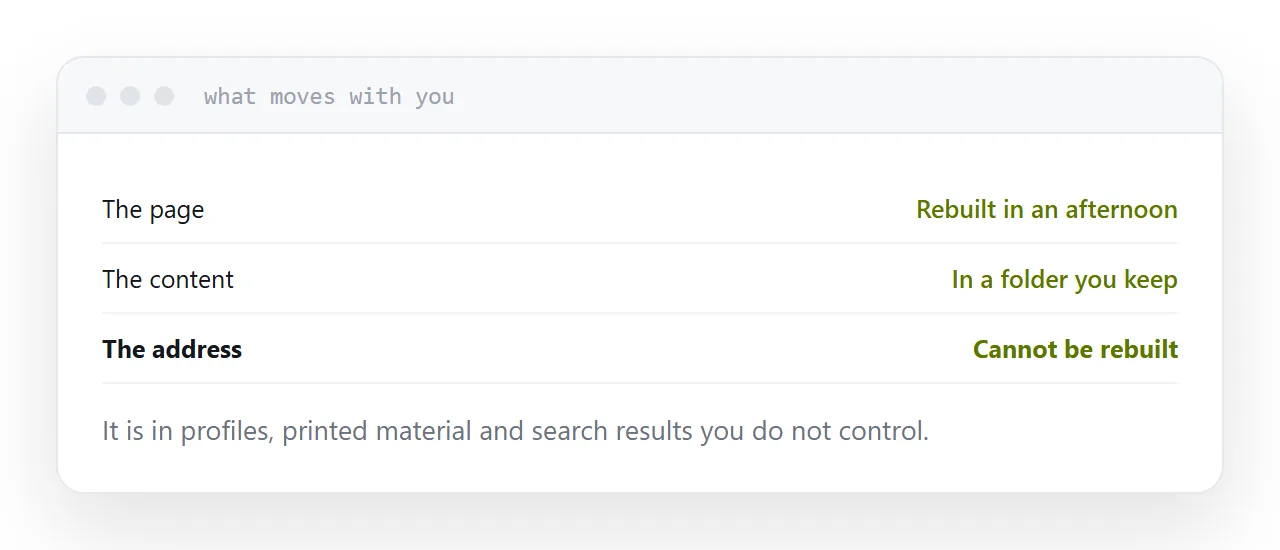
The page can be rebuilt in an afternoon. The address cannot, because it is in profiles, printed material, other people's pages and search results you do not control.
With your own domain, moving is a change of where it points and nothing breaks. Without it, moving means every link you ever published dies.
If a builder charges for custom domains, that fee is buying the thing that matters, and it also changes the comparison: at that price, a page you own and host costs less.
Keep the content outside
Whatever the page says, keep the text and the images in a folder of your own.
Then rebuilding somewhere else is an hour of layout rather than retyping everything from a screenshot. This costs nothing and it is the difference between a move being annoying and being a project.
What the page actually needs
Speed. It is opened on mobile data from a link. Every second costs visitors.
One clear thing. What this is, in a sentence a stranger understands, above the fold.
A way to respond. A form that actually delivers, or an email address, or a booking link. A page with no response path is decoration.
Readable on a phone. Which is where it will be read.
Everything else is preference. Judge any option, builder or otherwise, on those four rather than on a feature list.
Two neighbouring cases are worth a look: Choosing a Linktree alternative and Choosing a Tiiny Host alternative. Choosing hosting for a small business is also close.
Put it at an address
Use your own domain from the start, keep the content in a folder outside the builder, check what the export produces, and judge the page on speed, clarity and whether the response path works.
Then changing your mind later costs an afternoon rather than every link you have published.