Start from what the site has to do. For most small businesses the honest list is short, and it changes what you should be paying for.
The honest list
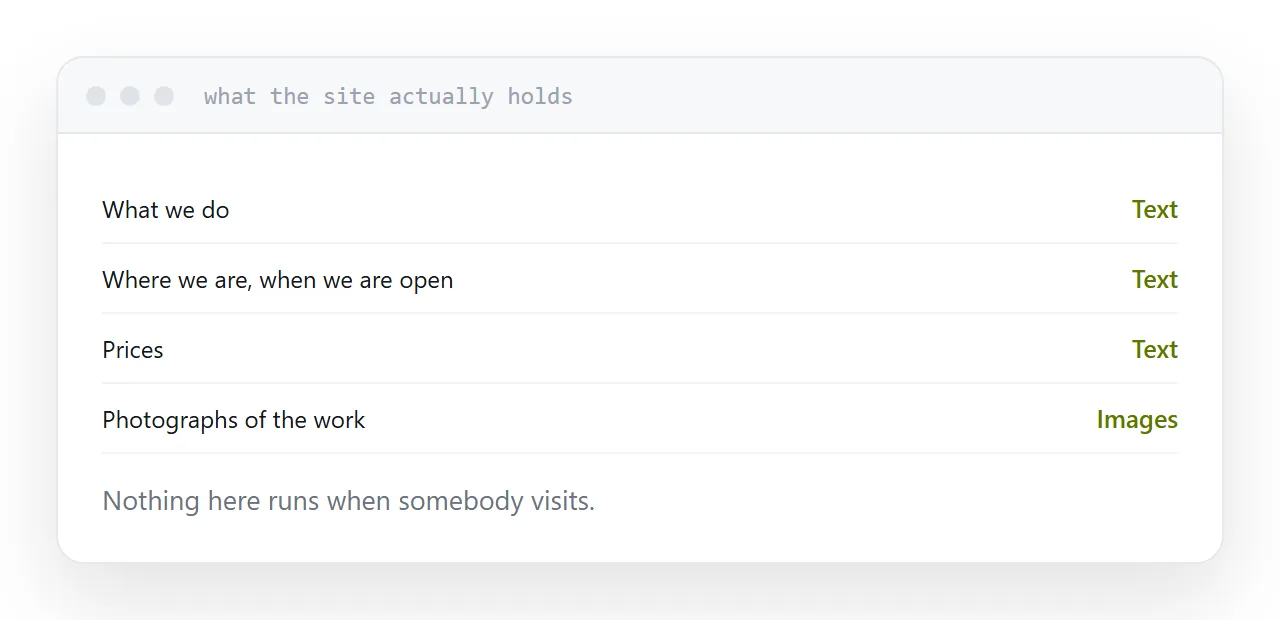
What we do. Where we are. When we are open. How to contact us. Prices, if you publish them. A few examples of the work.
That is a handful of pages of text and images, the same for everybody who visits.
Nothing in it needs code to run when somebody arrives, which means it is a static site, which means the hosting question is much simpler than the market suggests.
| Requirement | Needs a server |
|---|---|
| Opening hours, location | No |
| Services and prices | No |
| Photographs of work | No |
| A contact form | No, use a service |
| Online booking | Use a service |
| Card payment | Use a service |
| Customer accounts | Yes, and ask why |
Use services for the transactional parts
Booking, payment and scheduling are the parts that look like they need a server, and they are the parts you should least want to run yourself.
A booking service handles availability, reminders and cancellations. A payment service handles the card data, which you do not want anywhere near your own systems.
Link to them from the page. That keeps the site static and moves the regulated parts to people whose job is handling them.
Answer the phoned-in question
The most valuable page on a small business site is the one that answers whatever people ring up to ask.
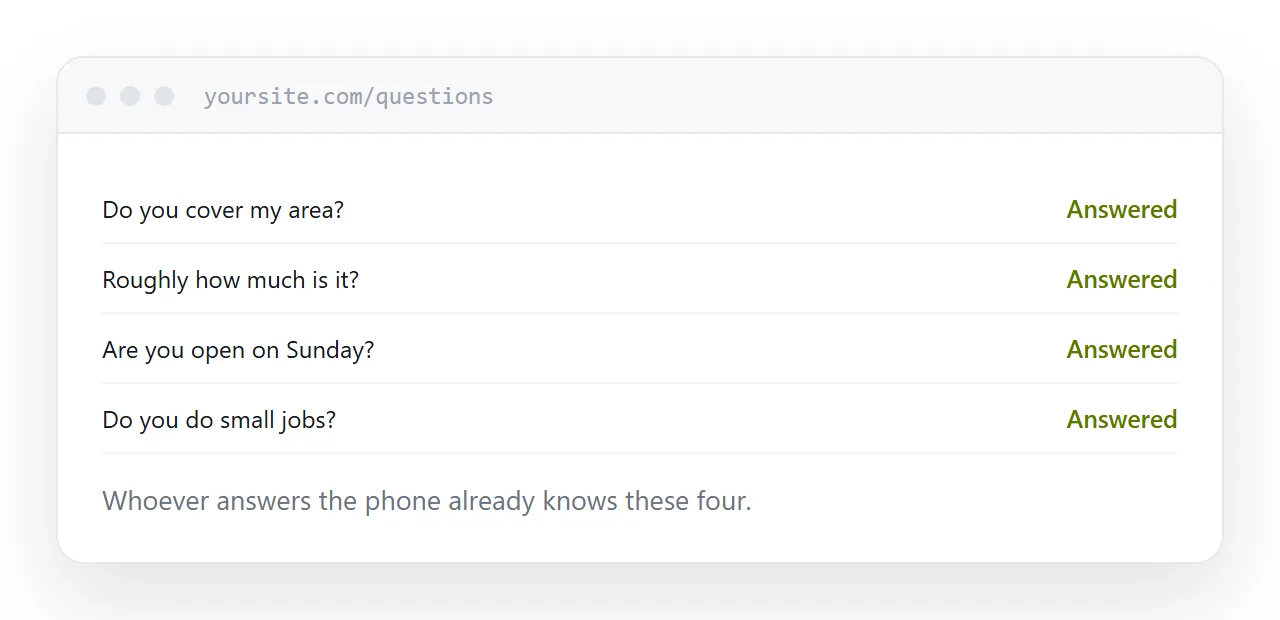
Do you cover my area. How much is it roughly. Are you open on Sunday. Do you do the small ones as well.
Whoever answers the phone knows these. Put each on a page, in plain words, and the calls reduce while the enquiries that remain are further along.
What not to pay for
Traditional hosting bundles databases, mail, control panels and a scripting runtime because that is what a website meant for twenty years.
For a four-page site, none of it is being used and all of it is something that can break or need patching. Performance add-ons for a page that is already a static file are particularly hard to justify.
Buy what the site is.
The one thing to own
The domain.
Registered in the business's own account, with a contact address that survives whoever set it up leaving. Everything else, the host, the builder, the form service, can be replaced without anybody outside noticing.
The domain cannot.
If this is near what you are doing, How to host a website and What hosting actually costs cover the cases on either side.
Put it at an address
Write down what the site actually does, check whether anything runs per visitor, use services for booking and payment, publish the answers to the questions people ring about, and own the domain whatever else you decide.