Free static hosting is genuinely free for a small page. The comparison is not about price but about which limit you will hit and what happens when you do.
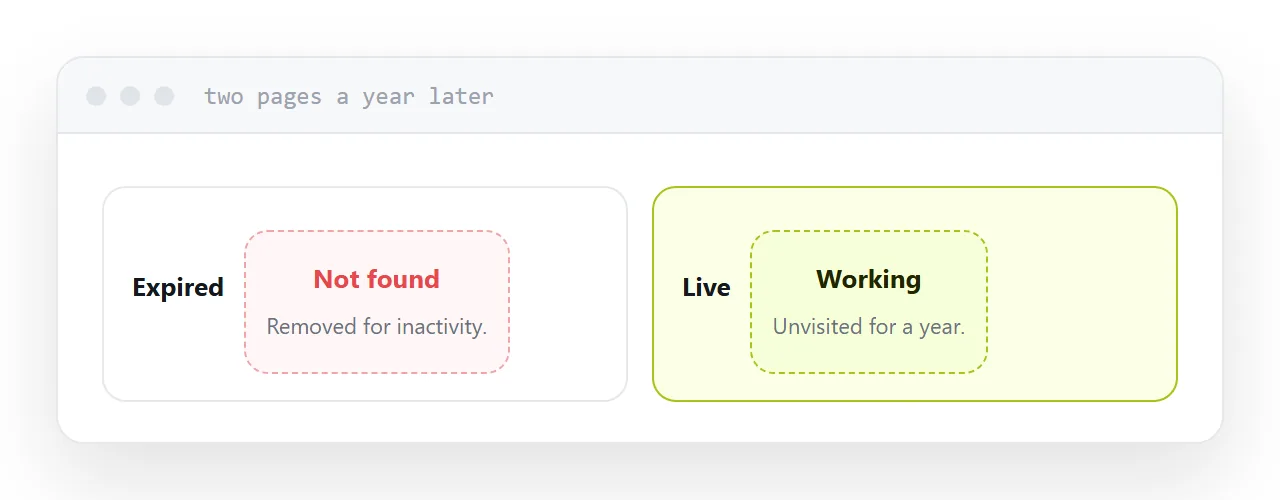
This guide covers the four limits, in the order they matter.
One: expiry
The limit that does real damage, because it is invisible.
Some free tiers remove pages after a fixed period. Some remove pages that have not been visited recently, which targets exactly the pages you published and stopped thinking about.
When it happens, every link you published dies together: in messages, in documents other people own, in printed material, in other sites. Nobody tells you, and you find out from a customer months later if at all.
Read the terms for this specifically before choosing anything. It is one line and it is the most important one.
Two: custom domains
Whether you can put your own domain in front of it.
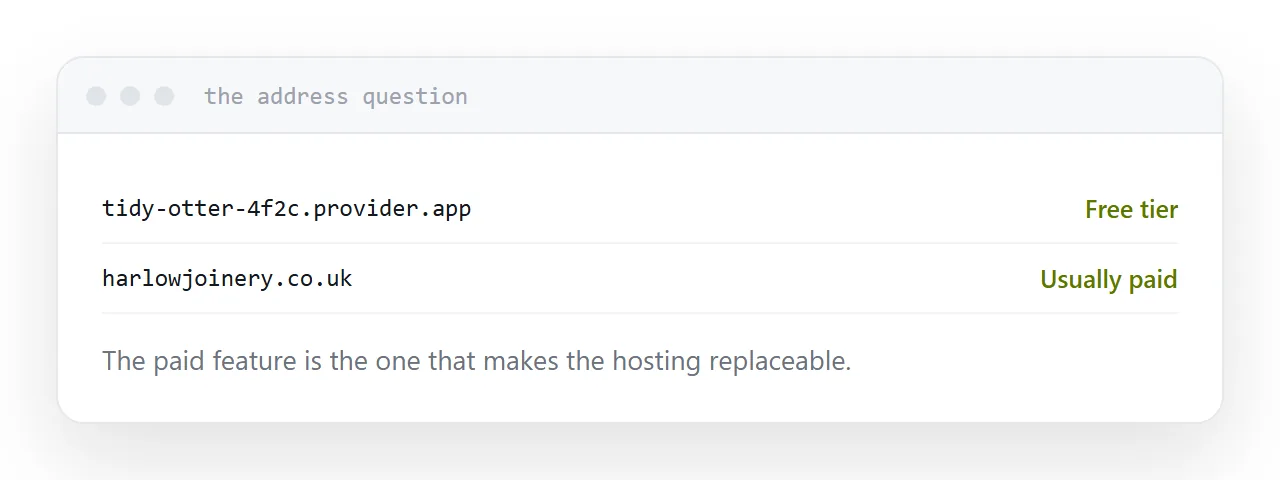
This matters more than any feature, because it is what makes the hosting itself replaceable. With your own domain you can move service and nothing breaks. Without it, the address belongs to the provider permanently.
It is commonly the first feature behind the paid tier, and when it is, the honest comparison is between a paid tier and hosting the page somewhere you control for similar money.
| Limit | How it fails | How visible |
|---|---|---|
| Expiry | Every link dies | Invisible |
| Custom domain | Address is not yours | Obvious up front |
| Bandwidth | Page stops serving | Sudden |
| Branding | A badge on your page | Obvious |
| Commercial use | Terms violation | Only if enforced |
Three: bandwidth
Free tiers cap how much data can be served.
For a normal page nobody comes close. The question is what happens if a page unexpectedly gets attention: a post does well, a link is shared widely, something is picked up somewhere.
Some services throttle. Some suspend the page. Some charge. All three are worth knowing before the day it happens, because that day is the worst time to find out.
Four: branding
A badge or a footer on your page.
Honest and mildly unprofessional depending on context. For a personal project it costs nothing; for a client-facing page it is a small signal you may not want.
It is the most visible limit and the least consequential.
The test that finds the hidden limit
Publish a page, note the date, do not visit it, and check again in a month.
That is the only reliable way to discover inactivity removal, which terms often describe vaguely or not at all. It costs nothing and it tells you whether the service is safe for the pages you care about, which are precisely the ones you publish and forget.
Commercial use
Most free tiers allow it. Some restrict it to personal or non-commercial pages.
If the page is a business page, read that line. Discovering a restriction after building a workflow means moving under pressure, which is when links get broken.
Two neighbouring cases are worth a look: Free HTML file hosting, compared and Choosing a Tiiny Host alternative.
Put it at an address
Check expiry first, then whether custom domains are included, then what happens when bandwidth runs out, then whether commercial use is allowed, and run the month-long test on an unvisited page.
Then free hosting stays free rather than quietly costing you every link you published.