A domain is a rented name and a pointer. Everything else people associate with it belongs to something else.
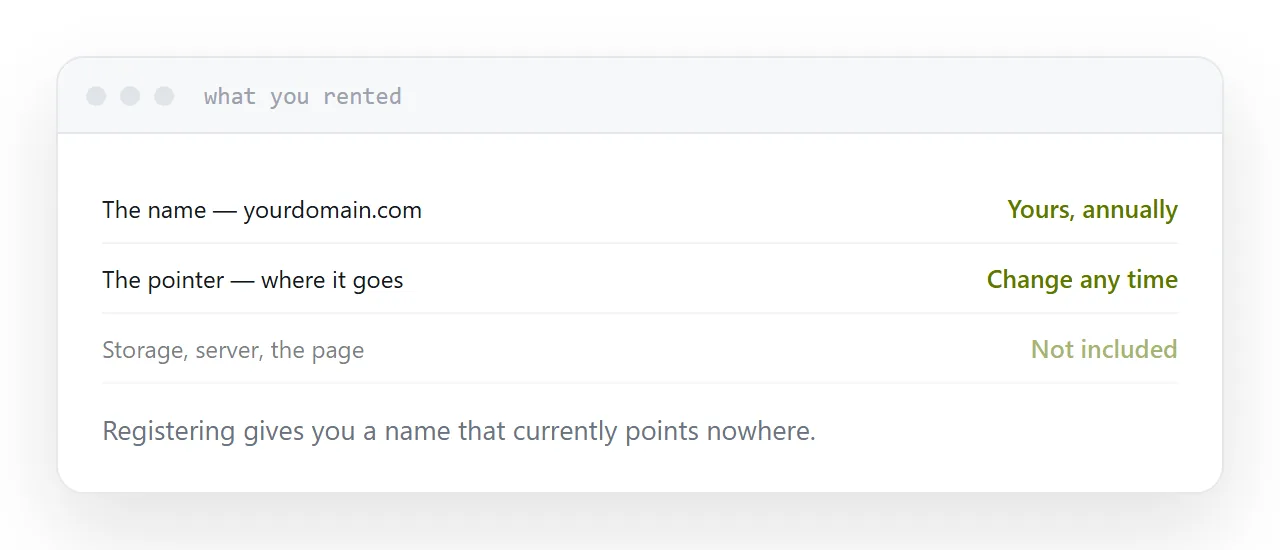
What it is not
It is not storage, not a server and not a website. Registering one gives you a name that currently points nowhere.
The page still has to live somewhere, and the domain is what says where. Separating those two ideas removes most of the confusion around the subject.
| Thing | What it does | Who provides it |
|---|---|---|
| Domain | The name | Registrar |
| DNS record | Where the name points | Registrar, usually |
| Hosting | Serves the page | Host |
| Certificate | Makes it secure | Usually the host |
| The page | The content | You |
Why owning the name matters
Because the page will move.
You will change host, redesign, rebuild on something else, or leave a platform. If the address people hold is on the host's domain, every one of those breaks every link, and there is no way to reach the people holding them.
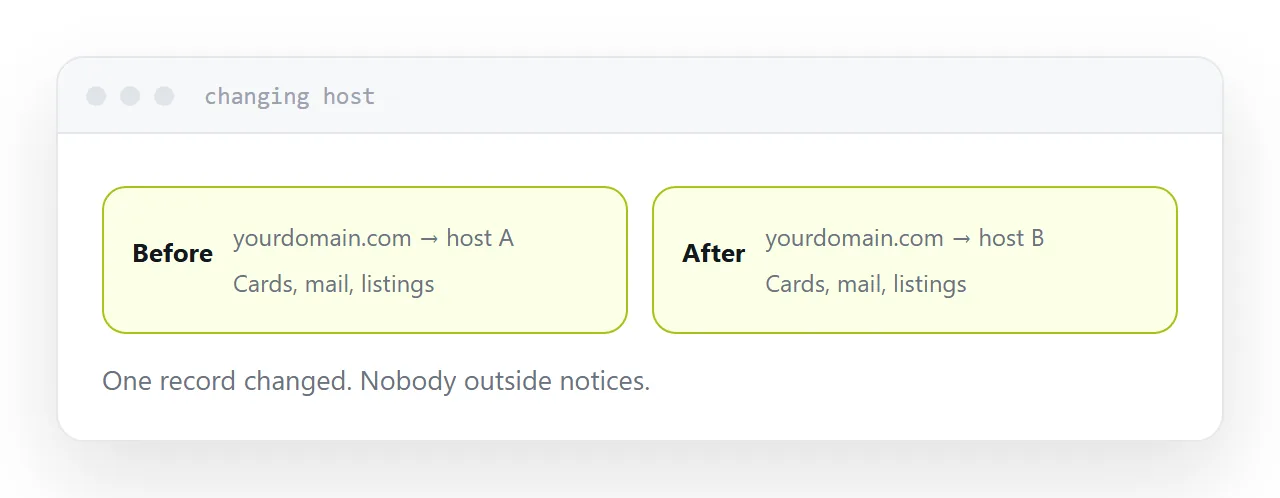
With your own name, moving is one record change. Printed material, mail signatures, other people's bookmarks and links from elsewhere all keep working. Nobody outside notices.
That is the entire value, and it is worth far more than the annual fee.
Registrar and host, separately
Keep the name at a registrar and the page at a host.
Bundling them is convenient and makes leaving harder, because the company you are unhappy with also holds your name. Separately, changing host is a record change and changing registrar is a transfer, and neither requires the other's cooperation.
Register it yourself
The most expensive mistake in this area is letting somebody else register the name.
An agency, a contractor or an employee registers it in their own account, and the name is legally theirs. Recovering it later ranges from awkward to impossible, and it is always discovered at the worst moment.
Register it in an account owned by the business, with a contact address that survives people leaving.
Renewal
Domains expire, and expired domains get bought by other people within hours.
Turn on automatic renewal and keep the payment card current. A domain lost this way takes the mail, the site and the links with it, and buying it back from whoever took it is a negotiation you will lose.
Closely related: How to put a custom domain on a page, and Where free domain names come from for the adjacent problem.
Put it at an address
Register the name in your own account, keep the registrar separate from the host, turn on auto-renewal, add the record once, and give out only the domain address rather than whatever the host called it.