Owning several domains is sensible. Serving content at several domains is a mistake that quietly costs you, and it happens by accident more often than by decision.
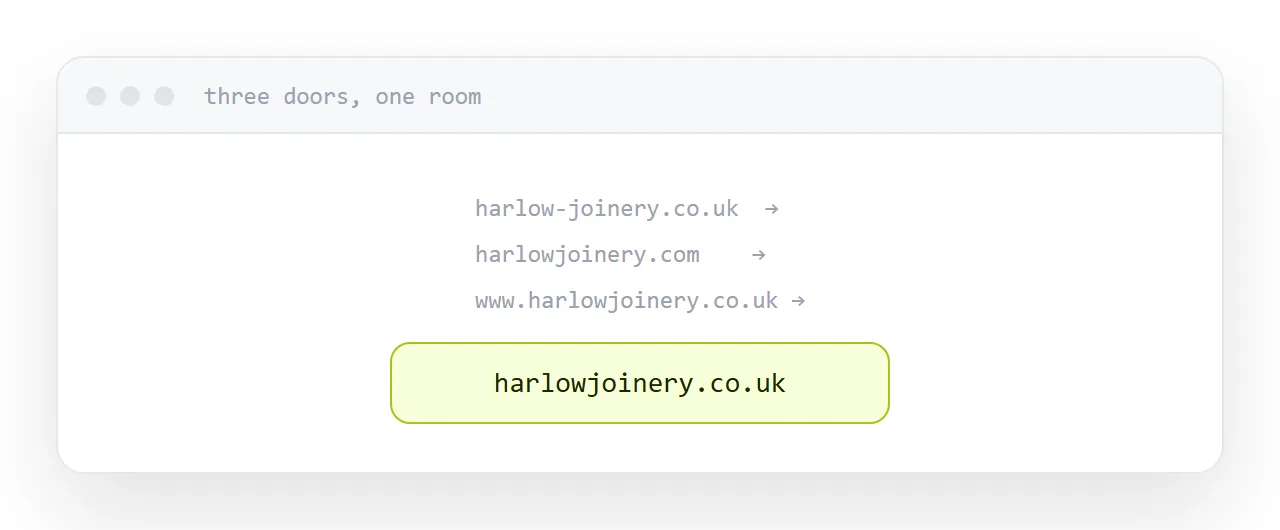
This guide covers why duplication hurts, what the extras are for, and the www case.
Duplication splits everything
The same content at three addresses is three pages as far as a search engine is concerned.
It has to decide which one is real. Links pointing at any of them are divided between them. Whatever reputation the content earns is split three ways, and no single address accumulates enough to compete.
The result is worse than having one address, which is the opposite of what buying three domains was supposed to achieve.
Redirect the extras
Point every other domain at the chosen one with a permanent redirect.
Visitors typing any variant arrive at the right place. The redirect tells search engines the addresses are the same thing and passes the value of any links onward.
One page, one address, several doors into it.
| Same content on each domain | Redirect to one | |
|---|---|---|
| Search engines see | Several competing pages | One page |
| Links accumulate | Split | Combined |
| Visitors reach the content | Yes | Yes |
| Maintenance | Several copies | One |
Picking the main one
Choose the address you will still want in five years.
Usually that is the shortest, the easiest to say aloud, and the one without hyphens or unusual spellings. It goes on business cards, gets read out on the phone, and is typed by people who heard it once.
Once chosen, use it everywhere without exception: profiles, email signatures, printed material, invoices, social accounts. Consistency is what makes the redirect unnecessary in practice.
The www case
This is where it goes wrong by default.
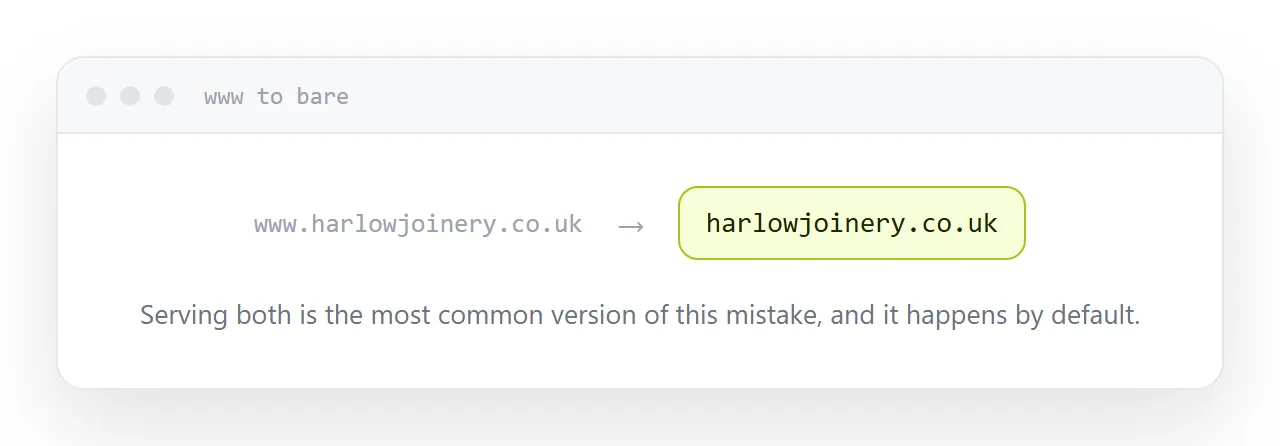
Many setups serve the site at both the bare domain and the www version without anyone deciding. Both work, so nobody notices, and the content is duplicated from the first day.
Pick one, redirect the other, and write the chosen form consistently. Which one you pick genuinely does not matter.
What the extras are for
Three legitimate reasons to hold domains you do not serve.
Typos. One or two obvious misspellings, redirected, catch people who mistyped.
Defence. Stopping someone else registering something confusingly similar to your name.
Campaigns. A short memorable address for something printed, redirecting to the relevant page. That also gives you a clean way to count how many people came from the printed material.
Beyond a handful, it becomes an annual cost defending against typos nobody makes.
Renew them
Extras lapse because nobody is watching them.
A lapsed domain that still receives traffic gets registered by someone else, and now a variant of your name points somewhere you do not control. Turn on automatic renewal for all of them, not just the main one.
If this is near what you are doing, Canonical URL: which address is the real one and How to put a custom domain on a page cover the cases on either side.
Put it at an address
Pick one address and commit to it, redirect every other domain permanently including the www form, use the chosen form everywhere, and keep the extras renewing.
Then every door leads to the same place and the place gets the full benefit.