Free names come from three places, and knowing which one you have tells you exactly how it can be taken away.
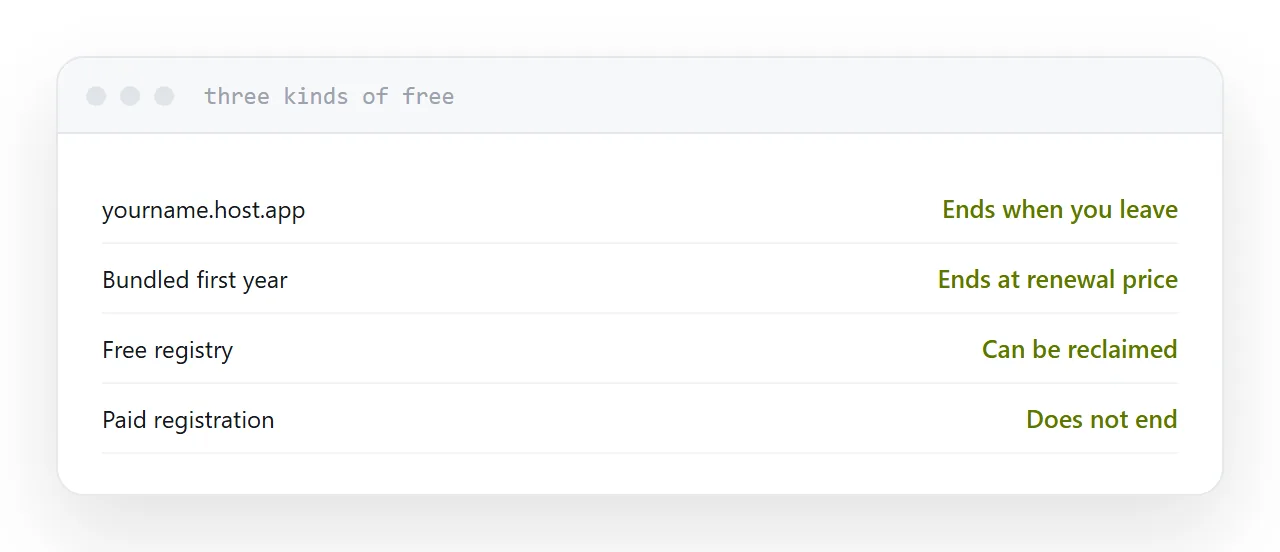
One: a subdomain of the host's name
What most free hosting gives you: your name in front of theirs.
It works, it is instant and it is theirs. Leaving the host means losing the address, and every link pointing at it breaks at once.
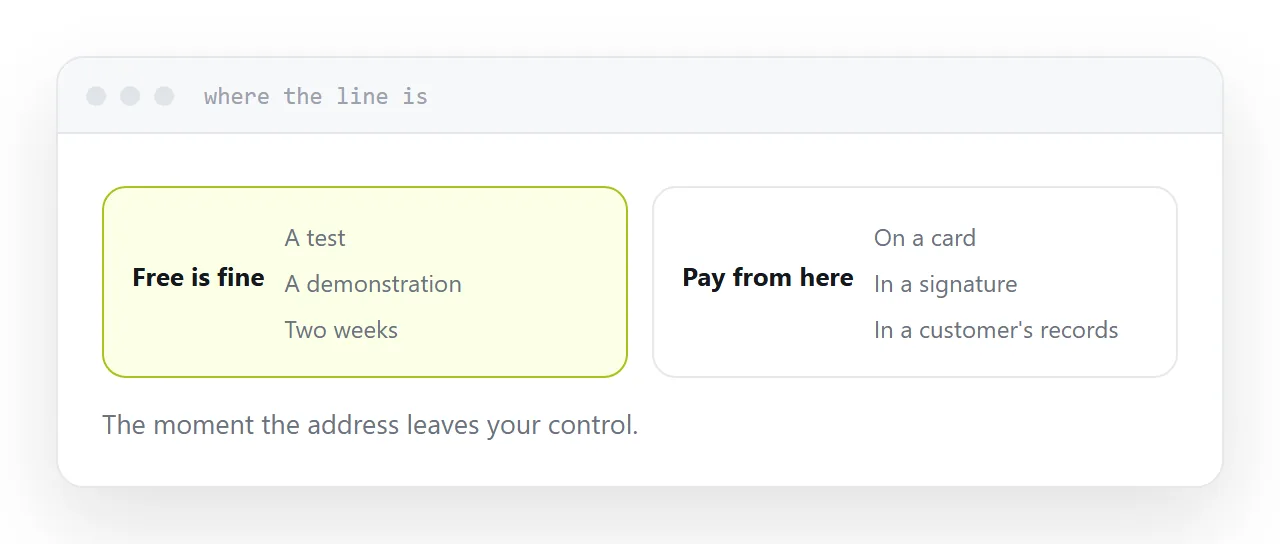
Perfectly reasonable for a test, a demonstration, a page that exists for a fortnight. Not for anything printed, put on a card, or given to a customer.
| Kind | How it ends |
|---|---|
| Host subdomain | You leave the host |
| Bundled first year | Renewal price arrives |
| Free registry | Reclaimed, sometimes abruptly |
| Paid registration | It does not, if you renew |
Two: a first year bundled with hosting
Common and generally honest. You buy hosting and the name is included for the first year.
Two things to check.
The renewal price. Year two is the real price and it is sometimes well above the market rate, because the free year was the acquisition cost.
Whose account. If the name is registered under the host's account rather than yours, leaving becomes a negotiation rather than a transfer. Ask, and check the registration record rather than accepting the answer.
Three: genuinely free registries
Certain registries hand out names at no cost, usually with unusual endings.
They work, and two things have happened repeatedly: names have been reclaimed with little notice when they became valuable, and mail from some of these endings is treated with suspicion by spam filters because they are heavily used for abuse.
For a personal experiment that is an acceptable trade. For a business address that will be printed, it is not.
Where the line is
The moment anyone outside sees the address.
A card, a leaflet, a signature, a listing, a customer's records. At that point the address has left your control, it is stored in places you cannot reach, and losing it means losing all of them silently.
A registration costs about the same as a couple of coffees per year. Against the cost of every printed link going dead, it is not a real decision.
What paying does not buy
Hosting. The name and the page remain separate things.
That separation is the advantage: the page can move between hosts freely, including onto something free, while the name stays yours and every link keeps working.
Paying for the name and using free hosting is a perfectly sound arrangement, and it is the one most small sites should be in.
If this is near what you are doing, What a custom domain gives you and How to put a custom domain on a page cover the cases on either side.
Put it at an address
Use a free subdomain only for temporary work, check the renewal price on bundled names, confirm whose account holds the registration, avoid free registries for business use, and pay for the name the moment it starts circulating.