Chatbots are usually bought to answer questions the site could have answered by displaying the information.
Do the count first
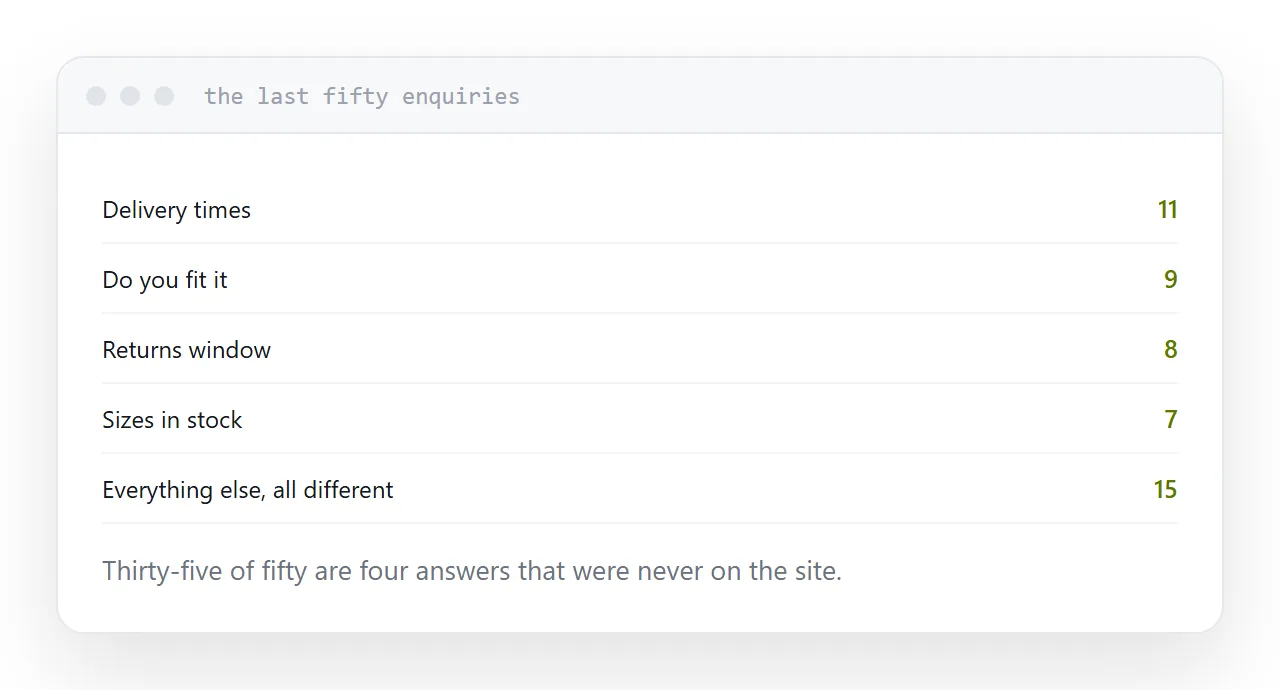
Take the last fifty enquiries, by whatever route they arrive, and group them by what was actually being asked.
The distribution is almost always the same: a small number of questions covering most of the volume, and a long tail of genuinely individual ones.
If twenty questions cover forty of the fifty, you do not have a conversation problem. You have twenty answers that are not on the site.
| Pattern in the fifty | What it points at |
|---|---|
| Same twenty repeat | A page |
| Depends on their account | A sign-in, or a bot with access |
| Genuinely different each time | A person, or a bot |
| Asked because the page is unclear | Rewrite the page |
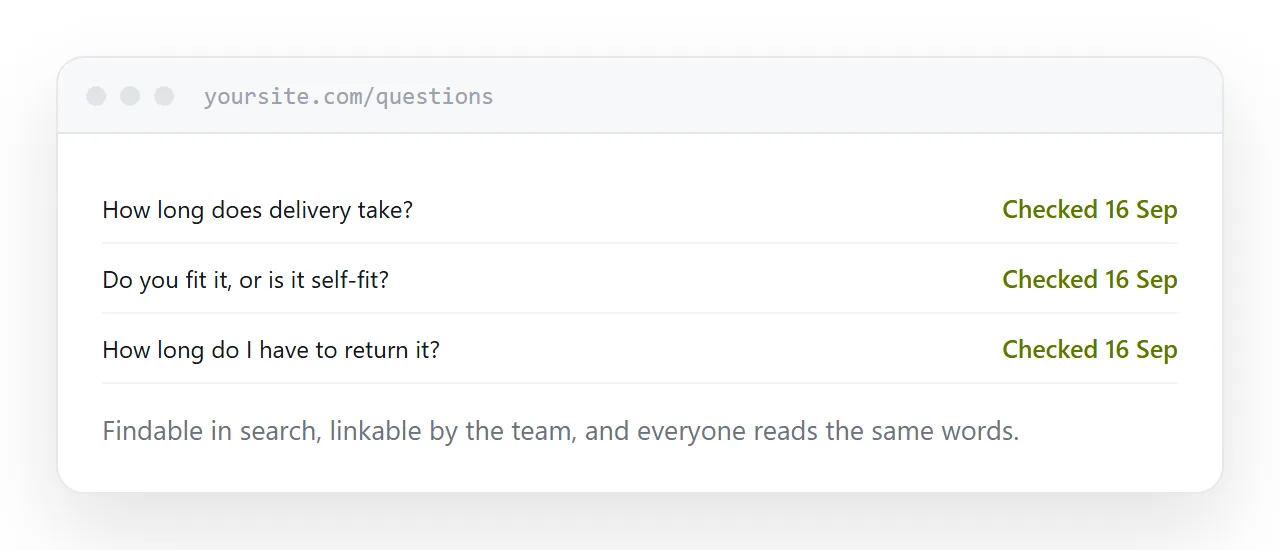
| Asked to check it is still true | Show a date on the page |
Why a page beats a bot for the repeated twenty
It is findable. A page is indexed, so somebody searching finds the answer without arriving at your site at all. A bot answers only people who have already arrived and chosen to ask.
It is linkable. Your team can send the exact answer. Nobody can link to a conversation.
It is auditable. Everyone reads the same words and you can see what those words are. A bot's answers vary, and nobody reviews them once it is running.
It does not invent. A page says what you wrote. A bot occasionally says something plausible and wrong, in your voice, to a customer.
Then measure again
Publish the page, link it prominently, and count the next fifty enquiries.
If the volume drops substantially, the problem was information and it is solved. What is left is the genuinely varied remainder, and now you know how large it is and what it consists of.
That is the point at which building something makes sense, because you know what it has to do.
If you build one
Point it at the page.
A bot answering from a well-written source is substantially more accurate than one answering from a model's general knowledge about your business. The page has to exist and be correct either way, so it is not extra work; it is the same work in the right order.
And budget for maintenance. Answers go stale, the tone needs occasional supervision, and a confidently wrong answer is worse than no answer at all.
Closely related: Prompting or a no-code builder, and How to set up a client portal for the adjacent problem.
Put it at an address
Count the last fifty questions, write the repeated twenty as a findable page, measure what still arrives, build only for the varied remainder, and point anything you build at that page.