Feedback on a landing page usually arrives as preferences about the headline and the button colour. That is not a failure of the people asked; it is what the question invited.
This guide covers the questions that work, who to ask, and testing properly.
Ask three specific questions
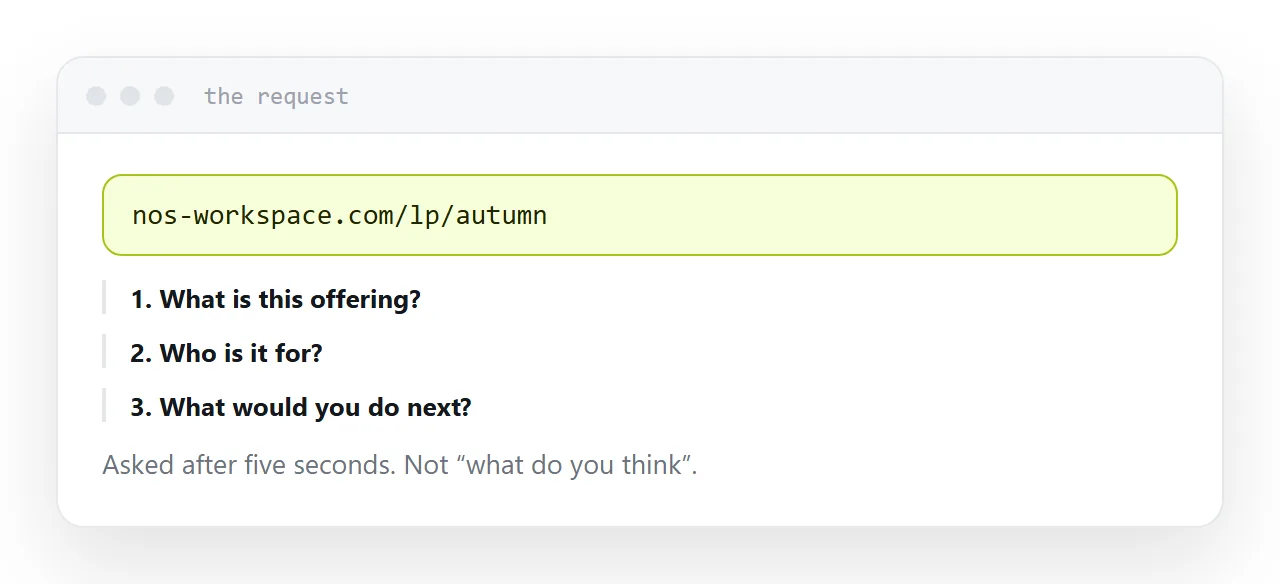
Show the page for about five seconds, then ask:
What is this offering.
Who is it for.
What would you do next.
If the answers are wrong or vague, the page is not communicating, regardless of how it looks. That is a finding you can act on.
Compare with "what do you think of this page", which produces an opinion about the image and a suggestion about the wording, from somebody who feels obliged to say something.
Five seconds is the real test
A visitor arriving from an advert or a link gives a page a couple of seconds before deciding whether they are in the right place.
So the test should match. Show it briefly, take it away, and ask what they remember.
A page that survives that is a page that works. One that needs careful reading to be understood is already losing the visitors it was built for.
| Question asked | What you get |
|---|---|
| What do you think | Colour and wording preferences |
| What is this offering | Whether it communicates |
| Who is it for | Whether the audience is clear |
| What would you do next | Whether the action is obvious |
| Would you use this | Politeness |
Ask people like the visitors
Colleagues cannot unknow the product.
They read the page and fill in everything it does not say, because they already have the context. Their feedback is about phrasing, because comprehension is not a problem they can experience.
Ask people who do not know what you do. Friends outside the industry, people in an adjacent field, anyone who would plausibly be a visitor. Their confusion is the finding.
Send the live link
A screenshot hides the things most likely to be wrong.
How long it takes to become usable. What it looks like at phone width. Whether the button is reachable with a thumb. Whether anything moves as it loads.
Those are half the problems with landing pages and none of them are visible in an image.
Test changes at a second address
Once feedback suggests a change, do not argue about whether it is better.
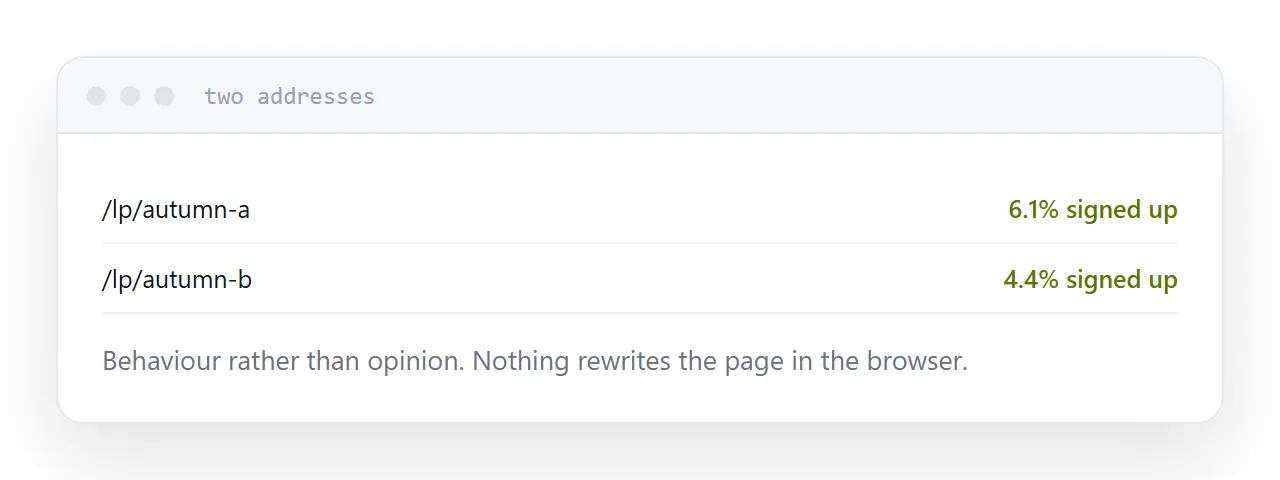
Publish the variant at its own address, send a share of the traffic to it, and compare. That measures what people did rather than what they said, and it settles disagreements that opinions cannot.
It also avoids testing tools that rewrite the page in the browser, which add weight and occasionally break it.
If this is near what you are doing, How to share feedback as a link and How to make a product landing page cover the cases on either side.
Put it at an address
Ask what it offers, who for and what next. Give them five seconds. Ask people who do not already know the product. Send the live link. Test real changes at a second address.
Then the feedback is about whether the page works rather than about taste.