Interactive fiction is one of the few forms where the whole work fits in a file and publishing has no gatekeeper.
Two kinds
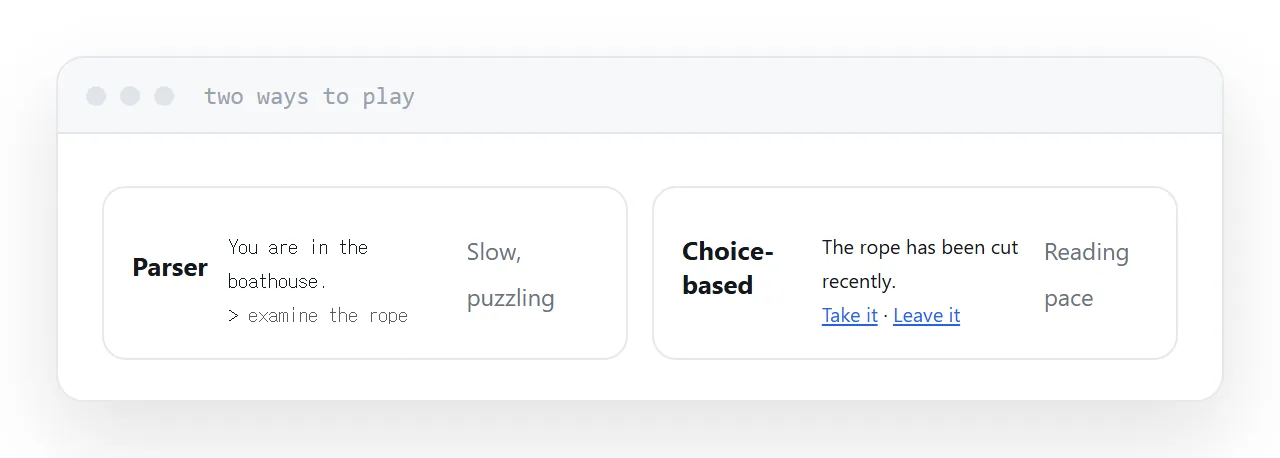
Parser games. You type commands and the game interprets them. Denser, slower, closer to a puzzle, and the tradition the form began in.
Choice-based games. You select from links. Closer to reading, faster to start, and where most recent work is.
They read so differently that liking one tells you little about the other. Anyone exploring the form should try both before deciding it is not for them.
| Parser | Choice-based | |
|---|---|---|
| Input | Typed commands | Links |
| Pace | Slow, puzzling | Reading pace |
| Barrier for new players | Higher | Very low |
| Works on a phone | Awkwardly | Well |
Why it is all free
Two reasons.
The tradition is amateur and literary rather than commercial, and it has been that way for decades. Competitions and communities are the distribution.
And a story is a single file. Hosting it costs effectively nothing, so there is no cost to recover, which is why so much of it has simply been given away.
Everything plays in a browser now
The interpreters that once had to be installed for each system now run as pages.
That means almost any text game, including work from decades ago, can be played on a phone with nothing installed. The archives handle this, and it is the main reason the form has stayed accessible while contemporary commercial games from the same era are unplayable.
Publishing your own
One of the few creative forms where publishing is an upload.
Export the file, put it at an address, and it is playable by anyone with a link. No store, no approval, no revenue share.
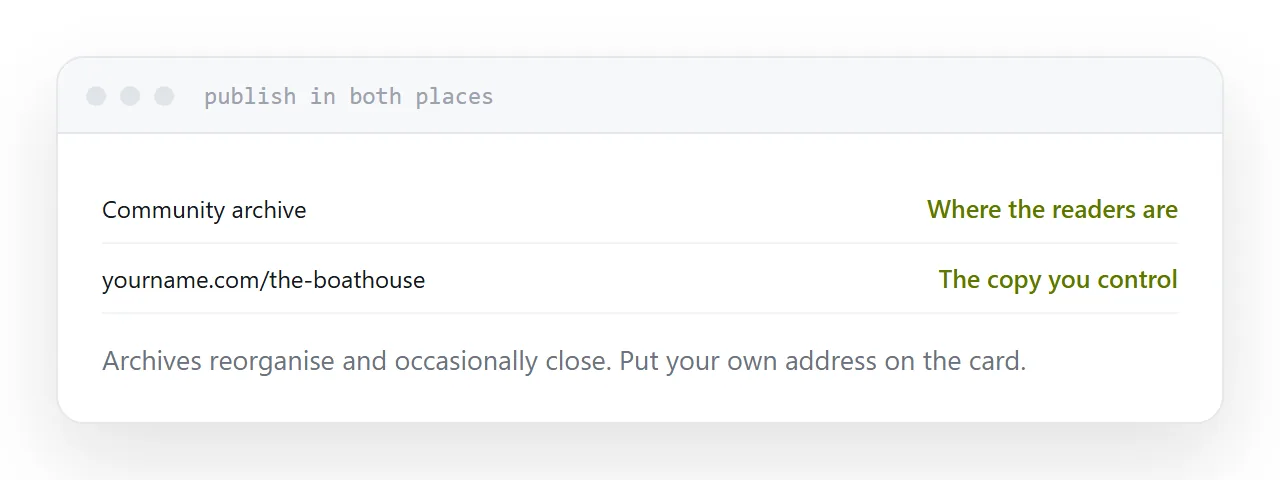
Submit it to a community archive as well. That is where the readers are, and where competitions and reviews happen, and the audience for a text game is a community rather than a general public.
Keep your own copy published
Archives change, reorganise and occasionally close.
Publish at your own address as well, and use that address as the one you put on a card, in a profile or in a message. Then your work does not depend on any one community continuing.
The description decides everything
A one-line description and a short paragraph determine whether anybody starts.
Say what the situation is and what the reader will be doing. Not the themes, not the influences. The player is deciding whether to spend twenty minutes, and the concrete sentence wins.
If this is near what you are doing, Making a branching story people can read and How to host a game online cover the cases on either side.
Put it at an address
Try both kinds before judging the form, play in a browser, publish to an archive for the readers, keep your own copy at your own address, and write a description that says what happens.