A daily word game is a single page. Every part people assume needs a server has a browser answer.
The answer comes from the date
Put a word list in the page. Count the days since a fixed starting date and use that number to choose a word.
Everybody loading the page on the same day gets the same puzzle, with nothing stored anywhere and no request made.
Tomorrow it changes by itself, indefinitely, with nobody doing anything.
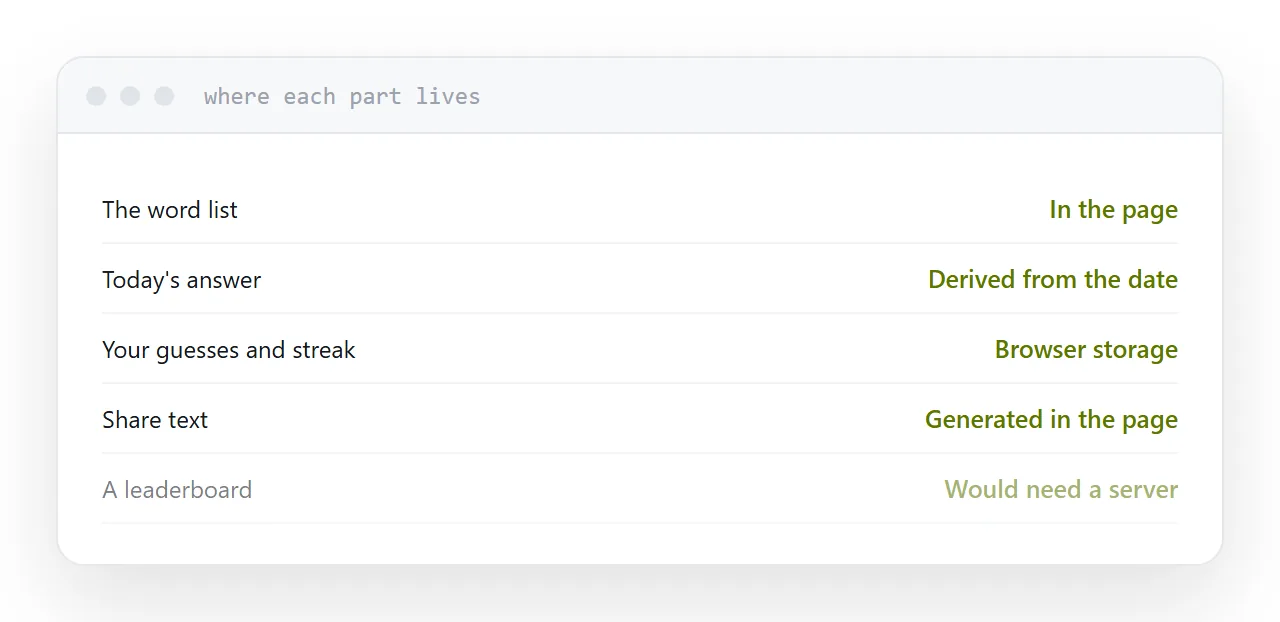
| Part | Where it lives |
|---|---|
| The word list | In the page |
| Today's answer | Derived from the date |
| Your progress | Browser storage |
| Your streak | Browser storage |
| Share text | Generated in the page |
| A leaderboard | Would need a server |
Progress in browser storage
Browser storage keeps what somebody did, on their device, between visits.
Which guesses they made today, whether they finished, how many days in a row. Enough for streaks and for stopping somebody replaying the same puzzle.
It is per device and per browser, so a streak does not follow somebody to their phone. For a puzzle, that is an acceptable limit, and removing it means accounts, a server and a different project.
Fix the time zone
The common fault.
If the day is derived from the visitor's local midnight, players in different places get different puzzles, and anybody sharing a result confuses somebody who has not reached that day yet.
Count days from a fixed reference in one time zone. Everybody plays the same puzzle, some of them at an odd hour.
The share text
The part that made the format spread.
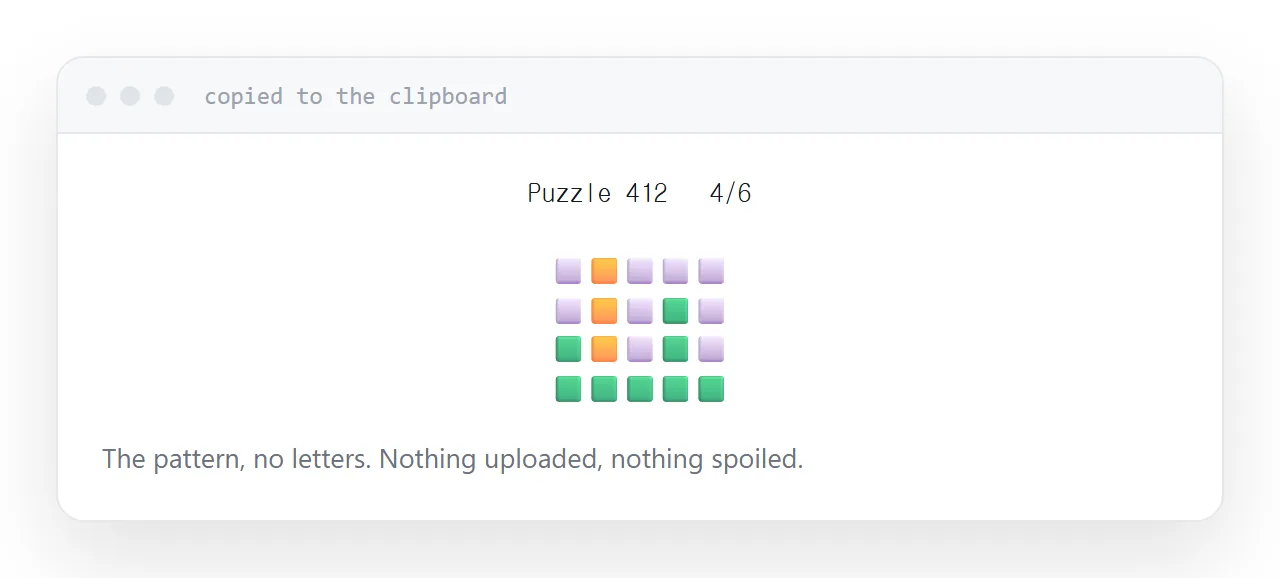
The page produces a small block of text: the puzzle number, the number of guesses, and a grid of coloured squares showing the pattern without revealing any letters.
It is generated and copied to the clipboard. Nothing is uploaded and nothing is spoiled, which is why people post it.
Visible answers
Somebody can open the developer tools and read the word list.
This is true of every puzzle that runs in a browser, including the well-known ones, and it matters far less than it seems. Anyone who does that has chosen not to play, which is their business.
Do not build a server just to hide a five-letter word.
The word list is the game
The mechanics are a weekend. What makes a puzzle worth returning to is the words.
A list drawn from a specific community, a workplace, a sport, a field, a fan base, is far more compelling than a general dictionary, because the words are recognised and the near-misses are funny.
That is also the only part you cannot copy from anybody else.
Two neighbouring cases are worth a look: Making a branching story people can read and How to host a game online.
Put it at an address
Derive the answer from the date, keep progress in browser storage, fix the time zone to one reference, generate the share text in the page, and spend your effort on the word list.