Both host static files free, both allow custom domains, and neither expires. For most pages that is the end of the comparison.
The differences appear at three specific points.
One: private repositories
Publishing from a private repository is behind a paid plan on one and included on the free tier of the other.
This is the most common practical reason people move. A client project, an internal tool, or anything whose source should not be public runs into it immediately.
Check the current terms rather than relying on what was true a year ago; this is the line most likely to have moved.
| Repository-integrated pages | Deployment platform | |
|---|---|---|
| Free static hosting | Yes | Yes |
| Custom domain | Yes | Yes |
| Private repository, free | Usually not | Usually yes |
| Build speed | Slower | Faster |
| Preview per branch | No | Yes |
| Expires | No | No |
Two: build speed and previews
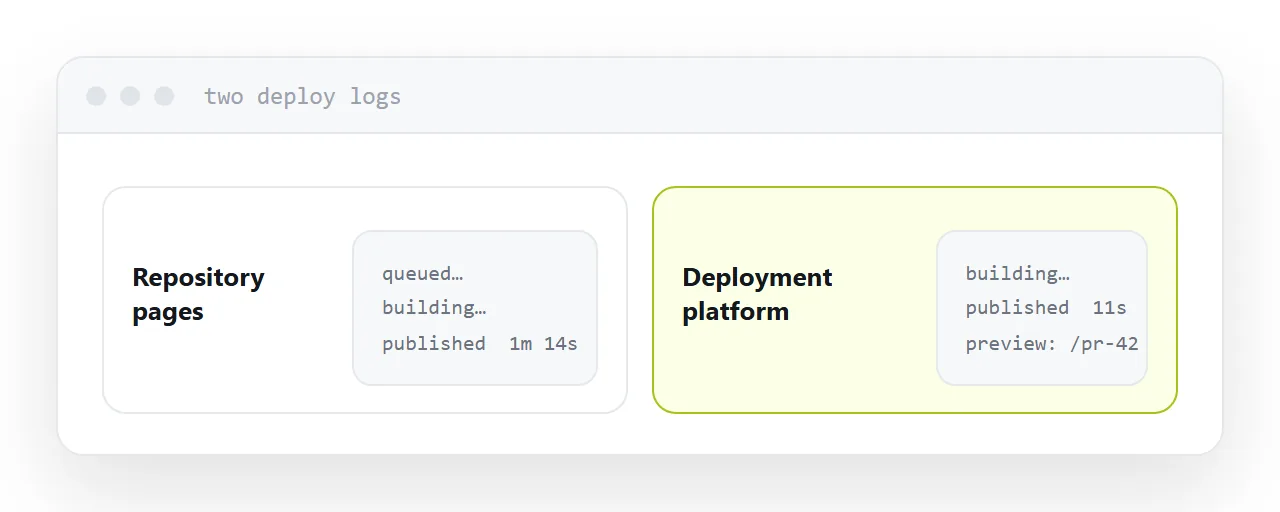
A purpose-built deployment platform publishes faster and produces a preview deployment for every branch.
For a page updated occasionally, irrelevant. For anything being iterated with a reviewer watching, the difference between a minute and ten seconds is the difference between a working session and a waiting session.
Preview deployments matter more than speed for teams: a reviewer sees a change before it merges, at its own address.
Three: what happens under load
Both handle ordinary traffic without any thought required.
What differs is the behaviour when something unexpectedly gets attention. Some services throttle, some absorb it, some contact you. Worth knowing before publishing something that could be picked up somewhere.
Neither publishes a hard number for typical free use, which is itself worth noting.
The decision that outlasts both
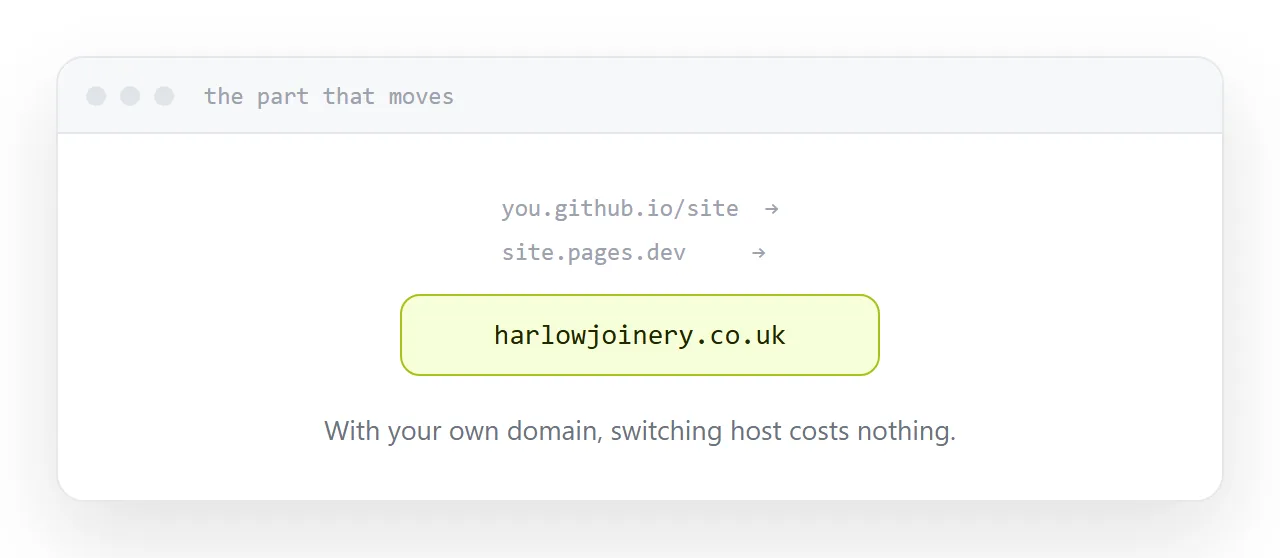
Put your own domain in front of whichever you choose.
Then the comparison stops mattering. Switching is a change of where the domain points, every published link keeps working, and you can move again later without cost.
Without your own domain, choosing a host is choosing an address permanently, and that is a much larger decision than build speed.
If you have no repository
Both of these assume source control, and that assumption is doing most of the work.
For a single file with no version history, both routes mean creating an account, creating a repository, learning enough tooling to commit, and configuring a build that has nothing to build.
That is a project's setup cost to publish one page. Use something that takes a file.
Two neighbouring cases are worth a look: Choosing a GitHub Pages alternative and Choosing a Netlify alternative.
Put it at an address
For one plain page, use whichever account you already have. Check private repository support on the free tier. Prefer faster builds if you iterate. Own the domain regardless, and use neither if you have no repository.
Then the choice is reversible and cheap.