The folder full of files called final is not a software problem. It is three conventions nobody agreed, and agreeing them takes twenty minutes.
One: naming
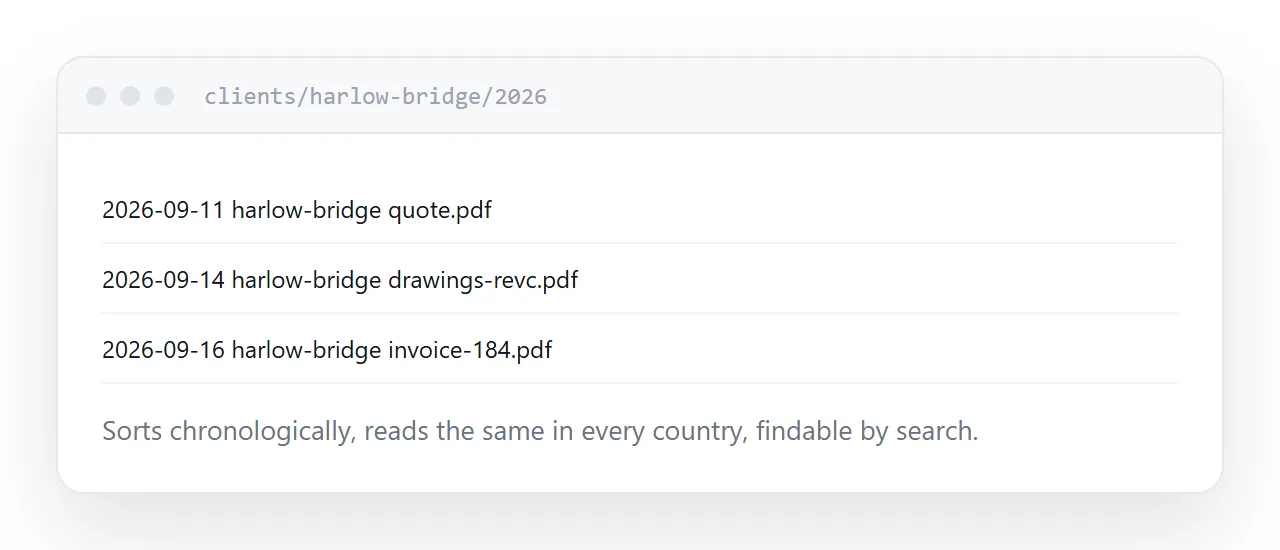
2026-09-14 harlow-bridge quote.pdf
2026-09-16 meridian invoice-2026-184.pdf
Date first, year-month-day. Sorts chronologically everywhere and reads identically regardless of country, which the alternatives do not.
Then who it concerns. Then what it is. Lowercase, hyphens within parts, spaces between them.
The point is not elegance. It is that search finds filenames far more reliably than document contents, and scans contain no text at all unless recognition has been run.
Two: one current version
Every organisation eventually has final, final2, final-v3 and final-really.
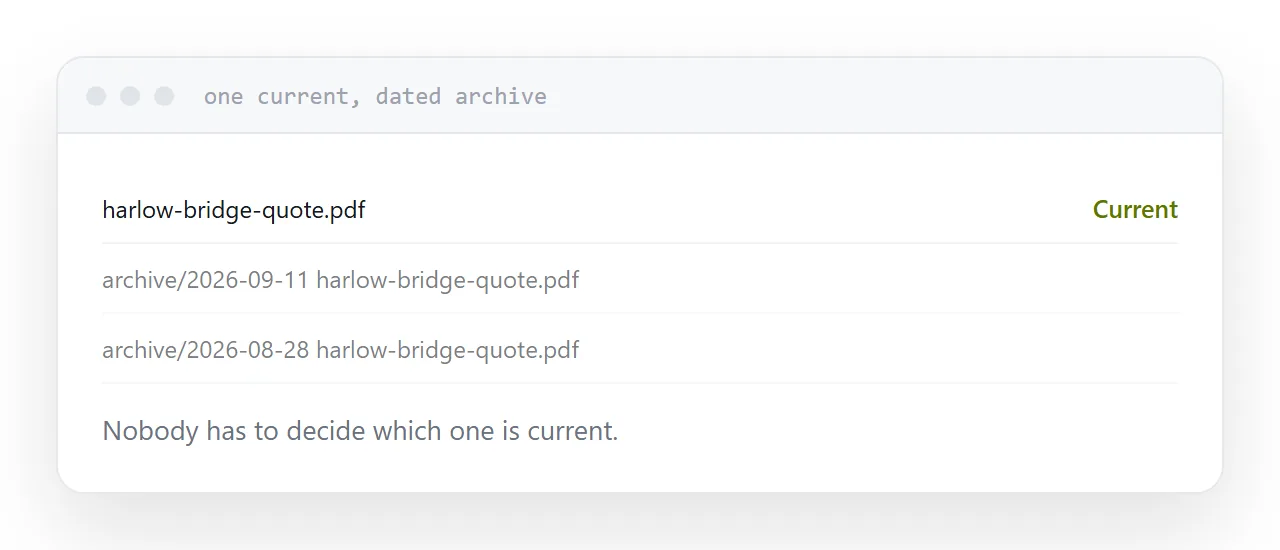
The rule that prevents it: one current file at a fixed name with no version in it, and superseded versions moved to an archive folder with their date prepended.
harlow-bridge-quote.pdf
archive/2026-09-11 harlow-bridge-quote.pdf
Anyone looking for the current one finds it without deciding anything, and the history is kept and out of the way.
| Version in the name | Fixed name plus archive | |
|---|---|---|
| Which is current | Ambiguous | Obvious |
| History kept | Cluttered | Yes, separately |
| Links to it | Break each version | Stable |
| Requires software | No | No |
Three: publish what is read outside
This is the one that produces the most visible friction.
A shared storage link puts a permission screen in front of a client and downloads on their phone. It carries your folder structure with it. It was never designed for that job.
Anything somebody outside reads goes to an address. Storage stays what it is good at, which is you finding things again.
Keeping those two separate removes most of the exchanges about resending documents and requesting access.
Recognition on scans
A scanned document is a stack of photographs and nothing in it is searchable.
Most operating systems and storage products can run text recognition, either automatically or on request. Doing it at filing time makes the document findable by anything written in it.
One minute, and it is the difference between a contract being findable in two years and not.
Write it down
Conventions agreed verbally last about three weeks.
One page: the naming pattern with two examples, the current-version rule, and the line about publishing rather than sharing storage links. Put it wherever people look, which is usually the onboarding material.
That is the whole implementation.
Closely related: How to organise PDF storage, and PDF storage and hosting for the adjacent problem.
Put it at an address
Agree a naming convention, keep one current file with dated archives, publish anything read outside, run recognition on scans, and write the convention down.
Then the folder full of files called final stops accumulating.