For a finished file, publishing genuinely is one action. Knowing which parts are fast and which are not keeps the speed honest.
What makes it fast
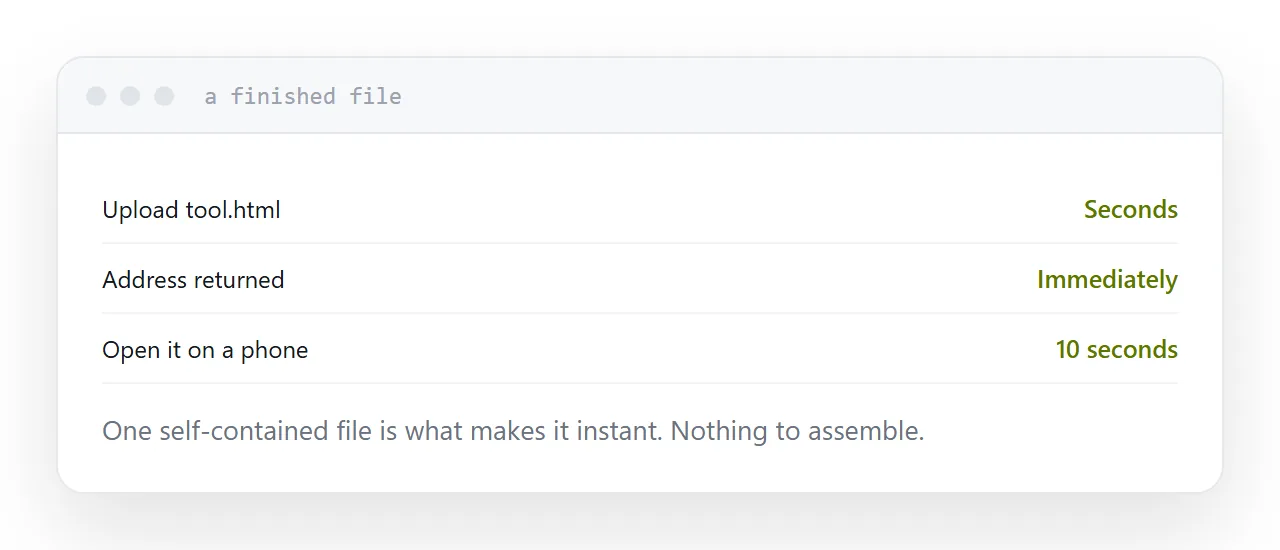
One self-contained file.
Styles and behaviour written in, no separate stylesheet, no framework loaded from elsewhere, no images that live somewhere else. There is nothing to assemble, so there is nothing to go wrong.
Upload it, and an address comes back. That is the whole operation and the timing claims are accurate.
| Step | Time |
|---|---|
| Upload a finished file | Seconds |
| Address returned | Immediately |
| Check on a phone | 10 seconds |
| Register a domain | 5 minutes |
| Record change settles | Minutes to hours |
The three checks worth ten seconds
Open it on a phone. Most faults show immediately: a layout that does not reflow, an image that never loads, text at desktop size.
Confirm it is permanent. Some free tiers keep the page for a week or a month. That is fine for a demonstration and wrong for anything you will refer to again, and the expiry is not obvious when you publish.
Check nothing points elsewhere. If the page references a stylesheet, a font or an image you did not upload, it works on your machine and breaks live. A self-contained file avoids this by construction.
The domain is the slow part
Registration is minutes. Pointing it takes a record change which settles quickly, though not always instantly.
That hour is the part worth spending, because the domain is what makes the address yours. Every link, card and message carrying it keeps working regardless of where the page moves later.
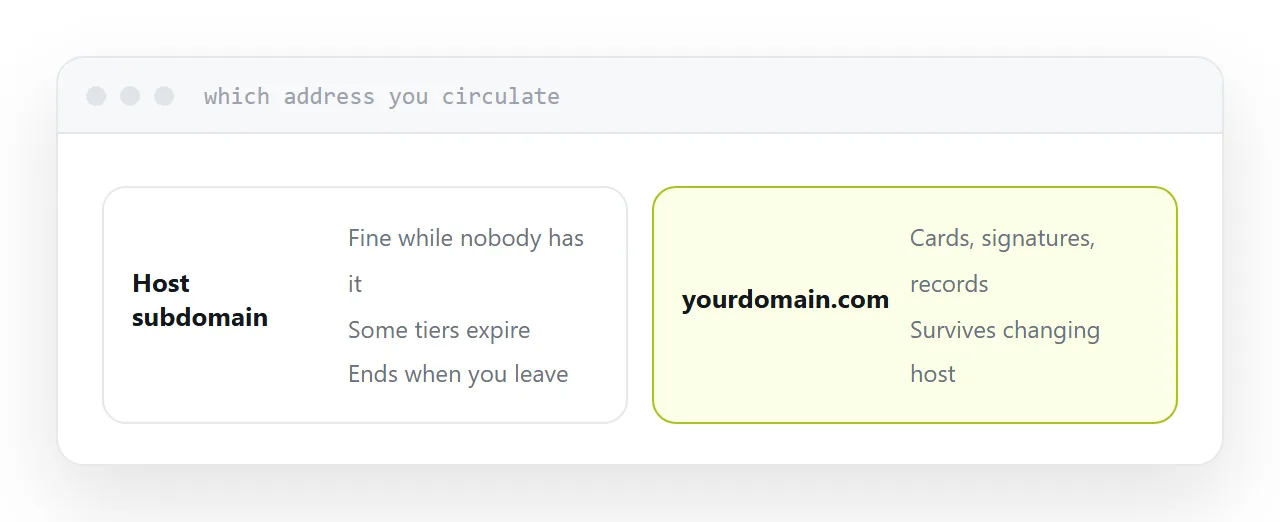
The host subdomain you get for free is fine while nobody outside has it, and wrong the moment the address is printed.
Why fast is safe here
Because a static page is portable.
If the page is a folder of files, moving it to a different host is uploading the same folder somewhere else. Publishing quickly does not commit you to anything, which is what makes the fast route a reasonable default rather than a shortcut.
What does commit you is circulating an address you do not own. That is the decision, not the hosting.
When to slow down
When the address goes on paper, in a signature, on a card, or into a customer's records.
At that point spend the extra hour: register the domain, point it, confirm the certificate, and circulate only that address.
For the surrounding ground, see How to upload an HTML file and How to turn an HTML file into a website.
Put it at an address
Keep the page in one self-contained file, upload it and take the address, open it on a phone, confirm the address does not expire, and add your domain before it reaches anyone.