Standing up a web server is a weekend. Everything about keeping it reachable is why most people stop.
What is genuinely easy
A machine, a web server, a folder of files. Working in an hour, and the same software running most of the internet.
Nothing about serving a page is difficult, and that is what makes the idea attractive. The difficulty is entirely in the surroundings.
The four things that make it a commitment
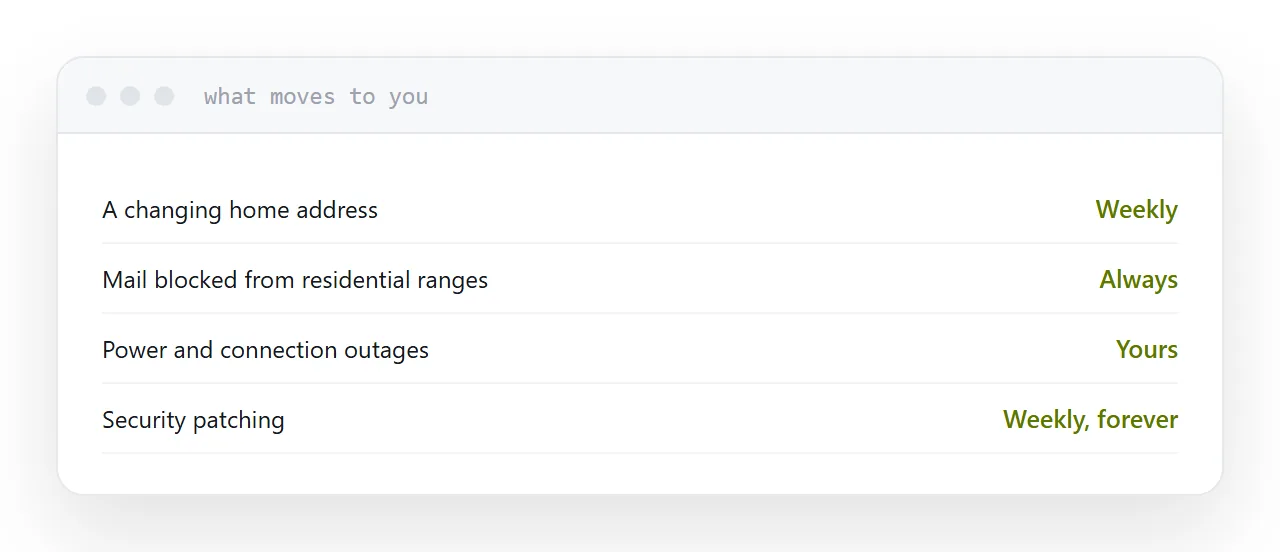
The address changes. Home connections usually get an address that changes without warning. The site disappears until something updates the record, which means running a dynamic update client or a tunnel and having it fail occasionally.
Residential connections are treated differently. Mail from a home connection is discarded by most receiving systems, and some corporate networks block residential ranges outright. So you learn about the block from a customer who could not reach you.
Outages. Power cuts, router reboots, the connection dropping for an hour. Each is a short outage nobody notices at home and every one of them is your site being down.
Patching is yours. A machine on the public internet is scanned constantly. Staying current is now a weekly job, and it does not pause when you are busy.
| Self-hosted at home | Static hosting | |
|---|---|---|
| Address stability | Changes | Fixed |
| Uptime | Yours to maintain | Theirs |
| Patching | Yours | Not applicable |
| Mail deliverability | Poor | Use a service |
| Cost for a small site | Power and time | Often nothing |
The cost comparison
Self-hosting is usually presented as free because the machine already exists.
Count the electricity for a machine running continuously, the connection you may need to upgrade, and the hours spent on the four items above. Then compare with static hosting for a small site, which is frequently free and requires no attention at all.
The saving is negative for most people. That does not make it the wrong choice; it makes the reason something other than cost.
When it is the right answer
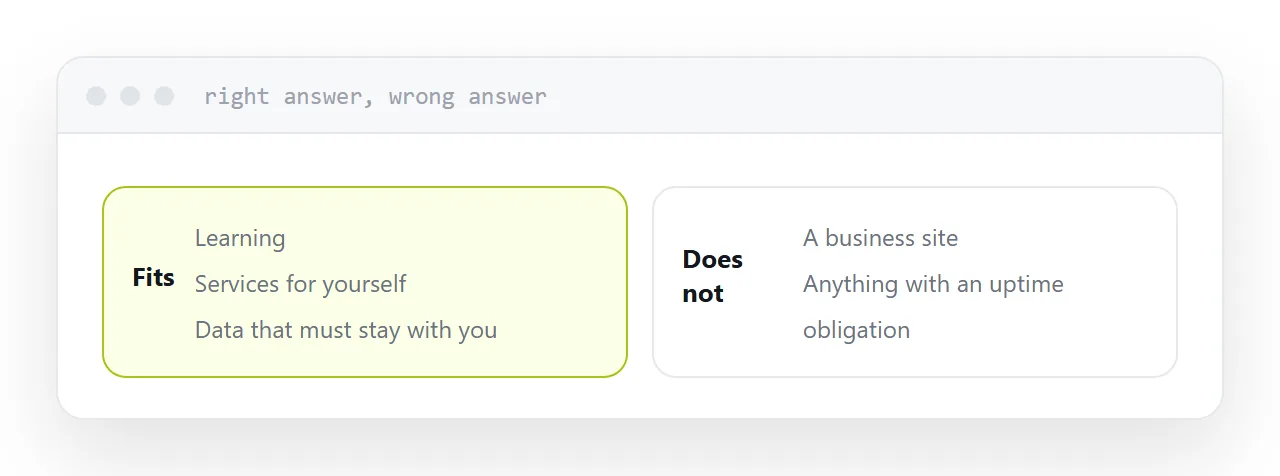
Learning. You will understand how the web works far better after running a server than after reading about one. That alone is worth a weekend.
Services for yourself. Backups, media, notes, automation. No uptime obligation, no strangers, and the data stays in your possession.
Data that must stay physically with you. A real requirement in some situations, and self-hosting is the only answer.
Something no provider will host. Rare, and it happens.
What is not on the list is a small business site. That has an uptime obligation to people who are not you.
The middle ground
A small rented server gives you the same control, a fixed address, somebody else's power and connection, and no patching of hardware.
You still maintain the operating system. Most people who want control end up here, and it is a sensible place to be.
Two neighbouring cases are worth a look: How to host a website and Free static website hosting, compared honestly.
Put it at an address
Keep learning separate from serving customers, plan for a changing home address, assume mail will be blocked, be honest about the patching, and put anything commercial on static hosting.