A PDF cannot tell you anything. What people call document analytics is information about the address the document was opened through, and knowing that changes what you should expect from it.
This guide covers what is reliable, what is noise, and how to use it without damaging a relationship.
The file is silent
An attachment, once sent, reports nothing. Not whether it arrived, not whether it was opened, not whether it was forwarded.
Attempts to make files report back have historically been blocked by readers, because a document that phones home is a security problem. Anything that still works is unreliable and depends on the reader's software and settings.
So the practical position is: to know anything, the document has to be opened through an address you control.
What is reliable
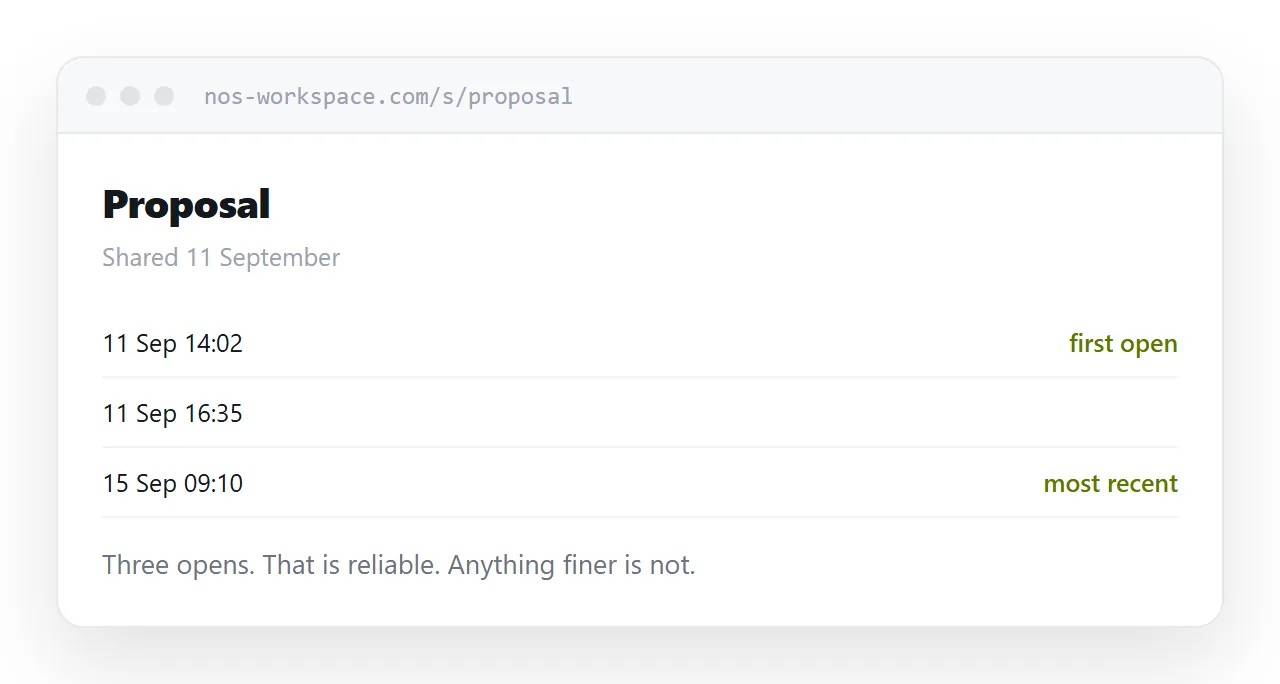
It was opened. Yes.
When. Yes.
How many times. Yes, and this is often the more interesting number. A document opened five times over two days is usually being shown to other people.
From how many places. Roughly, which tells you it has been forwarded.
That set is enough to change your behaviour, which is the only reason to measure anything.
| Signal | Reliability | What it is good for |
|---|---|---|
| Opened | High | Timing a follow-up |
| When | High | Understanding the process |
| Times opened | High | Spotting internal circulation |
| Pages viewed | Low | A rough hint |
| Time on page | Low | Almost nothing |
Page-level data is noisier than it looks
Products present per-page reading time as though it reveals interest. Be careful with it.
A document left open in a background tab accumulates time on whatever page it was showing. A reader who scrolled quickly to page twelve and stopped looks the same as one who read every page.
It is a hint. If eight of ten readers stop at the same page, something about that page is worth looking at. Anything finer than that is over-reading.
And acting on it visibly is worse than useless. Nobody wants to hear that you noticed they spent four minutes on the pricing page.
Per-recipient addresses
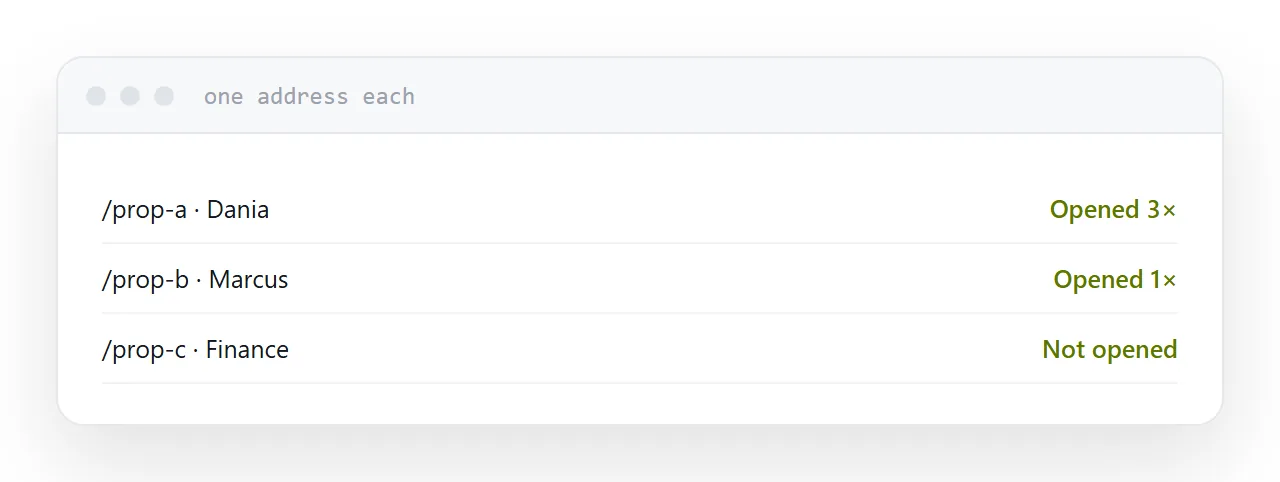
If you need to know which person opened it, give each person their own address.
That is honest: each recipient genuinely has their own link, and what you learn is about that link. It also survives forwarding sensibly, because you can see that the address you gave one person is being opened from several places.
The alternative, guessing from timing, is unreliable and occasionally embarrassing.
Say it
One line, in the message or on the page, for anything going outside your organisation.
It costs nothing, most recipients assume it already, and the alternative is a conversation you do not want to have with a client who worked it out.
Use it for timing
The good use is narrow and genuinely valuable.
Unopened after three days: send a short reminder, possibly in a different channel.
Opened, no reply: the document did its job and something else is in the way. Ask what.
Opened repeatedly: it is circulating internally. Offer to answer questions.
That is the whole toolkit, and it removes most of the guesswork from following up.
If this is near what you are doing, How document tracking works and How link tracking works cover the cases on either side.
Put it at an address
Share through an address, give each recipient their own, trust opens and discount reading depth, say that it is tracked, and use what you learn to decide when to follow up.
Then following up is a decision rather than a guess.