A static site is already fast and already rendered, which removes the technical problems most guidance is about. What remains is editorial.
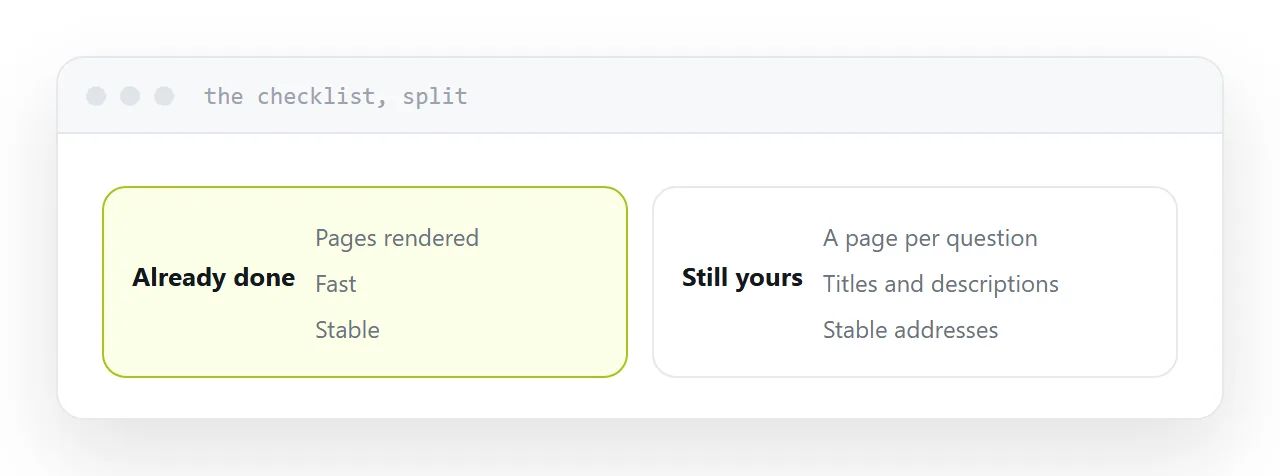
What being static already gives you
Pages are rendered. The content is in the file. Nothing has to run for it to be readable, which removes an entire category of problem that affects sites assembled in the browser.
They are fast. The file exists and can be served from close to the visitor. Speed is a real factor and static sites get it without effort.
They are stable. A page that does not depend on a database cannot return an error because the database was busy.
That is most of the technical checklist, handled by the architecture rather than by work.
| Item | Static site |
|---|---|
| Rendering | Done |
| Speed | Done |
| Uptime | Effectively done |
| Titles and descriptions | Yours to write |
| Page per question | Yours to write |
| Stable addresses | Yours to protect |
One page per question
The most common structural mistake in small sites is compressing everything onto five pages.
Search matches a page to a question. A page covering six topics matches none of them well, and a site of five pages can compete for about five questions.
Every distinct question somebody types deserves its own page, with the question in the heading and the answer immediately below it. This is why sites that answer things comprehensively outrank sites that are brochures.
Titles and descriptions
Written per page, by you.
A title generated from the site name and the file name is a wasted line in the result. Write the title as the sentence you want somebody to read in the search results, and the description as the reason to choose it.
Both are visible before anyone visits, which makes them the highest-leverage text on the page.
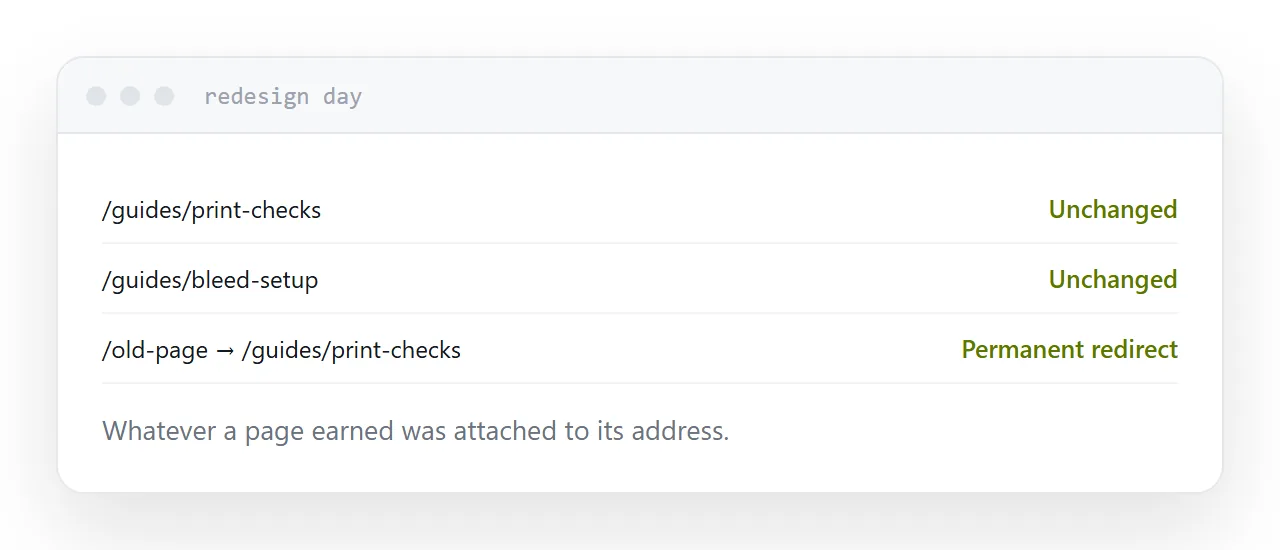
Never change an address
Whatever a page has earned is attached to its address.
A redesign that renames every page discards all of it, and the drop appears a few weeks later when nobody connects the two events.
If an address must change, redirect the old one permanently. That passes most of the value across and keeps every existing link working. Keep the redirects indefinitely; there is no point at which removing them helps.
The unglamorous items
Alt text on images, written as you add them, because writing it for two hundred images later is a job nobody does.
A sitemap generated at build time and submitted once.
Internal links between related pages, which is how a search engine understands what a site is about and how a reader finds the next thing.
If this is near what you are doing, What a static website is and Canonical URL: which address is the real one cover the cases on either side.
Put it at an address
Give every question its own page, write the title and description yourself, protect your addresses through redesigns, generate a sitemap at build time, and write alt text as you go.