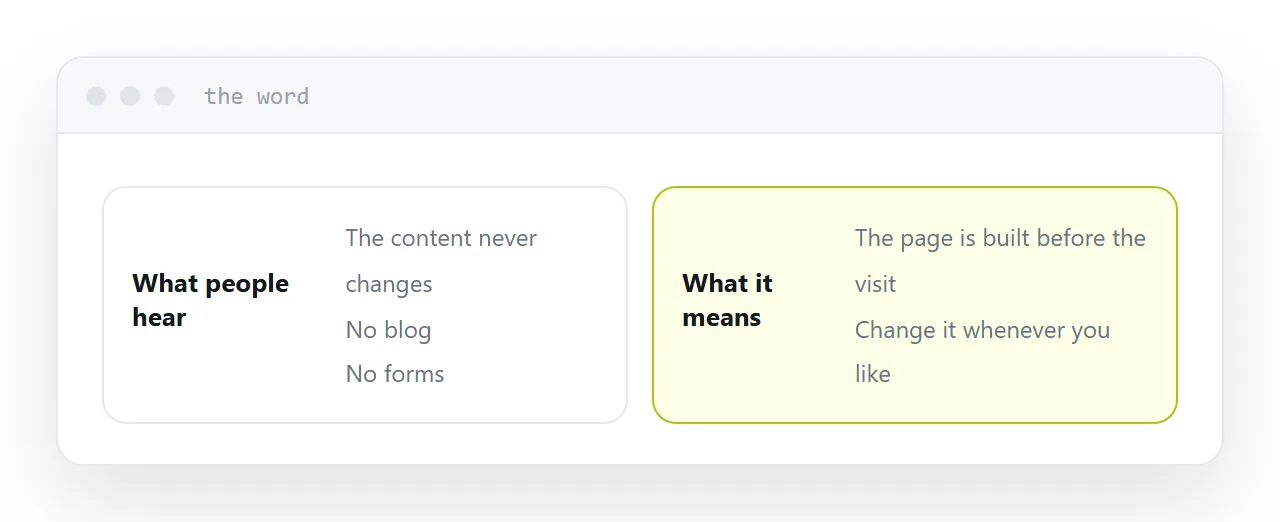
The word is misleading and the misunderstanding is expensive. Static describes when the page is built, not whether the content sits still.
The test
Could two people loading the page at the same moment see different things, because of who they are?
No. The site is static. It does not matter that you update it daily, that it has a thousand pages, or that it has a blog.
Yes. Something has to run per visitor, and that part needs a server.
That is the entire distinction, and it is much narrower than the word suggests.
| Assumed to need a server | Actually static |
|---|---|
| A blog | Yes, generated at publish |
| A contact form | Yes, posts to a service |
| Search | Yes, index built at publish |
| A site updated daily | Yes |
| Hundreds of pages | Yes |
| Personalised dashboards | No, needs a server |
What the word costs people
It sends them to hosting that runs code, with a database and a control panel, for a site that is a brochure.
That means an ongoing bill, security updates, a database that can break, and an administration login that will be attacked. None of it is doing anything for the site, and all of it is something that can require attention on a bad week.
The same site as files is faster, frequently free, and effectively unbreakable.
Partly static is normal
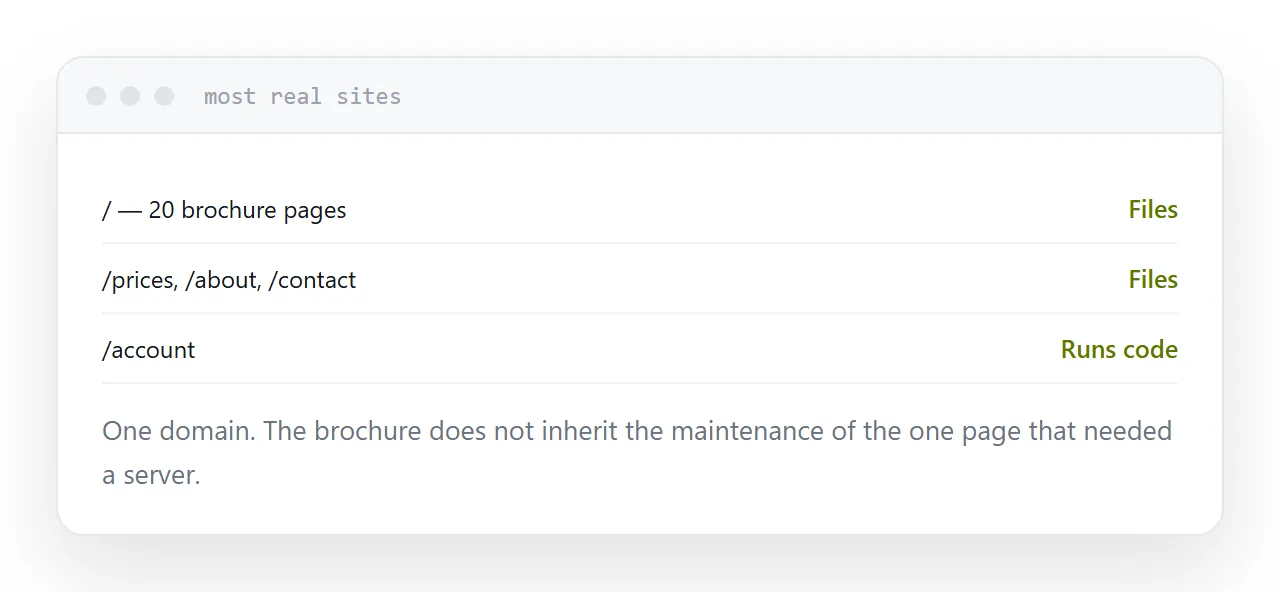
Most real sites are mostly static with a few pages that are not.
Twenty pages of brochure and one account area. Serve the twenty as files and put the account area somewhere that runs code, under the same domain.
That arrangement is common, and it means the brochure does not inherit the maintenance burden of the one page that needed a server.
Generators
A static site generator takes source content, templates and configuration, and produces finished pages.
It is a build step. It runs on your machine or in a pipeline, before publishing, and it is not present when anyone visits. The output is files.
That is why people say a site is "built with" a generator and "hosted" as static files: the two are different stages and only the second involves a host.
For the surrounding ground, see What a static website is and How to build a static site.
Put it at an address
Ask whether two visitors could see different pages, ignore how often the content changes, split the site if only part needs a server, treat the generator as a build step, and host the files accordingly.